🛒 Best Price Today on Amazon
Prime members get fast, free shipping on everything above, plus member-only deals. New members get a 30-day free trial — cancel anytime.
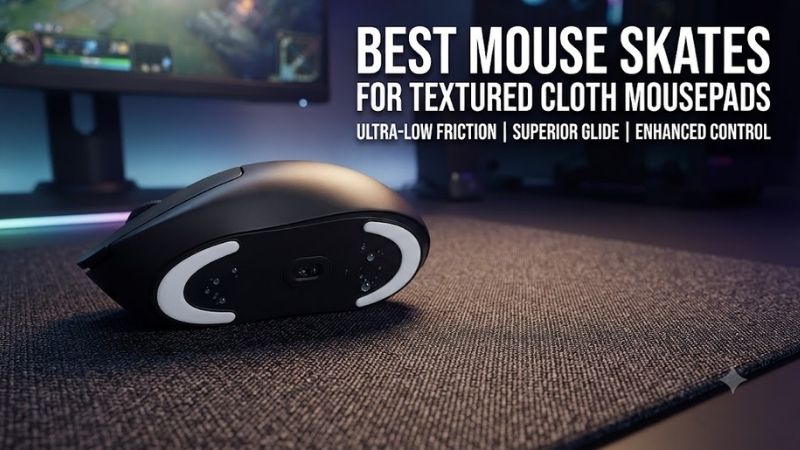
Textured cloth mousepads create a distinct balance between speed, tactile feedback, and stopping control. Choosing the best mouse skates for textured cloth mousepads helps prevent scratchy movement, excessive sinking, and inconsistent glide. The ideal skates should have smooth rounded edges, suitable contact area, and a material that complements the mousepad’s woven surface.
Quick Verdict: Which Mouse Skates Work Best on Textured Cloth?
For most gamers using textured cloth mousepads, high-quality PTFE skates provide a dependable starting point. Larger replacement feet offer stable pressure distribution, while smaller dot skates provide greater flexibility when adjusting contact area. The best choice depends on mouse weight, pad softness, and whether speed or stopping control is more important.
Best overall: Corepad PRO
Best for fast glide: X-Raypad Jade
Best balanced alternative: ESPTiger ICE V2
Best for controlled stopping: X-Raypad Obsidian
Best for a slower, planted feel: Corepad CTRL
Best customizable option: X-Raypad Jade Universal Dots
Quick Comparison Table
| Mouse skates | Material category | Glide preference | Main consideration |
|---|---|---|---|
| Corepad PRO | PTFE | Balanced | Mouse-specific fit |
| X-Raypad Jade | PTFE | Fast | May feel slippery on speed pads |
| ESPTiger ICE V2 | PTFE | Fast to balanced | Break-in and pad texture |
| X-Raypad Obsidian | Hardened PTFE | Controlled | Slower response than Jade |
| Corepad CTRL | PTFE | Control-focused | Can feel resistant on rough pads |
| X-Raypad Jade Dots | PTFE | Adjustable speed | Number and placement of dots |
How We Selected These Mouse Skates
We considered material, edge rounding, contact area, pad texture, and compatibility with common gaming mouse designs. We also evaluated the trade-offs between pre-cut replacement feet and universal dot skates, since their pressure distribution can differ considerably on soft or textured mousepads.
The 6 Best Mouse Skates for Textured Cloth Mousepads
Textured cloth mousepads introduce friction through woven fibers and surface irregularities. The interaction between the pad and mouse skates determines how much force is needed to begin movement and how easily the mouse continues sliding. Different skate designs can therefore change the feel of the same mousepad without altering sensor performance.
Corepad PRO – Best Overall for Balanced Cloth Glide
Corepad PRO is a strong general-purpose option for gamers who want smooth movement without deliberately maximizing speed. Its PTFE construction and rounded edges are intended to reduce unwanted friction while preserving a familiar relationship between mouse movement and the texture of the cloth pad.
Best for: Balanced and control-oriented FPS gaming on textured cloth.
Material and construction
Corepad PRO replacement feet are made for specific gaming mouse models.
This allows the feet to match the original recesses on the mouse base.
Correct sizing matters because a skate that extends beyond its intended area may create uneven contact or interfere with the mouse’s mechanical structure.
The rounded edges help reduce the chance of catching against woven fibers.
This is particularly important on coarse or textured pads.
Glide behavior
Corepad PRO generally emphasizes a controlled, predictable glide rather than an extremely fast sensation.
For tactical shooters such as Counter-Strike 2 and Valorant, some players appreciate this balance.
A skate with moderate friction can make stopping movements feel more deliberate.
However, greater friction is not universally beneficial.
Players who favor constant tracking may prefer a faster option.
Installation and break-in
The original skates should be removed carefully.
Adhesive residue must be cleaned from the skate recesses.
The new feet should sit flat without overlapping the edges.
After installation, the glide may feel different as the surfaces settle into regular use.
Avoid making immediate conclusions based only on the first few movements.
Advantages
-
Balanced PTFE glide
-
Rounded edges
-
Model-specific fit
-
Suitable for many cloth pads
-
Predictable everyday performance
Limitations
-
Requires the correct mouse version
-
Not the fastest option
-
Installation needs care
-
Feel varies with pad texture
Buy If: You want a dependable replacement for worn stock mouse feet.
Skip If: You specifically want the lowest possible glide resistance.
X-Raypad Jade – Best for Fast Movement
X-Raypad Jade skates are designed for users who prefer low resistance and smooth acceleration. Their PTFE construction makes them particularly attractive for textured cloth mousepads that already provide some natural stopping resistance.
Best for: Fast tracking games and players who find textured cloth too slow.
Why fast skates matter
A textured mousepad can require more force to start movement than a smooth speed pad.
Faster skates may reduce that initial resistance.
This can make small corrections feel easier.
For games such as Apex Legends or Overwatch, players who track moving targets continuously may appreciate the lighter glide.
However, the same reduction in resistance can make stopping the mouse feel less deliberate.
Material compatibility
Jade skates are intended for cloth and suitable plastic surfaces.
They should not automatically be selected for abrasive glass mousepads because wear characteristics differ.
For textured cloth, the combination is generally more appropriate.
Pressure distribution
A full-size pre-cut skate spreads mouse weight across a relatively broad contact area.
This can be useful on softer cloth pads.
A hard, heavily textured pad may behave differently because the skates contact a more rigid surface.
Advantages
-
Fast glide orientation
-
PTFE construction
-
Relevant to textured cloth
-
Useful for tracking-oriented gameplay
-
Multiple mouse-specific options
Limitations
-
May reduce stopping confidence
-
Can feel fast during initial use
-
Compatibility is model-specific
-
Surface texture changes the final feel
Buy If: Your cloth pad feels unnecessarily resistant during tracking.
Skip If: You already struggle to stop the mouse accurately.
ESPTiger ICE V2 – Best Fast-to-Balanced Alternative
ESPTiger ICE V2 offers a fast-glide alternative for users who want smoother movement on cloth mousepads without necessarily choosing universal dot skates. Its polished PTFE construction and curved edges make it relevant to gaming mice used on textured surfaces.
Best for: Players seeking smoother glide with model-specific replacement feet.
Edge design
The edges of mouse skates are important on textured cloth.
A sharp or poorly finished edge can catch on raised fibers.
Rounded edges help the skate move across the surface more smoothly.
This may be particularly noticeable during diagonal swipes or rapid direction changes.
Speed and control
ICE V2 generally targets a faster glide than traditional control-focused replacement feet.
However, the sensation depends on mouse weight and pad friction.
A light mouse on a fast hybrid pad may feel very different from a heavier mouse on a dense control pad.
Users should evaluate the entire combination.
Break-in considerations
New skates sometimes feel different during their earliest hours of use.
Small manufacturing and surface differences may become less noticeable as the contact surfaces settle.
Do not deliberately abrade new skates to accelerate the process.
Normal use is preferable.
Advantages
-
Smooth PTFE contact
-
Rounded edges
-
Fast-glide orientation
-
Model-specific replacement options
Limitations
-
May feel slippery on fast pads
-
Requires correct model selection
-
Not guaranteed to outperform stock feet
-
Personal preference matters
Buy If: You want a fast replacement option for a textured cloth pad.
Skip If: You specifically prefer heavy stopping resistance.
X-Raypad Obsidian – Best for Controlled Stopping
X-Raypad Obsidian skates use a harder PTFE-oriented construction and emphasize a more controlled glide than the Jade series. This makes them relevant to users who want additional stopping resistance or feel that their current mouse moves too freely.
Best for: Tactical FPS players prioritizing control.
Friction characteristics
A more control-oriented skate can require slightly greater force to maintain movement.
This may help some players execute deliberate flicks and stopping movements.
However, textured cloth mousepads already provide varying levels of friction.
Combining a very slow pad with control-focused skates can create excessive resistance.
Texture interaction
The pad’s weave affects the result.
A coarse surface may produce noticeable tactile feedback.
On a smoother cloth pad, the same skates may feel less resistant.
This is why skate recommendations should always consider the mousepad rather than treating mouse feet as isolated accessories.
Compatibility
Obsidian variants are available in several forms.
Choose the correct type for the mouse and pad.
Do not assume every Obsidian version uses identical construction or is appropriate for every surface.
Advantages
-
Control-oriented glide
-
Useful for deliberate stopping
-
Multiple configurations
-
Suitable for compatible cloth pads
Limitations
-
Can feel slow on dense cloth
-
May increase perceived friction
-
Variant selection requires attention
-
Not ideal for every tracking-focused player
Buy If: You want greater resistance during stopping movements.
Skip If: Your textured cloth pad already feels too slow.
Corepad CTRL – Best for a Planted Mouse Feel
Corepad CTRL is intended for users who want a more controlled interaction between the mouse and pad. It is particularly relevant to gamers who prefer deliberate movements and dislike the floating sensation sometimes associated with very fast mouse skates.
Best for: Players using firm cloth pads who want a slower glide.
Control-focused behavior
The CTRL series emphasizes friction and stopping feel.
This may suit players who make short flicks and prefer a strong sense of mouse placement.
However, too much friction can interfere with small corrections.
A control-oriented skate should not be chosen solely because a game involves precise aiming.
Mousepad pairing
On a moderately textured pad, Corepad CTRL may provide a stable, planted sensation.
On a very rough or soft pad, the combination could become overly resistant.
For this reason, gamers should consider pad softness and mouse weight before purchasing.
Advantages
-
Control-focused design
-
Suitable for deliberate movements
-
Model-specific fit
-
Rounded-edge construction
Limitations
-
Can be too slow on rough surfaces
-
Less suitable for speed-focused players
-
Requires compatible mouse version
-
Not a guaranteed accuracy improvement
Buy If: You prefer controlled movement over maximum glide speed.
Skip If: You already experience excessive friction.
X-Raypad Jade Universal Dots – Best Adjustable Skate Configuration
X-Raypad Jade Universal Dots allow enthusiasts to create a custom skate layout rather than replacing the original feet with a full-size shape. Their small contact areas can provide a fast sensation while giving users control over the number and positioning of the skate points.
Best for: Mouse modders who want adjustable contact geometry.
Why dot placement matters
A mouse supported by four small dots distributes pressure differently from one supported by large continuous feet.
This can influence how deeply the mouse sinks into a soft cloth pad.
Using too few dots may concentrate pressure.
On a textured surface, that pressure can produce undesirable drag or wear.
Adding more support points may improve stability.
Installation approach
Begin with a symmetrical configuration.
Position dots where they can support the mouse evenly.
Avoid blocking the optical sensor.
Test for rocking, scraping, and excessive sinking.
Increase contact area if necessary.
Advantages
-
Flexible placement
-
Fast PTFE material
-
Useful for custom mouse bases
-
Adjustable contact area
Limitations
-
Installation requires care
-
Small dots may sink into soft pads
-
Poor placement can create instability
-
Less convenient than model-specific feet
Buy If: You enjoy experimenting with skate layouts.
Skip If: You want the simplest possible replacement procedure.
Buying Guide: Choosing Mouse Skates for Textured Cloth Pads
Textured cloth mousepads create resistance through their woven surface. The interaction changes with mouse weight, pad softness, skate material, and contact area. The best combination should provide consistent movement without creating unwanted scratching or excessive sinking.
Understand Static and Dynamic Friction
Static friction affects how much force is required to begin movement.
Dynamic friction describes resistance once the mouse is already moving.
A skate can feel smooth during large swipes but resistant during tiny adjustments.
Both characteristics matter for aiming.
Choose PTFE With Rounded Edges
PTFE is commonly used because it provides relatively low-friction contact.
Rounded edges help the skate move across textured fibers.
Poorly finished edges can create scratchy movement.
Avoid installing damaged or uneven skates.
Consider Mousepad Softness
Soft mousepads compress under pressure.
Small dot skates can concentrate that pressure.
Larger feet distribute it across more surface area.
On very soft pads, larger contact areas may provide more stable movement.
Match Skates to Gaming Style
Tracking-heavy gameplay may benefit from lower resistance.
Tactical FPS players may prefer a more controlled stopping sensation.
Neither preference establishes an objectively superior product.
The mousepad and skate combination should feel predictable to the user.
Install Replacement Skates Correctly
Remove the original skates carefully.
Clean the recesses without damaging the mouse shell.
Ensure that no old adhesive remains.
Align the replacement feet.
Press evenly and allow the adhesive to settle.
Check that the mouse does not rock on a flat surface.
Frequently Asked Questions
Are PTFE skates good for textured cloth mousepads?
Yes. High-quality PTFE skates are generally a suitable starting point.
Are dot skates faster than full-size skates?
They can feel faster because of their contact geometry, but pad softness and pressure distribution matter.
Do mouse skates affect sensor accuracy?
They do not improve the sensor itself, but incorrect skate height or installation can affect tracking distance and consistency.
Should I use glass skates on textured cloth?
Some are designed for cloth, but compatibility and wear characteristics should be checked carefully.
How often should I replace mouse skates?
Replace them when worn, damaged, uneven, or when glide becomes inconsistent.
Can skates make a control pad feel faster?
Yes, to a degree. Faster skates can reduce perceived resistance.
Conclusion
Corepad PRO is a dependable overall option for textured cloth mousepads, offering balanced glide and rounded PTFE edges. X-Raypad Jade and ESPTiger ICE V2 suit faster movement, while Obsidian and Corepad CTRL emphasize control. For custom setups, Jade Dots provide adjustable contact. Choose according to pad texture, softness, and mouse weight.