🛒 Best Price Today on Amazon
Prime members get fast, free shipping on everything above, plus member-only deals. New members get a 30-day free trial — cancel anytime.
The best keyboard switch films for loose housings help reduce movement between the upper and lower sections of compatible mechanical switches. Selecting the correct film thickness and material matters because an oversized film can prevent the housing from closing properly, while an undersized one may provide little improvement.
Quick Verdict: Which Switch Films Are Best?
TX 0.15 mm polycarbonate films are our preferred starting point for many conventional MX-style switches with noticeable housing looseness. Their thin construction provides a controlled adjustment without introducing the more substantial compression associated with thick foam-based alternatives.
Deskeys 0.3 mm films are more appropriate when a compressible material is desirable.
Durock’s 0.15 mm hybrid films offer another thin option, while the 0.3 mm polyurethane version provides a different approach for larger gaps.
However, the correct film depends on the actual switch housing. Films are not universally necessary, and adding them to already-tight switches can create problems.
Quick Comparison Table
The seven products below represent distinct film materials or thickness options. Several belong to the same product family, so they are identified as alternative configurations rather than portrayed as completely different technologies. Thickness figures are manufacturer- or retailer-published nominal values.
| Switch Film | Thickness | Material | Best For |
|---|---|---|---|
| TX Switch Films 0.15 mm | 0.15 mm | Polycarbonate | Best general starting point |
| TX Switch Films 0.125 mm | 0.125 mm | Polycarbonate | Relatively tight housings |
| Deskeys Switch Films | 0.3 mm | Compressible proprietary material | Larger gaps |
| Durock HTV/PC Switch Films | 0.15 mm | Hybrid HTV/polycarbonate | Thin hybrid option |
| Durock PU Foam Switch Films | 0.3 mm | Polyurethane foam | Compressible fit |
| Kebo Switch Films | 0.125 mm | Polycarbonate | Thin precision option |
| Kebo Thick Switch Films | 0.2 mm | Polycarbonate | Intermediate thickness |
How We Selected the Best Keyboard Switch Films
Switch films should be selected according to the amount of movement between housing halves. They are not a universal performance upgrade, and the effect on sound can differ between switch families. We prioritized products with documented material and thickness information over marketing claims about guaranteed sound improvement.
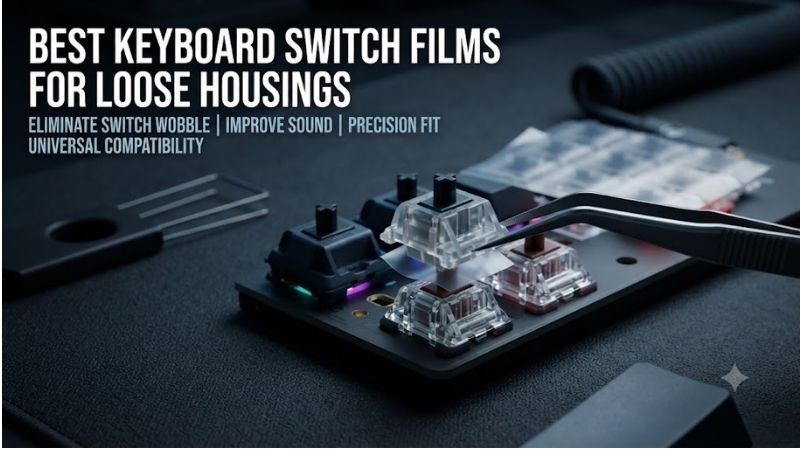
Housing Wobble Versus Stem Wobble
A switch contains multiple moving and stationary components. Housing wobble occurs when the upper shell shifts relative to the lower shell, while stem wobble describes movement of the stem within its guides. A film primarily addresses housing fit and should not be expected to eliminate every form of movement.
This distinction is important because a user may notice loose keycaps or lateral stem movement and assume that a housing film will solve the problem.
If the upper and lower housings are already securely attached, a film may provide little benefit.
Before purchasing, open one representative switch and inspect the actual fit.
A controlled comparison is more useful than applying films to an entire batch without diagnosis.
Film Thickness and Closure Tolerance
Nominal film thickness determines how much material is added between housing halves, but different materials compress differently. A 0.3 mm soft film cannot be treated as mechanically equivalent to a 0.3 mm rigid spacer because the compressed thickness may change when the switch closes.
Thin polycarbonate films are useful when only a small gap needs filling.
Thicker materials may suit looser housings.
However, excessive thickness can prevent the switch clips from fully engaging.
A partially closed housing is an installation failure, not a desirable tighter fit.
Material and Sound Characteristics
Polycarbonate films provide a relatively firm spacer, while foam and elastomer-based materials can compress between the housing sections. These differences may affect vibration transmission and perceived sound, but the result depends heavily on the switch, plate, keycap, and keyboard case.
Sound descriptions such as deeper, brighter, or muted are subjective.
A film does not guarantee a particular acoustic profile.
Likewise, filming a switch does not inherently reduce input latency or change its nominal actuation force.
Its primary purpose is mechanical fit adjustment between housing components.
Best Switch Films for Loose Housings Reviewed
These seven options cover thin rigid films, intermediate spacers, and thicker compressible materials. The reviews explain the intended application of each product and the risks of choosing an incompatible thickness, rather than assuming that the thickest film provides the best improvement.
TX Switch Films 0.15 mm — Best Overall Starting Point
TX 0.15 mm switch films are a useful starting point for many conventional MX-style switches showing moderate movement between the housing halves. Their thin polycarbonate construction provides a measurable spacer while avoiding the larger added thickness of some compressible foam designs.
Best For: Conventional MX-style switches with noticeable housing looseness.
Verified Specifications
-
Nominal thickness: 0.15 mm.
-
Material: Polycarbonate.
-
Pack size: 110 films in documented retail configurations.
-
Available colors: Multiple options.
-
Intended use: Compatible mechanical switch housings.
Mechanical Fit
A 0.15 mm spacer adds material at the interface between housing sections.
This can reduce relative movement when the original fit is loose.
However, actual compatibility depends on the switch design and manufacturing tolerances.
A switch with tight clips may resist proper closure.
Test one switch before committing to a full keyboard.
Installation
Open the switch carefully.
Position the film according to its intended orientation.
Ensure that the film does not cover a retaining feature or interfere with the switch stem.
Close the housing until the clips engage completely.
Check for visible gaps.
Sound and Feel
The film may reduce selected housing-related vibrations.
However, the result may be subtle in a keyboard with substantial case and plate damping.
Users should compare a filmed switch with an otherwise identical unfilmed switch before drawing conclusions.
Pros: Documented 0.15 mm thickness, polycarbonate material, 110-piece pack, useful general-purpose configuration.
Cons: Not universal, may be too thick for tight housings, installation requires opening switches.
Buy If: Your switches have moderate housing movement and accept 0.15 mm films correctly.
Skip If: The housings are already tight or do not close securely with films installed.
TX Switch Films 0.125 mm — Best for Smaller Housing Gaps
TX 0.125 mm films provide a thinner alternative for switches that need only minor housing adjustment. They are particularly useful when a 0.15 mm spacer prevents complete closure or creates excessive pressure between the upper and lower switch sections.
Best For: Relatively tight switch housings that still show slight movement.
Construction
The film uses polycarbonate material.
Its nominal thickness is 0.125 mm.
That difference from 0.15 mm may appear small, but switch housing tolerances can be tight enough for it to matter.
Practical Use
The thinner material provides a less aggressive adjustment.
It may be suitable for switches whose retaining clips already hold firmly but permit a small amount of housing movement.
However, some switches do not need any film.
A properly closed unfilmed housing is preferable to a film installation that creates stress.
Sound Expectations
The acoustic change may be less noticeable than with some thicker alternatives.
This is not necessarily a weakness.
A film should solve a mechanical problem without introducing a new one.
Pros: Thin nominal profile, documented material, useful for limited housing gaps.
Cons: May not adequately fill larger gaps, similar product family to TX 0.15 mm, no guaranteed sound difference.
Buy If: A thinner spacer matches your housing tolerance.
Skip If: The housing gap is too large for meaningful improvement.
Deskeys 0.3 mm Switch Films — Best Compressible Option
Deskeys switch films are known for using a thicker compressible material rather than a conventional thin rigid spacer. They are particularly relevant to switches with larger housing gaps, although the additional thickness requires careful checking of closure and compatibility.
Best For: Compatible switches that benefit from a compressible spacer.
Verified Specifications
-
Nominal thickness: 0.3 mm.
-
Pack size: 120 films in documented retail listings.
-
Material behavior: Compressible, rubber-like film.
-
Intended function: Tightening compatible switch housings.
Compression and Mechanical Fit
A thicker compressible film behaves differently from rigid polycarbonate.
When the housing closes, the material can deform to accommodate the interface.
This may allow it to fill certain irregular gaps.
However, the film still adds material.
If the housing cannot close completely, the installation is unsuitable.
Switch Compatibility
Retail documentation lists testing with selected Cherry MX, Gateron, and other compatible switch families.
However, compatibility should not be generalized to every switch from those brands.
Housing revisions can have different tolerances.
Sound Characteristics
The compressible material may reduce selected housing vibrations.
Some enthusiasts prefer the resulting sound.
However, acoustic outcomes remain subjective and depend on the keyboard’s broader construction.
Pros: Compressible material, documented thickness, 120-film packs, useful for selected loose housings.
Cons: May be excessive for tight switches, requires compatibility testing, not universally available.
Buy If: Your housing has sufficient clearance for a compressible film.
Skip If: The switch already closes tightly without a spacer.
Durock HTV/PC 0.15 mm Films — Best Thin Hybrid Construction
Durock’s 0.15 mm switch films use a hybrid construction with different materials on the opposing faces. This makes them an alternative to single-material polycarbonate films for builders who want a thin spacer with a slightly different mechanical interface.
Best For: Compatible MX-style housings requiring a thin hybrid film.
Material Construction
Documented Durock configurations use polycarbonate on one side and HTV material on the other.
The nominal thickness is 0.15 mm.
Retail guidance identifies the polycarbonate side as facing the upper housing for the relevant version.
Following the correct orientation helps ensure the film is installed as intended.
Practical Fit
The thin profile is relevant to switches with moderate housing looseness.
However, the mixed material construction does not guarantee universal compatibility.
The user should test one switch and inspect closure before installing the remaining films.
Acoustic Effects
Different contact materials can alter how vibrations transfer between housing halves.
The perceived change may be subtle.
It is not possible to promise a specific sound profile without evaluating the actual switch and keyboard assembly.
Pros: Hybrid material construction, documented thickness, useful MX-style compatibility range.
Cons: Installation orientation matters, may not suit tight housings, sound improvement is subjective.
Buy If: You want a thin film with a hybrid contact surface.
Skip If: Your switch cannot close fully after installation.
Durock 0.3 mm PU Foam Films — Best Thick Foam Alternative
Durock’s polyurethane foam switch films provide a compressible alternative to thin rigid plastic designs. Their greater nominal thickness makes them relevant to switches with larger gaps, but they should be selected for fit rather than simply because they contain more material.
Best For: Loose compatible housings requiring compressible filling.
Verified Construction
Durock offers a 0.3 mm polyurethane foam option.
Retail documentation identifies a 120-film package for the product family.
The material differs substantially from thin polycarbonate.
It can compress as the housing is assembled.
Installation Behavior
The foam should remain aligned with the housing interface.
It must not fold or interfere with the retaining clips.
After installation, all clips should engage fully.
A switch that remains visibly open should be disassembled and re-evaluated.
Potential Benefits
The film may reduce housing movement and selected vibrations.
However, excessive compression can alter the way the upper housing seats.
Fit should be checked before evaluating sound.
Pros: Compressible polyurethane, thick nominal profile, useful for some loose housings.
Cons: Too thick for some switches, may interfere with closure, requires careful installation.
Buy If: Thin films do not adequately address a documented housing gap.
Skip If: The switch is already mechanically secure.
Kebo 0.125 mm Polycarbonate Films — Best Alternative Thin Film
Kebo offers thin polycarbonate switch films intended to reduce movement between housing halves. Its documented 0.125 mm version provides another option for builders who need minor fit correction and prefer a straightforward single-material spacer.
Best For: Tight-to-moderate housing tolerances.
Verified Specifications
Kebo identifies polycarbonate construction.
Its standard film product is listed at 0.125 mm thickness, with 100 films per package.
This makes it comparable in purpose to TX’s thinner option.
However, the exact geometry may differ.
Switch compatibility should be verified through test installation.
Practical Advantages
The thin film is less aggressive than thicker foam alternatives.
It can be suitable when the housing clips already engage securely but slight movement remains.
However, it will not necessarily eliminate stem wobble.
Limitations
A 0.125 mm spacer may be insufficient for very loose housings.
The result also depends on the location and degree of movement.
Pros: Published polycarbonate material, 0.125 mm thickness, 100-film pack, straightforward design.
Cons: Limited gap-filling ability, requires individual compatibility checks, no universal acoustic guarantee.
Buy If: You need a thin alternative to TX films.
Skip If: Your switches require substantially more gap filling.
Kebo Thick 0.2 mm Films — Best Intermediate Thickness
Kebo’s thicker switch-film option provides an intermediate nominal thickness between the common 0.15 mm rigid films and 0.3 mm compressible alternatives. This makes it useful when thinner spacers are insufficient but larger foam films introduce too much material.
Best For: Compatible housings needing a moderate additional spacer.
Mechanical Positioning
A 0.2 mm film occupies more space than a 0.125 mm or 0.15 mm design.
That may help reduce movement in a looser housing.
However, the additional thickness increases the risk of incomplete closure.
The user must inspect the switch clips after installation.
Material Considerations
Kebo’s thick film offering uses polycarbonate construction.
Unlike compressible foam, the material provides a relatively firm spacer.
That difference matters when the housing gap is irregular.
Practical Testing
Install one film and compare the assembled switch against an unfilmed control.
Check the housing fit, stem movement, and keypress behavior.
If the film creates pressure or prevents full assembly, choose a thinner option.
Pros: Intermediate thickness, polycarbonate construction, useful for selected loose housings.
Cons: Less forgiving than compressible materials, can obstruct tight housings, requires testing.
Buy If: A 0.15 mm film is too thin and the housing accepts 0.2 mm securely.
Skip If: Your switch already has a tight housing fit.
Buying Guide: Choosing Keyboard Switch Films
Switch films should be selected through mechanical diagnosis rather than by purchasing the thickest option available. Their purpose is to improve the fit between housing halves, and the wrong thickness can introduce new problems. Begin with a small sample and evaluate closure, movement, and sound before modifying an entire keyboard.
Check Whether the Housing Is Actually Loose
Remove one switch.
Hold the lower housing securely.
Check whether the upper housing moves relative to it.
Do not confuse this movement with stem wobble.
A film is unlikely to help significantly if the housing is already secure.
Select Thickness Conservatively
Start with a thickness appropriate to the observed gap.
Thin films may be suitable for mild looseness.
Thicker materials may help with larger gaps.
However, incomplete housing closure is unacceptable.
Never force the housing clips to close around an unsuitable spacer.
Compare Rigid and Compressible Materials
Polycarbonate provides a relatively firm interface.
Foam and elastomer-based materials can compress.
Neither material is automatically superior.
The best option is the one that fits the switch without creating unwanted pressure or interference.
Test a Small Sample First
Install films in two or three switches.
Compare them with unfilmed examples.
Check closure, stem behavior, and keypress feel.
Only proceed with the complete keyboard if the mechanical fit is satisfactory.
Avoid Filming Incompatible Switch Types
Some switch designs use tight locking mechanisms or nonstandard housings.
Films may prevent those switches from closing.
Kailh Box-style housings are a common example requiring special caution.
Check the precise switch model rather than assuming all MX-stem switches accept films.
Understand the Limits of Sound Tuning
Switch films may reduce selected mechanical vibrations.
However, case material, plate stiffness, keycaps, and desk acoustics also influence sound.
A filmed switch does not necessarily sound better.
The goal is a secure housing fit and preferred acoustic result, not maximum modification.
Frequently Asked Questions
Switch films are useful for selected loose mechanical switches, but they cannot solve every wobble or sound problem. The following answers distinguish housing movement from stem movement and explain why film thickness must be matched to each switch design.
Do switch films reduce housing wobble?
They can reduce relative movement between upper and lower housings when correctly fitted.
Can films eliminate stem wobble?
Not necessarily. Stem wobble occurs within the stem-guidance mechanism and is a different issue.
Is 0.3 mm better than 0.15 mm?
No. The correct thickness depends on housing clearance and material compression.
Should I film every mechanical switch?
No. Switches with secure housings may not benefit and can become harder to close.
Can switch films improve gaming latency?
No. They are mechanical fit accessories, not electronic performance upgrades.
Are polycarbonate films better than foam?
Neither is universally better. Rigid and compressible materials behave differently.
What happens if a switch does not close after filming?
Remove the film and use a compatible thinner option, or leave the switch unfilmed.
Can I use films with Kailh Box switches?
Many Box-style housings have unsuitable tolerances or locking structures. Confirm exact compatibility before attempting installation.
Final Verdict
TX 0.15 mm films are a practical starting point for compatible loose MX-style housings, while Deskeys and Durock foam films provide thicker compressible alternatives. Kebo offers useful thin and intermediate options. Always test a small sample and verify complete housing closure before modifying every switch.