🛒 Best Price Today on Amazon
Prime members get fast, free shipping on everything above, plus member-only deals. New members get a 30-day free trial — cancel anytime.
The best keyboard foam kit for 75 percent layouts can reduce unwanted case resonance and change the acoustic character of a mechanical keyboard. However, foam is not universal: plate cutouts, PCB components, mounting points, and available case clearance must match the exact keyboard before installation.
Quick Verdict: Which 75% Foam Kit Is Best?
The right foam kit depends almost entirely on the keyboard model. StupidFish Designs offers individually cut case-and-plate foam sets for several popular 75% keyboards, making those products preferable to unverified universal sheets when a supported exact-match version exists.
For GMMK Pro owners, the StupidFish GMMK Pro Case and Plate Foam Set is a strong starting point. Keychron Q1 owners should select the corresponding Q1 version, while KBD75 builders must distinguish between V2 configurations and the V3 case.
The recommendation is to buy the correct model-specific foam rather than assume that any 75% kit will fit.
Quick Comparison Table
These seven kits are separate model-specific products rather than interchangeable sheets. Their primary difference is the keyboard they are designed to fit, although the final acoustic result also depends on the plate material, switch construction, case design, and how much foam is already present.
| Foam Kit | Intended Keyboard | Foam Coverage | Best For |
|---|---|---|---|
| StupidFish GMMK Pro | GMMK Pro | Case and plate | GMMK Pro modifications |
| StupidFish Keychron Q1 | Keychron Q1 | Case and plate | Original Q1 builds |
| StupidFish Q1 Pro | Keychron Q1 Pro | Case and plate | Q1 Pro builds |
| StupidFish KBD75 V2 Acrylic | KBD75 V2 with acrylic diffuser | Case and plate | V2 diffuser cases |
| StupidFish KBD75 V2 Aluminum | All-aluminum KBD75 V2 configuration | Case and plate | V2 aluminum cases |
| StupidFish KBD75 V3 | KBD75 V3 | Case and plate | Updated KBD75 builds |
| StupidFish Freebird75 | Freebird75 | Case and plate | Freebird75 modifications |
How We Selected the Best Foam Kits
Keyboard foam should be chosen for mechanical fit before acoustic preference. A material that sounds appealing in demonstrations can create problems if it interferes with a daughterboard, mounting screw, battery, flex cut, or stabilizer. We prioritized documented model-specific kits with clearly identified target keyboards.
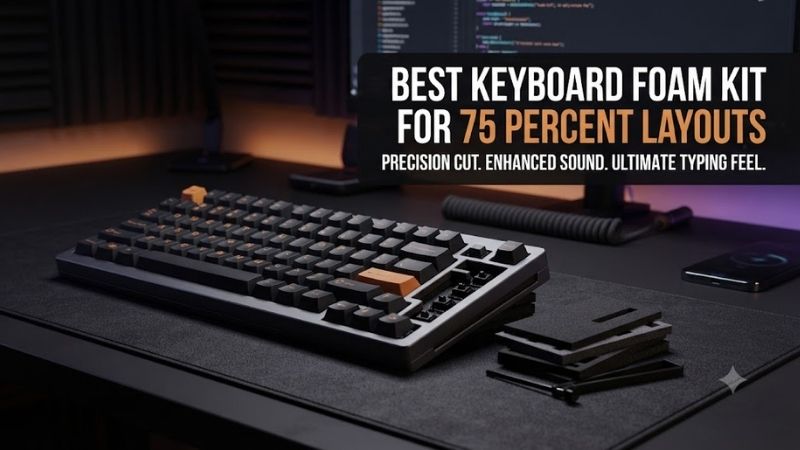
Plate Foam, Case Foam, and PE Foam Serve Different Purposes
Plate foam typically occupies the space between the switch plate and PCB, while case foam sits beneath the PCB or within empty case cavities. PE foam is a separate modification often installed closer to the switch interface and can change the keyboard’s sound more dramatically.
Plate foam may reduce certain vibrations and alter sound transmission between the plate and PCB.
Case foam can reduce some cavity resonance.
However, placing large amounts of material inside a case can also reduce desirable flexibility or create excessive compression.
PE foam changes acoustics through a different mechanism and must not be confused with ordinary case padding.
Matching the PCB and Mounting Design
A 75% layout does not define a standard PCB outline. Manufacturers position screw holes, connector cables, stabilizers, flex cuts, and mounting components differently, so two keyboards with similar key layouts may require completely different foam shapes.
For example, the Keychron Q1 and KBD75 V3 are both 75% keyboards, but their internal construction is not interchangeable.
Installing the wrong foam can obstruct components or place unwanted pressure on the PCB.
Buyers should confirm the exact model revision and mounting configuration.
Material Density, Compression, and Acoustic Expectations
Foam can reduce some high-frequency resonance and change the sound of bottom-out events, but the result depends on material density, thickness, switch selection, plate material, and case construction. It is therefore misleading to promise that any kit will produce a specific “thocky” sound.
A denser assembly may sound more muted.
A less damped board may sound brighter or more resonant.
Neither is automatically superior.
Some enthusiasts prefer the character of a lightly damped aluminum case, while others want a quieter, less hollow result.
The goal is controlled experimentation rather than maximum foam quantity.
Best Keyboard Foam Kits for 75% Layouts Reviewed
The seven options below are designed for different keyboard platforms. They should be treated as exact-fit accessories, not ranked by assuming one brand’s foam automatically improves every build. The reviews focus on construction differences, appropriate use cases, and possible limitations.
StupidFish GMMK Pro Case and Plate Foam — Best for GMMK Pro
The StupidFish GMMK Pro foam set is a purpose-cut solution for owners who want to change the acoustic behavior of the original GMMK Pro keyboard. Its advantage over generic foam sheets is the intended match to a documented keyboard platform and its internal mounting geometry.
Best For: Compatible original GMMK Pro builds.
Product Configuration
The kit includes case and plate foam designed for the GMMK Pro.
StupidFish lists it as a distinct product rather than a universal 75% sheet.
That distinction matters because the GMMK Pro contains a specific arrangement of mounting hardware, PCB components, and case cavities.
A correctly shaped insert can fit around those features.
However, buyers should confirm the keyboard revision before ordering, particularly because newer Glorious 75% keyboards use different internal designs.
Expected Acoustic Changes
Plate foam can change the way vibrations transfer between switches, plate, and PCB.
Case foam can reduce some resonance inside the aluminum housing.
The combined effect may be a more controlled acoustic character.
However, the result depends on the existing GMMK Pro configuration, including stabilizers, switches, and plate material.
No kit guarantees a particular pitch or sound profile.
Installation Considerations
Installation generally requires opening the keyboard and separating internal components.
The user should take photographs during disassembly and maintain the original screw locations.
Foam should not be forced against sockets, connectors, or mounting posts.
Pros: Model-specific cutouts, case and plate coverage, reduced need for DIY trimming, suitable for acoustic experimentation.
Cons: Requires disassembly, not a GMMK 3 compatibility guarantee, may alter typing flexibility.
Buy If: You own the supported GMMK Pro and want a purpose-cut damping set.
Skip If: You own a different Glorious 75% revision.
StupidFish Keychron Q1 Case and Plate Foam — Best for Original Q1
The StupidFish Keychron Q1 foam set is designed for the original Q1 platform rather than every keyboard carrying the Keychron name. It is useful for builders who want additional damping materials while keeping the modification aligned with the Q1’s specific case and PCB geometry.
Best For: Compatible original Keychron Q1 configurations.
Model-Specific Fit
The Keychron Q1 uses an aluminum case and gasket-oriented construction.
Its internal components include the PCB, plate, stabilization hardware, and acoustic materials that may already be installed.
The aftermarket foam must fit around these parts without disrupting the designed movement of the assembly.
Buyers should distinguish the original Q1 from Q1 Pro and later variants.
Sound Considerations
Additional damping may reduce cavity resonance and alter the perceived bottom-out sound.
However, a Q1 equipped with substantial factory foam may show less dramatic changes than an undamped build.
It is sensible to evaluate the existing configuration before purchasing more material.
Installation Risks
Foam that is too thick can place pressure on the PCB or reduce gasket movement.
It should not cover connectors or interfere with mounting screws.
Do not assume that more material always means better acoustics.
Pros: Purpose-cut original Q1 compatibility, case and plate damping, avoids general-purpose trimming.
Cons: Not automatically compatible with Pro variants, requires opening the keyboard, acoustic outcome remains subjective.
Buy If: You own the supported original Q1 and want a targeted acoustic modification.
Skip If: Your keyboard is a Q1 Pro, Q1 Max, or another unconfirmed revision.
StupidFish Keychron Q1 Pro Foam Set — Best for Q1 Pro Builds
The StupidFish Keychron Q1 Pro foam set is intended for the Q1 Pro’s specific internal arrangement. It is important to distinguish this kit from the original Q1 product, since wireless electronics and mechanical revisions can affect the space available inside the case.
Best For: Compatible Keychron Q1 Pro owners.
Why Version Compatibility Matters
Wireless keyboards can contain batteries and additional connectivity components.
A foam insert must not interfere with these elements.
Even if two keyboards share a familiar exterior shape, their internal layouts may differ.
The Q1 Pro-specific kit avoids relying on assumptions based on the original Q1.
Acoustic Benefits
The foam can alter the interaction between plate vibration and case resonance.
However, it does not change switch actuation specifications, wireless latency, or key registration.
Its primary function is acoustic and mechanical damping.
Installation
Any work near a rechargeable battery should be performed according to the keyboard manufacturer’s service instructions.
Do not compress or damage the battery.
Do not use conductive material around exposed electronic components.
Pros: Targeted Q1 Pro compatibility, avoids assuming Q1 interchangeability, useful acoustic modification.
Cons: Internal access required, battery clearance matters, no guaranteed sound improvement.
Buy If: You have a supported Q1 Pro and want matched foam.
Skip If: You cannot verify the keyboard’s exact revision.
StupidFish KBD75 V2 Acrylic-Diffuser Foam — Best for Diffuser Cases
The KBD75 V2 acrylic-diffuser edition requires careful attention to its case construction because the acrylic middle layer changes the internal space compared with an all-metal configuration. This dedicated foam kit is intended for that particular arrangement.
Best For: KBD75 V2 builds using the acrylic diffuser.
Construction Compatibility
The acrylic layer forms part of the keyboard’s case structure and lighting appearance.
Foam cut for another case configuration may not fit correctly.
The dedicated acrylic-diffuser kit is intended to account for the specific internal arrangement.
Sound and Lighting Trade-Offs
Foam can reduce some internal resonance, but opaque materials may also affect light transmission if installed incorrectly.
The original lighting design should be preserved.
Do not cover intended illumination paths unless the kit explicitly accommodates them.
Who Should Choose It
This is a specialized option for a specific enthusiast keyboard.
It is not an appropriate recommendation for a generic 75% board.
Pros: Specific V2 diffuser configuration, reduced need for improvised cutting, case and plate coverage.
Cons: Narrow compatibility, disassembly required, lighting clearance important.
Buy If: Your KBD75 V2 has the supported acrylic diffuser.
Skip If: You have the aluminum-only case.
StupidFish KBD75 V2 Aluminum Foam — Best for Metal V2 Cases
The KBD75 V2 aluminum-only foam set serves a different case configuration from the acrylic-diffuser version. Its inclusion matters because a buyer can own the correct keyboard generation but still purchase an incompatible foam kit if the case material and middle-layer arrangement are overlooked.
Best For: Aluminum-only KBD75 V2 builds.
Mechanical Fit
The kit is designed around the aluminum-only configuration.
This allows it to address the relevant cavities without assuming space occupied by an acrylic diffuser.
The mounting positions and available case volume matter more than the keyboard’s overall percentage layout.
Expected Sound Changes
Aluminum cases can exhibit a distinct resonant character.
Foam may reduce some of that resonance.
However, the effect also depends on plate material and switch selection.
A builder who prefers an open, resonant sound may not benefit from additional damping.
Installation
Confirm the case type before beginning.
Do not force pieces into locations where they overlap mounting posts or PCB components.
Pros: Specific aluminum-case fit, purpose-cut layers, useful for acoustic experimentation.
Cons: Not for diffuser configurations, subjective result, requires disassembly.
Buy If: Your keyboard is the supported aluminum-only KBD75 V2.
Skip If: You have the acrylic-diffuser version.
StupidFish KBD75 V3 Foam — Best for Updated KBD75 Builds
The KBD75 V3 foam set is intended for a later revision of the KBD75 platform. It gives owners a model-specific alternative to repurposing older V2 foam, which may differ in cutouts or thickness because the keyboard’s internal construction has changed.
Best For: Compatible KBD75 V3 keyboards.
Revision-Specific Design
A keyboard revision may change screw locations, PCB components, cable routing, or mounting structures.
Those changes can make older foam unsuitable.
The V3-specific product addresses the relevant platform.
Practical Acoustic Effects
Case and plate foam may alter resonance, keypress firmness, and perceived pitch.
However, the effect should be evaluated alongside the keyboard’s existing materials.
The aim is to achieve the user’s preferred sound without impairing the designed mounting behavior.
Compatibility Limits
Do not assume V2 and V3 kits are interchangeable.
Check the exact kit description and keyboard revision.
Pros: Revision-specific fit, purpose-cut dampening, avoids unnecessary trimming.
Cons: Limited to supported V3 boards, requires opening the keyboard, no guaranteed acoustic outcome.
Buy If: You own a supported KBD75 V3.
Skip If: You have an earlier revision.
StupidFish Freebird75 Foam — Best for Freebird75
The Freebird75 case-and-plate foam set provides a targeted modification for another popular 75% enthusiast platform. Its main advantage is the availability of pre-cut material for the intended keyboard rather than requiring a beginner to design every foam insert manually.
Best For: Compatible Freebird75 builds.
Construction
The foam is intended for the Freebird75 case and plate arrangement.
This can simplify installation compared with cutting a generic sheet.
However, the kit should still be checked for compatibility with the exact production revision.
Sound and Feel
Foam may reduce selected resonances while affecting how the keyboard responds to bottom-out force.
Some users will prefer the damped result.
Others may prefer the original construction.
The modification should be reversible wherever practical.
Installation
Keep screws and gaskets organized during disassembly.
Check that every connector remains accessible.
Avoid leaving loose material in contact with electrical components.
Pros: Model-specific design, pre-cut layers, suitable for targeted tuning.
Cons: Exact keyboard compatibility required, disassembly needed, subjective sound results.
Buy If: You have a supported Freebird75 keyboard.
Skip If: You use an unrelated 75% platform.
Buying Guide: Choosing a Foam Kit for a 75% Keyboard
A keyboard foam kit should be selected by exact model, revision, and internal construction before considering its acoustic claims. A correctly fitted inexpensive material can be more useful than a premium foam sheet that blocks components, compresses the PCB, or interferes with gasket movement.
Confirm the Keyboard Revision
Identify the complete model name.
Check whether the keyboard has a knob, battery, diffuser, or updated PCB.
Similar names do not guarantee identical internal construction.
Decide Which Acoustic Problem You Want to Address
Case foam may reduce cavity resonance.
Plate foam changes the interaction between plate and PCB.
PE foam produces a different sound modification.
Determine the source of the unwanted sound before adding material.
Avoid Excessive Compression
Foam should not force the keyboard assembly apart.
It should not obstruct gaskets, mounting points, batteries, or connectors.
If installation requires substantial pressure, reconsider compatibility.
Preserve Keyboard Flex and Electrical Safety
Some keyboards are designed to move slightly under typing force.
Excessive foam can reduce that movement.
Avoid conductive materials and protect sensitive electronics.
Frequently Asked Questions
A 75% keyboard’s layout does not establish which foam kit will fit. These answers address compatibility, acoustic expectations, differences between foam types, and the installation mistakes that can make a modification ineffective or mechanically unsuitable.
Can I use one 75% foam kit in any 75% keyboard?
No. Case, PCB, and plate geometry vary between models.
Does foam always make a keyboard quieter?
Not necessarily. It changes resonance and sound character, but the result depends on the entire build.
Is PORON better than EVA?
Neither is universally superior. Thickness, density, compression, and placement matter.
Can I install foam without opening the keyboard?
Most internal foam modifications require disassembly.
Does foam improve gaming responsiveness?
Not inherently. Acoustic damping does not automatically change latency or switch actuation.
Should I remove the factory foam first?
Evaluate the existing material and manufacturer instructions before replacing or stacking layers.
Final Verdict
The best keyboard foam kit for 75 percent layouts is the one precisely cut for your keyboard. StupidFish offers documented options for GMMK Pro, Keychron Q1, Q1 Pro, KBD75 V2/V3, and Freebird75. Prioritize exact compatibility, safe assembly, and your preferred sound rather than maximum foam thickness.