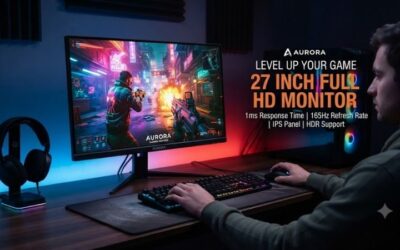
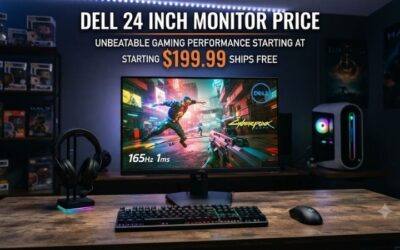
- Top Pick: Dell 27 240Hz Gaming Monitor – SE2726HG – 27-inch FHD (1920×1080) 240Hz Display, in-Plane Switching (IPS) Technology, AMD FreeSync Premium, TÜV 3-Star, 2X HDMI, DisplayPort 1.4, Tilt
- Best Value: Dell 24 240Hz Gaming Monitor – SE2426HG – 23.8-inch FHD (1920×1080) 240Hz Display, in-Plane Switching (IPS) Technology, AMD FreeSync™ Premium, TÜV 3-Star, 2X HDMI, DisplayPort 1.4, Tilt
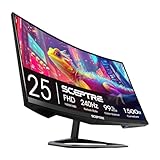
- Premium Choice: Sceptre Curved 24.5-inch Prime Gaming Monitor up to 240Hz 1080p R1500 1ms DisplayPort x2 HDMI x2 Blue Light Shift Build-in Speakers, Machine Black 2025 (C255B-FWT240 Series)
Refresh rate is the single most visible spec on a gaming monitor’s box, and in 2026 the meaningful decision at 1080p has narrowed to two numbers: 144Hz and 240Hz. A 144Hz panel draws a new image every 6.9 milliseconds; a 240Hz panel does it every 4.2ms. That 2.7ms gap sounds trivial written down, but across a full second of frantic tracking aim it adds up to roughly 96 extra frames of positional information about where your opponent actually is.
What changed recently is price. 240Hz used to carry a serious premium; today budget-to-midrange 1080p panels from Dell, Sceptre, SANSUI and ASUS routinely hit 240Hz for close to what 144Hz cost two years ago. That shifts the question away from “is 240Hz worth the money” and toward “can my GPU and my eyes actually use it.” This comparison breaks down where each refresh rate genuinely earns its keep.
As an Amazon Associate we earn from qualifying purchases at no extra cost to you.






⚡ Save on Your Next PC — Amazon Prime
Prime members get fast free shipping on the systems above, plus early access to Prime Day & Black Friday PC deals. New members get a 30-day free trial.
Watch: 144Hz vs 240Hz Monitor: Worth It in 2026? — Video Review
Quick Verdict
Choose 144Hz if you play mostly single-player and AAA titles, run a midrange or older GPU, or want to spend your budget on resolution, panel quality and colour accuracy instead of raw speed. Choose 240Hz if competitive shooters are your main diet, your GPU can consistently push 200+ fps at 1080p, and you want the smoothest motion and lowest input latency available without stepping up to expensive 360Hz+ OLED territory. For most players buying new in 2026, 240Hz at 1080p is the better default because the price gap has largely closed.
Key Differences
- Frame pacing: 144Hz delivers a new frame every 6.9ms, 240Hz every 4.2ms. The reduction in “stale” on-screen information is what players describe as feeling more connected to the game.
- Motion clarity: Higher refresh rates shorten the time each frame is held, cutting persistence blur. Fast-moving text, enemy nameplates and flick targets stay legible on a 240Hz panel where they smear at 144Hz.
- GPU demand: A 144Hz screen is comfortably fed by a midrange card in most titles. Saturating 240Hz means holding 240fps, which realistically limits you to esports titles or heavy use of upscaling and frame generation.
- Diminishing returns: Going 60Hz to 144Hz is transformative. Going 144Hz to 240Hz is a genuine but subtler upgrade that trained competitive players notice far more than casual ones.
- Panel trade-offs: At the same price, a 144Hz monitor often buys you higher resolution or a better panel, while a 240Hz monitor concentrates the budget into speed and typically stays at 1080p.
- Adaptive sync range: Both support FreeSync and G-SYNC Compatible modes, but a wider 240Hz range keeps frame times smooth across a broader spread of fps, which matters when performance fluctuates.
144Hz Monitors: The Balanced All-Rounder
144Hz remains the sweet spot for players who split time between competitive matches and story-driven games. It is high enough that mouse movement feels immediate and scrolling looks fluid, yet undemanding enough that a midrange GPU can hold the refresh rate in most modern engines without dropping settings to low. If you play Baldur’s Gate-style RPGs, racing sims or open-world titles at 1440p, a 144Hz panel lets you spend your money on resolution and colour instead of chasing frames you will never render.
The practical catch in 2026 is availability at 1080p. Manufacturers have increasingly skipped 144Hz on new small-format panels and gone straight to 240Hz, because the controller cost difference is now marginal. That means a 144Hz purchase increasingly makes sense at 1440p or 4K rather than at 1080p, where you may end up paying similar money for less capability.
240Hz Monitors: Built for Competitive Play
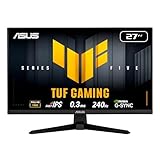
If your ranked ladder runs through Counter-Strike, Valorant, Apex or Rocket League, 240Hz is where the money goes. The ASUS TUF VG279QM5A is the enthusiast pick here: a 27-inch Fast IPS panel with a 0.3ms response figure, G-SYNC Compatible certification and Extreme Low Motion Blur Sync, which combines backlight strobing with adaptive sync for exceptionally clean motion. It also covers 99% sRGB, so it does not feel washed out when you switch to something slower paced.
For value-focused builds, the Dell SE2726HG (27-inch) and Dell SE2426HG (23.8-inch) pair 240Hz IPS panels with FreeSync Premium, dual HDMI and DisplayPort 1.4, and TÜV 3-Star eye comfort certification. If you prefer a curved, immersive setup, the Sceptre C255B-FWT240 offers a 24.5-inch 1500R panel with built-in speakers, while the SANSUI 27-inch curved model adds 130% sRGB coverage, 4000:1 contrast and a metal stand. The SANSUI 32-inch curved stretches 1080p across a large panel, which suits desk-distance immersion more than pixel density purists.
Which Should You Buy?
- For competitive FPS players: pick 240Hz. The ASUS TUF VG279QM5A is the strongest all-round option thanks to its Fast IPS panel and ELMB Sync.
- For budget-conscious upgraders: pick 240Hz via the Dell SE2426HG or SE2726HG, which deliver the refresh rate without a premium-brand markup.
- For immersive single-player gaming: pick a curved 240Hz panel like the Sceptre C255B-FWT240 or SANSUI 27-inch, or spend the same money on a 144Hz 1440p display instead.
- For older or midrange GPUs: pick 144Hz, or buy 240Hz and treat the extra headroom as future-proofing for your next graphics card.
- For large-screen desk setups: pick the SANSUI 32-inch curved 240Hz if screen size matters more to you than pixel density.
Frequently Asked Questions
Can you actually see the difference between 144Hz and 240Hz?
Yes, though it is subtler than the jump from 60Hz. Most people notice it immediately in mouse cursor movement and fast horizontal panning. Competitive players report the biggest benefit in tracking aim and recoil control, where the extra frames make target movement easier to predict.
What GPU do I need for 240Hz gaming?
For esports titles at 1080p, a current midrange card will comfortably exceed 240fps. For AAA games, expect to rely on upscaling and frame generation, or accept running below the panel’s maximum, which adaptive sync handles smoothly.
Is 240Hz worth it at 1080p rather than 1440p?
Yes, if speed is your priority. 1080p is easier to drive at high frame rates, which is exactly why competitive players still choose it. If visual fidelity matters more, 1440p at 144Hz is the better balance.
Does refresh rate matter for console gaming?
Current consoles cap out at 120Hz, so a 144Hz panel is sufficient. A 240Hz monitor will still run consoles perfectly at 120Hz, but the extra headroom only pays off on PC.
Final Verdict
In 2026, 240Hz at 1080p is the sensible default for anyone buying a new gaming monitor, simply because the price premium that once justified sticking with 144Hz has largely evaporated. Competitive players should prioritise the ASUS TUF VG279QM5A for its motion clarity, while value buyers are well served by the Dell SE2426HG and SE2726HG. Choose 144Hz deliberately rather than by default, and do it at 1440p or above, where the extra pixels genuinely buy you something the faster panel cannot.