🛒 Best Price Today on Amazon
Prime members get fast, free shipping on everything above, plus member-only deals. New members get a 30-day free trial — cancel anytime.
- Best Dual Computer Monitor Wall Mounts Compared
- VIVO MOUNT-V002G – Best Overall Dual Monitor Wall Mount
- VIVO MOUNT-TS32B – Best Flush Dual-Monitor Wall Mount
- VIVO MOUNT-TS38B – Best for Two Large Monitors
- Mount-It Dual Monitor Wall Mount – Best Alternative
- WALI Vertical Dual Monitor Wall Mount – Best Stacked Setup
- VESA Compatibility Explained
- Weight Capacity Matters More Than Screen Size
- Wall Type and Installation
- Articulating Arms vs Telescoping Wall Mounts
- Side-by-Side vs Stacked Dual Monitors
- Dual Wall Mount vs Desk Mount
- Cable Management
- FAQ
- Conclusion
The best dual computer monitor wall mount should support both screens securely while providing enough tilt, swivel, reach, and height adjustment for comfortable viewing. VIVO’s Mechanical Dual Wall Mount is the strongest all-around choice, while telescoping mounts work better for flush installations and larger 27- to 38-inch displays.
Quick answer: For most people in 2026, the best dual computer monitor wall mount for two screens is the Wall Mount — our #1 rated choice. See the full ranked comparison, alternatives and buying advice below.
Best Dual Computer Monitor Wall Mounts Compared
| Wall Mount | Best For | Screen Size | Capacity | VESA |
|---|---|---|---|---|
| VIVO MOUNT-V002G | Best Overall | 17–32 in | 19.8 lb each | 75×75, 100×100 |
| VIVO MOUNT-TS32B | Best Flush Setup | 21–32 in | 22 lb each | 75×75, 100×100 |
| VIVO MOUNT-TS38B | Best for Larger Monitors | 27–38 in | 22 lb each | 75×75, 100×100 |
| Mount-It Dual Wall Mount | Best Alternative | Varies | Varies | Common VESA patterns |
| WALI Vertical Dual Wall Mount | Best Stacked Setup | Up to 49 in listing | Varies | Check exact model |
Wall mounting can free nearly the entire rear section of a computer desk because the display bases disappear completely. This gives keyboards, speakers, controllers, laptops, notebooks, audio interfaces, and other accessories more usable space without requiring a deeper desktop.
The trade-off is installation. A desk arm can normally be moved or removed with little lasting impact, while a wall mount requires correctly placed fasteners in a stud, concrete, brick, or another suitable structural surface. Monitor weight, VESA pattern, wall construction, and mounting height therefore need to be checked before drilling.
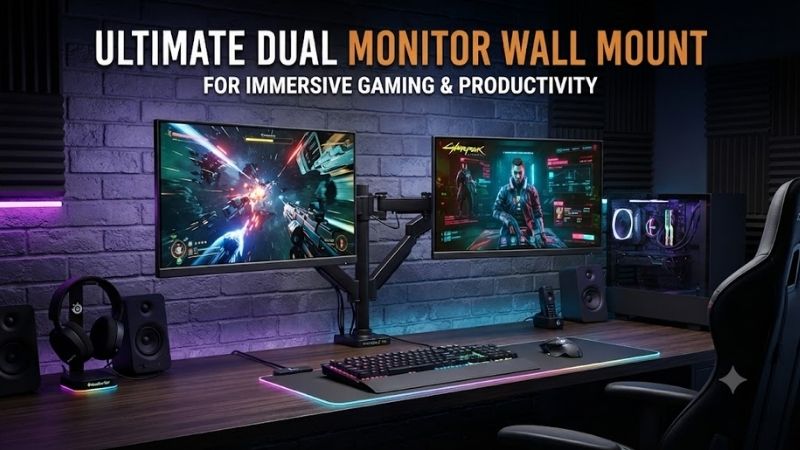
VIVO MOUNT-V002G – Best Overall Dual Monitor Wall Mount
Best For: Gaming desks, offices, and users who frequently reposition both displays
VIVO’s MOUNT-V002G is a true wall-mounted dual-monitor system designed for 17- to 32-inch displays. Each arm supports monitors weighing between 4.4 and 19.8 pounds and uses standard 75x75mm or 100x100mm VESA mounting patterns.
The system uses mechanical spring arms rather than fixed brackets. VIVO lists a height-adjustment range from 6.25 to 16 inches, plus maximum arm extension of approximately 19.75 inches from the wall. That range makes it easier to pull a screen toward you temporarily and then push it back when desk space is needed.
Key Features
- Supports two 17- to 32-inch monitors
- 4.4 to 19.8 lb capacity per monitor
- 75x75mm VESA
- 100x100mm VESA
- Mechanical spring arms
- Up to 19.75-inch extension
- 6.25- to 16-inch height adjustment
- ±90-degree tilt
- 180-degree swivel
- 360-degree rotation
- Portrait and landscape orientation
- Integrated cable management
- Wood, concrete, and brick installation support
What Makes It Different
The biggest advantage is independent positioning. Both screens can be moved, rotated, tilted, and extended rather than being locked into a fixed side-by-side arrangement. This is especially useful when one screen is used for gaming and the other for Discord, monitoring software, documents, or streaming controls.
The ability to rotate each display by 360 degrees also makes vertical layouts practical. A programmer, writer, or streamer can leave one screen horizontal while rotating the second into portrait mode for code, chat, or long documents.
VIVO states that the mount supports wood walls as well as concrete and brick installations. That makes it more adaptable than mounts packaged only for wood-stud installation, although the correct hardware and mounting method must still match the specific wall.
Pros
- Excellent range of motion
- Separate control for each monitor
- Good 17- to 32-inch compatibility
- Mechanical spring adjustment
- Nearly 20 inches of arm reach
- Supports portrait orientation
- Integrated cable routing
- Reasonable price for a full-motion design
Cons
- 19.8-pound limit excludes some heavy monitors
- Requires secure wall installation
- Moving both arms constantly can stress poor mounting surfaces
- More joints mean a less flush appearance than telescoping designs
Use Case
This mount works particularly well with two 24-inch or 27-inch gaming and productivity monitors. It allows the primary display to remain centered while the secondary monitor is angled inward, rotated vertically, or pushed against the wall when not needed.
Who It’s For
Choose the MOUNT-V002G if flexibility matters more than a perfectly flush installation. It is the most versatile option here for users who frequently change monitor positions throughout the day.
VIVO MOUNT-TS32B – Best Flush Dual-Monitor Wall Mount
Best For: Minimalist desks and users who want two monitors positioned close to the wall
The VIVO MOUNT-TS32B takes a different approach. Instead of long articulating spring arms, it uses telescoping arms intended to create a cleaner, more flush wall-mounted appearance. It supports monitors from 21 to 32 inches and up to 22 pounds per screen.
The mount supports 75×75 and 100x100mm VESA standards. VIVO specifies adjustable arm lengths from 10 to 15.5 inches, with a total arm span between monitor centers of approximately 20 to 30.5 inches.
Key Features
- 21- to 32-inch monitor support
- 22 lb capacity per screen
- 75x75mm and 100x100mm VESA
- 10- to 15.5-inch telescoping arms
- 20- to 30.5-inch center span
- ±90-degree tilt
- 180-degree swivel
- 360-degree rotation
- Height adjustment along center pole
- Portrait and landscape support
- Cable management
- Hardware supplied for wood-stud installation
What Makes It Different
The lower-profile design is its main advantage. Articulating gas or mechanical arms can project a considerable distance from the wall even when folded. Telescoping arms use fewer joints and can create a more deliberate side-by-side arrangement.
This is particularly attractive when the desk itself is shallow. Keeping the displays close to the wall increases viewing distance without requiring the desk to move farther into the room.
The telescoping mechanism also helps accommodate different monitor widths. Rather than fixing both screens at one exact spacing, each arm can be adjusted to bring bezels closer together or separate them slightly.
Pros
- Clean flush appearance
- 22-pound capacity per monitor
- Good for two 24- or 27-inch screens
- Adjustable monitor spacing
- Portrait rotation
- Useful cable management
- Affordable price
Cons
- Less reach than a full-motion spring arm
- Primarily packaged for wood-stud mounting
- Not ideal when screens need constant movement
- 32-inch maximum size
Use Case
This type of mount is ideal behind a permanent gaming or office desk where both screens remain in approximately the same position. It is especially effective with thin-bezel displays that are intended to look like one continuous workspace.
Who It’s For
Choose the TS32B if desk clearance and aesthetics matter more than long extension range. It works best once the preferred monitor arrangement has already been determined.
VIVO MOUNT-TS38B – Best for Two Large Monitors
Best For: 32-inch displays, larger productivity screens, and selected ultrawide-style setups
The MOUNT-TS38B expands the same telescoping concept for larger monitors. VIVO rates it for 27- to 38-inch displays with a maximum weight of 22 pounds per screen.
Its arms adjust from 12 to 19.8 inches, creating a center-to-center span from approximately 24 to 39.5 inches. That extra range is important because larger 32- and 34-inch-class displays need more physical separation than two compact 24-inch monitors.
Key Features
- Supports two 27- to 38-inch displays
- 22 lb capacity per monitor
- 75×75 and 100×100 VESA
- Telescoping 12- to 19.8-inch arms
- 24- to 39.5-inch arm span
- ±90-degree tilt
- 180-degree swivel
- 360-degree rotation
- Portrait and landscape positioning
- Steel construction
- Wood-stud mounting hardware
What Makes It Different
Large dual-monitor layouts can become difficult because the screens collide before their arms reach a comfortable position. The TS38B’s wider adjustable span gives 32-inch and selected 34-inch displays more room to sit next to each other naturally.
VIVO also describes the mount as using overlapping heavy-duty arms with fewer joints, which reduces visual clutter and is intended to provide a stronger hold for larger screens.
The current VIVO listing also shows a relatively modest direct-store price compared with many premium dual mounts, making it especially appealing for users who need larger screen compatibility without spending several hundred dollars.
Pros
- Designed for 27- to 38-inch screens
- Good spacing range
- 22-pound capacity per screen
- Flush installation style
- Excellent for two large monitors
- Full rotation and tilt
- Competitive pricing
Cons
- Heavy monitors above 22 pounds are excluded
- Less flexible than gas-spring arms
- Requires careful stud positioning
- Very wide screen combinations need accurate measurements first
Use Case
The TS38B works well with two 32-inch productivity monitors or larger high-refresh displays where a normal 27-inch dual arm is simply too narrow.
Who It’s For
Choose this model if both monitors are larger than 27 inches and their weights remain below the limit. It is especially useful when you want large displays to remain close to the wall.
Mount-It Dual Monitor Wall Mount – Best Alternative
Best For: Buyers who prefer Mount-It hardware or find a model with higher suitability for their screens
Mount-it! Dual Monitor Wall Mount is another option for creating a two-screen wall-mounted workstation. Mount-It offers multiple dual-monitor designs, so exact screen-size, load, and articulation specifications should be checked against the specific model number before installation.
A second current option, Mount-It Dual Monitor Wall Mount MI-45114B, is also available through retailers. This illustrates why the model number is important: “Mount-It dual wall mount” can describe multiple assemblies rather than one universal product.
Key Features to Check
- Maximum size per monitor
- Weight capacity per arm
- 75×75 or 100×100 VESA compatibility
- Gas-spring or mechanical adjustment
- Wall plate dimensions
- Stud or masonry installation requirements
- Maximum extension
- Tilt and rotation range
What Makes It Different
Mount-It has a broad range of wall-mount and gas-spring hardware, making it useful when a standard dual 32-inch specification does not fit your setup.
The most important buying rule is not to assume all variants share the same capacity. A dual arm designed around two lightweight 24-inch screens may be unsuitable for two heavy 32-inch gaming monitors even if both use the same 100x100mm VESA pattern.
Pros
- Several dual-monitor configurations available
- Competitive alternatives to VIVO
- Full-motion models available
- Useful for office and gaming installations
Cons
- Specifications vary heavily by model
- Similar product names can be confusing
- Exact wall requirements must be verified
Who It’s For
Choose Mount-It when a specific model matches your monitor weights and wall arrangement better than the VIVO options above.
WALI Vertical Dual Monitor Wall Mount – Best Stacked Setup
Best For: Vertical stacking rather than side-by-side monitors
WALI Vertical Dual Monitor Wall Mount for 13-49 inch Screens is aimed at users who want screens positioned one above the other rather than horizontally across the wall.
Vertical stacking can be extremely useful on narrow desks or in streaming and monitoring setups. The lower display can serve as the main gaming or productivity screen while the upper monitor displays communication apps, dashboards, video previews, security feeds, or reference material.
What Makes a Vertical Mount Useful
Side-by-side dual monitors require substantial wall width. Two 27-inch screens can easily occupy more than four feet horizontally, while vertical mounting keeps the setup centered in front of the user.
Stacking also helps ultrawide users. Instead of placing a second screen beside a wide 34-inch display and forcing excessive head rotation, a smaller secondary screen can sit directly above it.
Pros
- Saves horizontal space
- Useful for streaming
- Good for dashboards and monitoring
- Can work well above an ultrawide
- Cleaner narrow-desk layout
Cons
- Upper monitor can sit too high
- Neck movement can become uncomfortable
- Installation height requires careful planning
- Specifications vary by exact WALI version
Who It’s For
Choose a vertical dual mount if your desk is narrow or if the secondary display is mainly for information rather than constant focused work.
VESA Compatibility Explained
VESA refers to the mounting-hole pattern on the back of the display. Most of the VIVO dual wall mounts in this roundup support 75x75mm and 100x100mm patterns.
Do not assume screen size determines VESA compatibility. Two 27-inch monitors can use different mounting patterns or weights.
Before buying, check the monitor manufacturer’s specification page for both VESA pattern and monitor weight without the original desktop stand.
Weight Capacity Matters More Than Screen Size
Screen-size ratings are useful, but monitor weight is usually the hard limit.
For example, VIVO’s mechanical dual arm supports screens up to 32 inches but only up to 19.8 pounds each. Its telescoping models increase that to 22 pounds per display.
A heavy professional or gaming monitor can therefore be incompatible even if its diagonal measurement falls within the advertised range.
Always use the monitor’s weight without the desktop stand because the stand is removed during VESA mounting.
Wall Type and Installation
Wall mounting places all monitor weight and arm leverage directly into the wall structure. Never rely on thin drywall alone for an articulating dual-monitor system unless the manufacturer explicitly provides a rated fastening method for that construction.
VIVO specifies wood-wall and concrete/brick installation for the MOUNT-V002G, while its telescoping versions provide mounting hardware for wood-stud installation.
The mount should be attached to appropriate structural support. When in doubt, use a stud finder and follow the included installation guide or use professional installation.
Articulating Arms vs Telescoping Wall Mounts
Articulating spring arms are better when you constantly reposition screens. They provide more extension, height adjustment, and independent movement.
Telescoping mounts are better when the goal is a clean, flush workstation. They typically have fewer joints and keep the monitors closer to the wall.
For gaming, a mechanical arm is useful if the monitor needs to move closer for competitive play and farther away for general work. For a permanent office layout, telescoping arms usually look cleaner.
Side-by-Side vs Stacked Dual Monitors
Side-by-side screens are best when both monitors receive frequent attention. Spreadsheets, browsers, code, editing applications, and gaming plus Discord all work naturally with horizontal layouts.
Stacked monitors save horizontal space but require more vertical eye movement. They are ideal when the upper display contains information that is viewed only periodically.
A hybrid arrangement can also work: one monitor horizontal and the second portrait. VIVO’s mounts support 360-degree rotation, making this configuration straightforward.
Dual Wall Mount vs Desk Mount
A wall mount provides maximum desktop clearance. There is no clamp, pole, or monitor base touching the desk.
A desk mount is easier to relocate and does not require holes in the wall. Ergotron’s LX dual desk system, for example, supports two monitors up to 27 inches and allows up to 25 inches of extension, but it remains attached to the desk rather than the wall.
Choose wall mounting when the workstation will remain in one permanent location. Choose desk mounting when flexibility, apartment restrictions, or frequent desk moves matter more.
Cable Management
A wall-mounted setup looks unfinished if HDMI, DisplayPort, USB, and power cables hang loosely beneath both screens.
VIVO integrates cable management into its mechanical arm and telescoping designs.
Leave enough cable slack for the full movement range. A cable that looks perfect when the monitor is pushed back can be pulled dangerously tight when the arm is extended.
For permanent installations, cable raceways can run vertically from the monitor area to the desk or power outlet without placing cables inside the wall.
FAQ
Can You Wall Mount Two Computer Monitors?
Yes. A dual monitor wall mount can hold two screens from a shared or separate wall attachment, provided each display meets the mount’s VESA, size, and weight requirements.
What Is the Best Dual Monitor Wall Mount?
The VIVO MOUNT-V002G is the strongest general-purpose choice because it supports two 17- to 32-inch displays with independent mechanical arms, nearly 20 inches of reach, height adjustment, tilt, swivel, and rotation.
Can I Wall Mount Two 32-Inch Monitors?
Yes. Both the VIVO MOUNT-V002G and TS32B support monitors up to 32 inches, provided each screen remains below the relevant weight limit and uses a supported VESA pattern.
What About Two Monitors Larger Than 32 Inches?
The VIVO TS38B is designed for 27- to 38-inch screens and supports up to 22 pounds per monitor.
Is a Wall Mount Better Than a Monitor Arm?
A wall mount is better for maximum desk clearance and permanent installations. A desk-mounted arm is easier to move and does not require drilling. Full-motion versions of either type can provide excellent ergonomics.
Can I Mount One Monitor Vertically?
Yes. VIVO’s mechanical and telescoping dual mounts allow 360-degree monitor rotation, enabling one display to be used in portrait orientation.
Can a Dual Wall Mount Hold Ultrawide Monitors?
Sometimes. Width alone does not determine compatibility. Check the ultrawide monitor’s weight and VESA pattern. VIVO’s TS38B supports monitors up to 38 inches and 22 pounds each, while heavier ultrawides may require specialized mounts.
Conclusion
The best dual computer monitor wall mount depends on monitor size and how often you reposition the screens. VIVO MOUNT-V002G offers the best full-motion flexibility for 17- to 32-inch monitors, TS32B creates a cleaner flush setup, and TS38B is better for larger 27- to 38-inch displays. Vertical mounts are useful when horizontal desk space is limited.
Ready to decide? Our #1 pick for 2026 is the Wall Mount.
Live price & availability on Amazon.