🛒 Best Price Today on Amazon
Prime members get fast, free shipping on everything above, plus member-only deals. New members get a 30-day free trial — cancel anytime.
Choosing the best whole home mesh WiFi system means balancing coverage, backhaul, Ethernet speed, Wi-Fi generation, security, and ease of management. A strong mesh kit should remove dead zones without forcing devices onto weak nodes, while still giving gaming PCs and workstations fast wired options.
Quick answer: For most people in 2026, the best whole home mesh wifi system is the Mesh System — our #1 rated choice. See the full ranked comparison, alternatives and buying advice below.
Best Whole Home Mesh WiFi Systems Compared
Mesh systems coordinate several nodes under one network name, helping devices roam as you move through the house. Performance still depends on node placement and backhaul quality, so the fastest hardware can disappoint when satellites sit behind thick walls or too far from the main router in practice.
| Mesh System | Best For | Wi-Fi | Wired Ports | Coverage | Key Advantage |
|---|---|---|---|---|---|
| ASUS ZenWiFi BT10 | Maximum multi-gig performance | Wi-Fi 7 BE18000 | Dual 10G per unit | Up to 6,000 sq. ft. per 2-pack | 10G wired backhaul |
| TP-Link Deco BE63 | Overall Wi-Fi 7 value | Wi-Fi 7 BE10000 | 4 x 2.5G per unit | Up to 5,800 sq. ft. per 2-pack | Four 2.5G ports |
| eero Pro 7 | Simple smart-home mesh | Wi-Fi 7 BE10800 | 2 x 5GbE per unit | Up to 2,500 sq. ft. per unit | Easy management |
| NETGEAR Orbi 770 | Large homes | Wi-Fi 7 BE11000 | 2.5G Ethernet | Up to 5,500 sq. ft. per 2-pack | Broad coverage |
| Google Nest Wifi Pro | Simpler Wi-Fi 6E homes | Wi-Fi 6E AXE5400 | Gigabit Ethernet | Pack dependent | Matter and Thread |
ASUS ZenWiFi BT10
Best For: Maximum multi-gig home networking
ASUS ZenWiFi BT10 is a tri-band Wi-Fi 7 mesh system rated as BE18000, using 2.4 GHz, 5 GHz, and 6 GHz radios. It supports 320 MHz channels, 4K-QAM, and Multi-Link Operation, while eight internal antennas per unit target high-capacity whole-home coverage for modern wireless clients throughout a large connected home.
Each BT10 provides one 10G WAN/LAN port and one separate 10G LAN port, plus a Gigabit WAN/LAN connection. That layout suits multi-gig fiber, NAS storage, gaming PCs, or a 10G switch, and it also makes wired backhaul practical when Ethernet is already installed through the home for maximum stability.
ASUS rates a two-pack for coverage up to 6,000 square feet, while AiMesh coordinates the nodes. AiProtection Pro, VPN tools, guest networking, parental controls, and smart-home network options are built into the software, giving advanced users substantially more control than many simplified app-first mesh kits.
The BT10 stands out because 10G connectivity is available on each unit rather than only the gateway. That provides exceptional backhaul and local-network headroom, but it is unnecessary for most Gigabit homes. Users paying for 1 Gbps internet may get similar everyday results from a less expensive 2.5G mesh system.
Key Features:
- Tri-band Wi-Fi 7
- BE18000 wireless class
- 320 MHz channel support
- Multi-Link Operation
- Dual 10G Ethernet connectivity
- AiMesh and AiProtection Pro
Pros:
- Excellent wired backhaul potential
- Wi-Fi 7 radios
- Advanced controls
- Multi-gig expansion
Cons:
- Excessive for basic Gigabit plans
- More settings than casual users may want
Use Case: Large homes with multi-gig fiber, wired backhaul, fast NAS storage, and several premium gaming or workstation devices.
Who It’s For: Enthusiasts who want whole-home Wi-Fi without sacrificing 10 Gigabit wired networking.
TP-Link Deco BE63
Best For: Overall Wi-Fi 7 mesh value
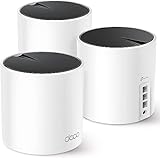
TP-Link Deco BE63 is a tri-band BE10000 Wi-Fi 7 mesh system using 2.4 GHz, 5 GHz, and 6 GHz. It supports 320 MHz channels, 4K-QAM, Multi-Link Operation, and six wireless streams, making it a strong fit for multi-gig internet, gaming, streaming, and busy smart homes spread across several rooms and floors.
Every Deco BE63 unit includes four auto-sensing 2.5GbE WAN/LAN ports. Any node can therefore connect to a gaming PC, switch, NAS, or another Deco through wired backhaul. Homes with Ethernet already installed can reduce dependence on wireless backhaul and keep more radio capacity available for client devices.
TP-Link rates a two-pack for coverage up to 5,800 square feet and more than 200 connected devices. HomeShield provides security and parental controls, while the Deco software also offers device-based QoS, guest networks, VPN functions, router mode, access-point mode, and node or band preferences too.
The BE63 is especially attractive because every node provides four 2.5G ports, reducing the need for an extra multi-gig switch. Its main limitation is the lack of 10GbE, so users building very fast NAS networks or moving beyond 2.5 Gbps internet should consider a more expensive mesh platform with greater wired headroom.
Key Features:
- Tri-band Wi-Fi 7
- BE10000 wireless class
- Four 2.5GbE ports per unit
- 320 MHz channels
- Multi-Link Operation
- HomeShield and device QoS
Pros:
- Excellent 2.5G port selection
- Strong multi-gig value
- App management
- Wired backhaul
Cons:
- No 10GbE
- Some advanced services may depend on plan level
Use Case: Multi-story homes with 1 Gbps to 2.5 Gbps fiber, wired gaming devices, and newer Wi-Fi 6E or Wi-Fi 7 clients.
Who It’s For: Buyers who want a modern Wi-Fi 7 mesh without paying for enterprise-like 10G connectivity.
eero Pro 7
Best For: Simple smart-home mesh networking
eero Pro 7 is a tri-band Wi-Fi 7 system with 2.4 GHz, 5 GHz, and 6 GHz radios. It carries a BE10800 rating and supports Multi-Link Operation for compatible Wi-Fi 7 devices. eero emphasizes automatic channel selection and simple management rather than exposing large numbers of manual radio settings overall.
Each Pro 7 unit has two auto-sensing 5GbE ports, allowing a node to function as the gateway or an extender with wired devices. eero lists wired speeds up to 4.7 Gbps and wireless speeds up to 3.9 Gbps, giving the system useful headroom for faster fiber plans and stable wired backhaul throughout the home.
eero rates each Pro 7 for up to 2,500 square feet of coverage and more than 200 connected devices. It also supports Zigbee, Thread, and Matter controller functions, making it appealing in smart homes where the network infrastructure may also help coordinate compatible connected-home devices as well.
The Pro 7 stands out for combining simple operation with 5GbE ports. That gives it more wired headroom than mainstream 2.5G systems without requiring a complex router interface. The trade-off is reduced manual control, so network enthusiasts may prefer ASUS or TP-Link for deeper configuration options.
Key Features:
- Tri-band Wi-Fi 7
- BE10800 rating
- Multi-Link Operation
- Two 5GbE ports per unit
- Zigbee and Thread support
- Matter controller support
Pros:
- Easy management
- Useful 5GbE connectivity
- Smart-home integration
- Simple expansion
Cons:
- Limited enthusiast-level controls
- Only two Ethernet ports per node
Use Case: Smart homes that need fast mesh coverage, multi-gig wired capability, and minimal day-to-day network administration.
Who It’s For: Users who prefer automatic optimization over detailed manual router tuning.
NETGEAR Orbi 770 Series
Best For: Large homes and broad coverage
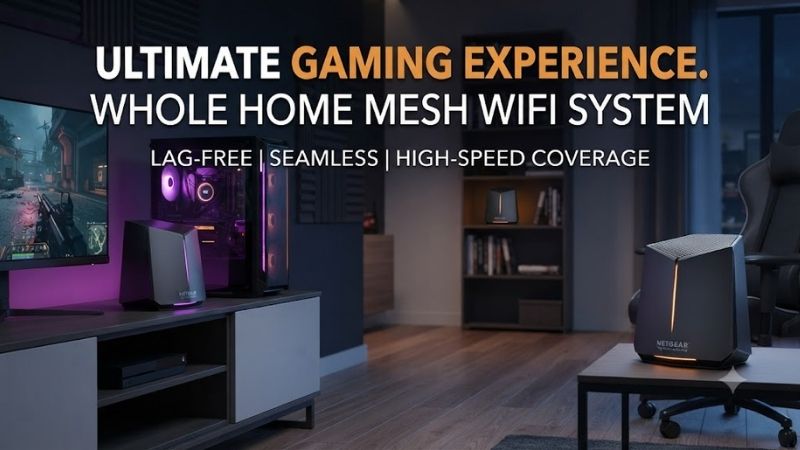
NETGEAR Orbi 770 is a tri-band BE11000 Wi-Fi 7 mesh system using 2.4 GHz, 5 GHz, and 6 GHz. NETGEAR rates the two-pack for up to 5,500 square feet and the three-pack for as much as 8,000 square feet, making the series a strong candidate for larger multi-floor homes with many rooms, devices, and coverage challenges.
The main router includes one 2.5GbE WAN port and three 2.5GbE LAN ports, while each satellite provides two 2.5GbE LAN ports. That makes wired backhaul, gaming PCs, TVs, consoles, and remote switches easy to connect, although internet service faster than 2.5 Gbps cannot use its full bandwidth through the gateway.
Orbi 770 supports Wi-Fi 7 features such as 320 MHz channels, Multi-Link Operation, and 4K-QAM. NETGEAR also provides separate main, IoT, and guest networks, automatic firmware features, and optional Armor security services, helping households separate smart-home devices from primary computers and phones.
The Orbi 770 is most compelling when coverage is the main problem. Its satellite layout and 2.5G ports suit large homes that need several wired endpoints away from the gateway. The trade-off is the 2.5G WAN ceiling, which provides less upgrade headroom than eero Pro 7 or ASUS BT10 for faster future fiber.
Key Features:
- Tri-band Wi-Fi 7
- BE11000 wireless class
- 2.5GbE WAN
- Multiple 2.5GbE LAN ports
- Up to 5,500 sq. ft. per two-pack
- Separate IoT and guest networks
Pros:
- Strong large-home coverage
- Multiple multi-gig ports
- Flexible satellite connectivity
- Simple management
Cons:
- WAN limited to 2.5GbE
- Larger investment than basic Wi-Fi 6E kits
Use Case: Large multi-floor homes with many rooms, several wired devices, and a need for broad coverage from two or three nodes.
Who It’s For: Families who prioritize whole-home reach and simple expansion over 5G or 10G Ethernet.
Google Nest Wifi Pro
Best For: Simpler Wi-Fi 6E smart homes
Google Nest Wifi Pro uses tri-band Wi-Fi 6E instead of Wi-Fi 7, operating on 2.4 GHz, 5 GHz, and 6 GHz. Its AXE5400 platform remains capable for Gigabit-class homes, especially when most client devices use Wi-Fi 6 or Wi-Fi 6E and do not benefit from the newest Wi-Fi 7 features or multi-gig wired networking.
Each point uses 2×2 radios across all three bands and supports up to 100 connected devices according to Google. Client steering helps compatible devices roam between mesh points, while network monitoring, guest access, device prioritization, and app-based controls keep routine management relatively simple.
Nest Wifi Pro also works as a Thread border router and supports Matter, which can simplify compatible smart-home deployments. The major hardware limitation is Gigabit Ethernet. Users paying for multi-gig fiber or planning fast wired backhaul will hit that ceiling long before the newer Wi-Fi 7 systems in this roundup.
Nest Wifi Pro makes sense when simplicity, Google Home integration, and Wi-Fi 6E matter more than maximum throughput. It is less future-ready than the other picks, but not every home needs 2.5G or 10G networking. A sub-Gigabit internet connection can still benefit from better coverage and cleaner 6 GHz spectrum.
Key Features:
- Tri-band Wi-Fi 6E
- AXE5400 wireless class
- 2.4 GHz, 5 GHz, and 6 GHz
- Up to 100 devices per point
- Thread border router
- Matter support
Pros:
- Easy Google Home integration
- 6 GHz connectivity
- Simple mesh management
- Smart-home support
Cons:
- Gigabit Ethernet only
- No Wi-Fi 7
Use Case: Homes with Gigabit-or-slower internet, Google Home devices, and users who want easy mesh coverage rather than maximum network speed.
Who It’s For: Mainstream households that value simplicity more than multi-gig performance.
How to Choose a Whole Home Mesh WiFi System
Start With Home Layout
Do not choose node count from square footage alone. Thick concrete, brick, metal, mirrors, floors, and appliances can weaken signals dramatically. Place the gateway where the internet enters the home, then position satellites where they still receive a strong upstream connection instead of placing them directly inside the worst dead zone.
Decide on Backhaul
Wireless backhaul is convenient because no new cable is required, but performance depends on radio conditions. Ethernet backhaul creates a dedicated wired path between nodes and is usually more consistent. If your home already has Cat 5e, Cat 6, or better cabling, using it can significantly improve a gaming-focused mesh deployment.
Match Ethernet to Internet Speed
A 2.5 Gbps fiber connection needs at least a 2.5GbE WAN port to avoid a hard bottleneck. Deco BE63 and Orbi 770 cover that class, eero Pro 7 reaches 5GbE, and ASUS BT10 extends to 10G. Nest Wifi Pro remains limited to Gigabit Ethernet despite supporting the newer 6 GHz wireless band for client connections.
Consider Wi-Fi 7 Clients
Wi-Fi 7 features such as Multi-Link Operation, 320 MHz channels, and 4K-QAM require compatible clients to deliver their full benefit. Older devices still connect normally, so buying Wi-Fi 7 is partly an investment in future laptops, phones, and gaming hardware rather than an immediate upgrade for every device you already own.
Avoid Too Many Nodes
More mesh units do not automatically mean faster Wi-Fi. Excessive overlap can complicate roaming, while satellites placed too far apart can create weak backhaul. Start with the smallest pack likely to cover the home, test real weak areas, and add another node only when measurements show that a genuine coverage gap remains.
Check Security and Smart-Home Features
Mesh platforms now differ substantially in software. ASUS emphasizes detailed controls, TP-Link uses HomeShield, eero integrates deeply with smart-home standards, NETGEAR offers Armor services, and Google focuses on Home integration. Choose the ecosystem whose controls, subscriptions, and privacy model fit how you manage the network.
FAQ
Is Mesh WiFi Better Than One Router?
Mesh WiFi is better when one router cannot cover the home consistently. Multiple nodes can improve signal strength across distant rooms and floors, while one powerful router may still be faster and cheaper in a small home. Mesh should solve a real coverage or placement problem rather than replace a good router without reason.
Is Wi-Fi 7 Worth It for Mesh?
Wi-Fi 7 makes sense for multi-gig internet, newer clients, and users who expect to keep the system for years. Wi-Fi 6E remains capable for mainstream service. In practice, the biggest upgrade can come from better Ethernet ports and backhaul rather than the theoretical combined wireless speed printed on the product box.
Does Mesh WiFi Increase Gaming Ping?
A weak wireless backhaul can add latency and inconsistency, while a well-designed mesh can perform reliably. Ethernet backhaul is preferable for gaming when available, and a PC can connect by cable to a nearby satellite. Internet routing and server distance still influence ping more than the word mesh itself.
How Many Mesh Nodes Do I Need?
Many medium or large homes work with two nodes, while complex layouts may need three. Construction matters more than room count alone. Do not place a satellite at the edge of connectivity; it needs a healthy link to the gateway or another node before it can provide good service to devices farther away.
Should Mesh Nodes Use Ethernet?
Ethernet backhaul is usually the best option when wiring is available because it removes wireless conditions from the connection between nodes. That improves consistency and preserves radio capacity for phones, laptops, consoles, and smart-home devices. Wireless backhaul remains useful when running cable is impractical.
Conclusion
The best whole home mesh WiFi system depends on coverage, backhaul, and wired speed. ASUS BT10 targets 10G networks, Deco BE63 balances Wi-Fi 7 with four 2.5G ports, eero Pro 7 favors simplicity, Orbi 770 suits large homes, and Nest Wifi Pro remains practical for easier Wi-Fi 6E smart-home networks.
Ready to decide? Our #1 pick for 2026 is the Mesh System.
Live price & availability on Amazon.