🛒 Best Price Today on Amazon
Prime members get fast, free shipping on everything above, plus member-only deals. New members get a 30-day free trial — cancel anytime.
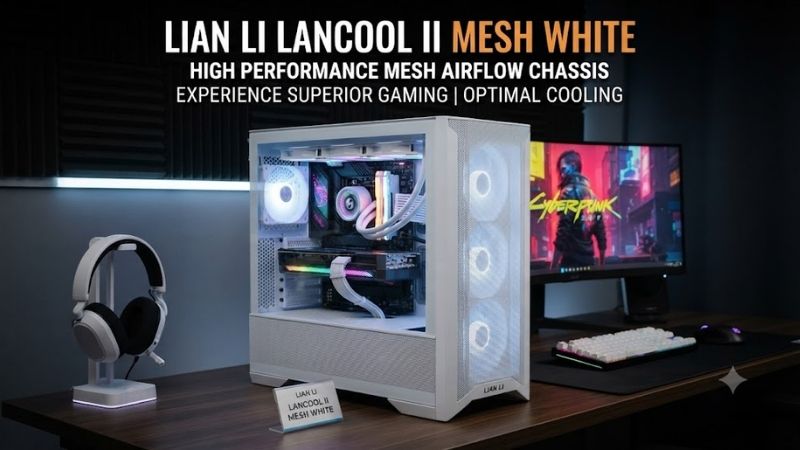
The Lian Li LANCOOL II Mesh White is an airflow-focused mid-tower built for gaming PCs that need strong cooling without giving up clean aesthetics. Its mesh front, three included ARGB fans, dual tempered-glass side panels, flexible radiator support, generous GPU clearance, and unusually practical cable-management system make it appealing for both beginners and experienced builders.
Quick answer: Our top pick in 2026 is the Specification — our #1 rated choice. See the full ranked comparison, alternatives and buying advice below.
Specifications
| Specification | Lian Li LANCOOL II Mesh RGB White |
|---|---|
| Case Type | Mid-Tower |
| Motherboard Support | E-ATX under 280 mm, ATX, Micro-ATX, Mini-ITX |
| Dimensions | 478 x 229 x 494 mm |
| Materials | Steel, dual 4 mm tempered glass |
| GPU Clearance | Up to 384 mm |
| CPU Cooler Clearance | Up to 176 mm |
| PSU Clearance | Up to 210 mm |
| Front Fan Support | 3 x 120 mm or 2 x 140 mm |
| Top Fan Support | 2 x 120/140 mm |
| Rear Fan Support | 1 x 120 mm |
| PSU Shroud Fan Support | 2 x 120 mm |
| Front Radiator Support | 360/280/240 mm |
| Top Radiator Support | 240 mm |
| Included Fans | 3 x 120 mm ARGB, 1300 RPM |
| Expansion Slots | 7 |
| Storage Support | Up to 9 drives |
| Front I/O | 2 x USB 3.0, USB-C, TRRS audio, lighting controls |
Lian Li lists the white LANCOOL II Mesh RGB as a 478 mm deep, 229 mm wide, and 494 mm tall chassis. It supports E-ATX boards under 280 mm wide as well as ATX, Micro-ATX, and Mini-ITX. GPU clearance reaches 384 mm, while tower CPU coolers can be up to 176 mm tall.
Performance
Airflow is the main reason to choose the LANCOOL II Mesh over the original LANCOOL II. The entire front section is designed around unrestricted intake, while additional ventilation around the lower shroud helps feed air toward the graphics card. That layout is especially useful for modern gaming systems where GPU temperatures often matter as much as CPU cooling.
The white RGB model includes three 120 mm ARGB intake fans mounted at the front. Lian Li rates them at 1300 RPM, with listed airflow of 49.14 CFM and noise at 25 dB(A). They provide usable cooling immediately, so a new builder does not need to purchase a complete fan set before assembling the system.
With three intake fans already installed, the most obvious upgrade is adding a rear exhaust fan. A second exhaust at the top can also help remove warm air from around the CPU socket and VRM area. This creates a balanced airflow path without requiring an expensive collection of premium fans on day one.
The front panel supports either three 120 mm fans or two 140 mm fans, while the top accepts two 120 or 140 mm fans. There is also space for one rear 120 mm fan and two 120 mm fans above the PSU chamber. This gives builders several ways to target airflow toward the CPU or graphics card.
Liquid-cooling support is equally flexible. Lian Li officially supports 360 mm, 280 mm, and 240 mm radiators at the front, while the top can hold a 240 mm radiator. This makes the case suitable for mainstream AIO configurations without forcing users into an oversized full-tower chassis.
A front-mounted 360 mm AIO is the strongest cooling configuration for high-power CPUs, but builders should still account for radiator and fan thickness when selecting a long GPU. The chassis allows up to 384 mm of graphics-card length under ideal conditions, but large front cooling hardware can reduce practical clearance.
Build Quality and Design
The LANCOOL II Mesh uses a steel chassis with 4 mm tempered-glass panels on both sides. That dual-glass arrangement is unusual because the right side of most cases is simply steel. Lian Li combines the glass with internal cable-management covers, allowing the builder to hide wiring without ruining the appearance of the opposite side.
The hinged side panels are one of the case’s strongest quality-of-life features. Instead of removing screws each time you need access, the glass panels swing open. Lower shroud panels also flip downward, giving quick access to the power supply and drive area while keeping the system visually clean when closed.
This design makes repeated upgrades much easier. Swapping storage, rerouting cables, replacing fans, or checking power connections requires less disassembly than in cases with conventional side panels. Builders who regularly change hardware will appreciate that convenience more than someone who assembles a PC once and never opens it again.
The white finish also works particularly well with RGB components. The bright interior reflects light more noticeably than a black chassis, making the included ARGB fans appear more prominent. Users who plan a white motherboard, GPU, cables, or cooling system can create a visually consistent build without relying heavily on extra lighting.
Cable Management
Cable management is one of the best parts of the LANCOOL II Mesh. Lian Li uses removable cover plates behind the motherboard tray, allowing cables to be routed underneath while keeping the glass side visually clean. A removable two-way cable-management bar can also be repositioned depending on motherboard size and cable routing.
This system is particularly helpful for first-time builders because the rear chamber does not need to look perfectly organized. As long as cables sit within the available depth and the covers can close properly, much of the wiring disappears behind panels. That creates a polished result without requiring custom-length cables.
The hinged lower shroud panels also improve access to the PSU wiring. Builders can connect SATA power, PCIe cables, or fan hubs without removing the entire rear side of the case. When the build is finished, the panels close over the lower compartment and separate the visible system from the power and storage area.
GPU and Component Clearance
GPU clearance of up to 384 mm gives the LANCOOL II Mesh enough room for many large graphics cards. That is important for high-end gaming builds, where triple-fan cards can be both long and thick. The case also provides seven expansion slots, which is standard for a full-size ATX mid-tower.
Users planning a vertical GPU can use Lian Li’s optional vertical GPU kit. However, the original accessory uses a PCIe 3.0 riser cable, and Lian Li notes that systems using a PCIe 4.0 motherboard and GPU may need the motherboard slot manually configured to Gen 3 for compatibility with that riser.
That limitation does not affect normal horizontal GPU installation, which is the better option for most users anyway. Horizontal mounting preserves straightforward compatibility and avoids putting the graphics card too close to the tempered glass, where airflow around thick modern coolers can sometimes become more restricted.
CPU cooler clearance reaches 176 mm, making the case compatible with many large tower coolers. This gives builders freedom to choose between high-end air cooling and liquid cooling rather than being forced toward a low-profile solution. The PSU area supports units up to 210 mm long.
Storage Support
Storage flexibility is another strong point. Lian Li lists support for up to nine drives through several mounting locations. The modular hard-drive cage holds three 3.5-inch HDDs or 2.5-inch SSDs, while additional 2.5-inch drives can be mounted behind the motherboard tray, behind the right flip panel, and above the PSU chamber.
That capacity is more than most modern gaming PCs need, since M.2 SSDs have reduced reliance on SATA drives. However, the extra mounts are valuable for users with large media libraries, recorded gameplay, older HDD archives, or several SATA SSDs carried over from previous systems.
The modular layout also allows builders to remove unnecessary storage hardware when it is not needed. Reducing clutter inside the lower chamber improves cable-management space and can simplify airflow. This flexibility makes the case equally usable for minimalist NVMe-only systems and larger storage-heavy workstations.
Front I/O and RGB Controls
The front I/O includes two USB 3.0 ports, a combined TRRS audio jack, lighting-mode controls, and USB-C support on the RGB model. The lighting buttons allow users to adjust the included fan colors and effects without opening software, while motherboard synchronization is available through the appropriate ARGB connection.
Lian Li states that the front ARGB control can synchronize with the motherboard by cycling the M button to the appropriate mode. The company also notes that the front ARGB header supports additional lighting within its stated LED limit, which gives builders some room to integrate compatible lighting hardware.
The physical controls are useful for users who do not want another background RGB application running in Windows. Motherboard synchronization remains available for more coordinated setups, but the case can still deliver lighting effects independently for simpler builds.
Noise Levels
Mesh cases prioritize airflow, which usually means they block less noise than sealed cases. The LANCOOL II Mesh follows that pattern. Its open front allows fan and GPU noise to escape more easily, but the improved airflow can also reduce the need for cooling components to run at maximum speed.
The included front fans are rated at 1300 RPM, which is moderate rather than extreme. Noise can be reduced further through motherboard fan curves if the fans are connected to controllable headers. Users aiming for a very quiet system should focus on efficient components and thoughtful fan tuning rather than expecting the chassis itself to isolate sound.
Dust Management
Lian Li includes a magnetic filter at the top and a removable tray filter at the bottom. The front itself relies heavily on its mesh design rather than a dense secondary filter. That helps airflow, but users in dusty rooms may need to clean the interior more regularly than with a heavily filtered closed-front case.
Positive pressure can help reduce dust entering through uncontrolled gaps. Running the three front fans as intake while using one or two exhaust fans creates a sensible starting configuration. Cleaning the front mesh and bottom filter periodically will keep airflow from degrading over time.
Pros and Cons
Pros
- Excellent front airflow
- Three included 120 mm ARGB fans
- Up to 384 mm GPU clearance
- 176 mm CPU cooler clearance
- 360 mm front radiator support
- Dual tempered-glass panels
- Hinged side panels
- Strong cable-management covers
- Up to nine drive positions
- E-ATX motherboard support
- Attractive white finish
- Flexible fan placement
- Optional vertical GPU support
Cons
- Mesh design provides limited noise isolation
- No rear exhaust fan included on RGB version
- Dual glass adds weight
- Older optional vertical riser is PCIe 3.0
- Top radiator support is limited to 240 mm
- Dust can enter more easily through open mesh
- Large drive capacity may be unnecessary for modern builds
Who Should Buy the LANCOOL II Mesh White?
This case is especially well suited to gamers building high-performance air-cooled systems. Three front intake fans, large GPU clearance, strong CPU cooler support, and open mesh ventilation provide a good foundation for hardware that produces substantial heat, including modern gaming GPUs and high-core-count processors.
It is also a strong choice for first-time builders. The hinged panels, cable-management covers, accessible PSU area, and flexible storage mounts reduce many of the frustrations associated with assembling a PC. You can achieve a clean-looking build without needing extensive experience with cable routing.
Users creating a white gaming PC should also consider it because the chassis provides a strong visual base for matching components. White GPUs, AIO coolers, memory, sleeved cables, and ARGB fans can all stand out clearly through the tempered-glass panel without the case itself dominating the build.
Who Should Skip It?
Users who prioritize extremely low noise may prefer a case designed around sound-dampening materials and more closed panels. The LANCOOL II Mesh intentionally leaves its intake path open, which benefits thermal performance but allows more fan and coil noise to reach the room.
It is also less compelling for builders who want the newest front-panel connectivity, extremely compact dimensions, or support for very large top-mounted radiators. Newer chassis designs may offer USB-C layouts, improved support for 360 mm top radiators, and internal dimensions optimized around the latest oversized graphics cards.
FAQ
Is the Lian Li LANCOOL II Mesh White Good for Airflow?
Yes. The case uses a full mesh front, additional lower ventilation, and three included 120 mm intake fans. Lian Li specifically designed the Mesh version to improve airflow compared with the original LANCOOL II, making it a strong choice for gaming systems with heat-producing CPUs and graphics cards.
Does the LANCOOL II Mesh Support a 360 mm Radiator?
Yes. Lian Li supports 360 mm, 280 mm, and 240 mm radiators at the front. The top supports up to a 240 mm radiator. Builders using a thick front radiator should check GPU clearance carefully because radiator and fan thickness can reduce the usable space for long graphics cards.
How Many Fans Come With the White RGB Version?
The LANCOOL II Mesh RGB White includes three 120 mm 3-pin ARGB fans mounted at the front. Lian Li lists them at 1300 RPM with rated airflow of 49.14 CFM per fan. A rear exhaust fan is not included in this configuration, so adding one is a sensible upgrade.
Can the LANCOOL II Mesh Fit Large GPUs?
Yes. Official GPU clearance reaches up to 384 mm under the standard configuration. That is enough for many large triple-fan cards. However, users installing a thick radiator and fans at the front should subtract that hardware depth when checking whether an especially long GPU will still fit comfortably.
Is the LANCOOL II Mesh Good for Beginners?
Yes. Hinged glass panels, flip-down PSU shrouds, removable cable covers, generous component clearance, and preinstalled fans make the build process easier. The case gives new builders enough room to work while hiding imperfect cable routing more effectively than many simpler budget chassis.
Conclusion
The Lian Li LANCOOL II Mesh White remains a strong airflow-focused case for builders who want cooling performance, generous clearance, clean cable management, and an attractive white design. Its three ARGB fans, mesh intake, hinged panels, storage flexibility, and 384 mm GPU support make it especially suitable for gaming PCs, even if newer cases offer more modern connectivity.
Ready to decide? Our #1 pick for 2026 is the Specification.
Live price & availability on Amazon.