🛒 Best Price Today on Amazon
Prime members get fast, free shipping on everything above, plus member-only deals. New members get a 30-day free trial — cancel anytime.
A Black Friday 27 inch monitor deal can be a smart upgrade because this size works equally well for gaming, productivity, and mixed-use desks. Instead of buying whatever receives the largest discount, compare resolution, refresh rate, panel type, ports, adaptive sync, and GPU requirements before deciding which deal is genuinely valuable.
Quick answer: For most people in 2026, the best black friday 27 inch monitor is the Monitor — our #1 rated choice. See the full ranked comparison, alternatives and buying advice below.
Best Black Friday 27 Inch Monitors at a Glance
| Monitor | Best For | Resolution | Refresh Rate | Panel |
|---|---|---|---|---|
| ASUS ROG Swift OLED PG27AQDP | Competitive OLED gaming | 2560 × 1440 | 480Hz | WOLED |
| LG UltraGear 27GX790A-B | High-refresh gaming | 2560 × 1440 | 480Hz | OLED |
| Samsung Odyssey OLED G6 G60SD | Premium QHD gaming | 2560 × 1440 | 360Hz | OLED |
| Alienware AW2725Q | 4K gaming | 3840 × 2160 | 240Hz | QD-OLED |
| Gigabyte M27Q X | Gaming and productivity | 2560 × 1440 | 240Hz | SuperSpeed IPS |
| Gigabyte GS27Q X | Value high-refresh gaming | 2560 × 1440 | Up to 250Hz | SuperSpeed IPS |
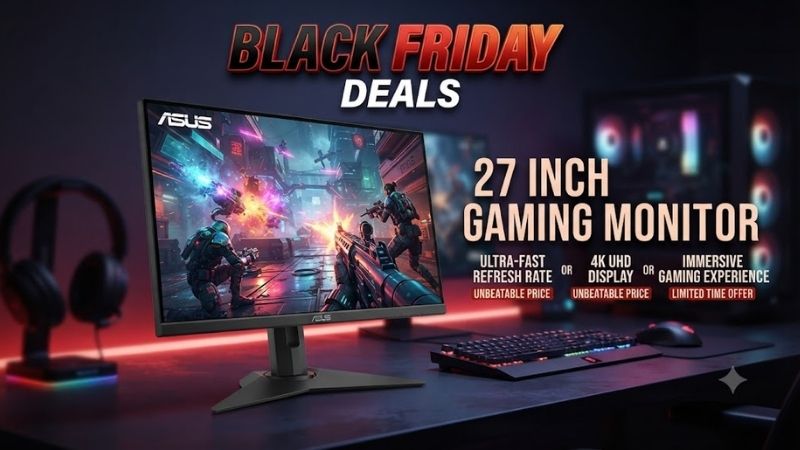
ASUS ROG Swift OLED PG27AQDP
Best For: Competitive gamers who want premium OLED speed
The ASUS ROG Swift OLED PG27AQDP is built around a 26.5-inch QHD WOLED panel with a native 480Hz refresh rate and a claimed 0.03ms gray-to-gray response time. That combination targets competitive players who want extremely fast motion clarity without giving up the deep blacks and near-instant pixel transitions associated with OLED.
At 2560 × 1440, the monitor is also easier to drive at very high frame rates than a 4K display. Competitive games such as Counter-Strike 2, Valorant, Overwatch 2, and Rainbow Six Siege can make better use of 480Hz when paired with a powerful CPU and GPU capable of producing hundreds of frames per second consistently.
The panel supports true 10-bit color and 99% DCI-P3 coverage, so the PG27AQDP is not limited to esports. Story-driven games benefit from OLED contrast, while creators working with wide-gamut content gain more color capability than a typical fast TN panel. VESA DisplayHDR True Black 400 adds further value for compatible HDR material.
ASUS also includes OLED-focused protections such as a custom heatsink and OLED Care features. These do not eliminate the possibility of image retention or burn-in, so users who display static desktop elements for many hours should still understand OLED behavior. Black Friday becomes attractive when the discount narrows the gap versus premium IPS alternatives.
Key Features
- 26.5-inch WOLED panel
- 2560 × 1440 resolution
- Native 480Hz refresh rate
- 0.03ms GTG response time
- 99% DCI-P3 coverage
- True 10-bit color
- G-SYNC Compatible
- DisplayHDR True Black 400
- OLED Care features
- Custom cooling solution
What Makes It Different
The defining feature is 480Hz OLED at QHD resolution. Traditional esports monitors often achieve extreme refresh rates by compromising contrast or image quality, while this model combines competitive speed with true OLED blacks. It makes the most sense when both responsiveness and premium image quality matter.
Pros
- Extremely high 480Hz refresh rate
- OLED pixel response
- Deep blacks
- Strong color coverage
- QHD suits high-frame-rate gaming
- Excellent competitive potential
Cons
- Expensive without a strong discount
- OLED requires sensible static-content use
- 480Hz demands a very fast gaming PC
Use Case: Competitive shooters, esports, fast multiplayer games, premium QHD gaming, and high-end gaming PCs.
Who It’s For: Players who can actually generate very high frame rates and want OLED image quality without sacrificing competitive motion performance.
LG UltraGear 27GX790A-B
Best For: High-refresh OLED gaming with DisplayPort 2.1
LG UltraGear 27GX790A-B is another 27-inch-class QHD OLED monitor capable of reaching 480Hz. It uses a 2560 × 1440 panel with a 0.03ms GTG response rating, giving competitive players an alternative to ASUS while maintaining the rapid pixel transitions that make OLED particularly effective during fast camera movement.
DisplayPort 2.1 support is one of the notable connectivity features. The monitor can handle its QHD 480Hz target through modern display connectivity, while HDMI is available for additional systems. Gamers building around current high-end GPUs may appreciate the newer interface when planning a monitor intended to remain in service for several hardware generations.
LG lists NVIDIA G-SYNC Compatible, VESA AdaptiveSync, and AMD FreeSync Premium Pro support. Variable refresh technology is useful when frame rates cannot remain fixed at the display maximum, preventing the purchase from becoming relevant only at 480 fps. AAA titles can still benefit even when they operate far below the headline refresh rate.
Its OLED panel also supports DisplayHDR True Black 400 and a wide DCI-P3 color gamut. This makes the display suitable for mixed gaming rather than only esports. Dark scenes gain much stronger black levels than conventional IPS panels, while fast competitive titles can exploit the exceptionally high refresh ceiling.
Key Features
- 26.5-inch OLED panel
- QHD 2560 × 1440 resolution
- 480Hz maximum refresh rate
- 0.03ms GTG response time
- DisplayPort 2.1
- G-SYNC Compatible
- VESA AdaptiveSync
- FreeSync Premium Pro
- DisplayHDR True Black 400
- Wide DCI-P3 coverage
What Makes It Different
The combination of QHD, 480Hz OLED, and DisplayPort 2.1 makes this model especially attractive to gamers building a modern high-end PC. It offers extreme refresh capability while retaining adaptive sync for demanding games where frame rates vary significantly below the monitor’s maximum.
Pros
- 480Hz OLED performance
- DisplayPort 2.1
- Strong adaptive-sync support
- Excellent contrast
- Fast pixel response
- Good fit for competitive and AAA gaming
Cons
- Requires powerful hardware for 480Hz gaming
- OLED ownership considerations remain
- Premium pricing makes deal quality important
Use Case: Esports, FPS gaming, fast action titles, premium gaming PCs, and users wanting modern display connectivity.
Who It’s For: Gamers considering a flagship QHD display and willing to wait for a meaningful Black Friday reduction instead of buying solely because of the OLED label.
Samsung Odyssey OLED G6 G60SD
Best For: Premium 360Hz QHD gaming
Samsung Odyssey OLED G6 G60SD offers a more achievable 360Hz refresh rate while keeping the benefits of OLED. Its 27-inch QHD panel runs at 2560 × 1440 with a 0.03ms GTG response rating, giving competitive players substantial refresh headroom without requiring the extreme frame rates associated with 480Hz alternatives.
The OLED panel provides extremely high contrast and supports HDR10+ Gaming. Dark game environments benefit from true pixel-level black control, while bright objects can stand out more clearly against dark backgrounds than on conventional IPS displays. This makes the G6 useful for horror, action, racing, and cinematic games alongside esports.
FreeSync Premium Pro support provides variable refresh functionality for compatible systems. The monitor also includes HDMI 2.1 and DisplayPort 1.4 connectivity, which improves flexibility when connecting gaming PCs or other compatible hardware. A USB hub gives users additional peripheral connectivity around the desk.
Samsung also incorporates OLED Safeguard+ features intended to help manage panel heat and reduce burn-in risk during normal use. OLED still deserves thoughtful treatment, particularly if the monitor spends most of the day displaying static productivity interfaces, but gaming-focused users may find the contrast advantage worth the trade-off.
Key Features
- 27-inch OLED display
- 2560 × 1440 resolution
- 360Hz refresh rate
- 0.03ms GTG response time
- HDR10+ Gaming
- FreeSync Premium Pro
- HDMI 2.1
- DisplayPort 1.4
- USB hub
- OLED protection features
What Makes It Different
The Odyssey OLED G6 sits between mainstream 240Hz displays and newer 480Hz flagships. A 360Hz ceiling remains extremely fast for competitive gaming while giving users OLED contrast and image quality. On Black Friday, this middle position could make it especially attractive when newer models push older premium OLED pricing downward.
Pros
- Fast 360Hz refresh rate
- Deep OLED contrast
- QHD resolution
- HDMI 2.1
- Excellent pixel response
- Strong gaming feature set
Cons
- Lower refresh rate than 480Hz flagships
- OLED burn-in considerations
- Premium value depends heavily on sale pricing
Use Case: Competitive gaming, AAA titles, mixed esports and single-player gaming, and high-end QHD PC setups.
Who It’s For: Gamers who want OLED and extreme speed but do not necessarily need to pay extra for a 480Hz panel.
Alienware AW2725Q
Best For: 4K gaming at 27 inches
Alienware AW2725Q targets a different type of buyer by combining a 27-inch-class 4K QD-OLED panel with a 240Hz refresh rate. The higher pixel density produces extremely sharp text and fine game detail at normal desktop viewing distances, making it appealing for users who divide their time between gaming and productivity.
Four-K gaming is much more demanding than QHD, particularly at high refresh rates. A powerful graphics card becomes important if the goal is to approach 240 fps in modern titles. Upscaling technologies can help in demanding games, while esports titles and older releases are more realistic candidates for exploiting the full refresh ceiling.
QD-OLED provides strong contrast and wide color performance alongside the resolution advantage. Compared with fast QHD displays, the main benefit is not competitive responsiveness but visual precision. Detailed environments, strategy interfaces, creative software, text, and high-resolution video all make stronger use of the dense 4K panel.
Black Friday is particularly relevant for this category because 4K OLED monitors command premium pricing. Buyers should compare the actual discounted price with high-refresh QHD OLED alternatives rather than assuming 4K is always the superior choice. GPU requirements and viewing distance determine whether the extra resolution delivers meaningful value.
Key Features
- 27-inch-class QD-OLED panel
- 3840 × 2160 resolution
- 240Hz refresh rate
- OLED-class pixel response
- High pixel density
- Adaptive-sync gaming support
- HDR capability
- Modern gaming connectivity
- Suitable for gaming and productivity
What Makes It Different
The AW2725Q prioritizes resolution rather than chasing 360Hz or 480Hz. At roughly 27 inches, 4K creates an exceptionally dense desktop image, making this monitor more attractive to gamers who also edit content, read text, code, or work on detailed applications throughout the day.
Pros
- Sharp 4K resolution
- 240Hz gaming
- QD-OLED contrast
- Excellent pixel density
- Strong mixed-use potential
- Premium image quality
Cons
- 4K demands significantly more GPU performance
- 240Hz is harder to reach in AAA games
- Premium pricing
- OLED considerations remain
Use Case: 4K gaming, content creation, mixed work and gaming, strategy games, RPGs, and powerful desktop PCs.
Who It’s For: Users who want one 27-inch display for both high-end gaming and detailed desktop work rather than prioritizing the highest possible competitive refresh rate.
Gigabyte M27Q X
Best For: High-refresh gaming without OLED pricing
Gigabyte M27Q X is a QHD SuperSpeed IPS monitor offering a 240Hz refresh rate and 1ms GTG response specification. It provides a useful alternative for buyers who want high-refresh gaming but prefer to avoid OLED pricing, burn-in concerns, or the need to treat static desktop content differently during long work sessions.
The 2560 × 1440 resolution suits a 27-inch screen particularly well because it offers noticeably more workspace and game detail than 1080p without creating the same GPU load as 4K. A 240Hz ceiling also remains fast enough for competitive gaming while being more realistic for a wider range of graphics cards.
One of its most practical features is the built-in KVM. Users can control multiple connected systems with the same keyboard and mouse, which is useful for a desk shared between a gaming PC and work laptop. USB Type-C connectivity adds further flexibility, although its power delivery is limited compared with docking-focused office displays.
The IPS panel cannot reproduce OLED black levels, but it avoids OLED’s static-image concerns and remains appropriate for long productivity sessions. For Black Friday shoppers wanting one monitor for eight-hour workdays followed by gaming, that durability profile may be more practical than chasing premium contrast.
Key Features
- 27-inch SuperSpeed IPS panel
- 2560 × 1440 resolution
- 240Hz refresh rate
- 1ms GTG response time
- DisplayHDR 400
- Wide color coverage
- Built-in KVM
- USB Type-C
- DisplayPort 1.4
- Adaptive-sync support
What Makes It Different
The KVM makes M27Q X much more than a basic gaming display. Users can build a combined work-and-gaming desk and switch peripherals between two systems without adding a separate KVM device. This versatility can matter more than OLED contrast for users who spend most of the day working at the same monitor.
Pros
- QHD 240Hz
- Built-in KVM
- No OLED burn-in concern
- Useful USB connectivity
- Good gaming and productivity balance
- Easier GPU requirements than 4K
Cons
- IPS contrast is limited
- HDR impact is modest compared with OLED
- Not as fast as newer 360Hz and 480Hz displays
Use Case: Gaming and work, dual-computer desks, esports, productivity, and users who want a reliable high-refresh IPS panel.
Who It’s For: Shoppers who want a practical 27-inch monitor that remains useful outside gaming and becomes especially attractive when Black Friday discounts push it below premium OLED models.
Gigabyte GS27Q X
Best For: Value-focused high-refresh QHD gaming
Gigabyte GS27Q X focuses on the essentials: a 27-inch QHD SuperSpeed IPS panel, 240Hz native refresh rate, and an overclock option reaching 250Hz. This combination gives competitive players high-refresh performance without adding expensive OLED technology or a large collection of premium connectivity features.
Its 2560 × 1440 resolution offers a sensible balance for midrange and upper-midrange gaming GPUs. Players can target high frame rates at QHD more realistically than at 4K, while desktop applications gain noticeably more usable space and sharper text than they would on a traditional 27-inch 1080p display.
Connectivity is simpler than on the M27Q X, with DisplayPort and HDMI handling the main video connections. That reduced feature set can become an advantage during Black Friday when the monitor receives a sufficiently aggressive discount. Buyers who do not need USB-C or KVM functionality avoid paying for features they would never use.
Key Features
- 27-inch SuperSpeed IPS panel
- 2560 × 1440 resolution
- 240Hz native refresh rate
- Up to 250Hz overclock
- 1ms MPRT rating
- Adaptive-sync support
- DisplayPort 1.4
- Dual HDMI connectivity
- Black Equalizer
- Gaming-focused OSD features
What Makes It Different
The GS27Q X concentrates on QHD and high refresh without turning the monitor into a premium docking display. This makes it potentially one of the more interesting Black Friday targets because a strong discount can deliver the core performance gamers need while avoiding the cost of features aimed at creators or multi-PC workstations.
Pros
- QHD resolution
- 240Hz to 250Hz refresh
- IPS panel
- Competitive-gaming focus
- Potentially strong sale value
- Lower GPU burden than 4K
Cons
- Basic connectivity
- HDR is not a major strength
- Lower contrast than OLED
- Fewer productivity extras than M27Q X
Use Case: FPS gaming, esports, midrange gaming PCs, competitive multiplayer, and budget-conscious high-refresh upgrades.
Who It’s For: Black Friday shoppers who want QHD and 240Hz-class performance while keeping the purchase focused on gaming essentials.
How to Choose a Black Friday 27 Inch Monitor
Decide Between QHD and 4K
QHD is the safest gaming choice at 27 inches because it combines good pixel density with manageable GPU requirements. Four-K looks sharper and provides more desktop space, but rendering 3840 × 2160 requires considerably more graphics power. Match the monitor to the GPU you actually use rather than the resolution with the largest discount.
Pick the Right Refresh Rate
A 144Hz to 180Hz monitor is enough for many gamers, while 240Hz suits competitive play and modern high-performance systems. Displays at 360Hz or 480Hz become worthwhile primarily when competitive titles regularly exceed 300 fps. Buying 480Hz for a system that produces 100 fps provides little immediate benefit.
OLED vs IPS
OLED delivers exceptional contrast, fast pixel transitions, and excellent dark-scene performance. IPS remains more straightforward for long productivity sessions involving static interfaces. If the monitor will display spreadsheets, browser windows, or editing software for most of the day, consider usage patterns before choosing OLED solely for gaming image quality.
Compare the Real Discount
Black Friday percentages can be misleading when retailers calculate savings from old list prices. Compare the sale price with recent normal pricing rather than trusting the discount badge. A monitor reduced by twenty percent from an inflated MSRP may be a weaker deal than another model discounted modestly from a genuinely competitive everyday price.
Match the Monitor to Your GPU
A high-refresh monitor is only useful when the gaming PC can generate enough frames. QHD 240Hz works particularly well with performance-oriented GPUs, while 4K 240Hz requires much more rendering power. Competitive games are easier to drive than demanding ray-traced AAA titles, so consider what you actually play.
Check Connectivity
DisplayPort remains important for high-refresh PC gaming, while HDMI 2.1 improves flexibility with modern consoles and high-bandwidth sources. USB-C and KVM features matter when the monitor also serves a work laptop. Do not pay more for docking features if the display will remain connected permanently to one desktop gaming PC.
FAQ
Is Black Friday a Good Time to Buy a 27-Inch Monitor?
Yes. Monitors are commonly discounted during major seasonal sales, particularly models that have newer replacements or compete in crowded categories. The best strategy is to shortlist several models in advance and compare their sale prices rather than deciding based only on whichever product receives the largest advertised discount.
Is 27-Inch 1440p Good for Gaming?
Yes. A 27-inch QHD monitor provides a strong balance between sharpness and performance. The resolution is significantly clearer than 1080p while requiring much less GPU power than 4K. It also pairs naturally with 165Hz, 240Hz, 360Hz, and even 480Hz refresh rates for different gaming priorities.
Is 4K Worth It at 27 Inches?
Four-K produces very sharp text and fine image detail at 27 inches, making it excellent for mixed productivity and gaming. Whether it is worthwhile depends on viewing distance and GPU power. Gamers prioritizing very high frame rates may receive more practical value from QHD, especially in competitive titles.
Should I Buy OLED on Black Friday?
OLED becomes particularly attractive when a meaningful discount reduces the premium over high-end IPS monitors. Its contrast and response times are excellent for gaming, but buyers should consider static desktop usage and manufacturer coverage. A discounted OLED is not automatically the best choice for every work-and-gaming setup.
Is 240Hz Enough for Competitive Gaming?
Yes. A 240Hz monitor already delivers very smooth motion and low frame persistence when paired with a PC producing high frame rates. Moving to 360Hz or 480Hz can provide further improvement, but the difference becomes progressively smaller and requires substantially higher system performance to exploit properly.
Conclusion
The best Black Friday 27 inch monitor depends on whether you prioritize OLED contrast, 4K detail, competitive refresh rate, or everyday value. PG27AQDP and LG 27GX790A target 480Hz gaming, Samsung G6 balances 360Hz OLED, Alienware favors 4K, while Gigabyte M27Q X and GS27Q X offer practical IPS alternatives.
Ready to decide? Our #1 pick for 2026 is the Monitor.
Live price & availability on Amazon.