Table of Contents
- 0.1 🛒 Best Price Today on Amazon
- 1 Best Monitors for Video Production and Unity Development
- 2 ASUS ProArt Display PA32UCXR — Best for HDR Production
- 2.1 Best For
- 2.2 Key Features
- 2.3 Pros
- 2.4 Cons
- 2.5 Use Case
- 3 Apple Studio Display XDR — Best for Mac HDR Workflows
- 3.1 Best For
- 3.2 Key Features
- 3.3 Pros
- 3.4 Cons
- 3.5 Who It’s For
- 4 BenQ PD3225U — Best for Color-Managed Unity Work
- 4.1 Best For
- 4.2 Key Features
- 4.3 Pros
- 4.4 Cons
- 4.5 Use Case
- 5 Dell UltraSharp U3225QE — Best Hybrid Unity Workstation
- 5.1 Best For
- 5.2 Key Features
- 5.3 Pros
- 5.4 Cons
- 5.5 Who It’s For
- 6 Apple Studio Display — Best for Mac Editing and Coding
- 6.1 Best For
- 6.2 Key Features
- 6.3 Pros
- 6.4 Cons
- 6.5 Use Case
- 7 How to Choose the Best Monitor for Video Production
- 7.1 Prioritize the Color Spaces You Actually Deliver
- 7.2 Choose 4K or 5K Based on Workspace Needs
- 7.3 Treat HDR Capability as More Than a Specification Badge
- 7.4 Match Connectivity to Your Development Machine
- 8 Is 60Hz or 120Hz Better for Unity Development?
- 9 27-Inch vs 32-Inch for Video Production
- 10 FAQ
- 10.1 Is a 32-inch 4K monitor good for video production?
- 10.2 Do Unity developers need a 120Hz monitor?
- 10.3 Is OLED better than Mini-LED for video production?
- 10.4 What monitor specifications matter most for Unity developers?
- 11 Conclusion
🛒 Best Price Today on Amazon
Prime members get fast, free shipping on everything above, plus member-only deals. New members get a 30-day free trial — cancel anytime.
- Best Monitors for Video Production and Unity Development
- ASUS ProArt Display PA32UCXR — Best for HDR Production
- Apple Studio Display XDR — Best for Mac HDR Workflows
- BenQ PD3225U — Best for Color-Managed Unity Work
- Dell UltraSharp U3225QE — Best Hybrid Unity Workstation
- Apple Studio Display — Best for Mac Editing and Coding
- How to Choose the Best Monitor for Video Production
- Is 60Hz or 120Hz Better for Unity Development?
- 27-Inch vs 32-Inch for Video Production
- FAQ
- Conclusion
Choosing the best monitor for video production means balancing color accuracy, resolution, HDR capability, connectivity, and workspace needs. Unity developers also benefit from sharp text, reliable color, and enough screen space for Scene, Game, Inspector, timeline, and profiling panels without constant window switching.
Quick answer: For most people in 2026, the best monitor for video production is the ASUS ProArt Display PA32UCXR — our #1 rated choice. See the full ranked comparison, alternatives and buying advice below.
Best Monitors for Video Production and Unity Development
| Monitor | Resolution | Refresh Rate | Color / HDR Highlight | Best For |
|---|---|---|---|---|
| ASUS ProArt Display PA32UCXR | 3840×2160 | 60Hz | 97% DCI-P3, Mini-LED, Dolby Vision | HDR video production |
| Apple Studio Display XDR | 5120×2880 | 120Hz | Mini-LED, P3 + Adobe RGB | Mac HDR production |
| BenQ PD3225U | 3840×2160 | 60Hz | 98% P3, Rec.709 modes | Editing and Unity art |
| Dell UltraSharp U3225QE | 3840×2160 | 120Hz | 99% DCI-P3, IPS Black | Hybrid Unity workstation |
| Apple Studio Display | 5120×2880 | 60Hz | P3, 600 nits | Mac editing and coding |
ASUS ProArt Display PA32UCXR — Best for HDR Production
For mixed video production and Unity development, the ASUS ProArt Display PA32UCXR is the strongest fit here. Its 32-inch 4K IPS panel uses Mini-LED backlighting, reaches up to 1,600 nits peak HDR brightness, and covers 97% DCI-P3. Dolby Vision, HDR10, and HLG support also suit HDR grading workflows.

ASUS ProArt Display 27" 4K OLED USB-C Professional Monitor (PA279CDV) – QD-OLED, 120Hz, HDR10, 99% DCI-P3, ΔE < 1.5, Calman Verified, USB-C (96W PD), AutoKVM, Ergonomic Stand, Mac, 3yr Warranty
Included for 'Best Monitor for Video Production: Unity Developer Picks' because the listing specifies QD-OLED and 120Hz, details this guide uses to compare options.
View on Amazon →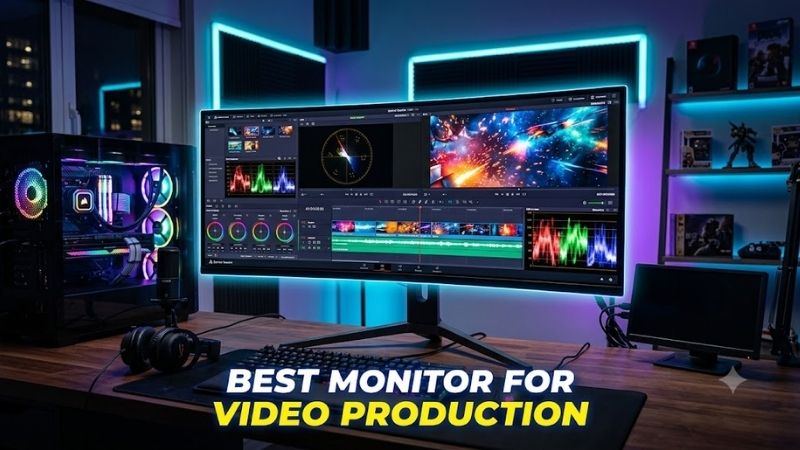
Best For
Professional video editors, colorists, VFX artists, cinematic Unity developers, and creators working with HDR footage.
Key Features
- 32-inch 3840×2160 IPS display
- Mini-LED backlighting
- Up to 1,600 nits peak HDR brightness
- 97% DCI-P3
- 99% Adobe RGB
- 100% sRGB
- 10-bit color
- Dolby Vision, HDR10, and HLG
- 60Hz refresh rate
The PA32UCXR stands apart because it targets serious color-managed production rather than general office use. ASUS lists 99% Adobe RGB, 100% sRGB, 10-bit color, and a 60Hz refresh rate. That combination favors editing, compositing, look development, and Unity lighting work over high-refresh competitive gaming.
Pros
- High peak brightness for HDR workflows
- Broad Adobe RGB and DCI-P3 coverage
- Multiple HDR formats
- Large 32-inch 4K workspace
- Well suited to color-sensitive production
Cons
- Limited to 60Hz
- More specialized than a general productivity monitor
- High-end features may be unnecessary for SDR-only workflows
Use Case
Choose the PA32UCXR when Unity is part of a broader professional content pipeline involving DaVinci Resolve, Premiere Pro, After Effects, Blender, Unreal Engine, or other applications where HDR previews and dependable wide-gamut color matter.
Apple Studio Display XDR — Best for Mac HDR Workflows
Apple’s Studio Display XDR is especially relevant to Mac-based editors and Unity creators who want a dense 27-inch 5K workspace. Apple specifies 5120×2880 resolution, Mini-LED backlighting with 2,304 dimming zones, up to 2,000 nits peak HDR brightness, 120Hz refresh, and P3 plus Adobe RGB wide-gamut support.
Best For
Mac-based video editors, motion designers, Unity developers, photographers, and creators handling HDR material.
Key Features
- 27-inch 5120×2880 Retina XDR display
- Mini-LED backlight
- 2,304 dimming zones
- Up to 2,000 nits HDR peak brightness
- Up to 1,000 nits SDR brightness
- 120Hz refresh rate
- Adaptive Sync
- P3 and Adobe RGB wide color gamuts
Its reference modes cover HDR video, HDTV, digital cinema, photography, sRGB, and Adobe RGB workflows, which helps when one display must move between editing and game-content tasks. The main trade-off is platform fit: the experience is strongest inside Apple’s current Mac ecosystem rather than a mixed Windows workstation.
Pros
- 5K resolution gives Unity and editing apps substantial desktop detail
- 120Hz improves motion and interface responsiveness
- Strong HDR brightness
- Wide selection of production reference modes
- Designed around current Mac workflows
Cons
- Less attractive for Windows-first workstations
- 27 inches provides less physical workspace than a 32-inch display
- Advanced HDR capability may be excessive for web-only SDR production
Who It’s For
Studio Display XDR makes the most sense for developers producing cinematics, promotional videos, HDR assets, and Unity projects on recent Macs, especially when the same workstation is also used for Final Cut Pro, Resolve, photography, or design.
BenQ PD3225U — Best for Color-Managed Unity Work
BenQ’s PD3225U is a practical 32-inch 4K option for creators who value color modes and straightforward desktop connectivity. It uses an IPS panel with a 2000:1 native contrast ratio, 400-nit brightness, 60Hz refresh, and coverage rated at 100% sRGB, 100% Rec.709, and 98% P3 by BenQ for color-managed work.
Best For
Unity developers, video editors, animators, designers, and creators producing primarily SDR or moderately demanding HDR content.
Key Features
- 31.5-inch 4K IPS panel
- 3840×2160 resolution
- 2000:1 native contrast ratio
- 100% sRGB
- 100% Rec.709
- 98% P3
- 400-nit brightness
- 60Hz refresh rate
- Multiple creator-focused color modes
Its strength is workflow flexibility rather than extreme HDR output. BenQ includes DCI-P3, Display P3, Rec.709, sRGB, HDR, CAD/CAM, Animation, and Darkroom modes, so editors and Unity developers can switch viewing conditions without rebuilding the workspace. The 60Hz ceiling is the main limit for motion-sensitive playtesting.
Pros
- Useful selection of creator color modes
- Strong Rec.709 and P3 coverage
- 32-inch 4K workspace
- Suitable for animation and game-asset workflows
- Higher native contrast than standard IPS displays
Cons
- 60Hz is less fluid for frequent game testing
- 400-nit HDR output is modest beside Mini-LED alternatives
- HDR capability is secondary to its SDR creator features
Use Case
The PD3225U works especially well when Unity development overlaps with animation, texture creation, editing, UI design, and Rec.709 delivery. It offers enough space to keep Unity panels visible while reserving substantial screen area for Premiere Pro, Resolve, Photoshop, or Blender.
Dell UltraSharp U3225QE — Best Hybrid Unity Workstation
Dell’s UltraSharp U3225QE is the best fit for a hybrid editing, Unity, and productivity desk. The 31.5-inch 4K IPS Black panel runs at 120Hz, covers 99% DCI-P3 and Display P3, and includes Thunderbolt 4 with up to 140W power delivery, DisplayPort, HDMI, USB, and 2.5GbE networking for a one-cable laptop setup.
Best For
Unity developers who also edit video, use a laptop workstation, switch between several computers, or want one monitor to function as a connectivity hub.
Key Features
- 31.5-inch 3840×2160 display
- IPS Black panel
- 120Hz refresh rate
- 3000:1 rated contrast ratio
- 99% DCI-P3
- 99% Display P3
- 100% sRGB and BT.709
- Thunderbolt 4
- Up to 140W USB-C power delivery
- Integrated USB and 2.5GbE connectivity
The higher refresh rate makes cursor movement, timeline scrubbing, scene navigation, and Unity play mode feel smoother than on 60Hz creator displays. Its 3000:1 rated contrast also improves dark-interface separation, while the built-in hub can simplify a laptop workstation. It is less specialized for high-end HDR mastering.
Pros
- 120Hz is useful for Unity playtesting
- Broad P3 and Rec.709 coverage
- Excellent laptop connectivity
- 140W charging suits powerful mobile workstations
- 32-inch 4K panel supports dense editing layouts
Cons
- Not designed primarily as an HDR mastering display
- 4K offers lower pixel density than 27-inch 5K screens
- Extensive docking features may be unnecessary on desktop-only systems
Who It’s For
The U3225QE suits developers who divide the day between Unity, programming, Premiere Pro, Resolve, web tools, and general productivity. The 120Hz panel makes it particularly attractive when a development monitor must also handle regular PC gaming and real-time project previews.
Apple Studio Display — Best for Mac Editing and Coding
Apple Studio Display is the simpler Mac-first choice for SDR production, coding, and Unity interface work. The 27-inch 5K Retina panel runs at 5120×2880 and 60Hz, reaches 600 nits, supports P3 wide color, and offers reference modes for HDTV, digital cinema, photography, and sRGB workflows used in content creation.
Best For
Unity developers, editors, designers, and programmers working primarily on recent Apple silicon Macs.
Key Features
- 27-inch 5120×2880 Retina display
- 218 pixels per inch
- 600-nit brightness
- 60Hz refresh rate
- P3 wide color
- Production reference modes
- Thunderbolt 5
- 96W host charging
- Integrated camera, microphones, and speakers
Its biggest advantage is pixel density: 218 pixels per inch keeps text, UI controls, and preview windows exceptionally crisp at typical desktop distances. Current models also provide Thunderbolt 5 connectivity and 96W host charging. The trade-off is limited HDR capability compared with Mini-LED or OLED production displays.
Pros
- Very sharp text and interface rendering
- 5K resolution supports dense creative layouts
- Strong integration with recent Macs
- Reference modes cover common SDR production standards
- Integrated audio and camera reduce desk clutter
Cons
- 60Hz refresh rate
- Less appropriate for demanding HDR mastering
- Windows compatibility is less straightforward than standard PC monitors
Use Case
Studio Display is ideal when much of the Unity workflow involves C# editing, UI design, Scene setup, 2D content, and SDR video. Its dense 5K resolution also works well for Final Cut Pro, Premiere Pro, Photoshop, and other applications where sharp interface elements matter more than extreme HDR brightness.
How to Choose the Best Monitor for Video Production
Prioritize the Color Spaces You Actually Deliver
For video production, color space matters more than headline resolution alone. Rec.709 remains central to SDR video, while DCI-P3 and Display P3 are useful for cinema and wide-gamut work. Unity creators also benefit because accurate color helps lighting, texture, UI, and post-processing decisions remain consistent across displays.
Choose 4K or 5K Based on Workspace Needs
Choose 4K when you want a large editing canvas without an extreme GPU load; choose 5K when text density and fine UI detail matter more. A 32-inch 4K screen offers comfortable panel space for Premiere Pro, DaVinci Resolve, After Effects, or Unity, while 27-inch 5K displays prioritize very sharp desktop scaling.
Treat HDR Capability as More Than a Specification Badge
HDR work needs more than an HDR badge. Peak brightness, black control, local dimming, supported transfer functions, and usable reference modes determine how well a monitor handles HDR material. Mini-LED and OLED designs generally give creators more meaningful highlight and shadow control than basic edge-lit LCD panels.
Match Connectivity to Your Development Machine
Connectivity should match the workstation, not just the monitor. Thunderbolt or USB-C can carry video, data, and laptop charging through one cable, while HDMI and DisplayPort remain important for desktops, capture hardware, and consoles. Unity developers using multiple machines should also value KVM or hub functions.
Is 60Hz or 120Hz Better for Unity Development?
A 60Hz monitor remains perfectly workable for coding, editing, grading, and asset creation. Moving to 120Hz mainly improves interaction: panning a Unity scene, scrolling scripts, moving timeline playheads, and previewing higher-frame-rate gameplay all appear smoother, making 120Hz worthwhile for development combined with regular gaming.
27-Inch vs 32-Inch for Video Production
A 27-inch 5K monitor favors high pixel density, while a 32-inch 4K monitor favors physical workspace. Editors who sit close and spend hours reading code may appreciate sharper 5K text. Developers who keep Inspector, Console, Project, Game, and Scene windows visible simultaneously may find a 32-inch canvas easier to organize.
FAQ
Is a 32-inch 4K monitor good for video production?
Yes. A 32-inch 4K monitor is a strong size for video production because it provides enough room for timelines, scopes, bins, and preview windows while keeping text readable at normal desk distances. It also gives Unity developers space for the Scene, Game, Inspector, Console, and Project panels on one screen.
Do Unity developers need a 120Hz monitor?
Not necessarily. A 60Hz display is sufficient for editing and color work, but 120Hz makes interface motion, scrolling, timeline navigation, and Unity playtesting feel smoother. Higher refresh is most useful when the same monitor handles game development and gaming, not because it improves color accuracy.
Is OLED better than Mini-LED for video production?
OLED is useful when deep blacks and per-pixel light control matter, especially for contrast-sensitive grading. Mini-LED can reach higher brightness and is often better suited to sustained HDR highlights. Neither panel type is automatically superior; workflow, room lighting, calibration, and burn-in tolerance all matter.
What monitor specifications matter most for Unity developers?
For Unity development, prioritize resolution, pixel density, accurate color, screen size, and refresh rate. A wide-gamut display helps with art and lighting, while 4K or 5K gives more room for editor panels. Developers who frequently playtest fast scenes may prefer 120Hz, while code-heavy work benefits most from sharp text.
Conclusion
The best monitor for video production depends on whether your priority is HDR mastering, Mac integration, color-managed editing, or a mixed Unity workstation. ASUS and Apple target demanding HDR work, BenQ emphasizes creator modes, Dell balances 120Hz with a powerful hub, and Studio Display favors crisp Mac workflows.
Ready to decide? Our #1 pick for 2026 is the ASUS ProArt Display PA32UCXR.
Live price & availability on Amazon.