Table of Contents
- 0.1 🛒 Best Price Today on Amazon
- 1 Best Monitors for RTX 5080 at a Glance
- 2 MSI MPG 322URX QD-OLED — Best Overall
- 3 ASUS ROG Swift OLED PG32UCDP — Best Dual-Mode
- 4 Samsung Odyssey OLED G8 G81SF — Best for Glare Control
- 5 Alienware AW3225QF — Best Curved 4K Monitor
- 6 ASUS ROG Swift OLED PG27AQDP — Best for Esports
- 7 How to Choose the Best Monitor for RTX 5080
- 7.1 Choose 4K 240Hz for the Best Balance
- 7.2 DisplayPort 2.1 Is Useful, but Not Mandatory
- 7.3 OLED Makes Sense for a High-End RTX Build
- 7.4 Match Screen Size to Resolution
- 7.5 Prioritize Variable Refresh Rate Support
- 8 4K 240Hz vs 1440p 480Hz for RTX 5080
- 9 FAQ
- 9.1 Is a 4K 240Hz monitor worth it for the RTX 5080?
- 9.2 Does an RTX 5080 monitor need DisplayPort 2.1?
- 9.3 Should I choose 4K 240Hz or 1440p 480Hz?
- 9.4 Is OLED good for an RTX 5080 gaming PC?
- 9.5 Is 27 inches or 32 inches better for the RTX 5080?
- 10 Conclusion
🛒 Best Price Today on Amazon
Prime members get fast, free shipping on everything above, plus member-only deals. New members get a 30-day free trial — cancel anytime.
- Best Monitors for RTX 5080 at a Glance
- MSI MPG 322URX QD-OLED — Best Overall
- ASUS ROG Swift OLED PG32UCDP — Best Dual-Mode
- Samsung Odyssey OLED G8 G81SF — Best for Glare Control
- Alienware AW3225QF — Best Curved 4K Monitor
- ASUS ROG Swift OLED PG27AQDP — Best for Esports
- How to Choose the Best Monitor for RTX 5080
- 4K 240Hz vs 1440p 480Hz for RTX 5080
- FAQ
- Conclusion
The best monitor for RTX 5080 should match the GPU’s strength at 4K, high refresh rates, and VRR rather than waste performance on a low-ceiling display. For most buyers, a 32-inch 4K OLED at 240Hz is the sweet spot, while 480Hz QHD or dual-mode OLED makes more sense for competitive play and esports.
Quick answer: For most people in 2026, the best monitor for rtx 5080 is the MSI MPG 322URX QD-OLED — our #1 rated choice. See the full ranked comparison, alternatives and buying advice below.
Best Monitors for RTX 5080 at a Glance
| Monitor | Best For | Resolution | Maximum Refresh Rate | Panel |
|---|---|---|---|---|
| MSI MPG 322URX QD-OLED | Best overall | 3840×2160 | 240Hz | QD-OLED |
| ASUS ROG Swift OLED PG32UCDP | Best dual-mode | 3840×2160 / 1920×1080 | 240Hz / 480Hz | WOLED |
| Samsung Odyssey OLED G8 G81SF | Best for glare control | 3840×2160 | 240Hz | QD-OLED |
| Alienware AW3225QF | Best curved 4K | 3840×2160 | 240Hz | QD-OLED |
| ASUS ROG Swift OLED PG27AQDP | Best for esports | 2560×1440 | 480Hz | WOLED |
NVIDIA lists the RTX 5080 with DisplayPort 2.1b and HDMI 2.1b, plus support for up to 4K at 480Hz or 8K at 165Hz with DSC. That makes premium 4K 240Hz OLED monitors especially well matched, while ultra-high-refresh QHD models can better serve esports players chasing lower latency and higher frame rates.

ASUS TUF Gaming VG27UQEL5A 27 Inch 4K 80Hz,1080P, 310Hz, Gaming Monitor
Included for 'Best Monitor for RTX 5080: 5 Displays for Serious Gaming' because the listing specifies 1080P and 310Hz, details this guide uses to compare options.
View on Amazon →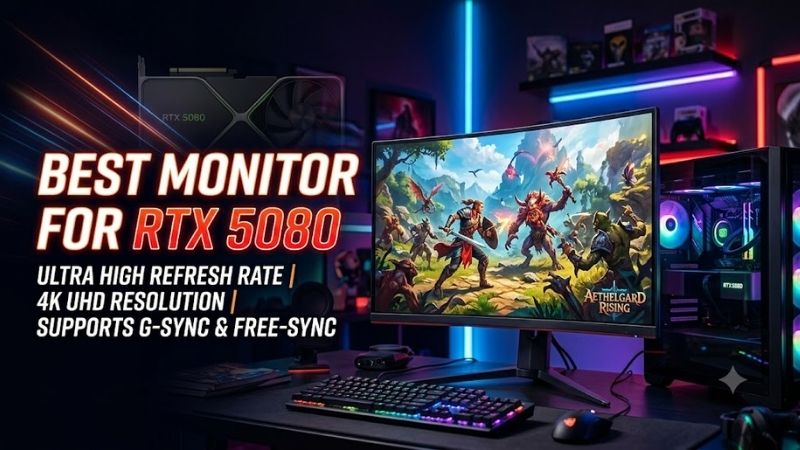
MSI MPG 322URX QD-OLED — Best Overall
Best For: High-end 4K gaming with DisplayPort 2.1
Key Features:
- 31.5-inch QD-OLED
- 3840×2160 resolution
- 240Hz refresh rate
- 0.03ms GTG response time
- DisplayPort 2.1a UHBR20
- Two HDMI 2.1 ports
- USB-C with 98W power delivery
- G-SYNC Compatible
- KVM support
- VESA DisplayHDR True Black 400
- Three-year warranty including panel burn-in coverage
What Makes It Different
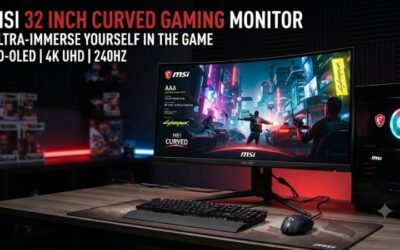
The MSI MPG 322URX QD-OLED is the strongest all-around pairing for an RTX 5080 because it combines a 31.5-inch 4K QD-OLED panel, 240Hz refresh rate, and DisplayPort 2.1a UHBR20. That connection can carry 4K at 240Hz without DSC, matching the GPU’s modern display output especially well for high-end gaming.
Pros
- DisplayPort 2.1a UHBR20
- Native 4K 240Hz
- QD-OLED contrast and color
- Strong laptop connectivity
- Built-in KVM
- Burn-in warranty coverage
Cons
- 240Hz is difficult to saturate in demanding native-4K games
- OLED requires sensible static-image management
Use Case
MSI also adds G-SYNC Compatible support, HDMI 2.1, USB-C with DisplayPort Alt Mode and 98W power delivery, plus KVM support. The 0.03ms GTG response time and DisplayHDR True Black 400 certification suit fast HDR games, while the three-year warranty includes panel burn-in coverage for normal ownership.
Who It’s For: RTX 5080 owners building a premium 4K system who want modern display bandwidth, OLED image quality, strong desktop connectivity, and one monitor that works for both gaming and productivity.
ASUS ROG Swift OLED PG32UCDP — Best Dual-Mode
Best For: AAA gaming at 4K plus competitive gaming at 480Hz
Key Features:
- 31.5-inch WOLED
- 4K mode up to 240Hz
- Full HD mode up to 480Hz
- HDMI 2.1
- DisplayPort 1.4 with DSC
- USB-C with 90W power delivery
- Adaptive-Sync
- KVM switch
- Adjustable stand
What Makes It Different
The ASUS ROG Swift OLED PG32UCDP is built for players who want both cinematic 4K and esports speed from one display. Its 31.5-inch WOLED panel runs at 3840×2160 up to 240Hz, then switches to 1920×1080 up to 480Hz, giving an RTX 5080 two very different performance targets without changing monitors at all.
Pros
- Switchable 4K 240Hz and FHD 480Hz modes
- OLED response characteristics
- KVM functionality
- 90W USB-C power delivery
- HDMI 2.1 connectivity
Cons
- 480Hz requires dropping to 1080p
- Competitive mode sacrifices substantial image sharpness
Use Case
The monitor also includes Adaptive-Sync, a KVM switch, two HDMI 2.1 ports, DisplayPort 1.4 with DSC, and USB-C with 90W power delivery. The trade-off is that its 480Hz mode is Full HD, so visual sharpness falls noticeably versus native 4K. That makes the mode best reserved for high-FPS competitive games.
Who It’s For: Gamers who regularly move between visually demanding titles such as RPGs and racing games and high-frame-rate shooters where maximum refresh rate takes priority over resolution.
Samsung Odyssey OLED G8 G81SF — Best for Glare Control
Best For: Bright gaming rooms and flat-screen 4K OLED setups
Key Features:
- 32-inch OLED
- 3840×2160
- 240Hz refresh rate
- 0.03ms GTG
- Glare Free coating
- G-SYNC Compatible
- FreeSync Premium Pro
- VESA DisplayHDR True Black 400
- HDR10+ Gaming
- HDMI 2.1
- DisplayPort 1.4
What Makes It Different
The Samsung Odyssey OLED G8 G81SF is a strong 4K choice for rooms where reflections can be distracting. Its 32-inch QD-OLED panel runs at 3840×2160 and 240Hz, while Samsung’s Glare Free surface reduces visible reflections. G-SYNC Compatible support makes it a natural match for variable-refresh gaming on an RTX 5080.
Pros
- Flat 32-inch 4K format
- 240Hz OLED panel
- Glare Free screen treatment
- G-SYNC Compatible
- HDMI 2.1
- Strong HDR-oriented feature set
Cons
- DisplayPort is version 1.4 rather than 2.1
- No USB-C input
- Less workstation connectivity than MSI or ASUS
Use Case
Samsung also lists VESA DisplayHDR True Black 400, HDR10+ Gaming, a 0.03ms GTG response time, HDMI 2.1, and DisplayPort 1.4. It lacks USB-C, so it is less convenient for a one-cable laptop setup than MSI or ASUS. Its real advantage is the combination of flat 4K QD-OLED image quality and glare control.
Who It’s For: Players who want a flat 32-inch OLED for an RTX 5080 and game in a room where windows, lamps, or other light sources frequently create distracting reflections.
Alienware AW3225QF — Best Curved 4K Monitor
Best For: Immersive 4K gaming on a curved QD-OLED display
Key Features:
- 31.6-inch QD-OLED
- 3840×2160
- 240Hz refresh rate
- 0.03ms GTG
- Curved panel
- NVIDIA G-SYNC Compatible
- Dolby Vision
- DisplayPort 1.4
- Two HDMI 2.1 inputs
- HDMI eARC support
What Makes It Different
The Alienware AW3225QF suits gamers who prefer a curved 32-inch-style screen for immersive 4K play. Its 31.6-inch QD-OLED panel runs at 3840×2160 and 240Hz, with a 0.03ms GTG response time and NVIDIA G-SYNC Compatible support. Dolby Vision support also gives it a distinct HDR feature set among this group.
Pros
- 4K 240Hz QD-OLED
- Curved screen
- G-SYNC Compatible
- Dolby Vision support
- Two HDMI 2.1 ports
- HDMI eARC
Cons
- Curvature may not suit productivity-focused buyers
- DisplayPort connection uses DP 1.4
- No high-wattage USB-C laptop charging
Use Case
Connectivity includes one DisplayPort 1.4 input and two HDMI 2.1 ports, with HDMI supporting 4K 240Hz, HDR, and VRR. One HDMI port also includes eARC, which can simplify audio routing to compatible sound systems. The curved shape is the main preference-based trade-off, especially for mixed gaming and productivity use.
Who It’s For: RTX 5080 gamers who value immersion and primarily play AAA games, racing titles, action games, or cinematic single-player releases rather than using the same display mainly for office work.
ASUS ROG Swift OLED PG27AQDP — Best for Esports
Best For: Competitive gaming at very high frame rates
Key Features:
- 26.5-inch WOLED
- 2560×1440
- Native 480Hz refresh rate
- 0.03ms GTG
- G-SYNC Compatible
- FreeSync Premium
- 99% DCI-P3
- DisplayHDR 400 True Black
- DisplayPort 1.4 DSC
- Two HDMI 2.1 ports
What Makes It Different
The ASUS ROG Swift OLED PG27AQDP is the specialist choice for esports. Its 26.5-inch WOLED panel uses a native 2560×1440 resolution and reaches 480Hz, giving the RTX 5080 a much lower pixel load than 4K while preserving a sharp QHD image. That combination is aimed at shooters, arena games, and other high-FPS titles.
Pros
- Native 480Hz refresh rate
- QHD instead of 1080p
- Fast OLED pixel response
- G-SYNC Compatible
- Compact competitive-gaming size
Cons
- Lower resolution than the 4K options
- 480Hz provides limited benefit unless frame rates are extremely high
- Less suited to buyers prioritizing 4K visual detail
Use Case
ASUS specifies a 0.03ms GTG response time, G-SYNC Compatible support, 99% DCI-P3 coverage, and VESA DisplayHDR 400 True Black certification. The obvious sacrifice is resolution: QHD will not show the same fine detail as 4K. In return, the 480Hz ceiling gives competitive players more room to use very high frame rates.
Who It’s For: Competitive FPS players using an RTX 5080 for games such as Counter-Strike 2, Valorant, Overwatch 2, Fortnite, or other titles where maintaining extremely high frame rates matters more than rendering at 4K.
How to Choose the Best Monitor for RTX 5080
Choose 4K 240Hz for the Best Balance
For an RTX 5080, 4K 240Hz is the most balanced premium target because it gives the GPU room to show both high image quality and high frame rates. You will not hit 240 fps in every demanding game, but VRR keeps motion smoother below the maximum. QHD 480Hz is better when competitive frame rate matters more than detail.
DisplayPort 2.1 Is Useful, but Not Mandatory
DisplayPort 2.1 is attractive because the RTX 5080 supports DP 2.1b, but it should not become the only buying criterion. Several excellent 4K 240Hz OLED monitors use DisplayPort 1.4 with DSC or HDMI 2.1. Focus on the actual supported resolution, refresh rate, HDR, VRR behavior, and ports you will really use.
OLED Makes Sense for a High-End RTX Build
OLED is especially compelling for an RTX 5080 because fast pixel response, deep blacks, and strong HDR contrast suit both competitive and cinematic games. QD-OLED models emphasize rich color and high contrast, while WOLED options can offer different surface treatments or dual-mode designs. Burn-in care still matters for static desktop use.
Match Screen Size to Resolution
A 32-inch 4K monitor delivers a strong balance of pixel density and physical size for desktop gaming, especially when you sit at a normal desk distance. A 27-inch QHD screen is easier to scan in competitive shooters and can reach higher frame rates. Choose size together with resolution rather than treating either spec in isolation.
Prioritize Variable Refresh Rate Support
G-SYNC Compatible support is useful because it lets the monitor vary refresh rate with RTX 5080 output, reducing visible tearing when frame rate changes. This matters most when a game moves well below the display’s maximum refresh. High refresh alone does not guarantee smooth motion if the GPU and monitor are not synchronized.
4K 240Hz vs 1440p 480Hz for RTX 5080
| Priority | 4K 240Hz | 1440p 480Hz |
|---|---|---|
| AAA visual quality | Better fit | Lower detail |
| Competitive shooters | Very strong | Better refresh ceiling |
| GPU load | Higher | Lower |
| Pixel density | Higher | Lower |
| Ray-traced gaming | Better visual target | Usually unnecessary |
| Esports | Fast enough for most users | Specialist choice |
| General desktop use | Better detail | Good, but less workspace clarity |
FAQ
Is a 4K 240Hz monitor worth it for the RTX 5080?
Yes. A 4K 240Hz monitor is a sensible match for the RTX 5080 because the card is designed for high-end 4K gaming and supports modern high-bandwidth display outputs. Whether a game reaches 240 fps depends on its engine, graphics settings, ray tracing load, and use of technologies such as DLSS and frame generation.
Does an RTX 5080 monitor need DisplayPort 2.1?
No. The RTX 5080 supports DisplayPort 2.1b, but a monitor does not need DP 2.1 to be a good match. Many 4K 240Hz OLED models use DisplayPort 1.4 with DSC and also provide HDMI 2.1. DP 2.1 matters most when you specifically want newer link bandwidth or a monitor built around that connection for future displays.
Should I choose 4K 240Hz or 1440p 480Hz?
For mixed AAA and competitive gaming, 4K 240Hz is generally the more versatile target because it preserves high detail while still offering a very high refresh ceiling. A 1440p 480Hz monitor makes more sense if esports is the priority and your games can produce extremely high frame rates at competitive graphics settings.
Is OLED good for an RTX 5080 gaming PC?
OLED is a strong choice for an RTX 5080 gaming PC because its fast pixel transitions, per-pixel lighting, and high contrast complement high frame rates and HDR. It is not automatically the best fit for every desktop, though. Long periods of static UI use may make OLED care features and burn-in coverage more important.
Is 27 inches or 32 inches better for the RTX 5080?
A 32-inch 4K display is the easiest recommendation for most RTX 5080 owners because it provides high pixel density without making UI elements excessively small at typical desk distances. Competitive players may prefer a 27-inch panel for easier visual scanning, while ultrawide fans may trade pixel density for a wider field of view.
Conclusion
The best monitor for RTX 5080 depends on whether you value 4K detail, esports refresh rate, or flexible dual-mode use. The MSI MPG 322URX closely matches the GPU’s modern DisplayPort capability, while ASUS, Samsung, and Alienware offer compelling alternatives for dual-mode, glare control, curved 4K, or 480Hz QHD gaming.
Ready to decide? Our #1 pick for 2026 is the MSI MPG 322URX QD-OLED.
Live price & availability on Amazon.