🛒 Best Price Today on Amazon
Prime members get fast, free shipping on everything above, plus member-only deals. New members get a 30-day free trial — cancel anytime.
Buying a mouse with onboard memory is really a decision about where your settings live. If your DPI stages, button assignments and macros sit inside the mouse, they survive a change of computer, a borrowed laptop or a machine where you cannot install companion software. If they live only in a desktop app, your carefully tuned setup quietly vanishes the moment that app is absent.
This guide is for players who rotate between a home rig and a laptop, compete or practise on PCs they do not own, and anyone who simply wants their mouse to behave identically everywhere. Every pick below was chosen from its Amazon product title and listing details, and each listing states onboard memory or onboard profile storage as a feature.
Quick Picks
As an Amazon Associate we earn from qualifying purchases
| Product | Best for | Key spec from title |
|---|---|---|
| Logitech G502 X Plus | Wireless play with a full set of saved profiles | HERO 25K Sensor |
| Logitech G502 HERO | Wired control with five stored profiles | HERO 25K Sensor, 25,600 DPI |
| Razer Basilisk V3 | Ergonomic shape with deep button customisation | 26K DPI Optical Sensor |
| Logitech G305 LIGHTSPEED | Portable wireless with settings saved on the mouse | Hero 12K Sensor, 12,000 DPI |
How to Choose
How many profiles you actually need stored
Profile count sounds like a spec-sheet contest, but the honest question is how many distinct setups you genuinely switch between. One stored profile covers a single game played the same way everywhere. Several profiles earn their keep when your library spans genres: a low-DPI layout for tactical shooters, a macro-heavy arrangement for an MMO, a plainer mapping for desktop work. The listings here range from a single saved profile to five, so match the count to your rotation rather than paying for slots that will sit empty.
What the memory holds, and what it leaves behind
Onboard storage is not a perfect clone of the software experience. Listings typically promise that DPI settings, button assignments and macros are written to the device, and sometimes lighting as well. Deeper software behaviour, such as per-game automatic switching or layered functions that depend on the app running, may not travel. Before buying, read the listing wording closely: a mouse that stores DPI and button maps covers most travel needs, while one that also carries macros and lighting suits players who rebuild nothing on a second machine.
Wired or wireless when settings travel
Connection type changes how portable your saved setup feels in practice. A wired mouse with onboard memory is the simplest travel companion: plug it into any PC and the profile is already there, with no receiver to lose and no battery to manage. Wireless models add freedom at your main desk and still carry their profiles onboard, but you must keep track of the USB receiver, because the stored settings are useless if the mouse cannot connect to the machine in front of you.
Buttons, shape and sensor still decide daily comfort
Onboard memory solves a settings problem, not an ergonomics one. A mouse you carry between machines gets used for long stretches, so its shape, button count and sensor behaviour matter every minute it is in your hand. Button-rich models suit players whose macros are the whole point of saving profiles, while lighter, simpler shapes suit fast, low-sensitivity aiming. Check the listed DPI range, the number of programmable buttons and the stated weight against your grip and games before the memory feature sways you.
The 4 Best Options
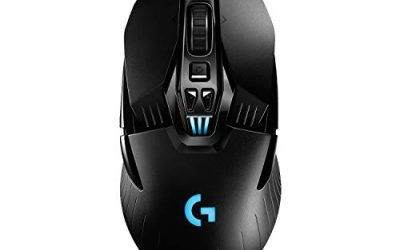
Logitech G502 X Plus

Players who want a wireless mouse that arrives at a new PC already configured will find the G502 X Plus easy to justify. Its listing states up to five onboard memory profiles, so separate layouts for shooters, strategy titles and everyday work can all live inside the mouse itself. Thirteen programmable controls give those profiles something substantial to store, and the LIGHTFORCE hybrid switches pair optical actuation with a mechanical feel. It suits a main-desk setup that occasionally travels to a second machine, a friend’s rig or a tournament PC where installing software is not an option.
Specs
- Sensor: HERO 25K gaming sensor
- Maximum sensitivity: 25,600 DPI
- Switches: LIGHTFORCE hybrid optical-mechanical switches
- Controls: 13 programmable controls
- Connection: LIGHTSPEED wireless, with USB-C charging cable included
- Onboard memory: Up to 5 onboard memory profiles
- Battery life: Up to 120 hours, per the listing
- Lighting: LIGHTSYNC RGB with 8 LEDs
Best for: Wireless players who switch between several games and several computers.
Watch out for: The listing gives two battery figures depending on lighting use, so expect less runtime with the RGB running.
ASIN: B092CB69Q4
Logitech G502 HERO

The wired G502 HERO puts onboard memory in its product title, and the listing backs that up: assign custom commands to its eleven programmable buttons and save up to five ready-to-play profiles directly to the mouse. That makes it a strong fit for players who move between a desktop and a laptop and refuse to rebuild their layout each time. The HERO 25K sensor covers a wide sensitivity range for both careful aiming and fast turns, while the adjustable weight system, built from five 3.6 g weights, lets you tune the balance of a mouse that starts out fairly substantial in the hand.
Specs
- Sensor: HERO 25K sensor
- Sensitivity range: 100 to 25,600 DPI
- Buttons: 11 programmable buttons
- Onboard memory: Save up to five profiles directly to the mouse
- Weight system: Five 3.6 g adjustable weights included
- Connection: Wired, PC and Mac
- Lighting: LIGHTSYNC RGB
- Model number: 910-005469
Best for: Wired players who want five stored profiles and a tunable weight.
Watch out for: With the weights fitted it becomes a heavy mouse, which low-sensitivity players who lift often may not enjoy.
ASIN: B07GBZ4Q68
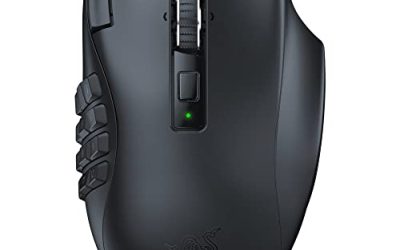
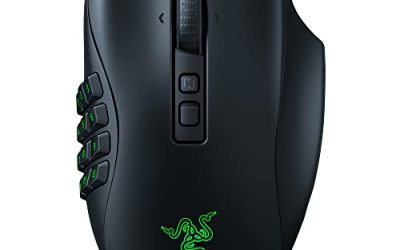
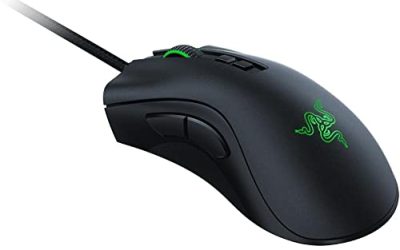
Razer Basilisk V3

Razer’s Basilisk V3 is the ergonomic entry here, built around a right-handed shape with a thumb rest and eleven programmable buttons. Its listing describes five on-board memory profiles, giving you access to custom keybinds and DPI settings wherever you plug in, with the HyperShift function doubling the inputs available on each button. The Focus+ optical sensor reaches 26,000 DPI, and the second-generation optical switches actuate at 0.2 ms with a stated lifecycle of 70 million clicks. Choose it if your saved profiles lean heavily on macros and secondary functions rather than on raw sensitivity changes alone.
Specs
- Sensor: Razer Focus+ optical sensor
- Maximum sensitivity: 26,000 DPI
- Switches: Razer Optical Mouse Switches Gen 2, rated to 70 million clicks
- Buttons: 11 programmable buttons
- Onboard memory: 5 on-board memory profiles
- Scroll wheel: HyperScroll tilt wheel
- Connection: Wired, Razer Speedflex cable
- Lighting: 11 Razer Chroma RGB lighting zones
- Model number: RZ01-04000100-R3U1
Best for: Palm-grip players whose profiles rely on macros and layered button functions.
Watch out for: The shape is firmly right-handed and on the larger side, so smaller hands and left-handed players should look elsewhere.
ASIN: B09C13PZX7
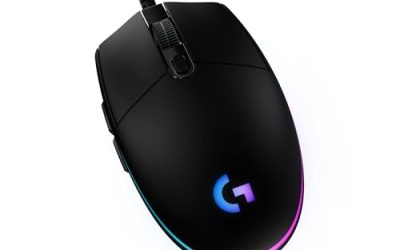
Logitech G305 LIGHTSPEED

The G305 LIGHTSPEED is the travel-friendly option: a compact wireless mouse whose title and feature list both state on-board memory, so your programmed buttons and DPI settings stay with the mouse when it moves to another computer. Six programmable buttons cover the essentials without crowding a small shell, and the HERO sensor reaches 12,000 DPI, which is plenty for the laptop and second-PC gaming this mouse is aimed at. At a listed 99 grams it slips easily into a bag, the receiver stores inside the body, and a single AA battery is rated for 250 hours of continuous gameplay.
Specs
- Sensor: HERO sensor, up to 12,000 DPI
- Tracking speed: More than 400 IPS
- Buttons: 6 programmable buttons
- Onboard memory: On-board memory stated in the title and feature list
- Connection: LIGHTSPEED wireless with 1 ms report rate
- Battery life: 250 hours of continuous gameplay on a single AA battery
- Weight: 99 grams
- Extras: Built-in storage for the USB wireless receiver
Best for: Laptop and second-PC gaming where the mouse has to carry its own settings.
Watch out for: It stores a simpler setup than the five-profile models above, and the compact shell will feel small in large hands.
ASIN: B07CMS5Q6P
Which One Fits Your Situation
You play on PCs you do not own
Tournament stations, a friend’s spare rig and library or office machines all share one problem: you cannot rely on companion software being installed. The G502 X Plus answers it best, because five profiles stored on the mouse cover several games without any app running, and its wireless receiver is the only accessory you need to remember.
You split time between a desktop and a laptop
A two-machine routine is where a single saved profile quietly proves itself. The G305 LIGHTSPEED keeps your button mapping and DPI on the device, stores its receiver inside the shell for the trip between rooms or buildings, and its long AA battery life means the move never starts with a flat mouse.
Your profiles are built around macros
If the point of saving a profile is a dense web of macros and secondary commands, the Basilisk V3 gives you the most to store: eleven programmable buttons, a HyperShift layer that doubles their duties, and five onboard profiles to hold different games’ layouts. The wired connection also means a borrowed PC needs nothing but a free USB port.
You want wired reliability and a heavier, planted feel
Some players prefer a cable and a mouse that stays put during deliberate movements. The G502 HERO pairs its five onboard profiles with an adjustable weight system, so the same saved layout can be paired with a balance you tune yourself, and there is never a battery or receiver to think about.
Common Mistakes
- Assuming every setting transfers, when some software-only behaviours stop working once the companion app is not running.
- Buying a five-profile mouse for a single game, then never using the extra slots the profiles were bought for.
- Forgetting that a wireless mouse’s stored profiles are useless on another PC if the USB receiver gets left behind.
- Saving a profile before finishing the button layout, then overwriting the one good copy with a half-edited version.
- Ignoring shape and weight because the memory feature looks good, even though the mouse is used for hours daily.
Frequently Asked Questions
Does onboard memory work without the software installed?
Yes, that is the point of it. Settings written to the mouse, such as DPI stages and button assignments, are stored on the device itself, so they remain active on a computer that has never seen the companion app. You generally need the software once, on your own machine, to create and save the profile in the first place.
How many profiles do I really need?
Most players need fewer than they expect. One profile is enough if you play a single game with one layout. Two or three cover a small rotation of genres with different sensitivities and button maps. Five profiles, as on several mice here, suit players who move between many titles or share a mouse between gaming and work setups.
What is the difference between onboard memory and cloud profiles?
Onboard memory lives inside the mouse hardware, so it works on any computer, signed in or not, with no account and no internet connection. Cloud profiles live in the maker’s software account and sync between machines where you install and sign into that app. Onboard storage is the more dependable option on PCs you do not control.
Will a saved profile keep my lighting settings too?
It depends on the mouse. Some listings state that lighting is saved to onboard storage alongside DPI and macros, while others mention only settings and button assignments. If matching lighting on a second machine matters to you, check the exact wording on the product listing before buying, because the detail varies between models and brands.