🛒 Best Price Today on Amazon
Prime members get fast, free shipping on everything above, plus member-only deals. New members get a 30-day free trial — cancel anytime.
- Best Laptop SSD Prices and Options Compared
- Samsung 990 EVO Plus 1TB – Best Overall Laptop SSD
- WD Blue SN5000 1TB – Best Balanced Value
- Crucial P3 Plus 1TB – Best Budget Laptop SSD
- Kingston NV3 1TB – Best Affordable High-Speed Pick
- How Much Does a Laptop SSD Cost?
- Is 1TB Enough for a Laptop?
- NVMe vs SATA SSD Price
- PCIe 3.0 vs PCIe 4.0
- Laptop SSD Heat and Power Consumption
- FAQ
- Conclusion
The typical SSD price for laptop upgrades varies from budget 1TB NVMe drives near the entry-level range to premium models costing considerably more for higher speed, TLC NAND, stronger endurance, and better software. For most laptops, a good 1TB PCIe 4.0 SSD offers the best balance of capacity, performance, heat, and price.
Quick answer: For most people in 2026, the best ssd price for laptop is the SSD — our #1 rated choice. See the full ranked comparison, alternatives and buying advice below.
Best Laptop SSD Prices and Options Compared
| SSD | Best For | Interface | Read Speed | Endurance |
|---|---|---|---|---|
| Samsung 990 EVO Plus 1TB | Best Overall | PCIe 4.0 x4 / 5.0 x2 | Up to 7,150 MB/s | 600 TBW |
| WD Blue SN5000 1TB | Best Balanced Value | PCIe 4.0 x4 | Up to 5,150 MB/s | 600 TBW |
| Crucial P3 Plus 1TB | Best Budget Upgrade | PCIe 4.0 x4 | Up to 5,000 MB/s | 220 TBW |
| Kingston NV3 1TB | Best Affordable High-Speed Pick | PCIe 4.0 x4 | Up to 6,000 MB/s | 320 TBW |
Laptop SSD pricing changes constantly because of NAND supply, retailer promotions, capacity, and interface generation. A faster model is not always the better purchase because most notebooks cannot use every benchmark advantage of a flagship drive, especially if the laptop only provides a PCIe 3.0 or slower PCIe 4.0 connection.
The first step is therefore identifying the laptop’s M.2 form factor and interface. Most modern notebooks use an M.2 2280 NVMe drive, while thin handheld-style systems and selected compact laptops may use M.2 2230. Older notebooks can still rely on 2.5-inch SATA SSDs, which are physically and electrically different from NVMe models.
Samsung 990 EVO Plus 1TB – Best Overall Laptop SSD
Best For: Newer performance laptops that can take advantage of fast PCIe 4.0 storage
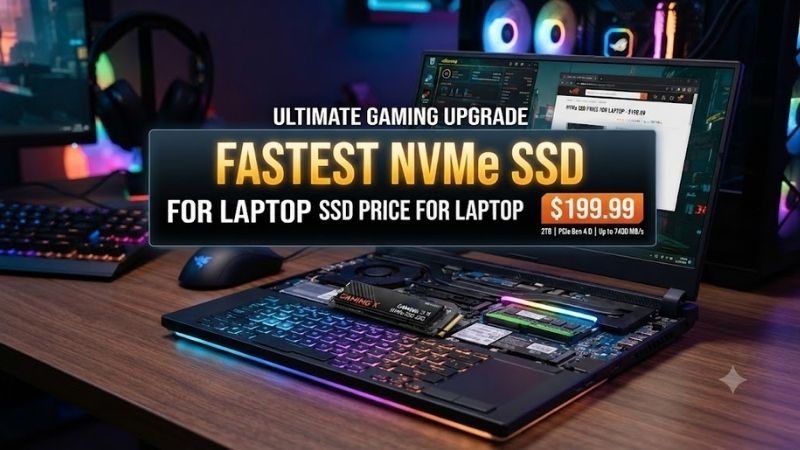
Samsung 990 EVO Plus 1TB is one of the fastest laptop-friendly drives in this roundup. Samsung rates the 1TB model for sequential reads up to 7,150 MB/s and writes up to 6,300 MB/s, using PCIe 4.0 x4 or PCIe 5.0 x2 with the NVMe 2.0 protocol.
The drive uses Samsung V-NAND TLC and an in-house controller, while Host Memory Buffer replaces a dedicated DRAM cache. Samsung specifies a typical active read/write power draw around 4.3W/4.2W and emphasizes improved efficiency, which can matter more in a laptop than another small gain in desktop benchmark scores.
Key Features
- 1TB capacity
- M.2 2280 form factor
- PCIe 4.0 x4 / PCIe 5.0 x2
- NVMe 2.0
- Up to 7,150 MB/s reads
- Up to 6,300 MB/s writes
- TLC V-NAND
- 600 TBW endurance
- Five-year limited warranty
- Samsung Magician support
What Makes It Different
The 990 EVO Plus combines near-flagship Gen4 throughput with a power-efficiency focus rather than pursuing maximum performance regardless of consumption. Samsung states that efficiency improved substantially over the earlier 990 EVO generation, making the model especially appealing for high-performance notebooks where temperature and battery usage matter.
The 1TB model also carries a 600 TBW rating and five-year limited warranty. That is a strong endurance specification for a laptop used for gaming, development, editing, and large file transfers, and it gives the drive more write headroom than several cheaper alternatives in this roundup.
Pros
- Excellent read and write speeds
- TLC NAND
- High 600 TBW endurance
- Good power efficiency
- Mature Samsung software
- Five-year warranty
- Strong gaming and productivity performance
Cons
- Premium pricing
- Faster than many laptops can fully use
- Limited benefit in older PCIe 3.0 notebooks
- 1TB may still feel small for large game libraries
Use Case
The 990 EVO Plus is ideal for a newer gaming laptop, mobile workstation, or creator notebook with a PCIe 4.0 M.2 slot. It works particularly well when large applications, games, project files, or media libraries need to load quickly without moving to a hotter PCIe 5.0 flagship SSD.
Who It’s For
Choose this Samsung if the laptop is relatively new and you want the strongest all-around specification. It makes less sense in an older machine limited to PCIe 3.0 because the interface will prevent the drive from reaching its advertised performance.
WD Blue SN5000 1TB – Best Balanced Value
Best For: Mainstream laptops needing good speed, TLC NAND, and strong endurance
WD Blue SN5000 1TB uses an M.2 2280 form factor and PCIe Gen4 x4 interface. Western Digital rates the 1TB model for up to 5,150 MB/s sequential reads and 4,900 MB/s writes, with up to 730K random read IOPS and 770K random write IOPS.
The 1TB version uses Western Digital 3D TLC NAND rather than the QLC flash found in the 4TB model. It is also rated for 600 TBW endurance and carries a five-year limited warranty, placing it in a stronger durability class than several entry-level NVMe drives.
Key Features
- 1TB capacity
- M.2 2280
- PCIe Gen4 x4
- Up to 5,150 MB/s reads
- Up to 4,900 MB/s writes
- TLC NAND
- 600 TBW endurance
- Five-year limited warranty
- 1.75 million-hour MTTF
- Low-power sleep mode
What Makes It Different
The SN5000 sits in a useful middle ground. It is clearly faster than older PCIe 3.0 laptop SSDs but avoids chasing the highest Gen4 benchmark numbers. That makes it especially sensible for laptops where heat, power use, and real-world value matter more than maximizing sequential throughput.
Western Digital’s 1TB model also has unusually strong endurance for its class. A 600 TBW rating matches many more expensive premium SSDs, so users who frequently install games, edit media, run development environments, or move large datasets do not have to accept a low endurance figure simply to save money.
Pros
- TLC NAND
- Strong 600 TBW endurance
- Good Gen4 performance
- Five-year warranty
- Suitable for mainstream laptops
- Lower performance demand can help thermals
Cons
- Slower than Samsung 990 EVO Plus
- No major advantage for extremely high-end workloads
- Price can overlap with faster drives during sales
- Requires M.2 2280 compatibility
Use Case
The SN5000 is an excellent upgrade for office notebooks, gaming laptops, and everyday productivity machines. It provides enough speed for Windows, games, large programs, and content creation without placing as much emphasis on peak benchmark throughput.
Who It’s For
Choose the WD Blue if you want a durable TLC-based 1TB drive and the price is meaningfully below premium Samsung options. It is arguably one of the safest choices for users who want performance and endurance without paying for specifications their laptop may never fully use.
Crucial P3 Plus 1TB – Best Budget Laptop SSD
Best For: Older laptops and value-focused upgrades where price matters more than endurance
Crucial P3 Plus 1TB is a PCIe 4.0 NVMe drive rated for sequential reads and writes up to approximately 5,000 and 4,200 MB/s in the P3 Plus family. Crucial also includes features such as TRIM, SMART monitoring, dynamic write acceleration, error correction, and integrated power-loss immunity.
The key trade-off is endurance. Crucial rates the 1TB P3 Plus at 220 TBW, significantly below the 600 TBW ratings of the Samsung and WD models above. It still carries a five-year limited warranty, but heavy write workloads deserve more consideration than with higher-end drives.
Key Features
- 1TB capacity
- PCIe 4.0 NVMe
- Up to 5,000 MB/s reads
- Up to 4,200 MB/s writes
- 220 TBW endurance
- Five-year limited warranty
- SMART support
- TRIM support
- Acronis cloning software support
- Power-loss protection features
What Makes It Different
The P3 Plus is attractive because it brings Gen4-class performance into a much more affordable price tier. For an older laptop replacing a slow hard drive, SATA SSD, or entry-level NVMe drive, the improvement in boot speed, application loading, game installation, and general responsiveness can be substantial.
The lower endurance figure matters less for light users. A notebook used mainly for office documents, browsing, media, school, and gaming will generally write far less data than a workstation constantly processing video files, virtual machines, databases, or large scratch workloads.
Pros
- Affordable
- Strong read speed for the price
- Five-year warranty
- Good laptop upgrade option
- Cloning software support
- Much faster than SATA storage
Cons
- 220 TBW endurance is relatively low
- Less suitable for write-heavy workloads
- Premium drives offer better sustained performance
- Price should be compared carefully during sales
Use Case
The P3 Plus makes sense for a budget laptop upgrade where the goal is to increase capacity and responsiveness without spending premium money. It is particularly useful for everyday notebooks that currently have a small 256GB SSD and need a straightforward jump to 1TB.
Who It’s For
Choose this Crucial if price is the main concern and the laptop will mostly run games, browsers, office software, media, and ordinary productivity applications. Heavy creators should consider a higher-end TLC drive with stronger endurance.
Kingston NV3 1TB – Best Affordable High-Speed Pick
Best For: Thin laptops and users seeking strong peak speed at a lower cost
Kingston NV3 1TB is available in both M.2 2280 and M.2 2230 versions, depending on the product variant. The 1TB model is rated for up to 6,000 MB/s sequential reads and 4,000 MB/s writes using PCIe 4.0 x4 NVMe.
Kingston rates the 1TB drive for 320 TBW endurance and lists an operating temperature range from 0°C to 70°C. The 2280 version weighs about 7g, while the compact 2230 version is only around 2.8g, which broadens compatibility with space-constrained devices.
Key Features
- 1TB capacity
- PCIe 4.0 x4 NVMe
- Up to 6,000 MB/s reads
- Up to 4,000 MB/s writes
- 320 TBW endurance
- M.2 2280 version
- M.2 2230 version available
- 3D NAND
- Low-profile design
- Five-year limited warranty on current product page
What Makes It Different
Form-factor choice is an important advantage. The standard 2280 model fits most laptops with full-length M.2 slots, while the 2230 version works in smaller systems designed for short drives. Users should confirm which version their laptop supports because a 2280 drive cannot physically fit in a 2230-only bay.
The NV3 also delivers a strong peak read specification for a budget-oriented drive. Its 6,000 MB/s rating exceeds the P3 Plus and SN5000 on paper, although real laptop performance will still depend on controller behavior, workload, temperature, and the PCIe capabilities of the host system.
Pros
- Fast 6,000 MB/s read rating
- Competitive pricing
- 2280 and 2230 versions
- Low weight
- Useful for thin notebooks
- Five-year warranty on current listing
- Simple Gen4 upgrade
Cons
- 320 TBW trails premium TLC drives
- Peak read speed does not guarantee best sustained performance
- NAND details are less specific than some premium rivals
- Exact form factor must be selected carefully
Use Case
The NV3 is useful when upgrading an affordable gaming laptop, school notebook, or compact system. Its 2230 option is especially interesting for devices where standard 80mm M.2 drives cannot fit.
Who It’s For
Choose Kingston NV3 if you want a faster budget Gen4 SSD than many older entry models and the endurance level suits your workload. It offers a strong price-to-speed ratio for ordinary notebook use.
How Much Does a Laptop SSD Cost?
A 500GB NVMe SSD is generally the cheapest meaningful upgrade for modern laptops, but 1TB usually offers better long-term value because Windows, applications, downloads, and games consume storage quickly. Paying slightly more for 1TB can prevent another upgrade within a year or two.
Budget 1TB NVMe drives usually occupy the lowest practical price tier and prioritize capacity over maximum endurance. Midrange drives cost more but often provide TLC NAND, stronger warranties, and better sustained performance. Premium models can cost significantly more for faster controllers, higher endurance, and mature management software.
Retail prices can vary dramatically between promotions. For example, current product listings retrieved for this comparison show large differences among Samsung, Kingston, Crucial, and WD options, so buyers should compare the actual purchase price rather than assuming a premium model always costs the same amount. Product availability also affects pricing.
Is 1TB Enough for a Laptop?
For most users, 1TB is the best starting capacity. It leaves room for Windows, office software, photos, documents, and several large games while avoiding the constant storage management that often comes with 256GB and 512GB drives.
Gamers who keep many AAA titles installed may prefer 2TB. A single modern game can exceed 100GB, and a 1TB SSD provides less than the advertised capacity after formatting and system files. The price per gigabyte is often better on larger drives during promotions.
NVMe vs SATA SSD Price
Older laptops may only support 2.5-inch SATA SSDs. SATA performance typically tops out around the 500–550 MB/s range, while NVMe drives can deliver several gigabytes per second through PCIe. However, installing an NVMe drive requires a compatible M.2 slot and protocol support.
Do not buy an M.2 drive based on shape alone. M.2 SATA and M.2 NVMe SSDs can look similar but use different interfaces. Check the laptop service manual, manufacturer specifications, or existing drive before purchasing.
PCIe 3.0 vs PCIe 4.0
A PCIe 4.0 SSD can usually operate in a PCIe 3.0 slot, but speed will be limited by the older interface. This means a premium 7,000 MB/s drive may perform much closer to a slower SSD when installed in an older notebook.
For a PCIe 3.0 laptop, buying the cheapest reliable Gen4 model may make more sense than paying for maximum speed. For a newer Gen4 gaming laptop, Samsung 990 EVO Plus or another faster drive can use more of the platform’s available bandwidth.
Laptop SSD Heat and Power Consumption
Heat matters more in laptops because storage sits inside a confined chassis with limited airflow. Very fast SSDs can generate more heat under sustained workloads, causing the controller to reduce speed if temperatures become excessive.
Power efficiency also influences battery life. Samsung specifically highlights improved efficiency on the 990 EVO Plus, while WD and Kingston target mainstream and notebook applications with lower-power designs. For everyday portable use, efficiency can be more valuable than winning synthetic benchmark charts.
FAQ
What Is a Good SSD Price for a Laptop?
A good price depends on capacity and drive class. For most buyers, the best value comes from a 1TB PCIe 4.0 NVMe drive with a five-year warranty rather than the cheapest possible SSD or a flagship model whose performance the laptop cannot fully use.
Is 1TB SSD Good for a Laptop?
Yes. One terabyte offers enough storage for Windows, applications, personal files, and several games while remaining affordable. Heavy gamers and creators may prefer 2TB to avoid managing free space constantly.
Which Laptop SSD Is Best?
Samsung 990 EVO Plus is the strongest overall option here, WD Blue SN5000 balances endurance and value, Crucial P3 Plus is attractive for budget upgrades, and Kingston NV3 offers strong peak speed with both 2280 and compact 2230 versions.
Can I Put a PCIe 4.0 SSD in a PCIe 3.0 Laptop?
Usually yes, provided the form factor and NVMe interface are compatible. The SSD will run at PCIe 3.0 speeds rather than its full Gen4 specification, so paying extra for maximum Gen4 performance may not provide much benefit.
Does a Faster SSD Improve Laptop Gaming FPS?
Usually not significantly. A faster SSD improves game loading, installations, updates, asset access, and Windows responsiveness. CPU and GPU performance still determine most frame-rate behavior once game data is loaded.
Conclusion
The best SSD price for laptop upgrades comes from matching storage performance to the notebook rather than simply buying the fastest drive. Samsung 990 EVO Plus leads for premium speed, WD Blue SN5000 offers excellent TLC endurance, Crucial P3 Plus provides affordable capacity, and Kingston NV3 combines strong Gen4 speed with flexible laptop-friendly sizes.
Ready to decide? Our #1 pick for 2026 is the SSD.
Live price & availability on Amazon.