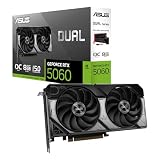
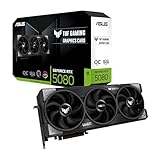
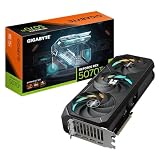
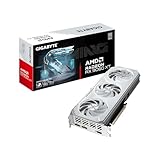
- Top Pick: ASUS Dual NVIDIA GeForce RTX 5060 Ti 16GB GDDR7 OC Edition Graphics Card, (PCIe 5.0, DLSS 4, HDMI 2.1b, DisplayPort 2.1b, 2.5-Slot, Axial-tech Fan, 0dB Technology), 3 Year Warranty
- Best Value: ASUS SFF-Ready Prime NVIDIA GeForce RTX 5060 Ti 16GB GDDR7 OC Edition Graphics Card (PCIe 5.0, 16GB GDDR7, HDMI/DP 2.1, 2.5-Slot, Axial-tech Fans, Dual BIOS), 3 Year Warranty
- Premium Choice: ASUS Dual NVIDIA GeForce RTX 5060 Ti 8GB GDDR7 OC Edition Graphics Card (PCIe 5.0, DLSS 4, HDMI 2.1b, DisplayPort 2.1b, 2.5-Slot, Axial-tech Fan, 0dB Technology), 3 Year Warranty
The GeForce RTX 5060 Ti and RTX 5070 sit one rung apart in NVIDIA’s Blackwell stack, but they solve slightly different problems. The 5060 Ti is the value pick built around a narrow 128-bit memory bus and a choice of 8GB or 16GB of GDDR7. The RTX 5070 steps up to a wider 192-bit bus, 12GB of GDDR7, and roughly a third more shader hardware, at the cost of higher power draw and a meaningfully larger price tag.
In 2026 that trade-off matters more than it used to. Modern engines lean hard on ray tracing, high-resolution textures, and neural rendering features, and VRAM capacity has become a genuine bottleneck in a way it simply wasn’t a couple of generations ago. The question isn’t just “which card is faster” — it’s whether you’d rather have more memory headroom for the next three years, or more raw throughput today.
As an Amazon Associate we earn from qualifying purchases at no extra cost to you.




⚡ Save on Your Next PC — Amazon Prime
Prime members get fast free shipping on the systems above, plus early access to Prime Day & Black Friday PC deals. New members get a 30-day free trial.
Watch: RTX 5060 Ti vs 5070: Which Wins in 2026? — Video Review
Quick Verdict
Buy the RTX 5060 Ti 16GB if you game at 1080p or 1440p, want maximum texture and ray tracing headroom on a mid-range budget, and value a cool, quiet, single-8-pin card that drops into almost any build. Buy the RTX 5070 if you want the highest frame rates the mainstream tier offers — particularly at 1440p with ray tracing enabled — and you have the PSU and case clearance to feed it. The 5060 Ti 8GB variants are best treated as 1080p cards only.
Key Differences
- Raw performance: The RTX 5070 is typically 25–35% faster at 1440p, with the gap widening in heavy ray-traced titles and shrinking at 1080p where the CPU starts to matter more.
- Memory capacity: The 5060 Ti is available with 16GB — more than the 5070’s 12GB — which is the single strongest argument for the cheaper card in texture-heavy or modded games.
- Memory bandwidth: The 5070’s 192-bit bus delivers roughly 50% more bandwidth than the 5060 Ti’s 128-bit interface, which is why it scales better as resolution climbs.
- Power and PSU: The 5060 Ti runs on a single 8-pin connector and a 600W-class supply; the 5070 draws considerably more and generally wants a 650W or better unit plus a 12V-2×6 adapter or native cable.
- Physical footprint: Most 5060 Ti designs are compact 2 to 2.5-slot dual-fan cards; 5070 partner models are usually longer, thicker, and heavier.
- Feature parity: Both support DLSS 4 with Multi Frame Generation, PCIe 5.0, HDMI 2.1b, DisplayPort 2.1b, and NVIDIA’s full encoder suite — no feature is locked to the higher tier.
GeForce RTX 5060 Ti: The Value 1440p Card
The 5060 Ti’s appeal is efficiency. It sips power, runs cool, and partner cards like the ASUS Dual RTX 5060 Ti 16GB OC and the white-finish ASUS Dual 16GB White OC use a 2.5-slot axial-tech cooler with 0dB idle, meaning the fans stop entirely on the desktop. For small form factor builders, the ASUS SFF-Ready Prime RTX 5060 Ti 16GB OC is the standout — it meets NVIDIA’s SFF-Ready length and clearance guidelines and adds a dual BIOS for quiet or performance profiles.
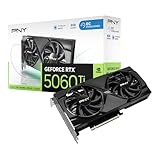
The catch is the 8GB versions. Cards like the ASUS Dual RTX 5060 Ti 8GB OC, the PNY RTX 5060 Ti 8GB OC Dual-Fan, and the RGB-lit PNY Epic-X 8GB Triple-Fan are perfectly capable 1080p performers and often the cheapest route into Blackwell, but 8GB is already a constraint in several 2025–2026 releases at 1440p with ray tracing. If your budget stretches at all, the 16GB model is the version worth owning.
GeForce RTX 5070: The 1440p Performance Pick
The RTX 5070 is where mainstream Blackwell starts to feel genuinely comfortable at 1440p. The extra shader cores and wider memory bus mean it holds high frame rates with ray tracing on in demanding titles where the 5060 Ti needs upscaling to stay smooth. Pair it with DLSS 4 Multi Frame Generation and it’s a credible high-refresh 1440p card, and a serviceable entry point for 4K if you’re willing to lean on quality-mode upscaling.
Its weakness is memory capacity. Twelve gigabytes is adequate today, but it’s less than the 16GB 5060 Ti offers, and in a handful of edge cases — 4K texture packs, heavy modding, large local AI models — the cheaper card will actually hold up better. You also need to plan for the extra power draw and the physically larger board.
Which Should You Buy?
- For 1080p high-refresh gaming: Pick the RTX 5060 Ti; even an 8GB model like the PNY Dual-Fan is enough here, and the savings are real.
- For 1440p with ray tracing: Pick the RTX 5070 — the bandwidth advantage shows up exactly where you’ll feel it.
- For longevity on a budget: Pick the RTX 5060 Ti 16GB. The extra VRAM ages better than a modest frame rate edge.
- For SFF and mini-ITX builds: Pick the ASUS SFF-Ready Prime RTX 5060 Ti 16GB OC for guaranteed clearance and lower thermal load.
- For creative and light AI work: Pick the 16GB 5060 Ti if capacity matters most, or the 5070 if throughput does.
Frequently Asked Questions
Is the RTX 5070 worth the extra money over a 5060 Ti?
If you game at 1440p or above, yes — the performance uplift roughly tracks the price gap. At 1080p the advantage narrows considerably and the 5060 Ti 16GB becomes the smarter buy.
Is 12GB on the RTX 5070 enough in 2026?
For 1440p, yes, in essentially every current title. It’s a tighter margin than 16GB, but the 5070’s faster memory subsystem offsets much of the capacity deficit in practice.
Should I ever buy the 8GB RTX 5060 Ti?
Only as a dedicated 1080p card, or if the price difference versus the 16GB version is unusually large. For 1440p, the 16GB model is worth the premium.
What power supply do I need?
Plan on a quality 600W unit for the RTX 5060 Ti and 650W or more for the RTX 5070. Check your PSU’s connector type before buying a 5070.
Final Verdict
The RTX 5070 is the faster card and the better choice for high-refresh 1440p and ray t