🛒 Best Price Today on Amazon
Prime members get fast, free shipping on everything above, plus member-only deals. New members get a 30-day free trial — cancel anytime.
- Low-Profile Graphics Cards at a Glance
- What “Low Profile” Actually Means for a Graphics Card
- Best Small Graphics Cards by Budget
- Mid-Range Low-Profile Cards for Real Gaming
- Premium Low-Profile Cards: Workstation-Class Options
- Bracket, Length, Slot Width and Power: Fit Checklist
- Best SFF Graphics Cards: Low-Profile vs Compact Full-Height
- Best Low-Profile Graphics Cards for GTA V and Older Games
- Decision Table: Pick X If…
- Used Low-Profile Cards: Inspection Checklist
- Alternatives to Consider
- Frequently Asked Questions
Updated November 2026 – The best low profile graphics cards for a slim or small form factor PC are the Gigabyte RTX 4060 OC Low Profile 8G for the strongest card that still fits a half-height bracket, the MSI RTX 3050 LP 6G OC for slot-powered builds with no PSU cable, and the Sapphire Pulse RX 6400 for tight budgets and media-box systems.
If you are searching for the best low profile graphics cards, the real question is not which card is fastest on paper. It is which card physically fits your case, which power source your small PSU can offer, and how much performance you can reasonably expect from a board built to a 75 W-class slot limit. This guide sorts the realistic options by budget, explains brackets, lengths and power connectors, and answers the most common long-tail questions about small form factor (SFF) graphics cards. Availability varies by region and new stock of some older low-profile models is limited, so treat the list as a map of what has existed and what makers list, not a guarantee of stock.
Low-Profile Graphics Cards at a Glance
| Card | Best for | Key stated specs | Limits |
|---|---|---|---|
| Gigabyte RTX 4060 OC Low Profile 8G | Strongest 1080p-class low-profile option | 8 GB GDDR6 · 128-bit · dual-slot · external power connector | Needs a PSU connector and about 180 mm of length |
| Gigabyte RTX 5060 OC Low Profile 8G | Newer-generation alternative where sold | 8 GB GDDR7 class · external power connector | Listed by some roundups; availability varies |
| MSI RTX 3050 LP 6G OC | OEM upgrade with no extra cable | 6 GB GDDR6 · 96-bit · slot-powered design | Previous generation; 6 GB memory is tight |
| Sapphire Pulse RX 6400 | Budget esports and media PCs | 4 GB GDDR6 · 64-bit · PCIe 4.0 x4 · no extra connector | Narrow PCIe link; light on AAA titles |
| Intel Arc A310 low-profile models | Media playback and encode on a small budget | 4 GB GDDR6 · AV1 hardware encode | Entry-level 3D; driver maturity varies |
| GeForce GTX 1650 low-profile models | Used or leftover older builds | 4 GB · 75 W-class board | Previous generation; no ray tracing or DLSS |
| NVIDIA RTX A2000 | Workstation-class, quiet, slot-powered | 6 GB or 12 GB · 70 W · low-profile bracket | Professional drivers and pricing tier |
| NVIDIA RTX 4000 SFF Ada | Maximum memory in a 70 W small card | 20 GB · 70 W · dual-slot low profile | Workstation product, premium tier |
What “Low Profile” Actually Means for a Graphics Card
A low-profile card is a board that fits a half-height expansion slot, roughly the height of a typical slim desktop or HTPC case. It ships with, or accepts, a short bracket instead of the full-height one. Many makers include both brackets in the box, so you can swap them with a small screwdriver. Always confirm the bracket in the box on the product page before buying, because some listings show only a single bracket.
Low profile does not mean single slot. Several of the strongest low-profile cards are dual-slot, which means they need two slot openings at the back of the case even though they are short in height. Slim cases that offer only one half-height slot cannot take them. Measure three things before you shop: the free height above the slot, the available length from the bracket to the nearest obstruction, and how many slot openings the case provides.
Best Small Graphics Cards by Budget
Budget tier: slot-powered cards for office-class PCs
Budget buyers are usually upgrading a pre-built slim desktop with a small PSU and no spare PCIe power cable. Here the key rule is simple: pick a card that draws everything from the slot. The PCIe slot is specified to deliver up to 75 W, and the cards below are designed around that limit.
Sapphire Pulse RX 6400 – Best for budget esports and media PCs
Specs: 4 GB GDDR6 · 64-bit bus · PCIe 4.0 x4 · no external power connector · about 170 mm long as listed by roundups.
The Radeon RX 6400 is the entry card in AMD’s RX 6000 line, and the Sapphire Pulse is the model most often cited in low-profile lists. Reviewers describe it as suited to esports titles, indie games and media playback rather than demanding AAA releases. Because the chip uses only four PCIe lanes, it is best in a PCIe 4.0 slot; in an older PCIe 3.0 slot reviewers note the narrow link can reduce performance further. One reviewer also points out that the RTX 3050 6 GB and Intel Arc A310 are stronger buys unless the RX 6400 is steeply discounted. Check the card page for a low-profile bracket, since the standard Pulse listing is the one cited.
Intel Arc A310 Low Profile – Best for media playback and AV1 encode
Specs: 4 GB GDDR6 · Alchemist entry chip · hardware AV1 encode · slot-power class board.
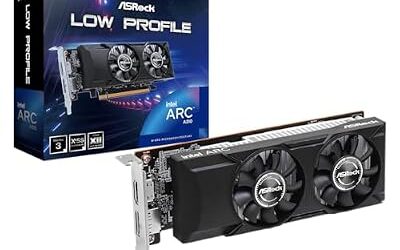
Intel’s Arc A310 appears in half-height form from board partners such as ASRock and Sparkle. It is chosen less for gaming and more for home-theatre, streaming and light-creator PCs, because it adds modern video codec hardware to an older system. Gaming performance is entry-level, and reviewers have long noted that Arc drivers behave differently from NVIDIA and AMD drivers in older titles. Treat it as a media card first.

ASRock Intel Arc A310 Low Profile 4GB Graphics Card, 2000 MHz GPU Clock, 4GB GDDR6, Low-Profile Design, Dual Fan, DisplayPort 2.0, HDMI 2.0b, 8K Support
Included for 'Best Low-Profile Graphics Cards for Small Form Factor PCs' as a representative home product in this roundup; selection reflects the product set returned for this topic.
View on AmazonGeForce GTX 1650 Low Profile – Best for used and leftover older builds
Specs: 4 GB · 75 W-class board in slot-powered variants · Turing architecture, previous generation.
The GTX 1650 was sold in several low-profile versions by Asus, Gigabyte, MSI, Zotac and others, and slot-powered variants existed. It is now a previous-generation card with no ray tracing or DLSS, so it only makes sense in a used build or where a leftover board is available. Follow the used-card checklist later in this guide, and confirm the exact variant, because some GTX 1650 boards need a 6-pin cable and some do not.
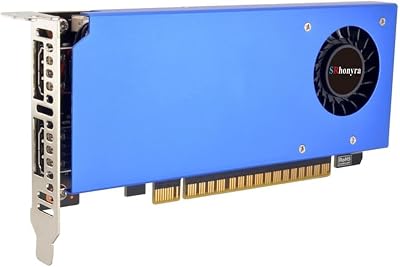
GTX 1650 4GB Low Profile Graphics Card | Native HDMIx2,128-Bit,PCIe 3.0 x16, DirectX 12 OpenGL 4.6,HDCP 2.2
Included for 'Best Low-Profile Graphics Cards for Small Form Factor PCs' as a representative home product in this roundup; selection reflects the product set returned for this topic.
View on AmazonMid-Range Low-Profile Cards for Real Gaming
MSI RTX 3050 LP 6G OC – Best for OEM upgrades with no extra cable
Specs: 6 GB GDDR6 · 96-bit bus · slot-powered design (70 W class) · half-height bracket included · short two-fan cooler.
The GeForce RTX 3050 6 GB is the card most roundups choose for a slim Dell, HP or Lenovo desktop that has a small PSU and no PCIe power lead. The MSI LP 6G OC is the model name most often cited, and Yeston, Maxsun and SOYO also sell 3050 6 GB low-profile boards in some regions. Reviewers report it as a clear step up over integrated graphics and over the RX 6400 for 1080p play, with DLSS support as a bonus. The trade-off is the 6 GB frame buffer: newer titles at high texture settings can exceed it, so plan on medium textures. It is a previous-generation product, so new stock varies.

msi Gaming RTX 3050 LP 6G OC Graphics Card (NVIDIA RTX 3050, 96-Bit, Boost Clock: 1492 MHz, 6GB GDDR6 14 Gbps, HDMI/DP, Ampere Architecture)
Included for 'Best Low-Profile Graphics Cards for Small Form Factor PCs' as a representative home product in this roundup; selection reflects the product set returned for this topic.
View on AmazonGigabyte RTX 4060 OC Low Profile 8G – Best for the strongest compact 1080p build
Specs: 8 GB GDDR6 · 128-bit bus · dual-slot · about 182 mm long as listed · external power connector · half-height bracket.
The reference RTX 4060 is rated at 115 W total graphics power, so a low-profile version must take power from the PSU as well as the slot. That is the key limit: unlike the RTX 3050 6 GB, this card is not a drop-in for a PSU with no spare lead. For anyone with a small form factor case and a PSU that has a PCIe connector, reviewers describe it as the strongest low-profile card, aimed at 1080p play at high settings and respectable 1440p in lighter titles, with DLSS 3 frame generation available. An ASUS RTX 4060 low-profile model is cited in some roundups too, with an 8-pin connector listed; confirm which variants your region sells.
Gigabyte RTX 5060 OC Low Profile 8G – Best for a newer-generation compact card
Specs: 8 GB GDDR7-class memory · 128-bit bus · dual-slot · external power connector · half-height bracket.
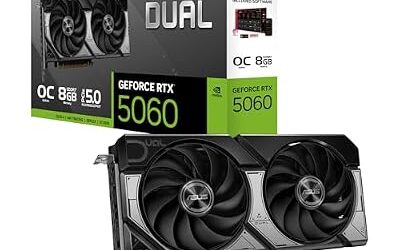
One roundup lists a Gigabyte RTX 5060 low-profile model, which suggests the RTX 50 generation has reached half-height boards. The RTX 5060 is the Blackwell-generation successor to the RTX 4060, with DLSS 4 support. Because this model is documented by fewer sources, look at the maker’s product page for the exact length, connector and bracket details before planning a build around it.

ASUS GeForce RTX 5060 LP BRK 8GB GDDR7 OC Edition Video Card RTX5060-O8G-LP-BRK
Included for 'Best Low-Profile Graphics Cards for Small Form Factor PCs' as a representative home product in this roundup; selection reflects the product set returned for this topic.
View on AmazonPremium Low-Profile Cards: Workstation-Class Options
NVIDIA RTX A2000 – Best for quiet, slot-powered professional work
Specs: 6 GB or 12 GB GDDR6 · 70 W maximum power as listed by the maker · low-profile bracket · four mini-DisplayPort outputs.
The RTX A2000 is a workstation card built on the same generation of architecture as the RTX 30 series. It is slot-powered, short and designed for compact professional PCs, and drivers are tuned for CAD and content tools. It will run games, but it is chosen for stability, multi-monitor output and a small thermal footprint. It is a previous-generation product, so used and refurbished stock is common.

NVIDIA RTX A2000 - Graphics Card - RTX A2000-6 GB GDDR6 - PCIe 4.0 x16-4 x Mini DisplayPort
Included for 'Best Low-Profile Graphics Cards for Small Form Factor PCs' as a representative home product in this roundup; selection reflects the product set returned for this topic.
View on AmazonNVIDIA RTX 4000 SFF Ada – Best for the most memory in a 70 W small card
Specs: 20 GB GDDR6 · 70 W maximum power as listed · dual-slot low profile · four mini-DisplayPort outputs.
This is the premium answer for builders who need lots of video memory in a tiny case, for example for 3D work or running local AI models. It is a workstation product rather than a gaming card, and it sits in the premium tier. If your only goal is gaming, a gaming-oriented RTX 4060 low-profile card is the more sensible route.

NVIDIA RTX 4000 SFF Ada Generation Workstation Ada Lovelace Architecture Dual Slot Low Profile Professional Graphics Board 900-5G192-2571-000 VD8465
Included for 'Best Low-Profile Graphics Cards for Small Form Factor PCs' as a representative home product in this roundup; selection reflects the product set returned for this topic.
View on AmazonBracket, Length, Slot Width and Power: Fit Checklist
- Bracket: confirm a half-height bracket is included, or that the maker sells one for your model.
- Slot width: single-slot cards fit slim cases with one slot opening; dual-slot cards need two openings and clearance for the fan.
- Length: measure from the slot to the first obstruction such as a drive cage, then compare it with the maker’s stated length. Budget about 5 to 10 mm extra for connectors.
- Power: slot-powered cards need nothing extra, while cards with a 6-pin or 8-pin socket need a free lead from the PSU. Check the card maker’s stated PSU requirement.
- PSU capacity: many slim OEM PSUs have low wattage and no PCIe leads. Do not use unrated adapters to force a connection; contact the PC maker if unsure.
- Airflow: slim cases run hot, and small fans spin faster. A card with higher board power will be louder and warmer.
Best SFF Graphics Cards: Low-Profile vs Compact Full-Height
The best SFF graphics cards are not always low profile. Many SFF cases, such as small mini-ITX builds, accept full-height cards as long as they are short and no more than two slots thick. If your case allows that, a compact full-height card gives far more performance than any half-height board. Makers list compact two-fan cards in the RTX 4060 and RTX 5060 class, and some small Radeon RX 7600 and RX 9060 XT models, with lengths around 200 mm. Always check the maker’s stated length, width and power requirement against the case specification.
What does “best SFF graphics cards 240 W” mean?
That query usually refers to a card power budget or an SFX power supply limit around 240 W, not a product category. Half-height low-profile cards stay at or below about 75 W to 115 W, so they fit well inside such a budget, whereas bigger compact cards may need a PSU rating above what a very small unit can deliver. Use the card maker’s stated total board power and recommended PSU as the deciding figures, and ask the case maker for the supported maximum.
Best Low-Profile Graphics Cards for GTA V and Older Games
For Grand Theft Auto V, a title released more than a decade ago, any card in the list above is a realistic option. The RTX 3050 6 GB and RTX 4060 low-profile cards suit higher settings and higher refresh rates, while the RX 6400 and Arc A310 suit more modest settings. Check that the card’s memory suits the texture settings you want, and do not expect the same results across systems, since the CPU matters a lot in this game. Older, lighter games are where entry cards make the most sense.
Decision Table: Pick X If…
| Pick this | If… |
|---|---|
| Gigabyte RTX 4060 OC Low Profile 8G | Your PSU has a free PCIe connector and your case has two half-height slot openings plus about 180 mm of length. |
| MSI RTX 3050 LP 6G OC | You have a slim PC with a small PSU and no cable for a graphics card. |
| Sapphire Pulse RX 6400 | You play esports or older titles and want the lowest cost with no external power. |
| Intel Arc A310 low profile | You mostly need video playback, AV1 encode and light gaming. |
| NVIDIA RTX A2000 | You want a quiet, stable professional card within 70 W. |
| NVIDIA RTX 4000 SFF Ada | You need lots of memory in a tiny case and accept a premium tier. |
| A compact full-height card instead | Your SFF case accepts a short dual-slot card and you want more performance than half-height boards offer. |
Used Low-Profile Cards: Inspection Checklist
Because many of these models are previous generation, used boards are common. Look for visible damage to the PCIe edge connector, bent heatsink fins, missing brackets and fan noise. Ask for photos of the actual card and its model sticker, and confirm that both brackets are included. Be cautious with cards that could have been run continuously, such as ex-mining boards, since heavy long-term use can wear fans and thermal paste. Favor sellers that offer a warranty or return window, and test the card after arrival with a stress test and temperature monitoring, stopping if temperatures climb abnormally. Do not rely on a claim about any specific listing; judge each one on the photos and terms offered.
Alternatives to Consider
- Integrated graphics: modern Ryzen processors with integrated Radeon graphics can cover light gaming and may remove the need for a card.
- Compact mini-ITX cards: if the case allows a short dual-slot card, this offers far more headroom.
- An external GPU enclosure or a different case: sometimes the best way to a stronger card is a small-form-factor case that supports a full-height board.
Frequently Asked Questions
What is the best low profile graphics card?
The Gigabyte RTX 4060 OC Low Profile 8G is generally named the strongest low-profile card by reviewers. It needs an external power connector, so if your PSU has none, the MSI RTX 3050 LP 6G OC is the usual slot-powered alternative.
What are the best small graphics cards under a tight budget?
The Sapphire Pulse RX 6400 and low-profile GTX 1650 boards are the budget-tier names most often cited, and used cards are the usual way to reach the lowest budgets. Their performance suits esports and older titles, and used purchases should follow the inspection checklist above.
Can a low-profile card run without a power cable?
Yes, if it is designed to draw only from the PCIe slot, which provides up to 75 W. The RTX 3050 6 GB, RX 6400 and Arc A310 low-profile boards are slot-powered designs, but the RTX 4060 low-profile cards need a PSU connector.
What does “MT” mean in a low-profile graphics card search?
It usually refers to a mini-tower or micro-tower OEM case, where the slot area is cramped and half-height brackets are common. Measure the slot height and length in the case, as OEM towers differ even within the same model line.
Will a low-profile card bottleneck my processor?
It can limit performance in newer games, but it will usually be the card, not the CPU, that sets the ceiling in slim office PCs. Match the card to the processor’s class, and remember that low-profile cards trade speed for size and power.
Is a low-profile card good for GTA V?
Yes, for GTA V any of the cards listed can run it, with the RTX 3050 6 GB and RTX 4060 low-profile models suiting higher settings. Results also depend on the processor and memory in the PC.