🛒 Best Price Today on Amazon
Prime members get fast, free shipping on everything above, plus member-only deals. New members get a 30-day free trial — cancel anytime.
- Best 4K 120Hz HDMI 2.1 Monitors for PS5 Compared
- LG UltraGear 32GS95UE-B – Best Overall 4K 120Hz PS5 Monitor
- Samsung Odyssey OLED G8 G80SD – Best OLED Alternative
- Sony INZONE M9 II – Best PS5-Focused IPS Monitor
- Gigabyte M32U – Best Value 4K 120Hz HDMI 2.1 Monitor
- How to Choose a 4K 120Hz HDMI 2.1 Monitor for PS5
- FAQ
- Conclusion
The best monitor 4K 120Hz HDMI 2.1 PS5 setup should deliver native 3840 × 2160 resolution, 120Hz console support, low input lag, VRR, and enough HDMI bandwidth for current PlayStation features. OLED provides the strongest contrast and motion, while IPS models remain attractive for brighter rooms, productivity, and lower burn-in concerns.
Quick answer: Our top pick in 2026 is the Monitor — our #1 rated choice. See the full ranked comparison, alternatives and buying advice below.
Best 4K 120Hz HDMI 2.1 Monitors for PS5 Compared
| Monitor | Best For | Panel | Maximum Refresh | PS5 4K 120Hz |
|---|---|---|---|---|
| LG UltraGear 32GS95UE-B | Best Overall | OLED | 240Hz at 4K | Yes |
| Samsung Odyssey OLED G8 G80SD | Best OLED Alternative | OLED | 240Hz at 4K | Yes |
| Sony INZONE M9 II | Best PS5-Focused IPS | IPS FALD | 160Hz PC | Yes |
| Gigabyte M32U | Best Value | SuperSpeed IPS | 144Hz | Yes |
The PS5 can output 4K at up to 120Hz in compatible games, but a monitor needs HDMI 2.1 support and appropriate bandwidth to use that mode properly. VRR also matters because it lets the display synchronize with changing frame rates, reducing tearing and making performance modes appear smoother when games cannot hold a fixed 120fps.
Panel technology changes the experience just as much as refresh rate. OLED displays provide effectively perfect blacks and extremely fast pixel response, while IPS monitors offer strong text clarity and are generally easier to use for long static desktop sessions. Mini LED or full-array local dimming improves HDR on LCD models without introducing OLED burn-in concerns.
LG UltraGear 32GS95UE-B – Best Overall 4K 120Hz PS5 Monitor
Best For: Players who want premium OLED image quality for both PS5 and high-end PC gaming
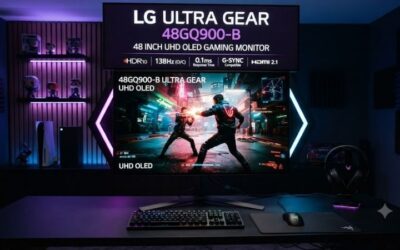
The LG UltraGear 32GS95UE-B uses a 31.5-inch 4K OLED panel with a native refresh rate of up to 240Hz. It also includes LG’s Dual Mode feature, allowing the monitor to switch from 3840 × 2160 at up to 240Hz to Full HD at up to 480Hz for extremely high-refresh PC gaming.
For PS5 users, the main attraction is HDMI 2.1 connectivity combined with the display’s 4K resolution and fast OLED response. The console itself is limited to 120Hz output, so the 240Hz capability primarily benefits PC gamers, but the extra refresh ceiling makes this monitor useful in mixed PS5 and desktop gaming setups.
Key Features
- 31.5-inch OLED display
- 3840 × 2160 resolution
- Up to 240Hz at 4K
- Up to 480Hz at 1080p Dual Mode
- 0.03ms GtG response time
- HDMI 2.1
- NVIDIA G-SYNC Compatible
- AMD FreeSync Premium Pro
- DisplayHDR True Black 400
- 1.5M:1 rated contrast ratio
- DCI-P3 98.5% typical coverage
- Adjustable stand
What Makes It Different
The biggest advantage is flexibility. A PS5 can use the monitor as a premium 4K 120Hz OLED display, while a gaming PC can push the panel beyond console limits. Switching to 1080p at up to 480Hz also gives competitive PC players an entirely different performance mode without buying a second esports monitor.
OLED response is another major benefit. LG rates the panel at 0.03ms GtG, which dramatically reduces pixel-transition blur compared with typical LCD technology. Fast camera movement, racing games, shooters, fighting games, and action titles therefore remain exceptionally clear even before the higher refresh rate is considered.
Pros
- Excellent OLED black levels
- True 4K resolution
- 240Hz PC capability
- 4K 120Hz PS5 support
- Very fast pixel response
- Strong adaptive-sync support
- Useful Dual Mode
- Excellent for PC and console sharing
Cons
- Premium pricing
- OLED requires sensible static-content management
- 32-inch size may be large for shallow desks
- PC features exceed what PS5 can use
Use Case
The 32GS95UE-B works best in a premium gaming room where one monitor handles both console and PC gaming. PS5 users can focus on 4K 120Hz modes and VRR, while PC owners can access the full 240Hz ceiling or switch to the 480Hz Full HD mode for competitive shooters.
Who It’s For
Choose this LG if image quality and motion performance matter more than minimizing cost. It is especially compelling for buyers who own a PS5 today but also use a powerful gaming PC, because the display offers substantially more performance headroom than the console alone requires.
Samsung Odyssey OLED G8 G80SD – Best OLED Alternative
Best For: Players who want 4K OLED gaming plus smart-TV-style features
The Samsung Odyssey OLED G8 G80SD uses a 32-inch 4K OLED panel with a maximum refresh rate of 240Hz and a rated 0.03ms GtG response time. Samsung provides two HDMI 2.1 ports alongside DisplayPort 1.4, making it suitable for PS5, Xbox, and PC configurations.
Samsung lists FreeSync Premium Pro and G-SYNC Compatible operation, giving the monitor strong variable-refresh support. HDR10 and HDR10+ Gaming are also supported, while the OLED panel delivers a rated 1,000,000:1 contrast ratio and 99% DCI color coverage.
Key Features
- 32-inch OLED panel
- 3840 × 2160 resolution
- Up to 240Hz refresh rate
- 0.03ms GtG response
- Two HDMI 2.1 ports
- DisplayPort 1.4
- FreeSync Premium Pro
- G-SYNC Compatible
- HDR10 and HDR10+ Gaming
- Smart TV functionality
- Built-in Wi-Fi and Bluetooth
- Integrated speakers
What Makes It Different
The G80SD goes beyond normal monitor functionality because Samsung includes the Tizen smart platform, wireless connectivity, Gaming Hub support in selected regions, and integrated speakers. This allows it to function more like a small premium television when the PS5 or gaming PC is turned off.
Samsung also incorporates OLED protection technologies and states that burn-in is covered under normal-use warranty conditions on the Vietnam product page, although warranty terms can vary by region. That is worth checking locally before purchase because OLED warranty coverage can influence long-term ownership confidence.
Pros
- Excellent OLED contrast
- 4K 240Hz panel
- HDMI 2.1
- Very fast 0.03ms response
- Strong VRR support
- Smart-TV functionality
- Built-in speakers
- Two HDMI inputs
Cons
- More expensive than value IPS monitors
- Smart features may be unnecessary for desk-only users
- OLED ownership requires attention to static images
- 240Hz cannot be fully used by PS5
Use Case
The Odyssey OLED G8 works especially well in a bedroom or compact gaming room where the same display serves PS5 gaming, PC gaming, and entertainment streaming. Its built-in smart features reduce the need for another television or streaming box and make the monitor more versatile outside gaming sessions.
Who It’s For
Choose the G80SD if you want OLED image quality but also care about entertainment features. It is less compelling for buyers who already use a dedicated television and need only a simple console monitor, because part of its value comes from the additional smart platform and integrated media functionality.
Sony INZONE M9 II – Best PS5-Focused IPS Monitor
Best For: PS5 owners who prefer an LCD display with PlayStation-specific features
Sony’s INZONE M9 II is a 27-inch 4K gaming monitor designed closely around PlayStation and PC gaming. The current model reaches up to 160Hz over DisplayPort and supports HDMI 2.1 connectivity for 4K gaming with PS5, including variable refresh rate operation.
Because the M9 II is designed within Sony’s gaming ecosystem, it includes console-friendly functionality that is more closely aligned with PS5 than most third-party monitors. It is also G-SYNC compatible for PC use, making it suitable for users who switch between a PlayStation console and an NVIDIA-powered desktop.
Key Features
- 27-inch 4K IPS display
- 3840 × 2160 resolution
- Up to 160Hz PC refresh
- HDMI 2.1
- 4K 120Hz PS5 compatibility
- HDMI VRR
- G-SYNC Compatible
- Full-array local dimming
- HDR support
- PlayStation integration
- Desk-friendly 27-inch size
What Makes It Different
The biggest advantage is integration with PS5. Sony’s INZONE series was designed specifically with its console ecosystem in mind, making the monitor attractive to users who do not want to research compatibility between several third-party implementations of VRR, HDR, and console refresh modes.
The 27-inch size is also easier to use on a conventional PC desk than 32-inch OLED models. At 4K resolution, pixel density is extremely high, giving text, menus, and games a crisp appearance. This also makes the monitor useful for productivity and mixed desktop work between gaming sessions.
Pros
- Strong PS5 integration
- 4K 120Hz console gaming
- HDMI 2.1 VRR
- Full-array local dimming
- Sharp 27-inch 4K image
- Better suited to productivity than large OLEDs
- Good PC compatibility
Cons
- IPS blacks cannot match OLED
- FALD can show blooming
- Smaller than 32-inch alternatives
- PC maximum refresh is below 240Hz OLED models
Use Case
The INZONE M9 II makes sense for a desk-based PS5 setup where viewing distance is short and image sharpness matters. It also fits users who regularly work on the same monitor because static desktop content does not carry OLED’s long-term image-retention considerations.
Who It’s For
Choose Sony’s INZONE option if PS5 is your primary gaming platform and you prefer LCD reliability and PlayStation-oriented features over OLED contrast. It is particularly attractive to buyers who use their monitor for both gaming and daily productivity.
Gigabyte M32U – Best Value 4K 120Hz HDMI 2.1 Monitor
Best For: Buyers who want proven 4K 120Hz PS5 functionality without OLED pricing
The Gigabyte M32U uses a 31.5-inch SuperSpeed IPS panel with 3840 × 2160 resolution and a maximum refresh rate of 144Hz. Gigabyte explicitly states that HDMI 2.1 supports PS5 and Xbox Series X at 4K UHD and 120Hz, making console compatibility straightforward.
The monitor includes two HDMI 2.1 ports, DisplayPort 1.4 with DSC, USB-C, a USB hub, and built-in 3W stereo speakers. It also provides a built-in KVM function, which is particularly useful when sharing the same keyboard and mouse between a gaming PC and another computer.
Key Features
- 31.5-inch SuperSpeed IPS
- 3840 × 2160 resolution
- Up to 144Hz refresh rate
- 120Hz console support
- Two HDMI 2.1 ports
- DisplayPort 1.4 DSC
- USB-C connectivity
- Built-in KVM switch
- 90% DCI-P3 coverage
- DisplayHDR 400
- 1ms MPRT
- Height-adjustable stand
What Makes It Different
The M32U focuses on value rather than exotic panel technology. It gives a PS5 exactly what is needed for 4K 120Hz gaming while also adding practical PC features such as USB-C and KVM switching. Buyers therefore spend less on features that the console cannot use, such as 240Hz or 480Hz refresh modes.
Gigabyte also states that its HDMI 2.1 implementation supports 4K 120Hz console operation, although the published PS5 specification uses 4:2:0 chroma in that mode. This is an important technical detail for buyers comparing HDMI implementations across monitors.
Pros
- Proven 4K 120Hz PS5 support
- 31.5-inch 4K display
- Two HDMI 2.1 ports
- 144Hz PC refresh
- USB-C
- Built-in KVM
- Good productivity potential
- Usually less expensive than OLED
Cons
- IPS contrast is modest
- HDR400 is limited
- 4K 120Hz PS5 uses 4:2:0 according to Gigabyte
- Motion response cannot match OLED
Use Case
The M32U is ideal for someone building a practical desk around a PS5, gaming PC, and work laptop. One monitor can provide 4K 120Hz console gaming, high-refresh PC gaming, USB-C connectivity, and KVM functionality without moving into premium OLED pricing.
Who It’s For
Choose the M32U if price-to-performance matters more than perfect blacks or cutting-edge HDR. It remains one of the easiest ways to obtain a large 4K monitor with clearly documented PS5 120Hz support and useful productivity features.
How to Choose a 4K 120Hz HDMI 2.1 Monitor for PS5
Confirm Real 4K 120Hz Support
Do not buy a monitor merely because the product page says HDMI 2.1. HDMI implementations can differ, and the display must explicitly support 3840 × 2160 at 120Hz through its HDMI input for PS5. Gigabyte, for example, directly specifies PS5 4K UHD 120Hz support on the M32U.
Look for VRR
Variable refresh rate is especially valuable on PS5 because games do not always maintain perfectly fixed performance. VRR lets the screen adapt its refresh timing to the console’s output, making frame-rate fluctuations appear smoother and reducing tearing in compatible titles.
OLED vs IPS
OLED is the best choice when black levels, motion clarity, response time, and cinematic image quality matter most. LG and Samsung’s 32-inch models provide almost instantaneous pixel response and extremely high contrast, making them particularly impressive for dark games and HDR content.
IPS is more practical if you use the display for long productivity sessions, frequently show static content, or simply want a lower-cost option. The trade-off is weaker black levels and more limited HDR contrast, although full-array local dimming can partially improve performance.
27-Inch vs 32-Inch
A 27-inch 4K monitor delivers extremely high pixel density and fits easily on standard desks. A 32-inch screen provides a more immersive experience and makes the extra detail of 4K easier to appreciate from a slightly greater viewing distance, but it needs more physical space.
HDR Quality Matters
Having an HDR logo does not guarantee strong HDR performance. OLED models benefit from pixel-level light control, while LCD monitors need effective local dimming and enough brightness to create meaningful contrast. Entry-level DisplayHDR 400 monitors provide HDR compatibility but usually cannot match premium OLED or advanced Mini LED displays.
Do You Need More Than 120Hz?
PS5 currently tops out at 120Hz, so buying a 240Hz monitor does not increase console frame rate. Higher refresh is valuable only if you also connect a powerful PC. If the monitor will be used exclusively for PlayStation, paying extra for 240Hz may provide little practical benefit.
FAQ
Does PS5 Support 4K at 120Hz?
Yes. PS5 supports 4K 120Hz output in compatible games and performance modes when connected to a suitable HDMI 2.1 display. The game itself must also provide a 120Hz mode; connecting the console to a 120Hz monitor does not force every title to run at 120fps.
Do I Need HDMI 2.1 for PS5 4K 120Hz?
For straightforward full-resolution 4K 120Hz console support, HDMI 2.1 is the interface to look for. Always confirm the monitor manufacturer’s actual supported resolutions and refresh rates because the HDMI 2.1 label alone does not describe every bandwidth or format capability.
Is OLED Better Than IPS for PS5?
OLED generally provides better black levels, faster response, and superior dark-scene contrast. IPS can be brighter in some implementations, offers excellent text clarity, and avoids OLED image-retention concerns. The better choice depends on whether gaming image quality or mixed productivity use matters more.
Is 144Hz Enough for PS5?
Yes. Because PS5 currently outputs up to 120Hz, a 144Hz monitor already has sufficient refresh-rate headroom for the console. A 240Hz monitor only becomes useful when connected to a PC capable of producing more than 120 frames per second.
What Size Monitor Is Best for PS5?
Twenty-seven inches is excellent for close desktop use, while 32 inches provides a more immersive 4K experience and works well from slightly farther away. The best size depends on desk depth, viewing distance, and whether you use keyboard-and-mouse or controller-based seating.
Conclusion
The best monitor 4K 120Hz HDMI 2.1 PS5 choice depends on budget and panel preference. LG’s 32GS95UE-B leads for premium OLED gaming, Samsung’s G80SD adds smart features, Sony INZONE suits PS5-focused IPS users, and Gigabyte M32U delivers excellent value with documented 4K 120Hz console support.
Ready to decide? Our #1 pick for 2026 is the Monitor.
Live price & availability on Amazon.