🛒 Best Price Today on Amazon
Prime members get fast, free shipping on everything above, plus member-only deals. New members get a 30-day free trial — cancel anytime.
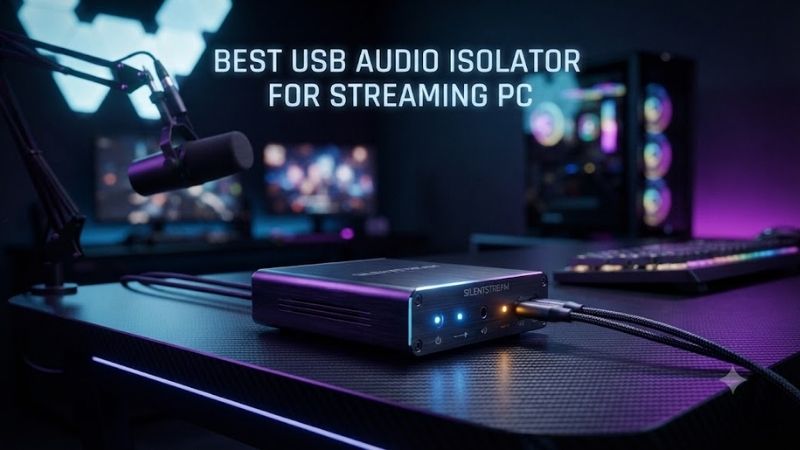
The best USB audio isolator for streaming PC systems can help resolve unwanted hum caused by electrical ground differences between a computer and compatible USB audio equipment. However, USB isolators are not interchangeable: some provide genuine galvanic isolation, while others only filter USB power noise. Choosing the correct device requires checking USB data speed, power requirements, and the audio interface’s actual connection method.
Quick Verdict
The TOPPING HS02 is our best overall recommendation for compatible USB audio interfaces because it provides USB 2.0 galvanic isolation, flexible connector options, and support for an external 5V power supply.
The Intona 7055-C is the strongest premium option for users requiring USB 3.0 SuperSpeed compatibility alongside galvanic isolation.
For simpler USB 2.0 audio installations, the TOPPING HS01 and Intona 7052-BOX offer alternatives with different connector arrangements and power requirements.
Before purchasing, confirm that USB is actually the source of the noise. A USB isolator will not solve every hum, hiss, or microphone interference problem.
Quick Comparison Table
| Product | USB Data Support | Isolation | Best For |
|---|---|---|---|
| TOPPING HS02 | USB 2.0 up to 480Mbps | Galvanic | Best overall |
| TOPPING HS01 | USB 2.0 | Galvanic | Simple audio setups |
| Intona 7052-BOX | USB 2.0 up to 480Mbps | Galvanic | USB-C connectivity |
| Intona 7055-C | USB 3.0 up to 5Gbps | Galvanic | Premium high-speed |
| Intona 7054-DK | USB 2.0 up to 480Mbps | Galvanic | Fixed installations |
| Intona 7055-D | USB 3.0 up to 5Gbps | Higher-rated galvanic isolation | Specialized equipment |
These six products provide electrical isolation rather than merely attempting to suppress USB noise with passive filtering.
How We Selected These USB Audio Isolators
We focused on identifiable devices that isolate the USB connection between a host and peripheral.
This is an important distinction because a USB noise filter is not necessarily a galvanic isolator.
Galvanic isolation prevents a direct conductive path across the designated electrical isolation barrier.
In audio setups, it can help when unwanted current flows through grounding connections and creates audible hum.
However, isolation does not guarantee lower microphone noise, better DAC measurements, or improved stream sound quality.
The actual benefit depends on the noise source and the connected equipment.
Detailed Product Recommendations
1. TOPPING HS02 — Best Overall
Best For: Streaming PCs using compatible USB DACs, audio interfaces, or other USB audio peripherals.
Why We Picked It: The HS02 provides USB 2.0 isolation with selectable USB-C and conventional USB connections, making it flexible for different computer setups.
Key Specifications
-
USB 2.0 support
-
Low-, full-, and high-speed USB modes
-
USB-B and USB-C input options
-
USB-A and USB-C output options
-
External 5V power connection
-
Isolated downstream power capability
-
Compact metal enclosure
Features and Benefits
The HS02 is designed to separate the USB host and peripheral electrically while preserving supported USB communication.
This is useful when connecting a computer to an audio device creates a ground-loop-related hum.
Its multiple connector options reduce the need for unusual adapters.
For bus-powered devices, an appropriate external 5V supply may be required to provide sufficient downstream power.
Performance and Practical Use
The HS02 supports USB 2.0 operation, including high-speed data rates.
This makes it more suitable for many USB audio devices than basic full-speed-only isolators.
However, users should verify the audio interface’s USB requirements and power consumption.
A device drawing more current than the isolated output can provide may disconnect or malfunction.
Pros
-
Genuine galvanic isolation.
-
Flexible USB connectors.
-
USB 2.0 high-speed support.
-
External power option.
Cons
-
No USB 3.x SuperSpeed support.
-
Some devices require additional power.
Buy If: You want an audio-focused USB isolator with flexible connections.
Skip If: Your device requires USB 3.0 bandwidth.
2. TOPPING HS01 — Best Simple USB Audio Isolator
Best For: Users with a straightforward USB DAC or compatible audio interface.
Why We Picked It: The HS01 provides a more basic isolation arrangement for users who do not need the HS02’s multiple connector options.
Key Specifications
-
Product: TOPPING HS01
-
USB data isolation
-
USB audio compatibility
-
Compact inline design
-
USB 2.0-class operation
-
External power requirements depend on connected equipment
Features and Benefits
The HS01 provides a dedicated connection between a computer and compatible USB audio hardware.
Its primary function is breaking an unwanted electrical ground path while allowing supported data communication.
This can be useful in streaming setups where connecting a USB interface introduces hum through powered monitors or other equipment.
Performance and Practical Use
The HS01 should not be purchased based solely on claims of improved digital audio quality.
A correctly functioning USB audio link already transfers digital data reliably.
The practical reason to use isolation is a diagnosed electrical noise problem.
Pros: Compact form, dedicated USB isolation, straightforward installation.
Cons: Fewer connection options, device power compatibility needs checking.
Buy If: You have a compatible USB audio peripheral and need a simple isolator.
Skip If: You require USB 3.x bandwidth or advanced connector flexibility.
3. Intona 7052-BOX — Best USB-C Isolation Option
Best For: USB-C streaming setups needing high-speed USB 2.0 galvanic isolation.
Why We Picked It: The 7052-BOX provides an integrated USB-C connection arrangement while supporting USB 2.0 high-speed communication.
Key Specifications
-
USB-C input and output
-
USB 2.0 data support up to 480Mbps
-
Galvanic isolation
-
Isolated downstream power capability
-
Compact enclosure
-
Intended applications include audio and video equipment
Features and Benefits
Many modern audio interfaces and laptops use USB-C connections.
The 7052-BOX is particularly useful when the user wants a compact isolator without relying on several adapters.
Its high-speed USB 2.0 support is more flexible than older isolators limited to 12Mbps.
Performance and Practical Use
USB-C connector shape does not mean USB 3.0 or USB4 bandwidth is available.
This product remains a USB 2.0 isolator.
High-bandwidth devices such as capture cards should not be assumed compatible merely because they use USB-C plugs.
Pros
-
USB-C connection.
-
High-speed USB 2.0 support.
-
Genuine isolation.
-
Compact construction.
Cons
-
Not USB 3.0.
-
Downstream power limits apply.
Buy If: You want USB-C galvanic isolation for a supported audio device.
Skip If: Your peripheral requires more than USB 2.0 bandwidth.
4. Intona 7055-C — Best Premium High-Speed Isolator
Best For: Advanced streaming and audio/video systems requiring USB 3.0 compatibility.
Why We Picked It: The 7055-C provides galvanic USB isolation while supporting both USB 2.0 and USB 3.0 traffic.
Key Specifications
-
USB 3.0 support up to 5Gbps
-
USB 2.0 support up to 480Mbps
-
Galvanic isolation
-
USB-A and USB-B connections
-
Optional auxiliary power input
-
Aluminum enclosure
-
Isolated output power capability
Features and Benefits
The 7055-C is different from most consumer-oriented USB audio isolators because it supports SuperSpeed USB operation.
This can be important when connecting higher-bandwidth USB equipment.
It also offers auxiliary power support for devices that need more current than the normal isolated output supplies.
Performance and Practical Use
The main disadvantage is cost and complexity.
A streamer using an ordinary USB 2.0 DAC may not receive any additional practical benefit from USB 3.0 capability.
The 7055-C makes the most sense when actual hardware requirements justify its wider compatibility.
Pros
-
USB 3.0 SuperSpeed support.
-
USB 2.0 backward compatibility.
-
Genuine galvanic isolation.
-
Auxiliary power option.
Cons
-
Premium cost.
-
Larger than compact inline isolators.
-
Unnecessary for many basic USB audio setups.
Buy If: You need high-bandwidth USB isolation for a demanding equipment chain.
Skip If: A compatible USB 2.0 isolator already addresses your problem.
5. Intona 7054-DK — Best for Fixed USB Audio Installations
Best For: Dedicated streaming stations with stable USB 2.0 equipment connections.
Why We Picked It: The 7054-DK provides galvanic USB 2.0 isolation with a more installation-oriented enclosure and conventional connectors.
Key Specifications
-
USB 2.0 support up to 480Mbps
-
USB-B host-side connection
-
USB-A device-side connection
-
Galvanic isolation
-
External enclosure
-
Limited isolated downstream current
Features and Benefits
The 7054-DK is appropriate for equipment chains where the isolator remains permanently connected.
For example, a USB audio interface can be connected to the device while the host computer remains separated through the intended isolation barrier.
Its conventional connector arrangement may also suit existing USB-B and USB-A cabling.
Performance and Practical Use
The isolated output-current limit is an important consideration.
Some bus-powered interfaces require more power than a compact isolator can provide.
Verify current consumption and supported data modes before purchasing.
Pros
-
Genuine isolation.
-
High-speed USB 2.0 support.
-
Appropriate for fixed equipment chains.
Cons
-
Limited downstream power.
-
Less convenient connector arrangement for USB-C-only systems.
Buy If: You want a dedicated USB 2.0 isolator for a fixed streaming desk.
Skip If: You have a high-current bus-powered peripheral without suitable independent power.
6. Intona 7055-D — Best Specialized High-Isolation Option
Best For: Advanced studio, measurement, and production installations with demanding isolation requirements.
Why We Picked It: The 7055-D supports USB 3.0 and USB 2.0 while providing a higher-rated isolation design.
Key Specifications
-
USB 3.0 support up to 5Gbps
-
USB 2.0 support up to 480Mbps
-
Manufacturer-rated 5kV RMS isolation
-
Aluminum enclosure
-
Auxiliary downstream power option
-
Industrial-oriented design
Features and Benefits
The 7055-D is designed for environments where electrical separation and USB compatibility are important technical requirements.
For ordinary streaming audio, its isolation rating is more than a practical recommendation criterion by itself.
A higher isolation-voltage specification does not guarantee quieter recordings than a correctly matched lower-rated isolator.
Performance and Practical Use
The 7055-D is best treated as a specialized tool.
It may be useful when audio equipment shares a system with demanding industrial or measurement hardware.
However, the user must follow all manufacturer safety and installation restrictions.
It should not be selected as a workaround for defective electrical wiring.
Pros
-
High-speed USB compatibility.
-
Higher-rated isolation design.
-
Auxiliary power flexibility.
Cons
-
Expensive and specialized.
-
Unnecessary for many home streaming PCs.
-
Does not replace proper electrical safety practices.
Buy If: You have a documented need for high-performance USB galvanic isolation.
Skip If: Your only issue is ordinary microphone hiss or poor gain staging.
Buying Guide: Choosing a USB Audio Isolator
Confirm That the Noise Is a Ground-Loop Problem
A USB isolator is most appropriate when a conductive connection between devices creates unwanted noise.
A practical diagnostic step is checking whether the hum changes when the USB connection is removed.
However, never disconnect protective earth wiring or modify mains power connections as a troubleshooting method.
Distinguish Galvanic Isolation From Noise Filtering
A genuine galvanic isolator breaks the direct electrical path across its isolation barrier.
A USB noise filter may instead reduce interference without providing equivalent isolation.
These products are not interchangeable.
Choose based on the diagnosed problem.
Check USB Data Speed
USB low speed operates at 1.5Mbps, full speed at 12Mbps, and USB 2.0 high speed at 480Mbps.
USB 3.0 SuperSpeed reaches 5Gbps.
An audio interface requiring high-speed USB 2.0 may not work correctly through a full-speed-only isolator.
Likewise, a USB 3.0 peripheral may require a more capable product.
Understand Isolated Power
Some USB peripherals draw power from the USB port.
An isolator may provide limited downstream power through an internal conversion circuit.
Others support an auxiliary power supply.
The power arrangement must meet the connected device’s requirements while preserving the intended isolation.
Consider Audio Interface Compatibility
Not every USB interface behaves identically.
Driver requirements, USB endpoint modes, data throughput, and power consumption all affect compatibility.
The manufacturer-supported USB version is a starting point, not an absolute guarantee.
Diagnose Analog Noise Separately
Noise from unbalanced analog cables, microphone preamplifiers, or poorly configured gain may remain after USB isolation.
If the hum exists even when the USB device is disconnected, investigate the analog signal path.
A USB isolator is not a universal audio repair accessory.
Frequently Asked Questions
Does a USB isolator remove microphone hiss?
Not necessarily. Microphone hiss often comes from preamp noise, microphone sensitivity, or gain settings rather than a USB ground loop.
Can a USB isolator improve stream sound quality?
It may remove a diagnosed electrical hum, but it does not inherently improve a correctly functioning digital audio signal.
Will a 12Mbps USB isolator work with every audio interface?
No. Some interfaces require USB 2.0 high-speed operation at 480Mbps.
Can I use a USB isolator with a capture card?
Only if the isolator supports the capture card’s USB bandwidth, power, and data-transfer requirements.
Is a USB isolator safe for fixing electrical grounding problems?
It is not a substitute for proper electrical safety or repairing defective wiring.
Conclusion
The TOPPING HS02 is the strongest overall recommendation among the best USB audio isolator for streaming PC options for compatible USB 2.0 audio equipment. Choose the Intona 7052-BOX for USB-C connectivity or the Intona 7055-C when USB 3.0 support is genuinely required. Before purchasing, diagnose the noise source and confirm both data-speed compatibility and isolated downstream power requirements.