🛒 Best Price Today on Amazon
Prime members get fast, free shipping on everything above, plus member-only deals. New members get a 30-day free trial — cancel anytime.

Logitech G PRO X Superlight 2 Lightspeed Wireless Gaming Mouse, 8K Polling, Lightweight, LIGHTFORCE Hybrid Switches, Hero 2 Sensor, 888 IPS, 44,000 DPI,USB-C Charging, PC & Mac (Renewed)
Included for 'Best Mouse for CS2: Top Picks for Competitive Aim in 2026' because the listing specifies 8K Polling and Lightweight, details this guide uses to compare options.
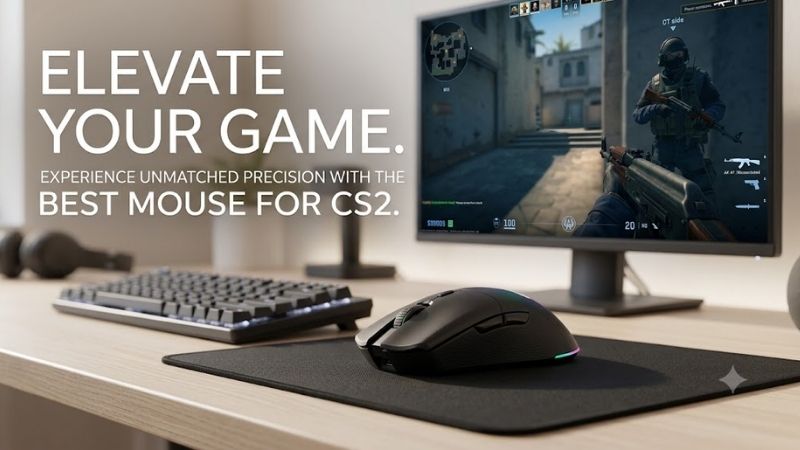
View on AmazonThe best mouse for CS2 should make crosshair placement, micro-corrections, flicks, and spray transfers feel predictable without fighting your grip. For most competitive players, shape comes first, then low weight, reliable wireless or wired input, crisp clicks, stable tracking, and a polling rate your PC can handle consistently.
Best Mouse for CS2: Quick Comparison
| Mouse | Best For | Shape | Weight | Max Polling Rate |
|---|---|---|---|---|
| Razer Viper V3 Pro | Lightweight competitive wireless | Right-handed symmetrical | 54 g black / 55 g white | 8,000 Hz |
| Logitech G PRO X SUPERLIGHT 2 | Versatile competitive use | Symmetrical | 60 g | 8,000 Hz |
| Endgame Gear OP1 8k v2 | Compact claw grip | Symmetrical | 49.5 g | 8,000 Hz |
| Pulsar X2H v3 Mini | High-hump claw grip | Symmetrical | 51 g ± 1 g | Up to 8,000 Hz with compatible dongle |
| Logitech G PRO X SUPERLIGHT 2 DEX | Right-handed ergonomic control | Asymmetrical | 60 g | 8,000 Hz |
Razer Viper V3 Pro
Best For: Lightweight wireless competitive play
Key Features
- Focus Pro 35K Optical Sensor Gen-2
- 35,000 DPI maximum sensitivity
- 54 g black / 55 g white
- HyperPolling up to 8,000 Hz
- 2.4 GHz wireless and wired operation
- Optical Mouse Switches Gen-3
- Up to 95 hours at 1,000 Hz
Razer’s Viper V3 Pro fits CS2 players who want a low-mass wireless mouse with a centered, symmetrical shape that supports fast wrist corrections and broad arm swipes. Its flatter sides and moderate rear profile suit claw and relaxed claw grips especially well, while the wide front gives the main buttons a stable landing area during repeated taps.
What Makes It Different
What separates it from older esports mice is the combination of very low weight, high polling support, and a modern optical sensor in a shell that remains simple rather than feature-heavy. In CS2, that favors players who care about raw aim consistency and fast resets more than extra buttons, RGB, or productivity controls.
Pros
- Very low weight for large low-sensitivity movements
- Up to 8,000 Hz wireless polling
- Simple competitive layout
- Strong fit for claw and relaxed claw grip
- Long battery life at lower polling settings
Cons
- Higher polling rates reduce battery life
- Symmetrical profile offers less palm support than ergonomic mice
- Shape may feel long for smaller hands
Use Case
Choose the Viper V3 Pro if you use medium or large hands with claw, relaxed claw, or hybrid fingertip grip and want minimal resistance during wide swings. Its shape rewards players who lift and reset often. The main limitation is preference: gamers who need strong palm support may feel less anchored than on a pronounced ergonomic shell.
Who It’s For
CS2 riflers, entry players, and low-sensitivity users who make frequent arm movements should appreciate the low weight and uncluttered shell. It also makes sense for high-refresh setups where higher polling can be used without destabilizing frame delivery. Palm-heavy players should compare it directly with an ergonomic alternative before buying.
Logitech G PRO X SUPERLIGHT 2
Best For: Familiar all-round competitive shape
Key Features
- HERO 2 sensor
- 100–44,000 DPI
- 60 g weight
- LIGHTSPEED wireless
- Up to 8,000 Hz report rate
- LIGHTFORCE hybrid switches
- Up to 95 hours of constant-motion battery life
The Logitech G PRO X SUPERLIGHT 2 remains a strong CS2 option for players who want a familiar, neutral shape that works across several grip styles. Its rounded hump fills the palm more than a very flat FPS shell, while the narrow waist gives claw and fingertip users enough room to guide small horizontal corrections around head level.
What Makes It Different
Its main advantage is balance rather than an extreme shape. The shell is easy to adapt to, the wireless platform is built for competitive use, and onboard memory keeps settings portable. The trade-off is that users seeking a deep ergonomic thumb groove or a tiny claw shell may prefer a more specialized design.
Pros
- Neutral shape works with several grip styles
- Up to 8,000 Hz LIGHTSPEED polling
- HERO 2 sensor with broad DPI adjustment
- Low 60 g weight
- Onboard memory
Cons
- Shape is less specialized than high-hump claw mice
- Some players may prefer softer mechanical click feel
- Minimal button layout limits non-gaming functions
Use Case
Choose the SUPERLIGHT 2 if you want one mouse that can cover entry fragging, rifling, AWP play, and general desktop use without forcing an aggressive grip. Its neutral dimensions are easier to share across different hand positions than a specialized mini shell. The compromise is that neutral shapes can feel less locked-in for strict claw users.
Who It’s For
This model fits players who do not want their mouse shape to dictate a specific technique. It works especially well for users moving between palm-claw, relaxed claw, and fingertip variations during a session. CS2 players upgrading from older medium-sized symmetrical mice may find the adjustment period shorter than with a highly sculpted shell.
Endgame Gear OP1 8k v2
Best For: Compact claw grip and wired 8K polling
Key Features
- PixArt PAW3950 sensor
- Up to 30,000 CPI
- 49.5 g weight
- 1,000 / 2,000 / 4,000 / 8,000 Hz polling
- Wired USB connection
- Kailh GX mechanical main switches
- 118.2 × 60.5 × 37.2 mm dimensions
The Endgame Gear OP1 8k v2 is best for claw-focused players who prefer a compact wired mouse and want very high polling without relying on a battery. Its narrow body encourages precise finger steering, while the rear hump gives the palm a defined anchor point. That combination can feel controlled during counter-strafing and short burst corrections.
What Makes It Different
Because it is wired, the OP1 8k v2 makes the most sense for desk setups where a light cable and bungee are acceptable. In return, players get a low-weight shell, an 8,000 Hz ceiling, and a shape aimed at direct control rather than broad palm support. Larger hands using full palm grip may find the chassis too short or narrow for comfort.
Pros
- Very light 49.5 g design
- Native wired 8,000 Hz polling
- Narrow shell supports finger control
- Compact dimensions work well for claw grip
- No battery management
Cons
- Wired connection requires cable management
- Compact size may not suit large palm grips
- Narrow sides can feel demanding for relaxed grips
Use Case
Choose the OP1 8k v2 if you value a compact claw shape, direct wired input, and easy access to high polling rates. It works particularly well for players who plant the rear of the mouse against the lower palm and steer with fingertips. Skip it if cable-free movement or broad palm support matters more than its narrow control-oriented chassis.
Who It’s For
This mouse makes the most sense for competitive players who keep their hand relatively tense and use the fingers to fine-tune crosshair placement after larger arm movements. It is particularly relevant to low- or medium-sensitivity riflers who want a narrow contact area rather than a shell that fills the entire hand during every movement.
Pulsar X2H v3 Mini
Best For: Aggressive claw and palm-claw grip
Key Features
- Pulsar XS-1 sensor
- 32,000 DPI
- 51 g ± 1 g listed weight
- Symmetrical high-hump design
- 1,000 Hz standard polling
- Up to 8,000 Hz with compatible dongle
- Optical switches
The Pulsar X2H v3 Mini targets players who like a compact mouse with a noticeably higher rear hump. That geometry gives claw and palm-claw users more contact under the back of the hand, which can steady repeated micro-adjustments. The narrow waist also leaves room for the thumb and ring finger to pull the shell into small corrections.
What Makes It Different
Compared with flatter symmetrical mice, the X2H v3 Mini feels more locked in at the rear and less open in the palm. That suits CS2 players who rely on claw tension and controlled stops, but it can feel restrictive for fingertip grip or broad palm movement. Its optional higher polling support also requires a compatible dongle.
Pros
- High rear hump supports claw anchoring
- Compact footprint
- Low listed weight
- Optical switches
- Optional high polling support
Cons
- 8,000 Hz requires a compatible additional dongle
- Rear hump may interfere with fingertip movement
- Mini sizing can be restrictive for large hands
Use Case
Choose the X2H v3 Mini if your hand naturally forms an aggressive claw and you want the rear of the mouse to meet the palm sooner. The high hump can make stopping feel deliberate when snapping between CS2 angles. It is less ideal for large hands using palm grip, and fingertip players may find the rear profile more intrusive than necessary.
Who It’s For
The X2H v3 Mini suits players who deliberately brace the rear of a mouse against the palm to create a repeatable stopping point. That can help when alternating between fast angle clears and tiny corrections onto a head. Players who prefer a loose, mobile fingertip grip should consider a flatter shell with less rear contact instead.
Logitech G PRO X SUPERLIGHT 2 DEX
Best For: Right-handed ergonomic CS2 players
Key Features
- HERO 2 sensor
- 100–44,000 DPI
- 60 g weight
- Asymmetrical right-handed shape
- Up to 8,000 Hz LIGHTSPEED polling
- LIGHTFORCE switches
- Up to 95 hours of battery life
The Logitech G PRO X SUPERLIGHT 2 DEX is aimed at right-handed players who want the familiar Logitech competitive platform in an asymmetrical shell. Its fuller right-side support and ergonomic contour can reduce the need to squeeze the mouse during long sessions, while the 60 g weight keeps broad low-sensitivity swipes from feeling heavy.
What Makes It Different
The DEX differs from the standard SUPERLIGHT 2 mainly through shape, not by becoming a button-heavy ergonomic mouse. That suits CS2 players who want right-hand support without giving up a stripped-down esports layout. Players who rotate the mouse heavily with the fingertips may still prefer straighter, symmetrical sides.
Pros
- Ergonomic right-handed shape
- Low 60 g weight
- HERO 2 sensor
- Up to 8,000 Hz LIGHTSPEED wireless
- Strong palm and palm-claw support
Cons
- Right-handed shape is less flexible for grip rotation
- Fuller shell may feel large to small hands
- Less fingertip freedom than flatter symmetrical designs
Use Case
Choose the SUPERLIGHT 2 DEX if you want a right-handed ergonomic shape but still prefer the simple five-button approach common to competitive mice. It is especially relevant for medium or large hands using palm-claw or relaxed claw. The fuller shell can feel substantial for small hands, so shape fit matters more here than the specification sheet.
Who It’s For
DEX is worth considering if symmetrical esports mice make you squeeze too hard or leave the outer side of the hand unsupported. Its asymmetrical body encourages a more settled right-hand position, which can be comfortable through long practice blocks. Players who constantly adjust grip angle may prefer the standard SUPERLIGHT 2 instead.
How to Choose the Best Mouse for CS2
Shape Comes Before Maximum DPI
Shape matters more than maximum DPI because CS2 aim depends on repeatable hand positioning. A symmetrical shell gives more freedom for claw and fingertip rotation, while an ergonomic shell offers stronger palm and thumb support. Choose the profile that lets you stop, reset, and re-center the mouse without changing your grip during a round.
Consider Weight With Your Sensitivity
Lower weight can make low-sensitivity arm movement easier, especially when clearing wide angles or transferring between targets. It does not automatically improve accuracy, though. Very light mice can feel twitchy if your hand relies on mass for braking, so the useful target is a weight that lets you accelerate and stop naturally on your usual pad.
Use Polling Rates Your PC Can Sustain
Polling rate controls how often the mouse reports position to the PC. Higher settings can reduce the interval between reports, but they also increase CPU and USB workload. For CS2, use the highest rate your system can sustain without frametime instability. A stable 1,000 or 2,000 Hz setup can be preferable to 8,000 Hz that causes stutter.
Match the Mouse to Your Grip
Claw players often benefit from a defined rear hump and narrow waist because those features give the fingers leverage for micro-corrections. Fingertip users usually prefer a shorter, flatter shell with easy front-to-back movement. Palm users should prioritize length and side support that keep the hand relaxed during wide swipes.
Do Not Buy Based on Sensor DPI Alone
Modern flagship sensors already exceed the speed and DPI needs of normal CS2 play, so maximum sensitivity should not drive the purchase. What matters is consistent tracking at your chosen DPI, sensible lift-off behavior, and settings that save correctly. Once those basics are covered, shell fit usually changes aim feel more than sensor branding.
Pay Attention to Click Feel
Click feel matters in CS2 because tap firing, burst control, utility binds, and rapid weapon inputs depend on predictable actuation. Optical or hybrid switches can reduce concerns about mechanical debounce, but stiffness and travel still vary by mouse. Pick a click that you can repeat quickly without tensing the index finger during long sessions.
FAQ
What DPI Is Best for CS2?
For most players, 800 to 1600 DPI is a practical range because it gives fine desktop control while keeping CS2 sensitivity easy to tune. The exact value matters less than your effective sensitivity, which is DPI multiplied by in-game sensitivity. Keep the setting consistent so your hand learns the same distance for common turns and corrections.
Is a Wireless Mouse Good Enough for Competitive CS2?
A wireless mouse can be fully suitable for competitive CS2 when it uses a modern low-latency 2.4 GHz connection and the receiver is positioned properly. Wired models still remove battery management and can be attractive for fixed desks. The better choice is the connection that stays reliable while preserving the shape and weight you prefer.
Do You Need 8,000 Hz Polling for CS2?
You do not need 8,000 Hz polling to play CS2 well. Higher polling can make motion updates more frequent, but the practical benefit depends on frame rate, display refresh rate, CPU headroom, and system stability. Start at 1,000 or 2,000 Hz, then test higher settings only if frametimes remain smooth during real matches.
Is a Lighter Mouse Better for CS2?
A lighter mouse often helps low-sensitivity players because large arm movements demand less effort, but shape and stopping control still matter more than the lowest possible gram count. If a mouse is too small or slippery, you may grip harder and lose consistency. Favor the lightest model that still gives your fingers predictable contact points.
What Mouse Features Matter Most for CS2?
For CS2, the most useful mouse features are a consistent sensor, dependable clicks, secure grip shape, low-friction feet, and a stable wired or wireless connection. Extra side buttons, RGB, tilt wheels, and productivity controls rarely improve aiming. Spend your attention on fit, weight balance, and settings you can reproduce across PCs.
Conclusion
The best mouse for CS2 is the one that matches your grip and lets you repeat the same stop, flick, and micro-correction under pressure. The Viper V3 Pro favors low-mass wireless speed, the SUPERLIGHT 2 offers a neutral shape, the OP1 8k v2 suits compact claw control, and the DEX adds right-hand ergonomic support.