🛒 Best Price Today on Amazon
Prime members get fast, free shipping on everything above, plus member-only deals. New members get a 30-day free trial — cancel anytime.
- Best Mouse for Apex Legends at a Glance
- Razer Viper V3 Pro — Best for Competitive Wireless Tracking
- Logitech G PRO X SUPERLIGHT 2 — Best All-Round Apex Mouse
- Pulsar X2H v3 — Best for Claw Grip
- Endgame Gear OP1 8k v2 — Best Wired Mouse for Apex Legends
- Which Apex Legends Mouse Shape Should You Choose?
- How to Choose the Best Mouse for Apex Legends
- FAQ
- Conclusion

Logitech G PRO X Superlight 2 Lightspeed Wireless Gaming Mouse, 8K Polling, Lightweight, LIGHTFORCE Hybrid Switches, Hero 2 Sensor, 888 IPS, 44,000 DPI,USB-C Charging, PC & Mac (Renewed)
Included for 'Best Mouse for Apex Legends: 5 Competitive Picks for 2026' because the listing specifies 8K Polling and Lightweight, details this guide uses to compare options.
View on Amazon
Logitech G PRO X Superlight 2 DEX Wireless Gaming Mouse, 60g pro-Grade Right-Handed Mouse with 5 programmable Buttons, USB-C Charging, 44k DPI Sensor, up to 8 kHz Polling for PC/Mac - Black (Renewed)
Included for 'Best Mouse for Apex Legends: 5 Competitive Picks for 2026' because the listing specifies 60g pro-Grade Right-Handed Mouse with 5 programmable Buttons and USB-C Charging, details this guide uses to compare options.
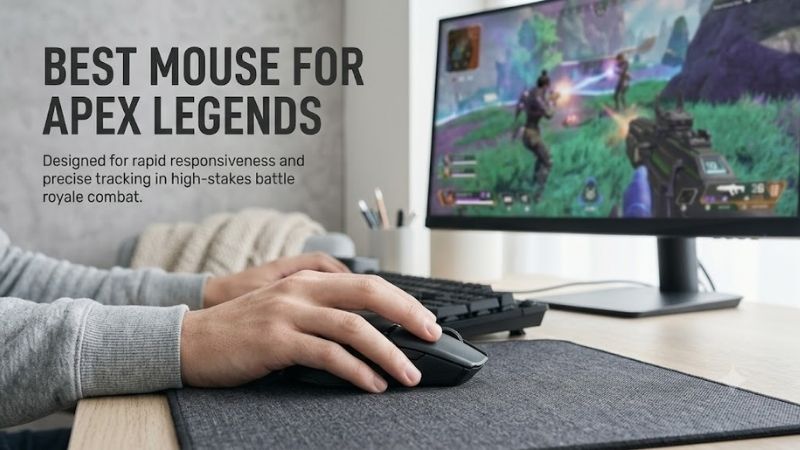
View on AmazonThe best mouse for Apex Legends should feel light, predictable, and easy to control through long tracking fights, fast armor swaps, and sudden close-range turns. This roundup focuses on competitive shapes, low weight, reliable sensors, and polling options that suit players who value consistent aim over extra buttons or flashy features.
Best Mouse for Apex Legends at a Glance
| Mouse | Best For | Weight | Polling Rate | Connection |
|---|---|---|---|---|
| Razer Viper V3 Pro | Competitive wireless tracking | 54 g black / 55 g white | Up to 8,000 Hz | 2.4 GHz wireless / wired |
| Logitech G PRO X SUPERLIGHT 2 | Balanced all-round FPS use | 60 g | Up to 8,000 Hz | LIGHTSPEED wireless / wired |
| Pulsar X2H v3 | Claw and palm-claw grip | 53 g ±1 g | Up to 8,000 Hz* | 2.4 GHz wireless / wired |
| Endgame Gear OP1 8k v2 | Narrow claw grip and wired setups | 49.5 g | Up to 8,000 Hz | Wired |
*Pulsar requires a separately purchased compatible 8K dongle for the X2H v3’s 8,000 Hz wireless mode.
Razer Viper V3 Pro — Best for Competitive Wireless Tracking
Razer’s Viper V3 Pro is built around a light 54 g black chassis, a right-handed symmetrical shape, and up to 8,000 Hz polling. That combination favors fast micro-corrections and long tracking sweeps in Apex, while the large shape works best for players who want more palm support than very small fingertip-focused mice provide.
Best For: Competitive Apex players using claw, relaxed claw, or hybrid grips.
Key Features
- Focus Pro Optical Sensor Gen-2
- Up to 35,000 DPI
- Up to 8,000 Hz HyperPolling
- 54 g black / 55 g white
- Optical Mouse Switches Gen-3
- 2.4 GHz wireless and wired modes
- Up to 95 hours at 1,000 Hz
- 127.1 × 63.9 × 39.9 mm
What Makes It Different: The Viper V3 Pro combines a relatively long esports shell with very low weight, giving players room to stabilize the hand without making large tracking movements feel heavy.
Pros
- Very low weight for its overall dimensions
- Up to 8 kHz polling without an optional receiver
- Long shell suits medium and larger hands
- Optical primary switches
- Strong battery specification at 1,000 Hz
Cons
- 8 kHz operation reduces battery life substantially
- Shape may feel too large for small-hand fingertip users
- Minimal button layout compared with MMO-style mice
Use Case: Ranked Apex, high-refresh competitive play, low-to-medium sensitivity, and players who need quick target transitions.
Who It’s For: Players wanting an ultralight wireless mouse without moving to an unusually small shell.
Logitech G PRO X SUPERLIGHT 2 — Best All-Round Apex Mouse
The Logitech G PRO X SUPERLIGHT 2 remains a strong fit for Apex players who want a simple, familiar esports shape with little adjustment time. At 60 g, it stays light enough for broad low-sensitivity swipes, while HERO 2 tracking, LIGHTSPEED wireless, and up to 8 kHz reporting give it a modern competitive feature set.
Best For: Players who want a neutral competitive shape rather than an aggressive grip-specific design.
Key Features
- HERO 2 sensor
- 100–44,000 DPI
- 60 g weight
- Up to 8,000 Hz report rate
- LIGHTSPEED wireless
- LIGHTFORCE switches
- Up to 95 hours of constant-motion battery life
- USB-C charging
What Makes It Different: Its shape avoids an especially narrow waist, extreme rear hump, or strongly ergonomic right-hand contour, making it easier to adapt across common FPS grip styles.
Pros
- Straightforward esports-focused button layout
- Lightweight without being extremely small
- Up to 8 kHz wireless reporting
- Long stated battery life
- USB-C charging
Cons
- 60 g is heavier than several newer ultralight competitors
- Players wanting a pronounced claw-grip hump may prefer another shape
- Few additional buttons for players who bind many Apex actions to the mouse
Use Case: Players switching between tracking, flicking, looting, and general FPS games without wanting a specialized mouse shape.
Who It’s For: Apex players seeking an uncomplicated wireless esports mouse that can accommodate several common grip styles.
Pulsar X2H v3 — Best for Claw Grip
Pulsar’s X2H v3 stands out for its high hump and narrow waist, a shape aimed at claw and palm-claw users who want stronger rear-palm contact. Its 53 g weight keeps direction changes quick, while the XS-1 sensor and optional 8 kHz polling support fast tracking. Players who dislike pronounced humps should look elsewhere.
Best For: Claw and palm-claw players who use the rear of the mouse as a stable contact point.
Key Features
- XS-1 sensor
- Up to 32,000 DPI
- 53 g ±1 g
- 120.4 × 65 × 39 mm
- 1,000 Hz included configuration
- Up to 8,000 Hz with optional dongle
- Optical switches
- Symmetrical high-hump shape
What Makes It Different: The high rear section fills more of the back of the hand than flatter symmetrical designs, while the narrow waist gives the thumb and fingers a more defined gripping area.
Pros
- Low 53 g weight
- Distinctive rear-hump design
- Optical switches
- Fine DPI adjustment in 10-unit increments
- Optional high polling support
Cons
- 8K dongle is not included with the standard model
- High hump is less suitable for players who avoid palm contact
- Shape is more specialized than neutral esports mice
Use Case: Tracking-heavy fights where a claw grip helps stabilize micro-adjustments while maintaining fast lateral movement.
Who It’s For: Players who already know they prefer rear-hump mice or use an aggressive to relaxed claw grip.
Endgame Gear OP1 8k v2 — Best Wired Mouse for Apex Legends
The Endgame Gear OP1 8k v2 is the wired option here, and that is exactly why it can make sense for a desk-bound competitive setup. Its 49.5 g body, narrow dimensions, and 8,000 Hz polling suit claw-oriented control and rapid corrections. The cable removes battery concerns, but it also makes a good bungee more important.
Best For: Claw players wanting a narrow, lightweight wired competitive mouse.
Key Features
- Custom PixArt PAW3950 sensor
- Up to 30,000 CPI
- 49.5 g weight
- 118.2 × 60.5 × 37.2 mm
- 1,000 / 2,000 / 4,000 / 8,000 Hz polling
- Kailh GX mechanical primary switches
- Flexible 1.8 m USB cable
- PTFE glides
What Makes It Different: Its narrow body and sub-50 g construction provide a distinctly compact feeling compared with the wider wireless options, while native wired 8 kHz operation avoids battery management.
Pros
- Lowest listed weight in this comparison
- Native 8 kHz polling
- Narrow competitive shape
- No charging required
- Multiple polling settings
Cons
- Wired connection introduces possible cable drag
- Narrow shell may feel restrictive for large hands
- Less convenient for portable wireless setups
Use Case: Fixed gaming desks, mouse-bungee setups, claw grip, and players prioritizing minimal weight without needing wireless convenience.
Who It’s For: Competitive Apex players comfortable with a cable and looking for a narrow, lightweight shell.
Which Apex Legends Mouse Shape Should You Choose?
For most Apex players, shape should decide the shortlist before maximum DPI or polling rate. Viper V3 Pro offers a longer, fuller shell; SUPERLIGHT 2 uses a balanced mainstream esports shape; X2H v3 adds a stronger rear hump; and OP1 8k v2 is noticeably narrower. Match the shell to your grip before chasing specifications.
| Grip Preference | Strong Match |
|---|---|
| Relaxed claw | Razer Viper V3 Pro |
| Mixed grip styles | Logitech G PRO X SUPERLIGHT 2 |
| Claw / palm-claw | Pulsar X2H v3 |
| Narrow claw grip | Endgame Gear OP1 8k v2 |
| Wireless low-sensitivity play | Viper V3 Pro / SUPERLIGHT 2 |
| Wired competitive setup | OP1 8k v2 |
How to Choose the Best Mouse for Apex Legends
Weight and Fast Tracking
Low weight helps most when your Apex sensitivity requires broad arm movement, repeated target switching, or quick 180-degree turns after a slide or grapple. A lighter mouse reduces inertia, but extremely low mass is not automatically easier to aim with. Players who overcorrect may prefer a slightly fuller shape that adds control.
Polling Rate
A higher polling rate can reduce the time between mouse reports, but it also increases CPU and battery demands. In Apex, 1,000 Hz is already practical for many systems, while 2,000 to 8,000 Hz makes more sense with a fast monitor and a PC that can hold high frame rates. Treat polling as fine-tuning, not a substitute for good aim.
Grip Style and Mouse Shape
Claw grip often benefits from a defined rear hump because the palm has a stable contact point while the fingers stay ready for rapid clicks. Fingertip users usually want less shell under the palm, while relaxed palm users need enough length and width to avoid tension. Hand size and grip style matter more than brand reputation.
Sensor and DPI
Modern esports sensors from major gaming brands already offer far more sensitivity than most Apex players use. What matters more is stable tracking, predictable lift-off behavior, and software that lets you set a repeatable DPI. Choose one DPI and build muscle memory around it instead of changing sensitivity whenever your aim feels off.
FAQ
Is a Lightweight Mouse Better for Apex Legends?
A very light mouse can help in Apex because the game rewards constant tracking, fast target transitions, and large corrections during movement-heavy fights. Still, lighter is not always better. If your hand feels tense or your crosshair becomes unstable, a slightly larger or more supportive shape may produce better consistency.
Do You Need 8,000 Hz Polling for Apex Legends?
You do not need 8,000 Hz polling to play Apex competitively. A stable 1,000 Hz connection is already responsive, while higher rates mainly reduce report intervals further. The benefit is easiest to notice on high-refresh displays and powerful PCs. If frame rate drops or battery life matters, lowering the rate is reasonable.
What Should Low-Sensitivity Apex Players Look For?
For low-sensitivity Apex players, prioritize low weight, smooth feet, a shape that supports wide arm sweeps, and a cable or wireless link that does not interfere with movement. Larger pads also matter because they give you room for tracking and 180-degree turns. Maximum DPI is far less important than repeatable control.
Is Wireless Good Enough for Competitive Apex?
Wireless gaming mice are fully viable for Apex when they use modern low-latency 2.4 GHz connections and a nearby receiver. They remove cable drag and keep large swipes cleaner, which many low-sensitivity players prefer. A wired mouse remains attractive if you never want to charge and can manage the cable with a bungee.
Conclusion
The best mouse for Apex Legends is the one whose shape lets you track smoothly without fighting the shell. Viper V3 Pro suits players wanting a larger ultralight wireless body, SUPERLIGHT 2 offers a familiar all-round esports shape, X2H v3 favors rear-hump claw control, and OP1 8k v2 is a sharp wired option for narrower grips.