🛒 Best Price Today on Amazon
Prime members get fast, free shipping on everything above, plus member-only deals. New members get a 30-day free trial — cancel anytime.
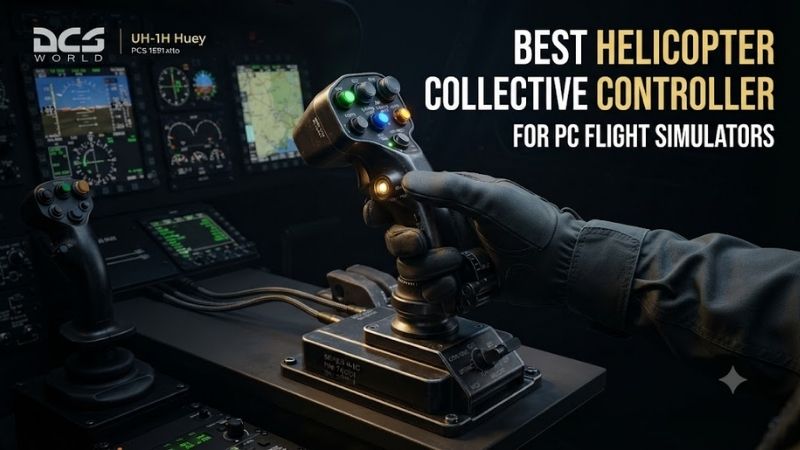
The best helicopter collective controller for PC flight sim gives pilots smooth, predictable control over rotor blade pitch during hovering, takeoff, landing, and low-speed maneuvering. Unlike conventional throttle quadrants, dedicated collective systems use an upward-moving lever that more closely resembles the control arrangement of a real helicopter cockpit.
Quick Verdict
The VIRPIL Rotor TCS Plus paired with a compatible collective grip is our best overall recommendation for a dedicated PC helicopter setup.
Its adjustable resistance, collective lever geometry, and integrated twist-throttle capability make it a flexible option for pilots who fly different helicopter types.
The standard Rotor TCS is attractive for users who do not require a separate twist-throttle axis.
For complete cockpit builders, the Pro Flight Trainer PUMA X provides a much broader solution incorporating cyclic, collective, and anti-torque controls.
Quick Comparison Table
| Controller Configuration | Best For | Collective Axis | Main Advantage |
|---|---|---|---|
| VIRPIL Rotor TCS Plus + Hawk-60 Grip | Best overall | Yes | Collective and twist-throttle control |
| VIRPIL Rotor TCS + Hawk-60 Grip | Best basic dedicated setup | Yes | Adjustable collective resistance |
| VIRPIL Rotor TCS Plus + SharKa-50 Grip | DCS Ka-50 pilots | Yes | Ka-50-inspired controls |
| VIRPIL Rotor TCS Plus + Dual-SF Grip | Complex helicopter operations | Yes | Extensive grip functions |
| Pro Flight Trainer PUMA X | Complete helicopter cockpit | Yes | Integrated flight controls |
| VIRPIL Rotor TCS + SharKa-50 Grip | Combat simulator specialists | Yes | Dedicated military-style grip |
| VIRPIL Rotor TCS + Dual-SF Grip | Advanced modular cockpit | Yes | Expandable controls without twist throttle |
Important: Several entries use the same VIRPIL collective base with different grips. These are distinct purchase configurations, not seven unrelated mechanical designs. Compatible grips and bases are generally purchased separately.
How We Selected These Collective Controllers
Collective Control Precision
A helicopter collective changes the overall pitch of the main rotor blades, affecting lift and the power required to maintain rotor speed.
Precise input is especially important while hovering because small collective changes can alter vertical movement and require corresponding anti-torque corrections.
We prioritized hardware with analog collective axes, adjustable resistance, and suitable physical travel.
Throttle and Grip Functionality
Some helicopters provide engine throttle control through a rotating grip incorporated into the collective assembly.
Other aircraft use engine governors, separate controls, or automated rotor-speed management.
Consequently, a twist-throttle mechanism is useful for certain helicopter types but is not mandatory for every simulated aircraft.
Mechanical Stability and Mounting
A collective is generally positioned beside the pilot’s seat, making mounting geometry an important purchasing consideration.
Loose desk clamps or poorly aligned lever mechanisms can make precise control uncomfortable.
Our evaluation therefore considers the intended mounting arrangement, additional hardware requirements, and whether a configuration makes sense for an existing PC simulator.
Best Helicopter Collective Controllers Reviewed
VIRPIL Rotor TCS Plus with Hawk-60 Grip — Best Overall
Best For: PC helicopter pilots seeking a flexible, dedicated collective.
Why It Stands Out
The VIRPIL Rotor TCS Plus combines a dedicated collective axis with an additional twist-throttle function.
This makes it particularly useful for enthusiasts who alternate between helicopter models with different engine and rotor-control arrangements.
Paired with the Hawk-60 grip, it provides a practical balance between dedicated helicopter controls and modular versatility.
Key Features and Performance
The Rotor TCS Plus uses contactless sensing and adjustable clutch resistance.
Its cam mechanism permits adjustments to the collective’s operating range, helping users adapt the lever movement to their cockpit layout.
The integrated twist axis supports separate throttle assignments when required by the simulated aircraft.
The upgraded base also incorporates a counterbalance arrangement intended to improve the movement characteristics of the collective.
The Hawk-60 grip adds switches and buttons that can be assigned to helicopter-specific functions.
Pros
-
Dedicated analog collective movement
-
Integrated twist-throttle axis
-
Adjustable clutch resistance
-
Contactless sensing
-
Modular grip support
Cons
-
Base and grip add to total cost
-
Requires suitable mounting
-
Configuration takes more effort than a basic throttle
Buy If: You want one premium collective platform for several helicopter types.
Skip If: You only fly helicopters with simple collective requirements and want to minimize cost.
VIRPIL Rotor TCS with Hawk-60 Grip — Best Dedicated Collective Without Twist Throttle
Best For: Pilots who manage engine throttle elsewhere.
Why It Stands Out
The standard Rotor TCS offers the core collective mechanism without the additional integrated twist-throttle axis of the Plus version.
That makes it a logical alternative for pilots who use separate engine controls or frequently fly helicopters with governor-managed rotor speed.
Key Features and Performance
The base provides an analog collective axis with adjustable mechanical resistance.
Its contactless sensing and clutch mechanism support controlled movement across the lever’s travel.
When paired with the Hawk-60 grip, it provides a dedicated left-hand helicopter controller capable of supporting multiple simulator functions.
The primary trade-off is the absence of a built-in twist-throttle axis.
If the pilot later begins flying aircraft requiring manual throttle rotation, an additional control assignment or hardware upgrade may be necessary.
Pros
-
Dedicated collective mechanism
-
Adjustable resistance
-
Compatible with modular grips
-
Appropriate for modern helicopter configurations
-
Avoids paying for unnecessary twist-axis hardware
Cons
-
No integrated twist throttle
-
Requires separate grip purchase
-
Needs secure mounting
Buy If: You fly helicopters with separate or automated engine-throttle management.
Skip If: You need traditional twist-grip throttle functionality.
VIRPIL Rotor TCS Plus with SharKa-50 Grip — Best for Ka-50 Simulation
Best For: DCS World pilots flying the Ka-50.
Why It Stands Out
The SharKa-50 grip is inspired by the collective controls found in the Ka-50 helicopter.
Its arrangement of hats, switches, and buttons is particularly attractive for pilots who want convenient access to combat and aircraft management functions.
When combined with the Rotor TCS Plus, it creates a configurable collective system suitable for detailed PC helicopter simulation.
Key Features and Performance
The SharKa-50 provides multiple directional hats, toggle switches, and push buttons.
These controls can be assigned to aircraft systems, communications, navigation, and other simulator functions.
The Rotor TCS Plus contributes the primary collective axis and twist-throttle capability.
This configuration is especially attractive when users want to reduce keyboard dependence while operating complex helicopters.
It does not automatically recreate every function of a real Ka-50 cockpit, however. Accurate control mapping remains necessary.
Pros
-
Ka-50-inspired control layout
-
Numerous assignable inputs
-
Dedicated collective axis
-
Twist-throttle capability
-
Appropriate for detailed combat simulation
Cons
-
Specialized grip layout
-
Higher total cost than a basic throttle
-
Requires cockpit mounting and configuration
Buy If: You frequently fly the Ka-50 or similar complex combat helicopters.
Skip If: You primarily fly basic civilian helicopters and rarely use additional switches.
VIRPIL Rotor TCS Plus with Dual-SF Grip — Best for Complex Helicopter Operations
Best For: Pilots who want extensive functions accessible from one hand.
Why It Stands Out
The Dual-SF collective grip is designed for users who need a substantial number of cockpit inputs without repeatedly reaching for a keyboard.
This is useful in helicopter simulations where aircraft systems, navigation, communications, and mission equipment must be operated during demanding flight conditions.
Key Features and Performance
Combined with the Rotor TCS Plus, the grip adds multiple assignable controls to the analog collective mechanism.
The adjustable base allows users to tune lever resistance while retaining the twist-throttle function.
A complex grip can improve workflow once the controls have been logically mapped.
However, additional buttons are only useful when pilots can remember their functions. An overloaded control layout may actually become less efficient during challenging flight maneuvers.
Pros
-
Extensive grip inputs
-
Dedicated collective functionality
-
Adjustable resistance
-
Integrated twist-throttle axis
-
Useful for complex aircraft profiles
Cons
-
More expensive configuration
-
Greater learning curve
-
Many controls may be unnecessary for simple aircraft
Buy If: You regularly operate complex helicopters and want fewer keyboard interactions.
Skip If: You prefer minimal controls with uncomplicated mappings.
Pro Flight Trainer PUMA X — Best Complete Helicopter Simulator System
Best For: Dedicated PC helicopter cockpit builders.
Why It Stands Out
The Pro Flight Trainer PUMA X is substantially different from a standalone collective.
It is a coordinated control system intended to provide the major physical inputs required for helicopter flight.
This makes it particularly attractive to enthusiasts creating a dedicated simulator station rather than upgrading an existing HOTAS setup one component at a time.
Key Features and Performance
The PUMA X family combines helicopter-oriented cyclic, collective, and pedal control arrangements.
Available configurations support different cockpit requirements, including variations in throttle and braking equipment.
Its integrated design helps reproduce the relative positioning of helicopter controls.
That can be particularly useful for developing consistent hand-and-foot coordination while practicing hovering, approach control, and transition to forward flight.
However, the system requires more space, planning, and financial commitment than a modular collective base.
Pros
-
Integrated helicopter control layout
-
Includes more than collective functionality
-
Suitable for permanent simulator installations
-
Multiple configuration choices
-
Realistic control positioning
Cons
-
Substantial total cost
-
Requires dedicated space
-
Less appropriate for occasional users
-
Some assembly may be required
Buy If: You are creating a dedicated helicopter simulation cockpit.
Skip If: You already own satisfactory cyclic and pedal controls.
VIRPIL Rotor TCS with SharKa-50 Grip — Best Combat-Focused Standard Base
Best For: Military helicopter pilots who do not need twist throttle.
Why It Stands Out
This configuration combines the standard Rotor TCS collective base with the military-oriented SharKa-50 grip.
It allows pilots to prioritize a specialized switch layout without paying for the Plus base’s additional twist axis.
Key Features and Performance
The standard TCS base provides the collective movement, while the SharKa-50 adds dedicated buttons, switches, and directional controls.
This arrangement works well when engine-throttle management can be handled through separate controls.
It also allows users to preserve a consistent hand position during aircraft system operation.
The limitation is narrower flexibility compared with the Plus configuration. Pilots who want to reproduce a traditional helicopter twist-throttle mechanism should consider the Plus version instead.
Pros
-
Dedicated collective control
-
Multiple military-style switches
-
Adjustable mechanical resistance
-
Modular grip arrangement
-
Appropriate for combat simulator layouts
Cons
-
Lacks twist-throttle axis
-
Specialized grip design
-
Mounting hardware must be considered
Buy If: You want Ka-50-style grip functionality without integrated throttle rotation.
Skip If: Your preferred helicopter requires independent twist-throttle operation.
VIRPIL Rotor TCS with Dual-SF Grip — Best Modular Alternative
Best For: Advanced pilots with separate throttle controls.
Why It Stands Out
This combination is a practical alternative to the Plus configuration when the user wants a highly functional grip but does not need an additional throttle axis.
It provides the essential collective movement while supporting a complex input layout.
Key Features and Performance
The Rotor TCS base supplies adjustable analog collective control, and the Dual-SF grip provides additional command inputs.
This division of functionality is useful for pilots who already own a dedicated throttle panel.
It can also be attractive for cockpit builders who prefer to separate collective pitch control from engine management.
Before purchasing, buyers should evaluate whether the grip’s extra functionality justifies its cost over a simpler configuration.
Pros
-
Precise dedicated collective axis
-
Numerous assignable controls
-
Adjustable resistance
-
Modular construction
-
Suitable for complex helicopter profiles
Cons
-
No integrated twist throttle
-
More expensive than a basic grip
-
Requires control mapping and mounting
Buy If: You want extensive collective-mounted controls with separate throttle management.
Skip If: You need a complete helicopter controller at the lowest possible cost.
Buying Guide: How to Choose a PC Helicopter Collective
Understand Collective Pitch and Throttle
Collective pitch controls the pitch of the main rotor blades collectively, changing lift and power demand.
Engine throttle controls engine power or governor-related behavior, depending on the helicopter.
These functions are mechanically combined on some aircraft but remain conceptually separate.
A collective with a twist-throttle axis is useful when reproducing aircraft that require manual throttle adjustment.
For other aircraft, a standard collective lever may be sufficient.
Prioritize Adjustable Friction
Helicopter flying often involves small, frequent collective adjustments.
A controller with inadequate resistance may move too easily, while excessive friction can make fine inputs uncomfortable.
Adjustable clutches allow pilots to find a compromise that suits their preferred flying style.
The ideal resistance depends on lever length, grip weight, mounting stability, and personal preference.
Plan the Mounting Position
Collective controls are normally positioned beside the pilot’s seat rather than directly on top of a desk.
Mounting height affects arm position and the ability to make controlled adjustments.
A poorly positioned collective can force awkward wrist or shoulder movements, particularly during extended hovering practice.
Confirm whether the selected product includes mounting hardware or requires a separate bracket.
Match the Controller to Your Simulator
DCS World often involves detailed military helicopter procedures and extensive cockpit bindings.
Microsoft Flight Simulator emphasizes a broader range of civilian aviation experiences, while X-Plane provides configurable control assignments for supported aircraft.
A standard USB collective may work across multiple PC simulators, but correct aircraft-specific binding is essential.
Frequently Asked Questions
Is a helicopter collective necessary for PC flight simulation?
No. A conventional throttle lever can be mapped to the collective axis. A dedicated collective primarily improves physical realism and ergonomics.
What is the difference between Rotor TCS and Rotor TCS Plus?
The Plus version adds an integrated twist-throttle axis. Both provide dedicated collective movement and adjustable resistance.
Can I use a helicopter collective in DCS World?
Yes, compatible PC collective hardware can be configured for supported DCS aircraft. The available bindings depend on the individual helicopter module.
Do I need rudder pedals with a collective?
Separate pedals are strongly recommended for realistic helicopter control because collective changes often require corresponding anti-torque adjustments.
Is the PUMA X better than a VIRPIL collective?
They serve different purchasing needs. PUMA X is a comprehensive control system, while VIRPIL offers modular collective components that can be incorporated into an existing cockpit.
Final Verdict
The best helicopter collective controller for PC flight sim depends on your preferred helicopters and existing equipment. VIRPIL Rotor TCS Plus provides excellent versatility, while the standard TCS suits pilots who do not need twist throttle. For a complete dedicated cockpit, Pro Flight Trainer PUMA X offers a comprehensive alternative.