🛒 Best Price Today on Amazon
Prime members get fast, free shipping on everything above, plus member-only deals. New members get a 30-day free trial — cancel anytime.
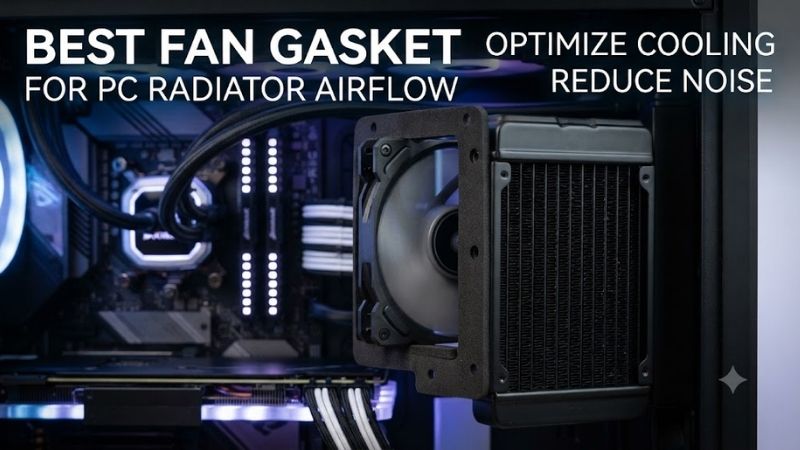
The best fan gasket for PC radiator airflow helps reduce the amount of air escaping between a fan frame and radiator surface. A good gasket may also limit vibration transmission and improve mounting contact. However, gasket thickness, fan dimensions, and screw length must be considered together. This guide compares six practical options for 120mm and 140mm liquid-cooling installations.
Quick Verdict
The Noctua NA-SAVG1 is our preferred choice for compatible 120mm Noctua fans because it provides a complete three-gasket package designed specifically for radiator installations.
The Darkside 120mm Single Radiator Foam Gasket is an attractive minimalist option when only a thin sealing layer is needed.
For users who need a thicker spacer, the Phobya 120mm Radiator Gasket 5mm and 10mm versions provide alternative mounting configurations.
The Alphacool Shroud & Decoupling 120mm is a better fit for installations where the builder specifically wants a 7mm spacer and has verified that the included longer screws are compatible with the radiator.
Quick Comparison Table
| Product | Size | Thickness | Best For |
|---|---|---|---|
| Noctua NA-SAVG1 | 120mm | Model-specific silicone seal | Best overall |
| Noctua NA-SAVG1 chromax.black | 120mm | Model-specific silicone seal | Black builds |
| Darkside 120mm Foam Gasket | 120mm | 1mm | Minimal clearance |
| Phobya Radiator Gasket | 120mm | 5mm | Moderate spacing |
| Phobya Radiator Gasket | 120mm | 10mm | Larger spacing |
| Alphacool Shroud & Decoupling | 120mm | 7mm | Spacer and decoupling |
All six selections target 120mm-class fan installations. The two Noctua products differ in finish, while the Phobya products use different thicknesses and are not interchangeable in tight mounting locations.
How We Selected These Gaskets
We prioritized products intended for radiator and fan interfaces rather than ordinary rubber fan screws or generic acoustic foam.
Our selection considers sealing effectiveness, material compliance, mounting dimensions, and additional hardware requirements.
Gaskets do not create airflow by themselves. Their purpose is to reduce bypass leakage and modify the interface between the fan and radiator.
The actual performance benefit depends on how much air was escaping before the gasket was installed.
A well-sealed radiator assembly may receive only a minor improvement, while a configuration with noticeable mounting gaps may benefit more.
Detailed Product Recommendations
1. Noctua NA-SAVG1 — Best Overall
Best For: Compatible Noctua square-frame 120 × 25mm radiator fans.
Why We Picked It: The NA-SAVG1 provides three silicone anti-vibration gaskets specifically intended for radiator mounting.
Key Specifications
-
Product: NA-SAVG1
-
Gasket size: 120 × 120mm
-
Material: Silicone rubber
-
Included quantity: Three gaskets
-
Color: Brown
-
Compatible fans: Supported Noctua square-frame 120 × 25mm models
Features and Benefits
The NA-SAVG1 uses soft silicone to create a more continuous seal between the fan frame and radiator.
Without a suitable seal, some airflow can escape around the fan’s edges rather than passing through the cooling fins.
The gasket also provides a compliant interface that can reduce small vibrations.
Its three-piece packaging is especially convenient for a 360mm radiator, where three 120mm fans are commonly installed on one side.
However, the gasket’s compatibility is tied to supported Noctua frame geometry.
A nominal 120mm fan from another manufacturer may not have the same frame design or contact surfaces.
Performance and Practical Use
The most realistic expectation is incremental optimization, not a dramatic cooling improvement.
A gasket can reduce bypass leakage, but it cannot compensate for an underpowered fan, insufficient radiator area, or poor case ventilation.
Pros
-
Dedicated radiator sealing design.
-
Three-piece package.
-
Soft silicone construction.
-
Suitable for compatible Noctua installations.
Cons
-
Limited fan-frame compatibility.
-
Brown appearance may not suit every build.
Buy If: You use compatible Noctua 120mm fans on a radiator.
Skip If: Your fans have an unsupported frame design.
2. Noctua NA-SAVG1 chromax.black — Best for Black Radiator Builds
Best For: Compatible black Noctua radiator fans and dark-themed custom loops.
Why We Picked It: This version provides the same fundamental sealing design as the standard NA-SAVG1 but uses a black finish.
Key Specifications
-
Product: NA-SAVG1 chromax.black
-
Fan size: 120 × 120mm
-
Material: Silicone
-
Color: Black
-
Included quantity: Three gaskets
-
Intended compatibility: Supported square-frame Noctua 120mm fans
Features and Benefits
The chromax.black version is particularly useful for radiator assemblies where the fan edges remain visible.
It creates a consistent appearance with black fans and radiator frames while retaining the same general sealing and anti-vibration purpose.
The package is suitable for three-fan radiator configurations when each fan is compatible.
However, there is no technical basis for claiming that the black version provides better airflow or cooling than the standard brown version.
Choose between the two primarily based on appearance and availability.
Pros
-
Black finish.
-
Dedicated radiator interface.
-
Three gaskets included.
Cons
-
No fundamental performance advantage over the standard version.
-
Frame compatibility remains restricted.
Buy If: You want the NA-SAVG1 design without the brown appearance.
Skip If: Your radiator fans are not supported by the gasket design.
3. Darkside 120mm Single Radiator Foam Gasket — Best Thin-Foam Option
Best For: Builders who need a thin seal without significantly increasing radiator assembly thickness.
Why We Picked It: Its approximately 1mm foam construction provides a minimal spacer between the fan and radiator.
Key Specifications
-
Product: Darkside 120mm Single Radiator Foam Gasket
-
Product number: DS-0388
-
Fan size: 120mm
-
Thickness: 1mm
-
Material: Foam
-
Quantity: Single gasket
Features and Benefits
A thin foam gasket is useful when the existing installation already has close fan-to-radiator contact.
The foam can compress around minor surface irregularities, reducing the opportunity for air to escape.
Its limited thickness is especially useful in cramped PC cases where adding a 5mm or 10mm spacer could cause clearance problems.
However, a foam gasket may not accommodate substantial mounting gaps.
It is also not intended to create a large standoff distance between the fan blades and radiator fins.
Performance and Practical Use
The most appropriate use case is improving the seal of an otherwise correctly mounted fan.
Users should inspect the foam after installation and ensure it does not protrude into the rotating fan blades.
Pros
-
Thin construction.
-
Minimal clearance impact.
-
Appropriate for basic sealing applications.
Cons
-
Sold individually.
-
Limited ability to bridge larger gaps.
Buy If: You need a thin gasket between a conventional 120mm fan and radiator.
Skip If: You specifically require a thick shroud or spacer.
4. Phobya Radiator Gasket 5mm for 120mm Fans — Best Moderate Spacer
Best For: Radiator installations requiring a thicker sealing interface than a conventional thin foam gasket.
Why We Picked It: The 5mm design provides additional separation between the fan frame and radiator.
Key Specifications
-
Product: Phobya Radiator Gasket
-
Product number: 38285
-
Fan size: 120mm
-
Thickness: 5mm
-
Intended application: Fan-to-radiator interface
Features and Benefits
A 5mm spacer can help bridge certain mounting gaps and alter the physical distance between the fan and radiator.
In some configurations, changing this distance can affect airflow distribution near the fan hub and radiator surface.
However, a thicker gasket does not automatically improve cooling.
The result depends on fan geometry, radiator restriction, and whether the gasket creates a proper perimeter seal.
Additional thickness also changes the screw length required to mount the fan safely.
For example, replacing a 1mm gasket with a 5mm gasket adds approximately 4mm to the mounting stack.
The builder must select compatible screws while respecting the radiator’s maximum permitted thread penetration.
Pros
-
Moderate spacer thickness.
-
Designed for 120mm radiator applications.
-
Useful for specific mounting arrangements.
Cons
-
Requires careful screw-length selection.
-
Can create clearance problems in compact cases.
Buy If: You have measured the mounting arrangement and need a 5mm radiator gasket.
Skip If: Your case has limited clearance.
5. Phobya Radiator Gasket 10mm for 120mm Fans — Best Thick Spacer
Best For: Custom radiator installations where a larger fan-to-radiator separation is intentional.
Why We Picked It: The 10mm thickness offers greater spacing than conventional thin gasket designs.
Key Specifications
-
Product: Phobya Radiator Gasket
-
Product number: 38335
-
Fan size: 120mm
-
Thickness: 10mm
-
Intended application: Radiator interface and spacing
Features and Benefits
The 10mm version is more accurately considered a combined gasket and spacer solution.
It can create additional distance between the fan and radiator while providing a sealing interface.
This may be useful for custom arrangements where the fan cannot sit directly against the radiator.
However, the additional spacing must be intentional.
A thick spacer can increase the total assembly depth enough to interfere with motherboard heatsinks, case panels, or nearby components.
It also requires longer mounting screws.
Incorrect screw length can cause either insufficient mechanical engagement or damage to internal radiator tubes.
Pros
-
Significant additional spacing.
-
Intended for 120mm radiator mounting.
-
Useful for custom configurations.
Cons
-
Large clearance requirement.
-
Longer hardware may be necessary.
-
No guaranteed temperature improvement.
Buy If: Your cooling layout specifically calls for a 10mm spacer.
Skip If: You only need a minimal air seal.
6. Alphacool Shroud & Decoupling 120mm — Best Integrated Spacer Kit
Best For: Builders needing a 7mm radiator spacer with matching mounting hardware.
Why We Picked It: The Alphacool kit combines a decoupling shroud with longer screws intended for compatible installations.
Key Specifications
-
Product: Alphacool Shroud & Decoupling 120mm
-
Product number: 24830
-
Fan size: 120mm
-
Thickness: 7mm
-
Included hardware: Four M3 × 37mm screws
Features and Benefits
This accessory is useful because it addresses both spacing and mounting hardware.
The 7mm shroud changes the distance between the fan and radiator while helping reduce direct mechanical contact.
For compatible radiators, the included M3 screws simplify installation planning.
However, the presence of screws does not guarantee universal compatibility.
Radiators use different thread standards and permitted screw depths.
A radiator with UNC 6-32 or M4 mounting holes cannot safely use M3 screws.
Likewise, the supplied screw length must be appropriate for the actual fan frame and radiator design.
Pros
-
7mm spacer.
-
Includes matching M3 screws.
-
Dedicated radiator application.
Cons
-
M3 mounting hardware only.
-
Additional assembly thickness.
-
Compatibility must be verified.
Buy If: Your radiator uses compatible M3 hardware and you want a defined 7mm spacer.
Skip If: Your radiator uses another thread standard.
Buying Guide: Choosing a Radiator Fan Gasket
Understand Air Bypass
A radiator fan creates a pressure difference that encourages air to move through the radiator fins.
When gaps exist between the fan frame and radiator, some air can escape through those gaps.
A gasket helps reduce this leakage.
However, not every radiator assembly has a significant sealing problem.
If the fan already contacts the radiator effectively, the improvement from an additional gasket may be very small.
Choose the Correct Gasket Thickness
Thin gaskets are generally appropriate for improving a conventional fan-to-radiator seal.
Thicker gaskets can function as spacers or shrouds.
These designs require more clearance and may change airflow distribution.
There is no universal thickness that produces the best cooling results for every radiator.
Check Fan Size and Frame Shape
A 120mm gasket is not interchangeable with a 140mm gasket.
Likewise, gaskets designed for specific square-frame fans may not fit other fan geometries correctly.
Before purchasing, inspect the gasket’s opening, mounting holes, and supported fan designs.
Calculate Screw Length Carefully
Adding a gasket changes the total thickness of the mounting assembly.
A thicker gasket may require longer screws, but those screws must not extend too far into the radiator.
Always check the radiator manufacturer’s permitted insertion depth.
Do not assume that a screw supplied with a spacer is safe for every radiator.
Distinguish Air Sealing From Vibration Control
Gaskets may reduce minor vibration transmission between the fan frame and radiator.
However, the primary function of a radiator gasket is often improving the air seal.
If a fan produces rattling or grinding because of a mechanical problem, replacing the gasket will not repair the fan.
Consider Whether a Gasket Is Worth Buying
For a properly assembled radiator with good fan contact, the cooling improvement may be modest.
A gasket is most useful when there is a meaningful sealing problem, noticeable vibration transfer, or a specific need for fan spacing.
For many gaming systems, improving airflow direction and fan-speed control may deliver more noticeable benefits.
Frequently Asked Questions
Do radiator fan gaskets improve cooling?
They can reduce air bypass and improve airflow through the fins, but actual temperature improvements depend on the original mounting arrangement.
Are thicker radiator gaskets better?
Not automatically. Thick gaskets add spacing and require more clearance.
Can I use a 120mm gasket with any 120mm fan?
Not necessarily. Fan-frame geometry and gasket design must be compatible.
Do fan gaskets reduce noise?
They may reduce minor vibration transmission, but they cannot fix damaged bearings or noisy fan motors.
Do I need longer radiator screws when adding a gasket?
Possibly. Screw length depends on the gasket thickness, fan frame, case structure, and radiator mounting requirements.
Conclusion
The Noctua NA-SAVG1 is our preferred choice among the best fan gasket for PC radiator airflow options for supported 120mm Noctua fans. The Darkside 1mm foam gasket suits minimal sealing requirements, while Phobya’s 5mm and 10mm designs and the Alphacool 7mm shroud are better suited to installations requiring additional spacing. The right gasket should improve the fan-to-radiator interface without creating clearance or screw-depth problems.