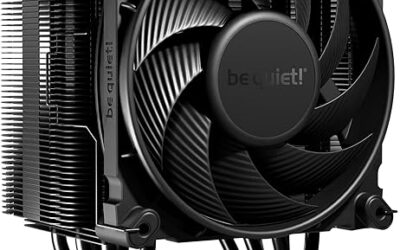
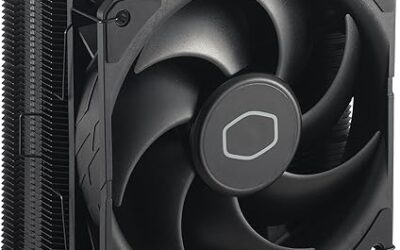
🛒 Best Price Today on Amazon
Prime members get fast, free shipping on everything above, plus member-only deals. New members get a 30-day free trial — cancel anytime.
Choosing the best CPU cooler for Ryzen 9 means balancing heat capacity, noise, case clearance, and the way you use your PC. Ryzen 9 chips can sustain demanding gaming, rendering, and productivity loads, so the right cooler should control temperature without creating unnecessary noise or installation headaches.
Quick answer: For most people in 2026, the best cpu cooler for ryzen 9 is the CPU Cooler — our #1 rated choice. See the full ranked comparison, alternatives and buying advice below.
Best CPU Coolers for Ryzen 9 Compared
For most Ryzen 9 builds, a large dual-tower air cooler or a well-designed 360 mm liquid cooler makes the most sense. Air cooling favors simplicity and long-term serviceability, while a 360 mm AIO can provide more thermal headroom in sustained multicore workloads when the case has enough radiator space.
This roundup focuses on coolers that officially support AMD AM5 and have the size or thermal design to suit Ryzen 9-class systems. The picks differ in radiator format, heatsink size, fan speed, acoustics, and installation demands, so the best choice depends on your case, workload, and tolerance for noise.
| CPU Cooler | Type | AM5 Support | Height / Radiator | Best For |
|---|---|---|---|---|
| Noctua NH-D15 G2 | Dual-tower air | Yes | 168 mm | Premium air cooling |
| ARCTIC Liquid Freezer III Pro 360 | 360 mm AIO | Yes | 398 × 120 × 38 mm radiator | Sustained heavy workloads |
| be quiet! Dark Rock Elite | Dual-tower air | Yes | 168 mm | Quiet gaming builds |
| Thermalright Phantom Spirit 120 EVO | Dual-tower air | Yes | 157 mm | Compact high-performance builds |
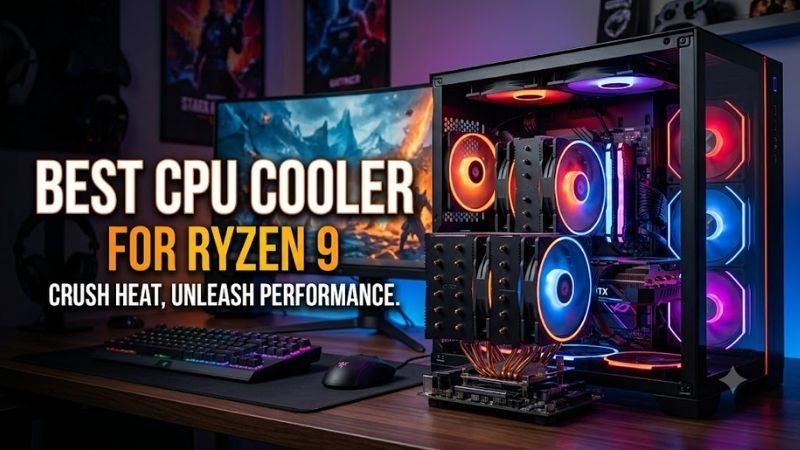
Noctua NH-D15 G2
Best For: Premium air-cooled Ryzen 9 builds
The Noctua NH-D15 G2 is a premium dual-tower air cooler built for high-heat desktop CPUs. It uses eight 6 mm heatpipes, two NF-A14x25r G2 PWM fans, and a 168 mm total height. Noctua lists AM5 support, making it a direct fit for modern Ryzen 9 systems when the case provides enough CPU-cooler clearance.
Key Features
- Eight 6 mm heatpipes
- Dual NF-A14x25r G2 PWM fans
- 168 mm total height
- AM5 and AM4 support
- Dual-tower heatsink
- NT-H2 thermal compound included
Its main advantage is strong cooling without a pump, radiator, or liquid loop. That reduces mechanical complexity and keeps maintenance simple over the long term. The two 140 mm-class fans can move substantial air at relatively modest speeds, which is useful for users who want high-end cooling without AIO pump noise.
What Makes It Different
The trade-off is physical size. At 168 mm tall and about 150 mm wide with fans installed, the NH-D15 G2 needs a roomy case and careful RAM planning. Large heat spreaders can force the front fan upward, increasing total height, so builders should check both memory clearance and the case’s cooler-height limit first.
Noctua also offers an LBC version optimized for relatively flat CPU heat spreaders such as AM5 and AM4. That makes it relevant to Ryzen 9 builders seeking maximum contact quality from this platform. The standard model remains the simpler default when you want broad socket flexibility across several current platforms.
Pros
- No pump or liquid loop
- Eight-heatpipe dual-tower design
- Premium dual-fan configuration
- AM5 mounting support
- Strong option for long-term builds
Cons
- 168 mm height limits case choice
- Large footprint around the CPU socket
- RAM clearance requires attention
Use Case
High-end gaming, streaming, workstation tasks, and Ryzen 9 systems where the owner wants substantial air-cooling capacity without using an AIO.
Who It’s For
Builders with roomy cases who prioritize premium air cooling, straightforward maintenance, and low mechanical complexity.
ARCTIC Liquid Freezer III Pro 360
Best For: Sustained Ryzen 9 productivity workloads
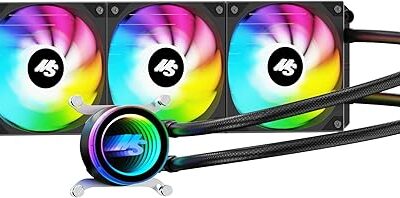
The ARCTIC Liquid Freezer III Pro 360 targets builders who want a high-capacity AIO for sustained Ryzen 9 workloads. It combines a 398 x 120 x 38 mm aluminum radiator with three P12 Pro fans, a PWM-controlled pump, and a small VRM fan integrated around the pump block. AM5 and AM4 are officially supported.
Key Features
- 360 mm AIO format
- 38 mm-thick aluminum radiator
- Three P12 Pro radiator fans
- PWM-controlled pump
- Integrated VRM fan
- AM5 and AM4 compatibility
- MX-6 thermal compound
The thicker 38 mm radiator is a meaningful design choice because it gives the cooler more radiator volume than many slimmer 360 mm units. In long rendering, compiling, or heavy productivity sessions, that extra surface area can help absorb and dissipate sustained heat, provided the case can feed the radiator with cool air.
What Makes It Different
That same radiator thickness is also the biggest fit concern. ARCTIC notes that the Liquid Freezer III Pro requires at least 63 mm of installation clearance, so top-mounted setups can conflict with tall motherboard heatsinks or memory. Builders should measure the complete radiator-and-fan stack before ordering.
The Liquid Freezer III Pro also gives users two control approaches: synchronized control through a single PWM connection or separate control of pump, VRM fan, and radiator fans. Separate control is useful for tuning acoustics, because you can avoid running every component aggressively when the CPU only needs moderate cooling.
Pros
- Large 360 mm radiator
- Thick 38 mm radiator design
- Dedicated VRM fan
- Flexible PWM control
- AM5 support
Cons
- Requires substantial radiator clearance
- More installation complexity than air cooling
- Pump adds another moving component
Use Case
Long rendering sessions, CPU-based media work, compiling, streaming, and other Ryzen 9 workloads that maintain high CPU utilization for extended periods.
Who It’s For
Users with 360 mm-compatible cases who prioritize sustained cooling capacity and are comfortable installing and tuning an AIO.
be quiet! Dark Rock Elite
Best For: Quiet premium Ryzen 9 gaming systems
The be quiet! Dark Rock Elite is another high-end air option for Ryzen 9 systems that prioritize low mechanical complexity. It uses seven 6 mm heatpipes, two fans, a copper base, and an aluminum fin stack. The cooler is officially compatible with AM5 and has a rated height of 168 mm, so case clearance matters.
Key Features
- Seven 6 mm heatpipes
- Dual-fan configuration
- Copper CPU contact base
- 168 mm height
- AM5 support
- Black exterior
- Integrated lighting support
Its appeal is the combination of large heat capacity and a noise-focused design. be quiet! lists overall noise levels of 11.0, 19.5, and 25.8 dB(A) at 50, 75, and 100 percent fan speed. Those figures are manufacturer specifications, not cross-platform benchmarks, but they help explain the cooler’s quiet-first positioning.
What Makes It Different
The Dark Rock Elite uses a dual-tower layout and weighs 1.34 kg, so motherboard access can become tighter than with a compact single-tower cooler. It is best suited to standard ATX or roomy mATX cases where you can install the memory and power cables before the cooler blocks convenient access to nearby connectors.
A key difference from the Noctua is presentation. The Dark Rock Elite uses a black finish and integrated lighting support, so it blends more naturally into dark gaming builds. That does not improve cooling by itself, but it matters for users who want a premium air cooler without the exposed brown fan color of standard Noctua models.
Pros
- Dual-tower air design
- Seven heatpipes
- Noise-focused positioning
- Black gaming-oriented appearance
- AM5 compatibility
Cons
- Large 168 mm height
- Heavy heatsink
- Can make motherboard access difficult
Use Case
Gaming, streaming, and mixed productivity systems where low noise and a polished dark aesthetic matter more than adopting liquid cooling.
Who It’s For
Ryzen 9 owners who want a substantial air cooler with a black appearance and do not mind dedicating considerable internal case space to the heatsink.
Thermalright Phantom Spirit 120 EVO
Best For: Ryzen 9 builds with tighter cooler clearance
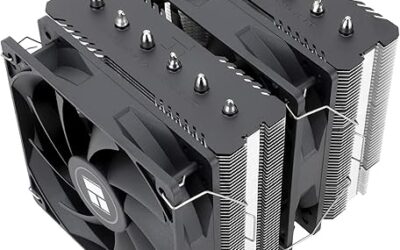
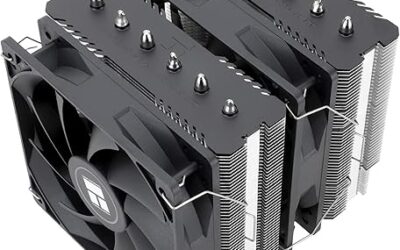
The Thermalright Phantom Spirit 120 EVO offers a more compact dual-tower approach for Ryzen 9. It supports AM5, measures 157 mm tall, and uses seven 6 mm heatpipes with two 120 mm TL-K12 fans. The shorter height can make it easier to fit in mid-tower cases that cannot accept 168 mm-class air coolers.
Key Features
- Seven 6 mm heatpipes
- Dual-tower heatsink
- Two 120 mm TL-K12 fans
- 157 mm cooler height
- AM5 compatibility
- 5 V three-pin ARGB
Its fans are specified for up to 2,150 RPM, giving the cooler more fan-speed range than quieter, lower-speed designs. That can be useful when a Ryzen 9 enters a sustained heavy load, but the acoustic profile will depend strongly on the fan curve. Users sensitive to noise should tune PWM behavior rather than leaving an aggressive default curve.
What Makes It Different
The Phantom Spirit 120 EVO also includes 5 V three-pin ARGB connections on its fans, making it easier to integrate into a gaming-focused build. Its dimensions are modest for a dual tower, but builders still need to check tall memory modules because the front fan can overlap the DIMM area depending on motherboard layout.
This model is most attractive for users who want a strong tower cooler without committing to the largest 140 mm dual-tower designs. It gives up some physical heatsink mass compared with bigger premium models, yet its 157 mm height and conventional 120 mm fan format can simplify case compatibility and replacement options.
Pros
- 157 mm height
- Seven-heatpipe design
- Dual 120 mm fans
- ARGB support
- AM5 compatibility
Cons
- High fan speeds may require tuning
- Front fan can interact with tall RAM
- Less heatsink volume than larger 140 mm towers
Use Case
Gaming PCs, mixed-use Ryzen 9 builds, and mid-tower systems where a 168 mm premium air cooler would be difficult or impossible to install.
Who It’s For
Builders seeking a dual-tower AM5 cooler with a more manageable height and gaming-oriented fan design.
Air Cooling vs 360 mm AIO for Ryzen 9
Between these four coolers, the first decision is air versus liquid. The NH-D15 G2, Dark Rock Elite, and Phantom Spirit 120 EVO avoid a pump and radiator, making installation more self-contained. The Liquid Freezer III Pro 360 needs radiator space but spreads heat over a much larger remote cooling surface.
For a workstation-style Ryzen 9 that spends long periods under all-core load, a 360 mm AIO is attractive because radiator capacity can help manage sustained heat output. For a gaming-first system with shorter CPU bursts, a high-end dual-tower air cooler can be simpler while still offering substantial thermal capacity.
Case size may decide the result before performance does. The NH-D15 G2 and Dark Rock Elite both stand 168 mm tall, while the Phantom Spirit 120 EVO is 157 mm. The ARCTIC needs 360 mm radiator support plus enough depth around the mounting location, so checking chassis specifications should be the first compatibility step.
Noise tuning also differs by design. Large air coolers can run their fans slowly during light work and have no pump tone, while an AIO adds pump behavior to the acoustic mix. The ARCTIC’s separate controls make detailed tuning possible, whereas air coolers are easier for users who want a simpler fan-curve setup.
How to Choose the Best CPU Cooler for Ryzen 9
Match Cooling Capacity to Your Workload
When choosing a Ryzen 9 cooler, start with the exact CPU model and workload rather than buying by cooler size alone. Gaming, streaming, compiling, video encoding, and 3D rendering place different sustained loads on the processor. A cooler that is comfortable in games may run its fans much harder during long all-core work.
Verify AM5 Socket Compatibility
Next, verify socket support. All four picks here officially support AM5, which is essential for current Ryzen 9 desktop platforms. Socket compatibility only confirms that the mounting system fits; it does not guarantee the cooler will clear your case, memory, graphics card, or motherboard heatsinks in a specific build.
Check Air Cooler Height
For air coolers, CPU-cooler height is the first physical number to check. A 168 mm tower may not fit a compact mid-tower even if the motherboard socket is fully compatible. Also examine front-fan overlap with DIMMs, because raising a fan above tall memory can add several millimeters to the installed cooler height.
Check AIO Radiator Clearance
For AIOs, check radiator length, thickness, fan thickness, and tube routing. A case that advertises 360 mm radiator support may still have conflicts with motherboard heatsinks or tall RAM when the radiator is top mounted. Front mounting can improve fit but may change GPU airflow and tube orientation options.
Tune the Fan Curve
Fan behavior matters as much as raw cooler size. A Ryzen 9 can change temperature quickly under boost, causing poorly tuned fans to ramp up and down repeatedly. A smoother fan curve with sensible delay or hysteresis often makes a system feel quieter without sacrificing meaningful performance during short workload spikes.
Compare Noise Data Carefully
Do not treat manufacturer noise ratings from different brands as direct benchmark results. Test distance, room conditions, fan speed, and measurement method can vary. Use published noise specifications as a design reference, then rely on consistent third-party testing if you need a direct acoustic comparison between specific coolers.
Consider Long-Term Maintenance
Air cooling is appealing for long-term ownership because the fan is usually the only moving part that may need replacement. AIOs add a pump and sealed liquid loop, but they can move heat away from the socket more effectively in space-constrained motherboard areas. The better format depends on case layout and service priorities.
Check RAM Clearance
Memory clearance deserves extra attention in Ryzen 9 builds because enthusiasts often pair these CPUs with taller DDR5 modules. Dual-tower coolers can overhang the DIMM slots, while AIO blocks usually leave the memory area more open. If you frequently swap RAM, an AIO can make future access easier despite the more complex installation.
Think About VRM Airflow
Motherboard VRM cooling is another secondary factor. Large air coolers create airflow around the socket, which can wash over nearby heatsinks. The Liquid Freezer III Pro uses a dedicated small VRM fan near the pump block, giving it a deliberate way to move air around the socket area even though the main radiator is mounted elsewhere.
Gaming vs Productivity Priorities
For gaming-focused systems, prioritize stable temperatures, low noise, and fit over chasing the largest possible cooling solution. Many games do not hold every Ryzen 9 core at full load for long periods, so an oversized setup may deliver little practical benefit if it makes the build harder to assemble or forces compromises elsewhere.
For creators and workstation users, sustained thermal capacity becomes more important. Long renders, code builds, and CPU-based media jobs can keep power and temperature elevated for much longer than a typical game. In that environment, a 360 mm AIO or a top-tier dual-tower air cooler is easier to justify than a smaller mainstream tower.
FAQ
Is an air cooler enough for Ryzen 9?
Yes. A high-end dual-tower air cooler can be appropriate for Ryzen 9 when the case has enough clearance and the workload does not demand the extra radiator capacity of a large AIO. The NH-D15 G2 and Dark Rock Elite are designed for high-heat desktop CPUs, while the Phantom Spirit 120 EVO offers a shorter 157 mm format.
Does Ryzen 9 need a 360 mm AIO?
A 360 mm AIO is not mandatory for every Ryzen 9 gaming PC. It becomes more attractive when you run long all-core workloads, want more radiator surface area, or prefer a cleaner socket area around tall memory. For a gaming-first build, a capable dual-tower air cooler can offer a simpler and highly practical alternative.
Should a Ryzen 9 AIO be top or front mounted?
For top mounting, a radiator can exhaust CPU heat directly out of the case and usually avoids warming the GPU with radiator exhaust. Front mounting can provide cooler intake air to the radiator but may raise internal air temperature. The best position depends on chassis layout, tube routing, GPU airflow, and available clearance.
Does a bigger CPU cooler always cool better?
No. Cooler size is only one part of thermal performance. Heatpipe design, cold-plate contact, fin density, fan pressure, radiator thickness, and fan control all matter. A larger cooler that fits poorly or uses an unsuitable fan curve can be less satisfying than a slightly smaller model tuned well for the case and workload.
What should I check before buying a Ryzen 9 cooler?
Before buying, check AM5 support, CPU-cooler height, radiator support, radiator thickness, RAM clearance, motherboard heatsink clearance, and fan or pump headers. For liquid coolers, also verify tube reach and mounting orientation. These checks prevent most compatibility problems before the system is assembled.
Conclusion
The best CPU cooler for Ryzen 9 depends on how much heat your workload sustains and how much room your case provides. The NH-D15 G2 and Dark Rock Elite suit premium air builds, the Phantom Spirit 120 EVO favors tighter cases, and the Liquid Freezer III Pro 360 fits users who want high-capacity liquid cooling.
Ready to decide? Our #1 pick for 2026 is the CPU Cooler.
Live price & availability on Amazon.