🛒 Best Price Today on Amazon
Prime members get fast, free shipping on everything above, plus member-only deals. New members get a 30-day free trial — cancel anytime.
The best 4K PC gaming monitor should combine sharp 3840 x 2160 resolution with a refresh rate high enough for modern GPUs, fast pixel response, adaptive sync, and the right ports. For 2026, 32-inch OLED 240Hz models dominate the premium tier, while dual-mode 480Hz displays add extra flexibility for competitive play.
Quick answer: For most people in 2026, the best 4k pc gaming monitor is the Monitor — our #1 rated choice. See the full ranked comparison, alternatives and buying advice below.
Best 4K PC Gaming Monitors Compared
| Monitor | Best For | Panel | Refresh Rate | Key Feature |
|---|---|---|---|---|
| MSI MPG 321URX QD-OLED | Best Overall | 31.5″ QD-OLED | 4K 240Hz | USB-C 90W and KVM |
| LG UltraGear 32GS95UE | Dual-Mode Gaming | 31.5″ OLED | 4K 240Hz / FHD 480Hz | Dual Mode |
| AORUS FO32U2P | DisplayPort 2.1 | 31.5″ QD-OLED | 4K 240Hz | DP 2.1 UHBR20 |
| ASUS ROG Swift PG32UCDP | Premium Competitive Gaming | 31.5″ WOLED | 4K 240Hz / FHD 480Hz | Dual Mode and KVM |
| Samsung Odyssey OLED G8 G80SH | Best 27-Inch Pick | 27″ QD-OLED | 4K 240Hz | DP 2.1 and 166 PPI |
MSI MPG 321URX QD-OLED
Best For: Best overall 4K PC gaming monitor
The MSI MPG 321URX QD-OLED combines a 31.5-inch 3840 x 2160 QD-OLED panel with a 240Hz refresh rate and 0.03ms GtG response time. It targets gamers who want 4K detail without dropping to a conventional 144Hz or 165Hz display, while retaining the instant-looking pixel response that makes OLED attractive for motion.
MSI specifies DisplayHDR True Black 400, approximately 99% DCI-P3 coverage, 10-bit color, G-SYNC compatibility, and FreeSync Premium Pro. These specifications make the 321URX suitable for visually demanding single-player games while still providing enough refresh-rate headroom for high-frame-rate competitive titles.
Key Features
- 31.5-inch QD-OLED panel
- 3840 x 2160 resolution
- 240Hz refresh rate
- 0.03ms GtG response
- DisplayHDR True Black 400
- 99% DCI-P3 coverage
- Two HDMI 2.1 ports
- DisplayPort 1.4a
- USB-C with 90W Power Delivery
- KVM functionality
- Three-year warranty including panel burn-in
What Makes It Different
Connectivity is one of the strongest reasons to choose the 321URX. MSI provides two HDMI 2.1 ports capable of 4K at 240Hz, DisplayPort 1.4a, and USB-C with DisplayPort Alt Mode and up to 90W charging. This makes it easy to connect a gaming PC, console, and work laptop without constantly changing cables.
The integrated KVM is also useful for mixed gaming and productivity setups. A keyboard and mouse can be shared between connected systems, while the USB-C connection can carry video and charge a compatible laptop. That gives the monitor more everyday value than a gaming display designed solely around one desktop PC.
OLED Care 2.0 is included to help manage panel-retention risk, and MSI backs the OLED panel with a three-year warranty that includes burn-in coverage. OLED still requires sensible usage habits, but explicit burn-in coverage provides more confidence for users who alternate between gaming, web browsing, and productivity.
Pros
- Excellent 4K 240Hz performance
- Fast OLED pixel response
- Strong QD-OLED color
- HDMI 2.1
- USB-C with 90W charging
- Integrated KVM
- Burn-in warranty coverage
Cons
- DisplayPort is 1.4a rather than 2.1 UHBR20
- OLED requires more care than LCD
- 32-inch size requires reasonable desk depth
Use Case and Who It’s For
The MPG 321URX is the strongest all-round option for users who want one monitor for gaming, productivity, and occasional laptop use. It combines premium OLED performance with practical connectivity instead of focusing entirely on benchmark specifications, making it especially suitable for a high-end gaming desk with several devices.
LG UltraGear 32GS95UE
Best For: 4K gaming and competitive esports on one monitor
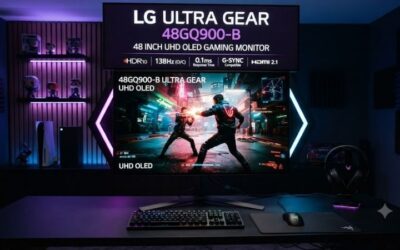
The LG UltraGear 32GS95UE uses a 31.5-inch OLED panel with a native 3840 x 2160 resolution and a 240Hz maximum refresh rate. Its defining feature is Dual Mode, which lets users switch from 4K at 240Hz to Full HD at up to 480Hz when maximum refresh rate matters more than native resolution.
LG also specifies a 0.03ms GtG response time, FreeSync Premium Pro, NVIDIA G-SYNC compatibility, DisplayHDR True Black 400, and a typical 1.5-million-to-one contrast ratio. That combination gives the monitor strong motion clarity, deep blacks, and adaptive-sync support for both AMD and NVIDIA gaming systems.
Key Features
- 31.5-inch OLED
- 4K 3840 x 2160 resolution
- 240Hz at 4K
- Up to 480Hz at 1080p
- 0.03ms GtG response
- FreeSync Premium Pro
- G-SYNC Compatible
- DisplayHDR True Black 400
- Anti-glare, low-reflection surface
- Pixel Sound audio system
What Makes It Different
Dual Mode is the reason to buy the LG instead of a standard 4K 240Hz monitor. Cinematic games can run at full 4K for maximum image detail, while competitive titles can switch to 1080p 480Hz when the GPU can generate extremely high frame rates. This effectively combines two gaming-monitor roles in one panel.
The benefit is particularly relevant for players who alternate between games such as Cyberpunk-style single-player titles and high-speed shooters. A fixed 4K 240Hz monitor is already fast, but 480Hz provides additional motion sampling for competitive gaming when resolution can be sacrificed.
LG also integrates Pixel Sound, which produces audio through the display rather than relying on conventional visible speakers. It will not replace a strong headset or dedicated speakers for serious gaming, but the cleaner design is useful for minimalist desks and casual listening.
Pros
- 4K 240Hz and 1080p 480Hz modes
- Excellent OLED motion response
- Strong HDR contrast
- FreeSync and G-SYNC support
- Useful for mixed AAA and esports gaming
- Integrated audio solution
Cons
- 1080p is visibly softer on a 32-inch 4K panel
- Premium dual-mode functionality increases complexity
- OLED remains susceptible to image retention
Use Case and Who It’s For
Choose the 32GS95UE if you play both graphically intensive games and serious competitive shooters. Instead of owning separate high-resolution and esports displays, Dual Mode lets one monitor cover both workloads. It is less necessary for users who rarely play above 240 FPS or have no interest in competitive gaming.
AORUS FO32U2P
Best For: DisplayPort 2.1 and high-end PC connectivity
The AORUS FO32U2P combines a 31.5-inch QD-OLED panel with 4K resolution, a 240Hz refresh rate, and a 0.03ms GtG response time. It covers 99% of DCI-P3, supports 10-bit color, and carries DisplayHDR True Black 400 certification, placing it firmly in the premium 4K OLED gaming category.
What separates it from most competitors is DisplayPort 2.1 UHBR20. Gigabyte specifies up to 80Gbps of DisplayPort bandwidth and positions the connection for uncompressed 4K 240Hz transmission without depending on Display Stream Compression under supported conditions.
Key Features
- 31.5-inch QD-OLED
- 3840 x 2160
- 240Hz refresh rate
- 0.03ms GtG
- DisplayPort 2.1 UHBR20
- Two HDMI 2.1 ports
- DisplayPort output
- 99% DCI-P3
- KVM support
- OLED Care
- Three-year OLED warranty
What Makes It Different
DisplayPort 2.1 UHBR20 is particularly attractive to users building around newer graphics cards with compatible outputs. While DisplayPort 1.4 with DSC can already drive 4K 240Hz displays effectively, UHBR20 gives the FO32U2P substantially more native link bandwidth and makes the monitor better prepared for high-bandwidth PC connections.
Gigabyte also includes a DisplayPort output for daisy-chain configurations, which is unusual on gaming monitors. Users running a gaming monitor alongside a secondary productivity display may appreciate having additional connection options, although the exact behavior depends on the connected hardware and display configuration.
Gaming-oriented functions include Gigabyte’s Tactical Switch and display modes designed to simulate smaller competitive-screen sizes. These features are useful when a player wants to concentrate visual information into a smaller central area without physically replacing a large 32-inch monitor.
Pros
- Full DisplayPort 2.1 UHBR20
- 4K 240Hz QD-OLED
- Excellent color coverage
- HDMI 2.1
- KVM support
- DisplayPort daisy-chain capability
- Strong PC-focused connectivity
Cons
- Advanced connectivity may be unnecessary for older GPUs
- Large 32-inch footprint
- Premium features can be excessive for casual gaming
Use Case and Who It’s For
The FO32U2P is ideal for enthusiasts who care about PC-side connectivity as much as panel performance. If your graphics card supports high-bandwidth DisplayPort 2.1 and you want a monitor that avoids being constrained to older DP standards, the AORUS is one of the most forward-looking choices in this roundup.
ASUS ROG Swift OLED PG32UCDP
Best For: Premium dual-mode gaming
The ASUS ROG Swift OLED PG32UCDP uses a 31.5-inch WOLED panel with 4K resolution, 240Hz refresh, and 0.03ms response time. Like the LG, it also supports Dual Mode, allowing users to switch into a Full HD 480Hz configuration when competitive speed becomes more important than 4K image quality.
ASUS specifies 99% DCI-P3 coverage, true 10-bit color, HDR10, adaptive sync, and peak HDR brightness up to 1,300 nits under specified test conditions. It also includes OLED Care features, an anti-glare coating, a proximity sensor, and a custom gaming feature set aimed at long-term desktop use.
Key Features
- 31.5-inch WOLED
- 4K 240Hz
- 1080p 480Hz Dual Mode
- 0.03ms GtG
- 99% DCI-P3
- HDMI 2.1
- DisplayPort 1.4 DSC
- USB-C with 90W Power Delivery
- KVM switch
- OLED Care
- Proximity sensor
What Makes It Different
ASUS combines dual-mode performance with a broad desktop feature set. USB-C can deliver up to 90W of power, three USB Type-A ports provide peripheral connectivity, and the built-in KVM simplifies switching between a gaming desktop and another computer.
The proximity sensor is another practical OLED feature. It can help the monitor react when the user moves away, reducing unnecessary static-image exposure. OLED Care adds additional panel-protection tools, making the PG32UCDP particularly appealing to users who expect to leave productivity applications open for long periods.
ASUS also includes gaming-specific functions such as aspect controls and software-based display tools. Players can therefore use the 32-inch screen for immersive 4K games, then reduce the effective image size or move to the 480Hz mode when switching into competitive titles.
Pros
- Excellent 4K 240Hz performance
- 480Hz Full HD mode
- Fast WOLED response
- USB-C 90W
- KVM functionality
- Strong OLED protection features
- Useful competitive gaming controls
Cons
- DisplayPort 1.4 instead of UHBR20 DP 2.1
- Premium feature set may cost more than needed
- 1080p mode sacrifices image sharpness
Use Case and Who It’s For
The PG32UCDP is best for enthusiasts who want dual-mode gaming but also value a sophisticated desktop setup. It competes closely with the LG, adding ASUS-specific gaming tools, KVM functionality, USB-C charging, and OLED protection features that can make it better suited to a mixed work-and-gaming environment.
Samsung Odyssey OLED G8 G80SH 27-Inch
Best For: Compact 4K gaming and maximum pixel density
Samsung’s 2026 Odyssey OLED G8 G80SH offers a 27-inch QD-OLED panel with 3840 x 2160 resolution, 240Hz refresh rate, and 0.03ms response time. Its smaller screen size raises pixel density to approximately 166 PPI, producing noticeably finer 4K text and image detail than a typical 32-inch 4K display.
The monitor also includes DisplayPort 2.1 UHBR20 and USB-C with up to 98W power delivery. Samsung pairs these modern connections with its Glare Free surface treatment and OLED Safeguard+ features, making the G80SH particularly attractive for compact high-end gaming and workstation setups.
Key Features
- 27-inch QD-OLED
- 3840 x 2160 resolution
- 240Hz refresh rate
- 0.03ms response time
- Approximately 166 PPI
- DisplayPort 2.1 UHBR20
- USB-C with 98W Power Delivery
- Glare Free coating
- OLED Safeguard+
- Ergonomic stand
What Makes It Different
Most premium 4K 240Hz OLED gaming monitors have centered around the 32-inch format. The G80SH gives users the same resolution on a smaller 27-inch surface, increasing pixel density and making fine text, detailed game assets, and desktop interfaces appear especially sharp at normal viewing distances.
The smaller screen is also easier to use for competitive gaming because the entire image occupies less of the player’s field of view. Users accustomed to 24- or 27-inch esports monitors may find the transition more natural than moving directly to a large 32-inch panel.
Its DisplayPort 2.1 UHBR20 connection is another important advantage for modern PC users. USB-C with 98W charging also makes the monitor useful with high-performance laptops, allowing one display to serve gaming and productivity systems without requiring a dedicated laptop charging brick at the desk.
Pros
- Very high 166 PPI pixel density
- 4K at 240Hz
- QD-OLED color and contrast
- DisplayPort 2.1 UHBR20
- USB-C with 98W charging
- Compact 27-inch footprint
- Strong choice for desktop work
Cons
- Smaller than users seeking maximum immersion may prefer
- 4K 240Hz requires a powerful GPU
- OLED still needs sensible static-content management
Use Case and Who It’s For
The G80SH is ideal for gamers who specifically prefer 27-inch monitors but do not want to sacrifice 4K resolution or high refresh rates. It also suits mixed productivity systems where high pixel density improves text clarity and where DisplayPort 2.1 and USB-C provide a more future-oriented connection setup.
How to Choose the Best 4K PC Gaming Monitor
Choose 27 Inches or 32 Inches
A 32-inch 4K monitor provides a more immersive experience and makes the resolution easier to appreciate without aggressive interface scaling. It works particularly well for cinematic games, racing titles, RPGs, and large desks where the user can sit slightly farther from the screen.
A 27-inch 4K monitor provides much higher pixel density. Text, icons, and fine image detail look exceptionally sharp, but Windows scaling is usually necessary. Competitive players may also prefer the smaller physical size because important information remains closer to the center of their vision.
Decide Whether 240Hz Is Necessary
A 240Hz monitor can display a new frame every 4.17 milliseconds, making motion appear smoother than 120Hz or 144Hz when the GPU produces sufficiently high frame rates. It is especially valuable in shooters, racing games, and other fast titles where motion clarity and responsiveness matter.
Driving demanding games at native 4K and 240 FPS is difficult even for powerful GPUs, so adaptive sync remains important. You do not need to reach 240 FPS constantly to benefit from the monitor; the additional refresh headroom also improves flexibility as GPU performance and upscaling technologies advance.
Consider Dual Mode
Dual-mode monitors are attractive when one system serves both 4K AAA gaming and competitive esports. Running 4K at 240Hz provides visual quality, while switching to 1080p at 480Hz prioritizes motion clarity and very high frame rates.
The trade-off is sharpness. A 32-inch display operating at 1080p has much lower pixel density than at native 4K. The mode should therefore be viewed as a specialized competitive option rather than the resolution you would normally use for desktop work or single-player gaming.
Check HDMI and DisplayPort
HDMI 2.1 is useful for modern PCs and consoles because it can handle high-bandwidth 4K signals and supports gaming features such as variable refresh rate on compatible devices. Two HDMI ports are convenient when a PC shares the monitor with a PlayStation or Xbox.
DisplayPort 2.1 UHBR20 provides more bandwidth than DisplayPort 1.4. However, DisplayPort 1.4 with DSC can still deliver an excellent 4K 240Hz experience. DP 2.1 matters most to buyers with compatible new GPUs who specifically want greater native link bandwidth.
OLED vs LCD
OLED provides effectively per-pixel lighting, allowing deep blacks, exceptional contrast, and extremely fast response times. These qualities make it particularly strong for dark games, HDR scenes, and high-refresh gaming where slower LCD pixel transitions can produce more visible smearing.
The main trade-off is image-retention risk from prolonged static content. Modern OLED monitors include protection routines, and several manufacturers provide burn-in warranty coverage, but users who display fixed productivity interfaces all day may still prefer a high-quality Mini LED LCD.
Match the Monitor to Your GPU
A 4K 240Hz display places enormous demands on graphics hardware. Competitive games can reach high frame rates more easily, while modern ray-traced AAA titles often require upscaling, frame generation, reduced settings, or a combination of these techniques even on powerful gaming PCs.
That does not make a 240Hz monitor wasted. Adaptive sync allows smooth output below the maximum refresh rate, and the display can remain useful through multiple GPU upgrades. Buying a premium monitor can make sense if you expect it to outlast the graphics card currently installed in your PC.
FAQ
Is 4K 240Hz worth it for PC gaming?
Yes, if you have a powerful GPU and play a mix of competitive and visually demanding games. 4K provides significantly more detail than 1440p, while 240Hz delivers much smoother motion when frame rates are high. The combination is expensive and demanding, but it offers fewer compromises than earlier 4K gaming displays.
Is OLED better than IPS for 4K gaming?
OLED generally provides faster pixel response, deeper blacks, and stronger contrast than conventional IPS gaming monitors. IPS still has advantages for users concerned about burn-in or static desktop content. For primarily gaming-focused use, OLED currently provides the more impressive motion and HDR experience.
Is 32 inches too large for 4K gaming?
No. Thirty-two inches is one of the strongest sizes for 4K because it balances immersion with approximately 140 PPI pixel density. The screen is large enough to show the benefits of UHD resolution without becoming unwieldy on a normal desk, provided the user has enough viewing distance.
Do I need DisplayPort 2.1 for 4K 240Hz?
Not necessarily. Several excellent monitors deliver 4K 240Hz through DisplayPort 1.4 using Display Stream Compression. DisplayPort 2.1 UHBR20 provides significantly more bandwidth and is attractive for future-facing builds, but DP 1.4 DSC remains completely viable for high-refresh 4K gaming.
Is 480Hz better than 4K 240Hz?
It depends on the game. 480Hz is useful for competitive titles where extremely high frame rates and motion clarity matter, while 4K 240Hz provides far better image detail. Dual-mode monitors such as the LG 32GS95UE and ASUS PG32UCDP let you switch between these priorities instead of choosing only one.
What GPU is best for a 4K 240Hz monitor?
A high-end GPU is recommended because 4K contains more than eight million pixels per frame. The exact requirement depends heavily on the game, settings, ray tracing, and upscaling technology. Competitive titles can reach high refresh rates more easily, while demanding AAA games typically require performance compromises.
Conclusion
The best 4K PC gaming monitor depends on whether you prioritize pure 4K image quality, esports speed, connectivity, or smart features. MSI MPG 321URX balances value and features, LG 32GS95UE excels at dual-mode gaming, AORUS FO32U2P leads on DisplayPort 2.1, while Samsung and ASUS offer strong premium alternatives.
Ready to decide? Our #1 pick for 2026 is the Monitor.
Live price & availability on Amazon.