🛒 Best Price Today on Amazon
Prime members get fast, free shipping on everything above, plus member-only deals. New members get a 30-day free trial — cancel anytime.
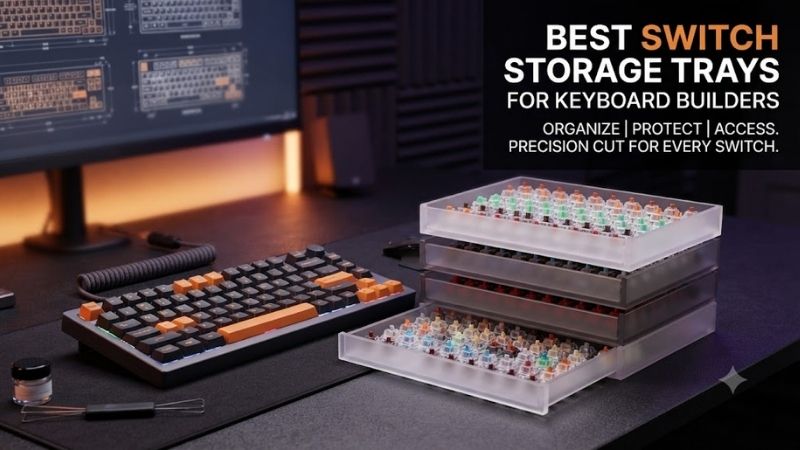
Keeping mechanical switches organized becomes increasingly difficult as a keyboard collection grows. The best switch storage trays for keyboard builders help separate switch types, protect delicate pins, and maintain an efficient workspace during lubrication and assembly. This guide compares six practical options for different building and storage needs.
Quick Verdict: Which Switch Storage System Is Best?
The right storage system depends on whether switches are being stored, displayed, transported, or modified. A sealed container is useful for long-term storage, while a dedicated switch tray or lube station provides better organization during active keyboard assembly. Some builders benefit from owning both types.
Kinetic Labs Switch Containers are a practical overall option for storing complete switch batches. C9LABS Stackable Switch Storage Boxes suit collectors who prefer multiple organized containers, while the Fat Cat Lube Station V1.5 is better for arranging switches and stems during modification.
Quick Comparison Table
| Product | Storage style | Capacity | Best for |
|---|---|---|---|
| Kinetic Labs Small Switch Container | Sealed container | 90 switches | Compact collections |
| Kinetic Labs Large Switch Container | Sealed container | 150 switches | Full keyboard batches |
| C9LABS Stackable Storage Box | Magnetic-lid box | Approx. 70–100 switches | Modular storage |
| ktechs Mechanical Switch Container | Snap-lock container | Approx. 110 switches | Budget storage |
| Fat Cat Lube Station V1.5 | Open workstation tray | 45 switches and 45 stems | Switch lubrication |
| CustomKBD MX Switch Opener Tray | Aluminum workstation | Variable work area | Switch disassembly |
How We Selected These Switch Storage Products
We considered how each product organizes switches, prevents accidental mixing, protects delicate components, and supports realistic keyboard-building workflows. We also distinguished sealed storage containers from open workstation trays because they solve different problems despite appearing in similar product searches.
Capacity claims were evaluated alongside actual use. A container holding 150 loose switches does not provide the same organization as a tray with individually separated positions. Likewise, a lubrication station may be excellent during assembly but unsuitable for protecting switches during transportation.
The 6 Best Switch Storage Trays for Keyboard Builders
Mechanical switch storage is often underestimated until a builder needs to separate several batches with different springs, lubrication, or films. A reliable storage system reduces the chance of mixing components and makes it easier to return to a project after several days without losing track of modifications.
Kinetic Labs Small Switch Container – Best Overall Compact Storage
The Kinetic Labs Small Switch Container is a useful choice for keyboard builders who want to store a complete switch batch without occupying excessive desk space. Its 90-switch capacity is appropriate for many compact and tenkeyless keyboard projects, while its stackable design supports organized storage.
Best for: Builders storing switches for 60%, 65%, 75%, and selected TKL keyboards.
Key specifications
-
Capacity: 90 standard mechanical switches
-
Airtight-style sealing design
-
Thick plastic construction
-
Stackable container shape
-
Compact storage footprint
-
Single- and multipack configurations
Why the capacity matters
Many compact mechanical keyboards require fewer than 90 switches.
A 90-switch container can therefore hold the necessary replacement switches for a build, including a small number of spares depending on layout.
For a 60% keyboard, this capacity is generally more than sufficient.
For some TKL layouts, it may be close to the exact required quantity.
Builders should count their keyboard’s switch positions rather than assuming that the layout name describes the precise switch total.
Protection and storage
The container’s sealing design helps reduce exposure to ordinary dust during storage.
This is useful because loose debris can enter switch housings and interfere with smooth movement.
A closed container also prevents switches from scattering when the workspace is reorganized.
However, an airtight-style lid does not establish waterproof protection.
The switches should still be stored in a dry environment away from excessive heat and moisture.
Practical workflow
One advantage of compact containers is the ability to dedicate one container to each switch type.
For example, a builder might keep linear switches in one container, tactile switches in another, and modified spare switches in a third.
Labels should record the switch model, quantity, and modification status.
This reduces confusion when several batches have similar housing colors.
Pros
-
Convenient 90-switch capacity
-
Stackable design
-
Enclosed storage
-
Useful for organizing multiple batches
-
Compact footprint
Cons
-
Does not separate individual switches
-
Loose switches may move during transportation
-
Not designed as an active lubrication station
-
No dedicated compartment for springs or stems
Buy If: You want organized storage for complete switch batches.
Skip If: You primarily need individual switch positions for lubrication or filming.
Kinetic Labs Large Switch Container – Best for Full Keyboard Builds
The Kinetic Labs Large Switch Container provides a higher-capacity alternative for builders working with full-size keyboards or maintaining larger switch inventories. It uses the same general storage concept as the smaller version while increasing capacity to approximately 150 standard switches.
Best for: Full-size keyboard builds, bulk switch purchases, and larger switch collections.
Key specifications
-
Capacity: 150 switches
-
Stackable plastic construction
-
Enclosed storage
-
Airtight-style seal
-
Compatible storage concept with the smaller container
Advantages of larger capacity
A full-size keyboard often requires approximately 104–108 switches, depending on its layout.
Purchasing additional switches is common because builders may want replacements for damaged pins, defective units, or later repairs.
A 150-switch container can store a complete keyboard batch with room for spares.
It can also accommodate switches purchased in larger quantities for future builds.
Inventory management
The larger container is useful when a builder standardizes several keyboards around one switch model.
Instead of using multiple small bags, a single labeled container can hold a substantial inventory.
The limitation is that loose switches do not remain in a fixed orientation.
If the builder needs to distinguish modified and unmodified switches, separate containers or internal bags may be necessary.
Protection considerations
The enclosed design protects against casual dust exposure, but it does not prevent switches from contacting one another.
For most ordinary mechanical switch batches, this is acceptable during stationary storage.
For expensive switches with delicate pins, transportation requires additional consideration.
A container should not be packed so tightly that the lid applies pressure to the switches.
Pros
-
Larger storage capacity
-
Useful for full-size builds
-
Stackable construction
-
Enclosed storage
-
Convenient for bulk purchases
Cons
-
Takes more space than the smaller version
-
No individual switch slots
-
Loose components require separate organization
-
Not an active workstation tray
Buy If: You store full-size keyboard switch sets or larger inventories.
Skip If: You only work with compact keyboards and prioritize minimal storage space.
C9LABS Stackable Switch Storage Boxes – Best Modular Organization
C9LABS Stackable Switch Storage Boxes are particularly attractive for enthusiasts who own many switch types and want to keep them separated in an organized collection. Their magnetic covers and modular stacking system make them useful for dedicated keyboard workstations.
Best for: Collectors maintaining multiple small and medium switch batches.
Key features
-
Small and large container versions
-
Approximate capacity of 70 switches in the smaller option
-
Larger version listed around 90–100 switches
-
Magnetic cover
-
Stackable structure
-
Multiple pack configurations
-
Optional stacking bases depending on the package
Why modular storage is useful
A keyboard enthusiast may own several switches with similar appearances but different internal components.
One batch might use a heavier spring, another might be factory-lubricated, and a third might contain manually filmed switches.
Keeping these batches separate prevents accidental mixing.
C9LABS boxes allow builders to assign individual containers to specific configurations and stack them to conserve desk or shelf space.
Magnetic cover design
The magnetic cover is convenient when switches need to be accessed frequently.
Unlike a tightly sealed container that requires more effort to open, a magnetic lid can make repeated selection easier.
This is useful when comparing switches or selecting samples for a keyboard build.
However, the lid should not be assumed suitable for uncontrolled transportation.
Before carrying the boxes, make sure the covers are secure and the containers cannot separate.
Capacity considerations
The manufacturer’s capacity information varies slightly between descriptive sections.
Buyers should treat the stated figures as approximate because switch dimensions and housing designs can differ.
For example, a large switch with an unusual upper housing may occupy more room than a conventional MX switch.
Pros
-
Modular storage
-
Magnetic lids
-
Multiple size options
-
Attractive collection organization
-
Stackable system
Cons
-
Not individually slotted
-
Magnetic lids require care during travel
-
Capacity depends on switch dimensions
-
Less suitable for protecting disassembled components
Buy If: You maintain several switch varieties and want easy access to each batch.
Skip If: You need sealed storage for frequent transportation.
ktechs Mechanical Switch Container – Best Budget Storage Option
The ktechs Mechanical Switch Container provides a straightforward solution for storing mechanical switches without relying on expensive custom trays. Its snap-lock lid, sealing ring, and stackable design make it relevant to builders who want practical storage for everyday workshop use.
Best for: Budget-conscious keyboard builders storing moderate switch quantities.
Key specifications
-
Approximately 460 ml capacity
-
Approximate capacity of 110 switches
-
Snap-lock lid
-
Rubber sealing O-ring
-
Stackable design
-
Suitable for loose switches and other small keyboard components
Storage characteristics
A snap-lock lid is useful because it provides a positive mechanical closure.
This can reduce the chance of the container opening accidentally when being moved between workspaces.
The rubber sealing ring adds another barrier against ordinary dust exposure.
However, the presence of a sealing ring does not guarantee that the container is waterproof.
It should not be submerged or exposed to significant moisture.
Practical organization
The approximate 110-switch capacity makes the container relevant to many full-size keyboard projects.
It can hold a large batch without requiring multiple smaller boxes.
For builders who purchase switches in bags, moving them into a rigid container can improve organization and make counting easier.
However, loose storage is not ideal for separating different lubrication states.
A builder should avoid combining unmodified and modified switches in the same compartment unless they are individually identified.
Limitations
The product’s availability can vary, and the exact current packaging should be checked before purchase.
Its design also focuses on storage rather than active assembly.
A separate switch holder may still be useful during lubrication.
Pros
-
Practical container design
-
Snap-lock closure
-
Sealing ring
-
Approximate 110-switch capacity
-
Stackable
Cons
-
Limited internal organization
-
Not intended for switch lubrication
-
Availability varies
-
Loose components can contact one another
Buy If: You want an economical container for complete switch batches.
Skip If: You need a tray that holds every switch upright during maintenance.
Fat Cat Lube Station V1.5 – Best Tray for Switch Lubrication
The Fat Cat Lube Station V1.5 is designed for active mechanical keyboard modification rather than long-term enclosed storage. Its acrylic structure provides dedicated positions for switch housings and stems, allowing builders to organize components while lubricating and preparing a switch batch.
Best for: Switch lubrication, filming, spring replacement, and organized assembly work.
Key specifications
-
Acrylic construction
-
45 switch positions
-
45 stem positions
-
Brush holder
-
Lubricant jar area
-
Dedicated workstation layout
Why individual slots matter
During lubrication, a switch is separated into several components.
These typically include the upper housing, lower housing, stem, and spring.
If the parts are placed loosely on a desk, they can become mixed or contaminated.
Individual slots make it easier to arrange components systematically.
A builder can organize a batch, apply lubricant to the relevant surfaces, and reassemble switches while maintaining a consistent workflow.
Batch size
The 45-switch capacity is well suited to working on part of a keyboard at a time.
For example, an enthusiast preparing approximately 90 switches can process them in two batches.
This can be more manageable than disassembling an entire keyboard’s worth of switches simultaneously.
A smaller work batch also reduces the risk of losing track of which switches have already been lubricated.
Workstation ergonomics
The integrated brush and jar areas keep frequently used supplies nearby.
This helps reduce unnecessary reaching and makes the process more organized.
However, the station itself does not replace the need for clean tools and careful lubrication.
The acrylic surface should be protected against solvents or chemicals that could damage it.
Storage limitations
The open construction does not provide the same dust protection as a sealed container.
It is primarily a working tray.
When the project is complete, finished switches should be transferred into suitable storage packaging.
Pros
-
Dedicated switch and stem positions
-
Integrated tool organization
-
Supports consistent lubrication
-
Useful for batch processing
-
Clear workstation purpose
Cons
-
Not enclosed storage
-
Limited to 45 switches per batch
-
Acrylic requires careful handling
-
Availability may be limited
Buy If: You regularly lubricate or modify mechanical switches.
Skip If: You only need a sealed container for finished switches.
CustomKBD MX Switch Opener Tray – Best for Advanced Switch Disassembly
The CustomKBD MX Switch Opener Tray combines a workstation-oriented tray with a built-in mechanism for opening compatible Cherry MX-style switch housings. Its aluminum construction and acrylic cover make it a specialized option for enthusiasts who frequently disassemble switches.
Best for: Advanced keyboard builders performing repeated switch-opening operations.
Construction
The tray uses a CNC-machined aluminum body and an acrylic lid.
Its opening mechanism is designed around compatible MX switch housings.
The intention is to make disassembly more organized and convenient than using individual handheld switch openers repeatedly.
However, housing compatibility is critical.
Not every switch with an MX-compatible keycap stem uses the same external locking clips.
Integrated opening workflow
A dedicated switch-opening station can help standardize repetitive maintenance work.
Instead of repeatedly positioning a handheld opener, the builder uses the integrated opening interface.
The disassembled components can then be organized in the available tray area.
This is useful for spring swaps, lubrication, and other internal modifications.
Important limitation
The CustomKBD tray is not a substitute for a large individual-slot storage organizer.
Its main purpose is switch disassembly.
Builders who need to store hundreds of finished switches will still benefit from separate containers.
The product may also have limited availability, so it should be treated as a specialist option rather than a universally obtainable accessory.
Pros
-
Integrated MX switch-opening function
-
CNC aluminum construction
-
Acrylic lid
-
Specialized workstation design
-
Useful for repetitive modifications
Cons
-
Not universal across switch housing types
-
Limited general storage capacity
-
More specialized than ordinary containers
-
Availability may be restricted
Buy If: You frequently open compatible MX switches and want a dedicated workstation accessory.
Skip If: You only need inexpensive storage for assembled switches.
Buying Guide: How to Choose Switch Storage Trays
Mechanical switch storage should support the builder’s workflow rather than simply provide enough physical space. Switches contain delicate pins, small moving parts, and sometimes customized components, so an effective storage system should prevent confusion and unnecessary handling.
Choose Between Storage Containers and Lubrication Trays
Storage containers are intended to hold complete switches between projects.
They usually prioritize capacity, closure security, and compact organization.
Lubrication trays serve a different purpose.
They keep switches or their components separated during maintenance.
Some products combine several functions, but few perform every task equally well.
A builder who regularly modifies switches may benefit from a lubrication station and separate sealed containers.
Calculate the Correct Storage Capacity
The required number of switches depends on keyboard layout and the number of spares.
A compact keyboard may require approximately 60–70 switches, while a full-size layout can exceed 100.
Builders should count the actual key positions before purchasing.
It is also useful to allow space for spare switches.
However, storing completely different switch types in one large container can make later identification difficult.
Separate containers with labels are usually preferable.
Protect Switch Pins During Storage
Conventional mechanical switches often have exposed metal pins.
These pins can bend if switches are compressed or handled roughly.
When packing a container, avoid placing heavy objects on top of loose switches.
Do not force the lid closed when the contents exceed the available space.
For transportation, consider whether individual separation or protective inner packaging is necessary.
Magnetic and optical switches may have different component structures, but they still require careful handling.
Prevent Dust and Contamination
Dust and debris can enter switch housings through openings around the stem.
For ordinary assembled switches, enclosed storage helps reduce exposure.
Disassembled switches require even more care.
During lubrication, keep the work surface clean and avoid allowing loose fibers to contact the components.
If a switch is contaminated, clean it appropriately before applying lubricant.
Lubricating a dirty switch can trap debris inside the mechanism.
Organize Switches by Modification Status
A useful labeling system should identify the switch model, quantity, lubrication status, spring configuration, and whether films have been installed.
For example, a builder might maintain separate containers for factory-lubricated switches and manually modified switches.
This prevents confusion when comparing different configurations.
Recording the date of modification can also help with future maintenance.
Consistent organization becomes particularly valuable when a collection contains several similar-looking switch families.
Frequently Asked Questions
Should mechanical switches be stored in trays or containers?
Containers are generally better for long-term storage, while trays are more useful during modification.
Can switch pins bend during storage?
Yes. Excessive pressure and uncontrolled movement can damage exposed metal pins.
Are airtight containers necessary?
Not always, but enclosed storage helps reduce ordinary dust exposure.
Can I store lubricated and unlubricated switches together?
It is better to separate them unless each switch can be identified reliably.
Do magnetic switches need special storage?
Follow the manufacturer’s recommendations. Keep delicate components protected and avoid unnecessary exposure to contamination.
How many switches should a storage container hold?
Choose capacity based on your keyboard’s switch count, spare inventory, and how you organize different batches.
Can a lubrication station be used for long-term storage?
An open station is less suitable because switches remain exposed to dust and accidental contact.
Final Verdict
Kinetic Labs Switch Containers are strong choices for general mechanical switch storage, with 90- and 150-switch versions for different batch sizes. C9LABS offers modular organization, while the Fat Cat Lube Station is better for active modification. Serious keyboard builders benefit from keeping finished switches in containers and working components in dedicated trays.