🛒 Best Price Today on Amazon
Prime members get fast, free shipping on everything above, plus member-only deals. New members get a 30-day free trial — cancel anytime.
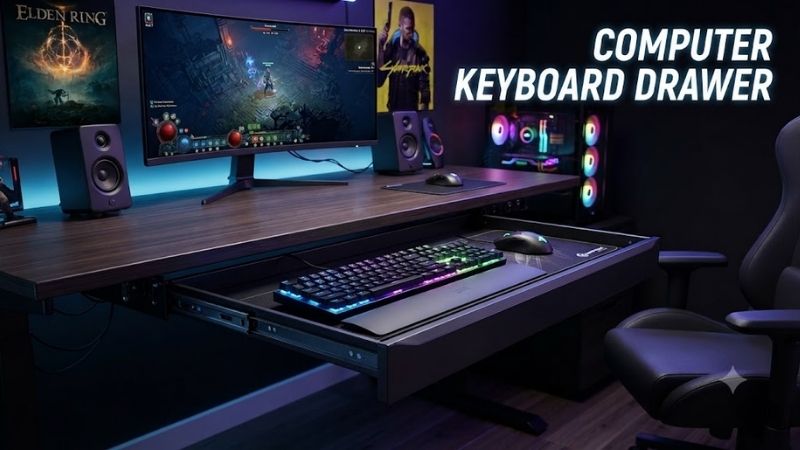
A computer keyboard drawer can free valuable desk space while lowering your keyboard and mouse into a more comfortable typing position. The best models balance tray width, height adjustment, smooth sliding, sturdy mounting, and enough mouse space without interfering with chair clearance or desk frames.
Best Computer Keyboard Drawer Options Compared
| Product | Best For | Key Advantage | Limitation |
|---|---|---|---|
| VIVO MOUNT-KBST1 | Best Overall | Adjustable width and height | Clamps remain visible |
| Humanscale 6G Keyboard System | Best Ergonomic | Refined height and negative tilt | Premium price |
| 3M AKT60LE | Best Professional Office | Adjustable ergonomic support | Requires permanent installation |
| VIVO MOUNT-KB08S | Best Swing-Away Design | 12 height settings | Needs under-desk clearance |
| VIVO MOUNT-KB01B | Best Rotating Tray | 360-degree rotation | Smaller tray surface |
| VIVO MOUNT-KB05HB-DR | Best With Storage | Integrated accessory drawer | Large under-desk footprint |
Best Computer Keyboard Drawer Picks
VIVO MOUNT-KBST1
Best For: Users who want an adjustable clamp-on keyboard tray without drilling into the desktop.
The VIVO MOUNT-KBST1 uses a split tray that adjusts from 22.5 to 30 inches wide and measures 11 inches deep. Its clamp system supports desktops from 0.5 to 3.4 inches thick, while five height positions provide 2.4 inches of vertical adjustment for matching the keyboard position to the user’s chair and desk.
Key Features
- 22.5 to 30-inch adjustable tray width
- 11-inch tray depth
- Up to 11-pound capacity
- Five height positions
- 2.4-inch height adjustment
- Clamp-on mounting
- Sliding extension
- Wrist pad included
- Mouse pad and mouse wrist rest included
What makes this tray useful is its ability to fit several keyboard sizes without permanently altering the desk. The platform can accommodate a keyboard and mouse together, while the clamps make installation practical for renters or users with expensive desktops that they do not want to drill.
Pros
- No drilling required
- Adjustable width and height
- Includes wrist-support accessories
Cons
- Clamps are visible on the desktop
- Requires enough space around desk edges
Who Should Buy It: Choose the MOUNT-KBST1 if you want an ergonomic keyboard position but cannot drill into the desk. It is particularly useful for home offices, gaming desks, and shared workspaces where the setup may eventually move, though fixed mounting can look cleaner in a permanent workstation.
Humanscale 6G Keyboard System
Best For: Ergonomic workstations where precise height and tilt positioning matter most.
The Humanscale 6G belongs to a professional keyboard-support family designed to position the keyboard and mouse close to the user. Humanscale emphasizes easy height adjustment and negative tilt, allowing the platform to angle away from the body rather than forcing the wrists upward during long periods of typing.
Key Features
- Adjustable keyboard arm
- Negative-tilt positioning
- Multiple platform configurations
- Left- or right-side mouse options
- Gel palm support options
- Under-desk track mounting
- Height adjustment
- Professional ergonomic design
- Customizable system components
Its main advantage is adjustability rather than simple storage. A well-positioned tray can bring the keyboard closer to elbow height while keeping the mouse nearby, reducing the need to reach forward across a deep desk. The platform can also be configured around different keyboard and pointing-device layouts.
Pros
- Excellent ergonomic adjustability
- Multiple platform configurations
- Strong professional-workstation focus
Cons
- More expensive than simple trays
- Installation is more involved
Who Should Buy It: The Humanscale 6G is best for users who type for many hours and treat workstation ergonomics as a priority. It makes sense in professional offices, editing suites, design environments, and long-term home workstations where fine positioning matters more than getting the cheapest possible tray.
3M AKT60LE Adjustable Keyboard Tray
Best For: Traditional office setups that need a dedicated adjustable keyboard and mouse platform.
The 3M AKT60LE is designed as an adjustable support for a keyboard and mouse or trackball. Its under-desk system positions input devices below the desktop while allowing users to move the platform into a more comfortable working position, making it a practical option for established office desks and workstation furniture.
Key Features
- Under-desk keyboard support
- Keyboard and mouse platform
- Adjustable positioning
- Designed for workstation use
- Dedicated mounting track
- Ergonomic placement
- Palm-support compatibility
- Suitable for office desks
The 3M approach is more permanent than a clamp-on tray. Once installed, the keyboard support becomes part of the workstation rather than an accessory hanging from the front edge. That can provide a cleaner desktop appearance and a stable typing surface, but it requires a desk that can accept the mounting hardware.
Pros
- Professional office design
- Stable fixed installation
- Supports keyboard and pointing device
Cons
- Requires under-desk installation
- Less convenient to move between desks
Who Should Buy It: Choose the AKT60LE for a dedicated office desk where the tray will remain installed for years. It suits employees, remote workers, and organizations that want a conventional ergonomic keyboard system rather than a temporary clamp solution, provided the desktop is suitable for permanent mounting.
VIVO MOUNT-KB08S
Best For: Users who want a tray that adjusts vertically and swings away when not needed.
The VIVO MOUNT-KB08S uses a 26.8-inch-wide by 11-inch-deep tray and supports up to 11 pounds. Its arm offers a height range from about 2.2 to 6.5 inches below the desktop, while a 12-position locking system and approximately 165 degrees of swinging movement provide more flexibility than a basic sliding drawer.
Key Features
- 26.8 x 11-inch tray
- 11-pound weight capacity
- 12 locking height positions
- 2.2 to 6.5-inch height range
- 165-degree swing
- 8.6-inch forward and backward movement
- Under-desk mounting
- Larger 34-inch version available
What makes this model different is the swinging mechanism. Instead of relying only on straight rails, the tray can move forward and backward while changing vertical position. That can help users fine-tune typing height or move the tray farther under the desk when they need more room for another task.
Pros
- Wide height-adjustment range
- Swing-away movement
- Spacious tray surface
Cons
- Needs substantial under-desk clearance
- Permanent mounting is required
Who Should Buy It: The MOUNT-KB08S suits users who want more positional freedom than a fixed slide-out tray can provide. It works especially well for desks used for both keyboard work and other activities, although users should carefully check frame rails, drawers, and crossbars before installation.
VIVO MOUNT-KB01B Rotating Keyboard Tray
Best For: Compact desks where the keyboard should rotate completely out of the way.
The VIVO MOUNT-KB01B uses a single central bracket and a 22.8 by 9.8-inch platform that can rotate through 360 degrees. It supports up to 11 pounds and offers two height-clearance settings, making it an unusual alternative to conventional trays that rely on long sliding tracks beneath the desktop.
Key Features
- 22.8 x 9.8-inch tray
- 360-degree rotation
- 11-pound capacity
- Central mounting bracket
- Two height-clearance settings
- Steel and particle-board construction
- Under-desk installation
- Compact storage movement
The rotating design is its main advantage. When the keyboard is not needed, the platform can pivot beneath the desk instead of simply sliding backward on rails. This can be helpful on workstations where conventional tracks would conflict with another component or where users frequently alternate between typing and open desk space.
Pros
- Full 360-degree rotation
- Compact mounting concept
- Easy to move out of the way
Cons
- Smaller than wide keyboard trays
- Needs rotation clearance under the desk
Who Should Buy It: Choose the rotating VIVO tray if storage movement matters more than maximum width. It is best for compact keyboards, smaller mice, and multifunction desks where the keyboard must disappear quickly, while users with full-size boards and large mouse areas should choose a wider platform.
VIVO MOUNT-KB05HB-DR
Best For: Users who want a keyboard tray and small storage drawer in one under-desk system.
The VIVO MOUNT-KB05HB-DR combines a 26.8 by 11-inch keyboard platform with a separate low-profile drawer. Its clamp system works with desktops from 0.5 to 3.4 inches thick, while five bracket-height positions allow 2.4 inches of adjustment and the keyboard tray extends about 8.5 inches from the desk.
Key Features
- 26.8 x 11-inch keyboard tray
- Integrated accessory drawer
- 22 x 8.8 x 1.9-inch drawer interior
- Clamp-on installation
- Five height positions
- 2.4-inch height adjustment
- Up to 11-pound tray capacity
- Smooth sliding track
The storage drawer distinguishes this model from ordinary clamp-on trays. Small items such as cables, pens, adapters, flash drives, or stationery can remain under the desktop instead of occupying valuable surface space. The trade-off is a larger overall assembly that needs more room beneath the desk.
Pros
- Keyboard tray and storage combined
- No desktop drilling required
- Useful height adjustment
Cons
- Takes considerable under-desk space
- Drawer adds weight and bulk
Who Should Buy It: This model is useful for small home offices where both desktop and drawer space are limited. It can replace a separate accessory organizer while keeping the keyboard below the work surface, but users with desks containing crossbars or existing drawers should measure carefully before purchasing.
Computer Keyboard Drawer Buying Guide
Clamp-On vs Screw-Mounted Trays
Clamp-on trays are easier to install because they grip the desk edge instead of requiring pilot holes. They are useful for renters, temporary offices, and desks that may be resold later. The trade-off is visible hardware on the desktop and compatibility limits based on edge thickness, bevels, frames, or support rails.
Screw-mounted trays usually create a cleaner permanent workstation and can support more sophisticated adjustment arms. They are better for long-term ergonomic setups, but installation requires careful measurement. Desks with thin particleboard, glass surfaces, metal crossbars, or shallow undersides may not be suitable for every mounting system.
Measure Tray Width and Mouse Space
A full-size keyboard can be roughly 17 inches wide before allowing any space for the mouse. A tray under 23 inches may therefore feel tight if you use broad mouse movements, while 26-inch or wider platforms give more comfortable room for a standard keyboard and pointing device on the same surface.
Gamers should be especially careful because low-sensitivity mouse settings require much more lateral movement than ordinary office work. A wide keyboard drawer can help, but competitive players may still prefer the mouse on the desktop. Compact keyboards such as 75% or tenkeyless designs free significantly more tray space.
Height and Tilt Adjustment
A keyboard drawer should position the keys so your shoulders can remain relaxed and your elbows stay close to a comfortable angle. Simply lowering the keyboard is not always enough because users with different chairs, desks, and body dimensions need different heights, making adjustable models more versatile.
Tilt also affects wrist position. Ergonomic systems often emphasize neutral or slightly negative keyboard angles rather than raising the rear edge sharply. Buyers with wrist discomfort should prioritize fine adjustment over storage features, while occasional users may be satisfied with a basic fixed-height sliding tray.
Check Desk Construction Before Buying
Always inspect the underside of the desk before choosing a keyboard drawer. Steel support beams, drawer boxes, cable trays, motors, standing-desk crossbars, and thick front aprons can block tracks or brackets even when the desktop dimensions appear large enough from above.
Clamp models also need a flat, accessible front edge. Permanent systems require enough material for screws to hold securely without penetrating the top surface. Glass desks generally need purpose-built solutions, and hollow desktops may not provide the structural strength required by conventional screw-mounted hardware.
Consider Chair and Knee Clearance
Lowering a keyboard below the desktop reduces available space for your legs. A thick tray, mounting arm, or storage drawer can interfere with knees, especially when the desk is already low or the chair must be raised to align the eyes with a monitor.
Measure the distance from the underside of the desk to your thighs while seated in your normal working posture. Height-adjustable trays are useful because they can balance typing position against leg clearance. A tray that looks ergonomic on paper can become uncomfortable if it forces the chair too low or pushes the user farther from the desk.
Frequently Asked Questions
Is a Computer Keyboard Drawer Better Than Keeping the Keyboard on the Desk?
A keyboard drawer can be better when the desktop is too high for comfortable typing or when additional work surface is needed. It allows the keyboard to sit closer to elbow height and can move it away when unused. However, a poorly positioned tray can reduce knee room, so proper height, width, and adjustment matter.
How Wide Should a Keyboard Drawer Be?
Around 26 inches is a practical starting point when a full-size keyboard and mouse need to share one tray. Smaller platforms can work with compact keyboards, while gamers using broad mouse movements may prefer 30 inches or more. Measure your actual keyboard and mouse area rather than relying only on the advertised tray width.
Can I Install a Keyboard Tray Without Drilling?
Yes. Clamp-on products such as VIVO MOUNT-KBST1 and MOUNT-KB05HB-DR attach to compatible desk edges without permanent holes. They are useful for rental furniture and temporary setups, although the clamps remain visible and require a flat desk edge within the manufacturer’s supported thickness range.
Are Keyboard Drawers Good for Gaming?
They can be, especially when a tray creates more mouse space on the main desktop or places the keyboard at a comfortable height. Gaming requires careful attention to tray width and stability, however. Players who use low mouse sensitivity may find a traditional tray too narrow for large aiming movements.
What Should I Check Before Buying an Under-Desk Keyboard Tray?
Measure desk thickness, underside clearance, front-edge shape, mounting depth, and the location of crossbars or drawers. Then compare those measurements with the tray’s mounting requirements. Also confirm that the platform is wide enough for your keyboard and mouse and does not reduce leg clearance excessively.
Is an Adjustable Keyboard Tray Worth the Extra Cost?
Yes for users who type for several hours every day. Height, tilt, and distance adjustment make it easier to position the keyboard around your body instead of adapting your posture to a fixed tray. For occasional use, a simple sliding model can be sufficient, but long work sessions benefit more from precise positioning.
Conclusion
The best computer keyboard drawer depends on desk thickness, mounting preference, mouse space, and how much height or tilt adjustment you need. VIVO offers strong value across clamp-on, rotating, and adjustable designs, while Humanscale and 3M better suit ergonomic users who want more refined positioning.