🛒 Best Price Today on Amazon
Prime members get fast, free shipping on everything above, plus member-only deals. New members get a 30-day free trial — cancel anytime.
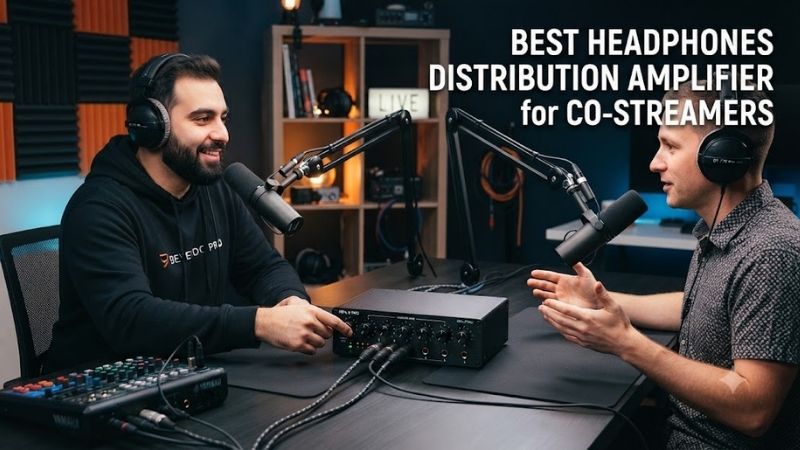
The best headphones distribution amplifier for co-streamers lets multiple people monitor the same production audio without sharing one headphone volume control. Whether two creators stream from a gaming room or four hosts record together, a dedicated distribution amplifier provides separate headphone outputs, consistent monitoring, and simpler cable management.
Quick Verdict
The Samson QH4 is our best overall desktop choice for co-streamers because it provides four independent headphone outputs, balanced input connections, and convenient monitoring controls.
The Behringer HA400 is the most straightforward budget option when four users only need to hear one shared stereo mix.
For larger production spaces, the PreSonus HP60 and Mackie HM-800 offer more advanced routing arrangements and additional monitoring flexibility.
A headphone distribution amplifier is not a microphone mixer. It distributes audio to listeners but does not automatically combine microphones or create separate streaming outputs.
Quick Comparison Table
| Product | Headphone Channels | Main Advantage | Best For |
|---|---|---|---|
| Samson QH4 | 4 | Balanced inputs and monitoring controls | Best overall |
| Behringer HA400 | 4 | Simple individual volume control | Budget |
| Mackie HM-4 | 4 | Straightforward desktop operation | Small teams |
| ART HeadAmp4 | 4 | Compact headphone distribution | Home studios |
| PreSonus HP60 | 6 | Separate mixes and talkback | Advanced collaboration |
| Mackie HM-800 | 8 | Up to 16 headphone connections | Larger studios |
How We Selected These Headphone Amplifiers
We prioritized active headphone amplifiers with multiple independently adjustable outputs.
Unlike a passive headphone splitter, an active distribution amplifier provides dedicated amplification and avoids simply placing several headphone loads on one ordinary output.
For co-streaming, the main considerations are channel count, physical connectivity, headphone impedance, monitoring controls, and whether participants can receive different audio mixes.
We also considered the difference between four separate volume controls for one shared signal and a genuinely configurable monitoring system.
Detailed Product Recommendations
1. Samson QH4 — Best Overall
Best For: Two to four co-streamers sharing a desktop production setup.
Why We Picked It: The QH4 provides four separate headphone channels, balanced main inputs, auxiliary connections, and monitoring functions that are useful for collaborative recording.
Key Specifications
-
Four independent headphone amplifiers
-
Four 1/4-inch stereo headphone outputs
-
Two balanced 1/4-inch input connections
-
3.5mm auxiliary input and output
-
Individual headphone volume controls
-
Master mute and mono controls
-
External 15V DC power
Features and Benefits
The QH4 allows several participants to hear a shared production mix while setting individual listening volumes.
This is important because different headphones can produce different loudness levels from the same input signal.
One streamer may use sensitive in-ear monitors while another wears less-sensitive over-ear headphones.
Independent amplification prevents the entire group from depending on one volume setting.
The balanced input arrangement is also convenient when connecting a compatible mixer or audio interface.
Performance and Practical Use
The QH4 supports four listening positions without requiring four separate audio interfaces.
However, it does not automatically provide a different combination of game, chat, and microphone audio for each participant.
Creating personalized mixes requires an appropriate upstream routing system.
Pros: Four independent outputs, balanced inputs, auxiliary connection, master monitoring controls.
Cons: No independent source mix per listener; requires a suitable upstream audio signal.
Buy If: You want a compact monitoring amplifier for a small co-streaming team.
Skip If: Every participant needs a completely different headphone mix.
2. Behringer HA400 — Best Budget Distribution Amplifier
Best For: Co-streamers needing four headphone outputs from one stereo source.
Why We Picked It: The HA400 provides a compact and straightforward four-channel design with independent listening levels.
Key Specifications
-
Four stereo headphone amplifier channels
-
Four 1/4-inch headphone outputs
-
One stereo input connection
-
Individual volume controls
-
Included 12V DC adapter
-
Approximately 40mW into 100-ohm loads per output
Features and Benefits
The HA400 is particularly useful when several people sit around one gaming or streaming desk.
A stereo feed from a mixer can be connected to the unit and distributed to four headphones.
Each participant controls their listening volume without affecting the others.
Its uncomplicated interface also reduces setup time.
Performance and Practical Use
The main limitation is routing flexibility.
Everyone receives the same underlying stereo mix.
If one streamer wants more voice chat while another prefers louder gameplay, the HA400 cannot independently change those source balances.
Pros: Compact design, four volume controls, external adapter included.
Cons: One shared mix, no advanced routing, 1/4-inch headphone adapters may be required.
Buy If: You need inexpensive distribution of one stereo stream-monitoring mix.
Skip If: You need separate cue mixes or advanced talkback.
3. Mackie HM-4 — Best Simple Desktop Alternative
Best For: Small co-streaming teams using an existing audio mixer.
Why We Picked It: The HM-4 offers four independent headphone outputs in a straightforward desktop enclosure.
Key Specifications
-
Four headphone channels
-
One stereo input
-
Four 1/4-inch stereo outputs
-
Individual output-level controls
-
External power adapter
-
Metal enclosure design
Features and Benefits
The HM-4 serves the same broad purpose as the Behringer HA400 but provides an alternative physical design and manufacturer ecosystem.
Its controls are easy to understand because each knob corresponds to a headphone output.
For a two-person gaming stream, the unused outputs leave room for guests or another production participant.
Performance and Practical Use
The HM-4 is not intended to replace a full audio mixer.
It cannot independently adjust microphone, music, game, and voice-chat levels for each listener.
Those signals must first be combined by the appropriate upstream device.
Pros: Four dedicated headphone outputs, simple operation, compact desktop arrangement.
Cons: Shared source mix, no per-person input routing.
Buy If: You already have a mixer and want additional headphone connections.
Skip If: Your primary need is combining multiple microphones.
4. ART HeadAmp4 — Best Compact Studio Alternative
Best For: Small collaborative streams and gaming podcast setups.
Why We Picked It: The ART HeadAmp4 offers independent headphone amplification in a compact format suitable for desktop production.
Key Specifications
-
Four headphone amplifier channels
-
Stereo input
-
Individual output-level controls
-
External power
-
Dedicated headphone distribution design
Features and Benefits
The HeadAmp4 is useful for a streamer who already controls the overall mix through another device.
Connecting the mixer’s monitoring output allows multiple listeners to receive that signal.
Independent volume control can help when users wear different headphone models.
Performance and Practical Use
The amplifier is designed to distribute an existing audio signal, not to process separate microphone inputs.
Its usefulness therefore depends on whether the upstream audio system supplies the correct monitoring mix.
Pros: Four independent listening levels, dedicated amplification, compact form.
Cons: No individualized source routing, additional cabling required.
Buy If: You want a basic four-listener distribution amplifier.
Skip If: You require six or more separate monitoring channels.
5. PreSonus HP60 — Best for Customized Monitoring
Best For: Multi-person gaming productions with separate audio feeds and communication requirements.
Why We Picked It: The HP60 supports six headphone channels, two main stereo input buses, external input blending, and talkback functionality.
Key Specifications
-
Six independent headphone outputs
-
Two main stereo input mixes
-
Individual external input per channel
-
Mix A/B balance controls
-
Talkback microphone input
-
Rackmount design
-
Dedicated output controls
Features and Benefits
The HP60 provides much more flexibility than a simple shared-mix amplifier.
For example, one main input might carry game and chat audio while another contains the production mix.
Individual listeners can adjust the relationship between the available feeds.
External inputs provide additional customization.
A producer can also use the talkback system to communicate with participants.
Performance and Practical Use
This functionality is valuable when several people participate in one production.
However, the HP60 requires more cabling, more configuration, and a suitable audio mixer or interface to supply the intended signals.
For two people sharing one audio mix, much of its capability may be unnecessary.
Pros: Six channels, configurable monitoring, talkback, professional rackmount design.
Cons: Greater installation complexity, larger physical footprint.
Buy If: Your co-streaming setup needs personalized monitoring and production communication.
Skip If: You only need two inexpensive headphone outputs.
6. Mackie HM-800 — Best for Large Co-Streaming Studios
Best For: Multi-host productions with numerous headphones or separate monitoring positions.
Why We Picked It: The HM-800 provides eight amplifier channels, two main stereo inputs, auxiliary inputs, and a total of sixteen physical headphone outputs.
Key Specifications
-
Eight amplifier channels
-
Sixteen headphone output connections
-
Two main stereo inputs
-
Auxiliary input per channel
-
Input selection controls
-
Stereo/mono options
-
Rackmount construction
Features and Benefits
The HM-800 is designed for situations where many people need headphone monitoring.
Two headphone outputs per amplifier channel allow additional listeners to connect, although paired outputs are not independently controlled channels.
For a streaming studio with several participants and production staff, this can significantly simplify monitoring distribution.
Performance and Practical Use
The system is more complex and physically larger than desktop four-channel amplifiers.
It is most useful when the studio genuinely needs several monitoring positions.
Users should understand that sixteen headphone sockets do not mean sixteen fully independent audio mixes.
Pros: High headphone capacity, multiple input choices, rackmount construction.
Cons: Large footprint, higher setup complexity, not economical for small teams.
Buy If: You operate a multi-person production studio.
Skip If: Your setup contains only one or two co-streamers.
Buying Guide: Choosing a Headphones Distribution Amplifier
Count Independent Headphone Channels
A four-channel amplifier typically provides four separately adjustable listening levels.
However, the number of sockets is not always the number of independent mixes.
Some rackmount systems provide two sockets for each amplifier channel.
Check how volume and routing are controlled.
Understand Shared Mixes and Personal Mixes
Basic distribution amplifiers send the same stereo mix to everyone.
More advanced systems can receive multiple source mixes or additional individual feeds.
If co-streamers need different game-to-chat balances, choose a system capable of the necessary routing.
Match Input and Output Connections
Most professional headphone distribution amplifiers use 1/4-inch connections.
Gaming headsets often use 3.5mm plugs.
Adapters may be required, but headset microphones cannot automatically be routed through an ordinary stereo headphone amplifier.
Check Headphone Impedance
Headphones differ in electrical impedance and sensitivity.
An amplifier must provide sufficient output level without excessive distortion.
Impedance alone does not determine loudness, so output-power figures and headphone sensitivity should both be considered.
Prevent Feedback and Routing Problems
When distributing a stream mix, avoid accidentally routing monitored microphone audio back into the wrong input.
A headphone amplifier will reproduce the signal it receives, including unwanted echoes or feedback loops.
Correct mixer configuration is essential.
Frequently Asked Questions
Can four streamers share one headphone amplifier?
Yes. A four-channel distribution amplifier can provide separate headphone volume control for four listeners.
Does a headphone splitter work as well?
A passive splitter may function, but an active amplifier provides dedicated output amplification and greater level control.
Can each streamer hear a different mix?
Only if the amplifier and upstream audio system support that routing.
Can I connect headset microphones through a headphone amplifier?
Ordinary stereo headphone amplifiers distribute listening audio; they do not automatically process headset microphone signals.
Is a rackmount amplifier necessary for two co-streamers?
Usually not. A compact four-channel unit is often sufficient.
Conclusion
The Samson QH4 is our best overall recommendation among the best headphones distribution amplifier for co-streamers options because it combines four independent headphone outputs with convenient input and monitoring controls. The Behringer HA400 is a practical budget alternative, while the PreSonus HP60 and Mackie HM-800 suit more demanding multi-person productions. Select the correct channel count and routing capability before buying.