🛒 Best Price Today on Amazon
Prime members get fast, free shipping on everything above, plus member-only deals. New members get a 30-day free trial — cancel anytime.
- Dual Band vs Tri Band Routers at a Glance
- What Is a Dual Band Router?
- What Is a Tri Band Router?
- Number of Wi-Fi Bands
- 2.4GHz Performance
- 5GHz Performance
- 6GHz and Modern Tri Band Routers
- Gaming Performance
- Device Capacity
- Mesh Wi-Fi Performance
- Speed Differences
- Range
- Cost and Value
- Which Is Better for Gaming?
- Who Should Buy a Dual Band Router?
- Who Should Buy a Tri Band Router?
- FAQ
- Conclusion
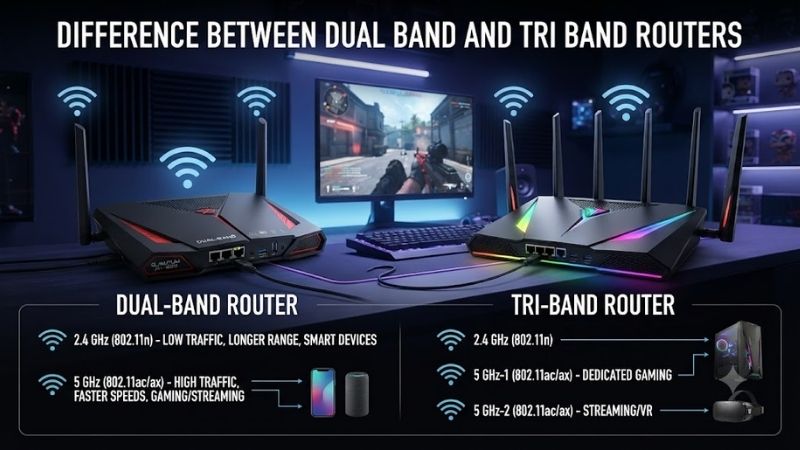
The difference between dual band and tri band routers is the number of wireless frequency bands available for connected devices. A dual band router normally provides one 2.4GHz and one 5GHz band, while a tri band router adds another 5GHz or 6GHz band, giving busy networks more wireless capacity and flexibility.
Dual Band vs Tri Band Routers at a Glance
| Feature | Dual Band Router | Tri Band Router |
|---|---|---|
| Number of Bands | 2 | 3 |
| Typical Bands | 2.4GHz + 5GHz | 2.4GHz + 5GHz + 5GHz or 6GHz |
| Device Capacity | Good | Better for busy networks |
| Congestion Management | Moderate | Better |
| Gaming | Excellent for many homes | Better with many active devices |
| Mesh Backhaul | Usually shared | Can use dedicated band |
| Cost | Lower | Higher |
| Best For | Small to medium homes | Large or device-heavy homes |
What Is a Dual Band Router?
A dual band router broadcasts wireless networks on two frequency bands. The standard configuration combines 2.4GHz with 5GHz, allowing devices to use the band that best suits their location and performance needs. Many modern routers automatically place clients on the appropriate band through band-steering features.
The 2.4GHz band generally provides longer range and stronger wall penetration, making it useful for smart-home devices, older hardware, and clients located farther from the router. Its disadvantage is congestion because Bluetooth devices, neighboring Wi-Fi networks, and many household electronics can compete within the same spectrum.
The 5GHz band typically provides substantially more available spectrum and supports wider channels, making it better for gaming, high-resolution streaming, video calls, and large downloads. Its signal normally loses strength more quickly through walls than 2.4GHz, so performance may decline faster as distance from the router increases.
What Is a Tri Band Router?
A tri band router provides three independent wireless bands instead of two. Traditional tri band Wi-Fi 5 and Wi-Fi 6 routers commonly use one 2.4GHz band and two separate 5GHz bands, while newer Wi-Fi 6E and Wi-Fi 7 models may combine 2.4GHz, 5GHz, and 6GHz.
The additional band does not automatically make one device three times faster. Its main advantage is increased network capacity because connected clients can be distributed across more wireless resources. This can reduce competition when several phones, gaming systems, televisions, laptops, and smart devices transfer data simultaneously.
In a mesh Wi-Fi system, the third band can also be particularly useful for communication between mesh nodes. Some systems reserve one high-speed band for wireless backhaul, preventing traffic between nodes from competing directly with client devices for the same radio resources.
Number of Wi-Fi Bands
A dual band router essentially divides wireless traffic between two available radio networks. If several high-bandwidth devices all depend on the 5GHz band, they must share that radio’s available airtime. Performance can remain excellent, but heavy simultaneous traffic increases competition and can reduce throughput.
A tri band router creates another path for wireless traffic. For example, several gaming PCs may use one 5GHz band while televisions, phones, and laptops use another. With Wi-Fi 6E or Wi-Fi 7 hardware, compatible devices may instead move to 6GHz, leaving additional capacity available for older 5GHz clients.
The third band therefore improves capacity rather than simply increasing the top speed of every client. A laptop connected to one 5GHz radio still uses only the capabilities of that specific connection unless newer technologies allow multi-band operation. The primary benefit is reducing how many devices compete for the same resources.
2.4GHz Performance
Both dual band and tri band routers normally include 2.4GHz because the band remains important for range and compatibility. Smart plugs, security cameras, printers, older laptops, and other low-bandwidth devices frequently use it because they do not require extreme speed and may be located far from the router.
Adding a third band does not significantly improve 2.4GHz performance by itself. A tri band router may use better antennas, processors, or radios than a cheaper dual band model, but those differences come from the individual hardware rather than the simple fact that three bands are available.
For gamers, 2.4GHz is usually the fallback rather than the preferred connection when 5GHz, 6GHz, or Ethernet is available. The crowded spectrum and limited channel width make latency consistency more vulnerable to interference, particularly in apartment buildings where many neighboring networks overlap.
5GHz Performance
The 5GHz band is often the most useful frequency for gaming because it combines strong throughput with broad compatibility. Dual band routers dedicate one 5GHz radio to all compatible devices, which works well for many households when the number of simultaneously active clients is reasonable.
Traditional tri band routers add a second 5GHz radio, allowing heavy traffic to be separated. One family member could download a large game while another streams 4K video and someone else joins a video call, with clients distributed between the two radios rather than competing on one 5GHz channel.
This does not eliminate every performance bottleneck. Internet speed, channel interference, router hardware, device Wi-Fi capabilities, and distance still matter. The third band simply gives the network administrator or automatic steering system more resources for balancing wireless demand.
6GHz and Modern Tri Band Routers
Wi-Fi 6E introduced the 6GHz band, which provides additional clean spectrum for compatible devices. A typical tri band Wi-Fi 6E router combines 2.4GHz, 5GHz, and 6GHz instead of using two separate 5GHz bands. This can provide excellent performance for modern laptops, phones, and gaming hardware.
The main trade-off is range. Higher-frequency 6GHz signals generally lose strength more quickly through walls and floors than 5GHz or 2.4GHz. It works best when compatible devices are relatively close to the router or when a mesh system provides nearby access points throughout the home.
Compatibility is another consideration because older devices cannot connect to 6GHz. A household filled with 5GHz-only hardware may gain less practical benefit from a 2.4/5/6GHz tri band router than one containing several newer Wi-Fi 6E or Wi-Fi 7 clients.
Gaming Performance
A dual band router can provide excellent gaming performance when the gaming PC or console has a strong 5GHz connection and network congestion is limited. Online games normally require relatively little bandwidth, so consistent latency and low interference matter more than extremely high theoretical throughput.
Tri band becomes more useful when gaming occurs alongside heavy household traffic. If several users stream, download games, transfer backups, and join video calls at the same time, distributing clients across multiple high-speed bands can reduce wireless contention and maintain more consistent performance.
Neither router type automatically beats Ethernet for a stationary gaming PC. A wired connection avoids wireless interference and provides predictable latency. Tri band Wi-Fi is most useful when Ethernet installation is impractical or when several gaming devices depend on wireless connectivity simultaneously.
Device Capacity
Dual band routers can support many devices, particularly modern Wi-Fi 6 models using technologies designed to improve network efficiency. The actual limit depends on the router processor, memory, radio design, client behavior, and how much traffic each device generates rather than a simple advertised device count.
A home with thirty mostly idle smart-home devices creates less pressure than ten devices simultaneously transferring large files. This is why counting connected clients alone can be misleading. Active airtime usage is more important when determining whether an additional band will produce a noticeable benefit.
Tri band routers provide more wireless capacity for active clients because traffic can be distributed over additional spectrum. They are therefore attractive for large households, gaming homes, content creators, and environments where several people regularly perform bandwidth-intensive tasks at the same time.
Mesh Wi-Fi Performance
Mesh networking is one of the strongest reasons to consider tri band hardware. In a wireless mesh, satellite nodes need to communicate with the main router. When client traffic and backhaul share the same band, available airtime must be divided between those functions, potentially reducing throughput at distant nodes.
A tri band mesh can reserve one radio for dedicated wireless backhaul while the remaining bands serve phones, PCs, consoles, and other clients. This allows communication between nodes to occur without directly consuming the same wireless resources used by connected devices.
Not every tri band mesh uses dedicated backhaul, however. Some dynamically allocate all bands depending on conditions, while others use Ethernet backhaul when available. Buyers should check how the specific mesh system handles backhaul rather than assuming every three-band design works identically.
Speed Differences
Tri band does not mean an individual device automatically receives higher maximum speed. A client connected to a 5GHz band cannot simultaneously use the other bands on conventional Wi-Fi implementations. Its speed remains limited by the radio, channel width, signal quality, client capability, and router specifications.
The benefit appears when several devices operate at once. A dual band router may have one high-speed 5GHz radio serving every performance-sensitive client, while a tri band model can split them across two high-speed radios or move compatible devices onto 6GHz.
Wi-Fi 7 introduces additional technologies such as Multi-Link Operation that can change how devices use multiple bands, but both router and client must support those capabilities. The simple dual-band-versus-tri-band distinction still primarily describes available radio resources rather than guaranteed client speed.
Range
A tri band router does not automatically provide greater physical coverage. Coverage depends on antenna design, transmit power, building materials, placement, interference, and frequency. A well-designed dual band router can cover a larger area than a poorly positioned tri band model.
The additional band mainly provides capacity rather than range. In fact, a 6GHz third band generally has shorter practical reach through obstacles. Large homes needing better coverage should therefore consider mesh systems or wired access points instead of assuming an expensive tri band router alone will solve dead zones.
Placement remains critical regardless of router type. Position the router centrally, keep it away from large metal objects, and avoid enclosing it in cabinets. Improving placement can sometimes produce a larger performance gain than upgrading from a dual band router to a higher-end tri band model.
Cost and Value
Dual band routers usually provide better value for smaller households because they deliver the two frequency ranges needed by most devices without paying for an additional radio. Modern dual band Wi-Fi 6 routers can provide excellent gaming, streaming, and everyday networking when network demand is moderate.
Tri band routers cost more because they require additional radio hardware and are often positioned in premium product lines. The extra expense makes sense when many active clients compete for Wi-Fi, when a mesh network needs wireless backhaul, or when 6GHz support is important.
Paying for tri band hardware provides little benefit if only a few devices connect at once and internet speed is modest. In that situation, investing in better router placement, Ethernet wiring, faster internet service, or a stronger dual band router may improve the network more noticeably.
Which Is Better for Gaming?
Dual band is usually sufficient for one or two gamers in a small or medium home, especially when gaming devices use Ethernet or a strong 5GHz connection. It provides good performance without the additional cost of a third radio and remains compatible with nearly every modern wireless client.
Tri band becomes the better choice when several gamers and streamers share the network, game downloads frequently occur during active sessions, or a wireless mesh system covers a large home. The additional band helps separate traffic and reduces the chance that one busy client dominates the primary 5GHz connection.
Competitive players should still prioritize stable Ethernet whenever possible. When wireless is required, signal quality, channel congestion, and router placement matter as much as the number of bands. A premium tri band router positioned poorly can still perform worse than a properly placed dual band model.
Who Should Buy a Dual Band Router?
Choose dual band if you live in an apartment or medium-size home with a moderate number of devices. It is particularly sensible when gaming PCs and consoles use Ethernet, leaving Wi-Fi mainly for phones, tablets, smart televisions, and lower-bandwidth devices.
Dual band also offers better value when your internet connection is slower than the capacity of the router. Paying for another wireless band cannot increase the speed delivered by the ISP, so budget may be better spent on stronger coverage, better wired networking, or a future internet upgrade.
Who Should Buy a Tri Band Router?
Choose tri band if your household has many simultaneously active devices or if multiple users game, stream 4K video, download large files, and work remotely at the same time. Additional wireless capacity can reduce contention and make performance more predictable during busy periods.
Tri band is also recommended for many wireless mesh installations because a third band can improve communication between nodes. Wi-Fi 6E and Wi-Fi 7 tri band models additionally provide 6GHz access, which can benefit newer devices operating close enough to take advantage of the cleaner spectrum.
FAQ
Is tri band Wi-Fi faster than dual band?
Tri band Wi-Fi provides more total wireless capacity, but it does not automatically make a single device faster. The main advantage is that clients can be distributed across additional radio resources, reducing congestion when many devices are active. Individual speed still depends on the connected band and client hardware.
Do I need tri band for gaming?
Most gamers do not need tri band if they use Ethernet or have a strong 5GHz connection with limited network congestion. Tri band becomes more valuable in households where several gaming, streaming, downloading, and video-conferencing devices operate simultaneously or where a wireless mesh system is used.
Is tri band better for a large house?
Tri band can improve capacity, especially in mesh systems, but it does not automatically increase range. Large homes benefit most from multiple access points or mesh nodes placed strategically. A tri band mesh can be particularly effective because one band may handle wireless communication between nodes.
What is the third band on a tri band router?
The third band depends on the Wi-Fi generation. Older tri band routers commonly use one 2.4GHz band and two 5GHz bands. Newer Wi-Fi 6E and Wi-Fi 7 models often use 2.4GHz, 5GHz, and 6GHz, providing additional spectrum for compatible devices and reducing pressure on older bands.
Is dual band enough for a smart home?
Dual band is sufficient for many smart homes because most IoT devices use the 2.4GHz band and consume little bandwidth. Problems are more likely when the same network also supports heavy gaming, streaming, downloads, and many high-speed clients. In those situations, tri band can provide useful additional capacity.
Conclusion
The difference between dual band and tri band routers is mainly network capacity rather than raw speed for one device. Dual band offers excellent value for most homes, while tri band is better for busy households, wireless mesh systems, and newer 6GHz clients. Choose based on simultaneous traffic, coverage design, and device compatibility.