🛒 Best Price Today on Amazon
Prime members get fast, free shipping on everything above, plus member-only deals. New members get a 30-day free trial — cancel anytime.
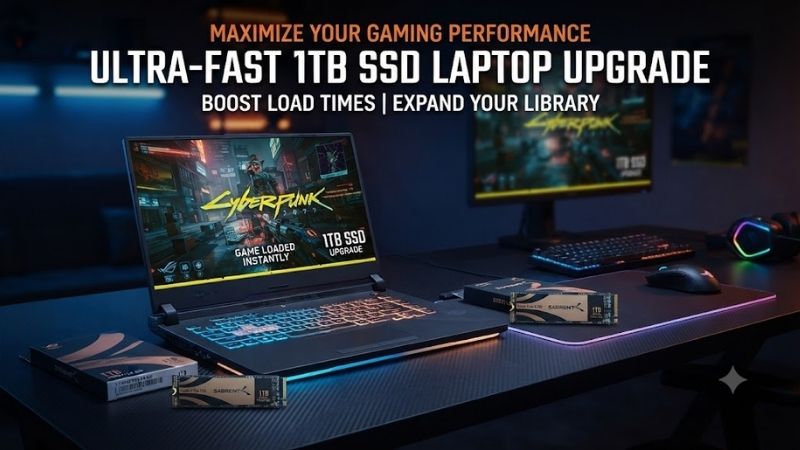
The best 1TB SSD laptop upgrade should deliver fast load times without creating excessive heat or wasting battery power. Laptop buyers also need to consider M.2 length, PCIe generation, single-sided construction, endurance, and whether a heatsink will physically fit. These five 1TB SSDs cover gaming laptops, ultrabooks, work machines, and affordable everyday upgrades.
Quick answer: For most people in 2026, the best 1tb ssd for laptop is the 1TB SSD — our #1 rated choice. See the full ranked comparison, alternatives and buying advice below.
Quick Comparison
| 1TB SSD | Best For | Interface | Max Read | Max Write | Endurance |
|---|---|---|---|---|---|
| Samsung 990 EVO Plus | Best Overall | PCIe 4.0 x4 / 5.0 x2 | 7,150 MB/s | 6,300 MB/s | 600 TBW |
| WD_BLACK SN7100 | Best Gaming Laptop | PCIe 4.0 x4 | 7,250 MB/s | 6,900 MB/s | 600 TBW |
| Crucial T500 | Best Performance | PCIe 4.0 x4 | 7,300 MB/s | 6,800 MB/s | 600 TBW |
| SK hynix Platinum P41 | Best Efficiency | PCIe 4.0 x4 | 7,000 MB/s | 6,500 MB/s | 750 TBW |
| Kingston NV3 | Best Budget | PCIe 4.0 x4 | 6,000 MB/s | 4,000 MB/s | 320 TBW |
Samsung 990 EVO Plus 1TB
Best For: Balanced performance and efficiency
Key Features:
- 1TB capacity
- M.2 2280 form factor
- PCIe 4.0 x4 and PCIe 5.0 x2 support
- Up to 7,150 MB/s sequential reads
- Up to 6,300 MB/s sequential writes
- Samsung V-NAND TLC
- 600 TBW endurance
- Five-year limited warranty
- Samsung Magician support
The Samsung 990 EVO Plus is the strongest all-around choice for a modern laptop because it combines high PCIe 4.0 performance with relatively modest power requirements and a thin M.2 2280 design. Samsung rates the 1TB version at up to 7,150 MB/s sequential reads and 6,300 MB/s writes.
Samsung uses its own controller and V-NAND TLC flash. The drive relies on Host Memory Buffer rather than dedicated DRAM, allowing it to maintain a straightforward client-PC design while still reaching speeds close to the practical ceiling of PCIe 4.0 in normal consumer workloads.
The physical dimensions also work well for notebooks. Samsung lists the drive at a maximum thickness of approximately 2.38 mm, making it easier to fit underneath factory SSD covers and thermal pads than models equipped with desktop heatsinks.
Power behavior is another reason to consider it for mobile systems. Samsung lists active read and write power around 4.3W and 4.2W for the 1TB model, with much lower device-sleep consumption. Actual battery impact depends on the laptop, but lower SSD power use can help reduce unnecessary heat inside thin chassis designs.
Endurance is rated at 600 TBW, and Samsung includes a five-year limited warranty. That is enough for normal gaming, productivity, content creation, and everyday file movement without forcing buyers into a workstation-focused SSD.
What Makes It Different: The 990 EVO Plus supports both PCIe 4.0 x4 and PCIe 5.0 x2 interfaces, giving it additional platform flexibility while remaining an efficient client SSD rather than a hot-running flagship Gen5 model.
Pros:
- Excellent overall speed
- TLC V-NAND
- 600 TBW endurance
- Five-year warranty
- Thin M.2 2280 construction
- Samsung Magician software
- Good balance of speed and power use
Cons:
- No dedicated DRAM
- Usually more expensive than budget SSDs
- Full performance requires a modern PCIe slot
- Not designed for laptops using shorter 2230 drives
Use Case: Gaming laptops, premium ultrabooks, productivity systems, and users replacing a smaller factory SSD with a fast 1TB model.
Who It’s For: Laptop users who want an easy recommendation that balances performance, endurance, efficiency, and established software support.
WD_BLACK SN7100 1TB
Best For: Gaming laptops
Key Features:
- PCIe 4.0 x4
- M.2 2280
- TLC 3D NAND
- Up to 7,250 MB/s reads
- Up to 6,900 MB/s writes
- 600 TBW endurance
- DRAMless design
- Laptop-focused power efficiency
- Five-year warranty
The WD_BLACK SN7100 is one of the strongest 1TB choices for gaming laptops. Western Digital rates the 1TB model at up to 7,250 MB/s sequential reads and 6,900 MB/s writes, giving it some of the highest performance in this roundup.
Western Digital specifically designed the SN7100 around gaming laptops and handheld systems. The company states that the drive can provide up to twice the power efficiency of its previous generation at maximum speed, making it a particularly interesting option for users who want performance without unnecessary power draw.
The 1TB drive uses Western Digital TLC 3D NAND and carries a 600 TBW endurance rating. That gives it significantly more write headroom than a budget drive such as Kingston NV3 and makes it more appropriate for users recording gameplay, installing large games frequently, or working with substantial project files.
Another laptop-friendly feature is the slim M.2 layout. The SN7100 is designed as a conventional 2280 NVMe drive without a large heatsink. This avoids clearance issues in notebooks where the SSD sits beneath a metal thermal shield or close to the battery.
What Makes It Different: The SN7100 is explicitly optimized around mobile gaming, combining high-end Gen4 speed with improved efficiency rather than simply chasing desktop benchmark numbers.
Pros:
- Up to 7,250 MB/s reads
- Up to 6,900 MB/s writes
- TLC 3D NAND
- 600 TBW endurance
- Strong power efficiency
- Designed with laptops in mind
- Five-year warranty
Cons:
- Gaming branding may increase price
- No dedicated DRAM
- M.2 2280 only for this consumer model
- Peak performance needs PCIe 4.0
Use Case: Gaming laptops, portable creator machines, game-development systems, and notebooks that frequently handle large installations.
Who It’s For: Gamers who want flagship-class PCIe 4.0 speed in a laptop-oriented SSD.
Crucial T500 1TB
Best For: Maximum PCIe 4.0 laptop performance
Key Features:
- PCIe 4.0 NVMe
- M.2 2280
- Up to 7,300 MB/s reads
- Up to 6,800 MB/s writes
- Up to 1.15 million random-read IOPS
- Up to 1.44 million random-write IOPS
- 600 TBW endurance
- Five-year limited warranty
- Non-heatsink model available
The Crucial T500 1TB is ideal when you want maximum PCIe 4.0 performance and your laptop has enough cooling to sustain it. Crucial rates the 1TB model at up to 7,300 MB/s sequential reads and 6,800 MB/s writes, along with strong random performance.
Crucial sells the T500 both with and without an integrated heatsink. Laptop users should almost always choose the bare version because Crucial lists the non-heatsink model at approximately 0.09 inch high compared with roughly 0.38 inch for the heatsink configuration.
That distinction matters in notebooks where the storage bay may have only a few millimeters of clearance. Many laptops already include a thin factory thermal pad or metal SSD cover, making a desktop-style heatsink unnecessary and often impossible to install.
Crucial also rates the 1TB version at 600 TBW and backs it with a five-year limited warranty. The company promotes an improved performance-to-power ratio compared with the older P5 Plus, which is useful for laptops where sustained performance and heat output need to stay balanced.
What Makes It Different: The T500 is the fastest raw performer here while still being available as a thin bare M.2 2280 drive suitable for many laptops.
Pros:
- Up to 7,300 MB/s reads
- Up to 6,800 MB/s writes
- Strong random IOPS
- 600 TBW endurance
- Five-year warranty
- Non-heatsink laptop-friendly version
- Excellent for demanding applications
Cons:
- High performance can create more heat
- Heatsink version is too tall for most laptops
- More speed than basic users need
- Requires PCIe 4.0 to justify the premium
Use Case: Mobile workstations, high-end gaming notebooks, content-creation laptops, and systems handling large project files.
Who It’s For: Power users who want one of the fastest PCIe 4.0 laptop SSDs available.
SK hynix Platinum P41 1TB
Best For: Efficiency and endurance
Key Features:
- PCIe 4.0 x4 NVMe
- M.2 2280 single-sided
- SK hynix 176-layer TLC NAND
- Up to 7,000 MB/s reads
- Up to 6,500 MB/s writes
- 750 TBW endurance
- Device Sleep support
- Five-year warranty
- 2.38 mm maximum thickness
The SK hynix Platinum P41 remains a particularly good laptop SSD because it combines strong performance with a single-sided design and solid endurance. SK hynix rates the 1TB drive at up to 7,000 MB/s reads and 6,500 MB/s writes.
The drive uses SK hynix 176-layer 3D TLC NAND and is explicitly listed as single-sided. Its maximum thickness is approximately 2.38 mm, which reduces the risk of clearance problems in thin notebooks. Single-sided construction is also convenient when the underside of the M.2 slot sits close to other motherboard components.
Endurance is especially strong at this capacity. SK hynix lists the 1TB Platinum P41 at 750 TBW, exceeding the 600 TBW ratings of Samsung 990 EVO Plus, WD_BLACK SN7100, and Crucial T500.
The P41 also supports Device Sleep mode and operates within a typical client SSD power profile. While battery runtime ultimately depends on the complete laptop, the combination of a single-sided PCB and efficiency-focused design makes the drive well suited to portable systems.
What Makes It Different: The P41 combines high-end Gen4 performance, TLC NAND, a single-sided form factor, and the strongest endurance rating among the 1TB drives compared here.
Pros:
- Single-sided M.2 2280
- TLC NAND
- Up to 7,000 MB/s reads
- Up to 6,500 MB/s writes
- 750 TBW endurance
- Device Sleep support
- Five-year warranty
- Thin 2.38 mm design
Cons:
- Slightly slower than T500 and SN7100
- Availability varies
- Older design than some competitors
- No 4TB option in the original P41 lineup
Use Case: Premium thin laptops, work machines, mobile content creation, and systems expected to remain in service for several years.
Who It’s For: Buyers who prioritize efficiency, endurance, and laptop-friendly physical construction over chasing the absolute highest benchmark result.
Kingston NV3 1TB
Best For: Budget laptop upgrades
Key Features:
- PCIe 4.0 x4 NVMe
- M.2 2280
- M.2 2230 version also available
- Up to 6,000 MB/s reads
- Up to 4,000 MB/s writes
- 320 TBW endurance
- Five-year limited warranty
- Low-power design
- Reduced-heat focus
The Kingston NV3 1TB is the budget option for users who want a noticeable laptop upgrade without paying for top-end benchmark performance. Kingston rates the 1TB M.2 2280 model at up to 6,000 MB/s sequential reads and 4,000 MB/s writes.
Those speeds are lower than the other drives in this roundup, but they remain far beyond SATA SSD performance and are more than sufficient for Windows startup, web browsers, productivity applications, game loading, and ordinary file transfers.
Kingston explicitly promotes the NV3 around lower power consumption and reduced heat. That is useful in thin laptops where the SSD sits in an enclosed compartment with limited airflow. The M.2 2280 version measures only 2.3 mm thick and weighs about 7 grams.
A separate M.2 2230 NV3 family is also available. That does not mean the 2230 version can replace every laptop SSD, but it gives Kingston broader compatibility with compact systems and gaming handhelds than many competitors.
The main trade-off is endurance. Kingston rates the 1TB version at 320 TBW, substantially below the other drives compared here. Normal laptop users may never reach that figure, but intensive video editing and other write-heavy professional workloads justify choosing a higher-end model.
What Makes It Different: NV3 prioritizes cost, efficiency, and broad form-factor availability instead of maximum benchmark speed.
Pros:
- Up to 6,000 MB/s reads
- Low-power design
- Reduced heat generation
- Thin M.2 2280 construction
- 2230 family available
- Five-year warranty
- Good mainstream value
Cons:
- Only 4,000 MB/s writes at 1TB
- 320 TBW endurance
- Slower than premium Gen4 SSDs
- Less suitable for sustained heavy workloads
Use Case: General-purpose laptops, office machines, school computers, budget gaming notebooks, and storage-capacity upgrades.
Who It’s For: Users who need an affordable 1TB NVMe SSD and care more about practical laptop performance than benchmark leadership.
How to Choose a 1TB SSD for a Laptop
Check the Physical M.2 Size
Most upgradeable laptops use M.2 2280 SSDs, but compact systems can use 2230 or 2242 drives. The numbers describe the physical dimensions. A 2280 drive measures 22 mm wide and 80 mm long, so it cannot simply be installed in a laptop designed exclusively for a shorter module.
Confirm NVMe Support
M.2 describes the physical format, not the storage interface. Older laptops may use M.2 SATA while newer models generally use PCIe NVMe. Check the laptop specification or service manual before ordering because an NVMe drive may not function in a slot wired only for SATA.
Check PCIe Generation
A PCIe 4.0 SSD can normally operate in a PCIe 3.0-compatible NVMe slot, but performance drops to the older interface limit. If your laptop only supports PCIe 3.0, paying extra for a 7,300 MB/s drive such as the T500 may provide very little practical benefit.
Prefer Single-Sided or Thin SSDs
Thin laptops can have limited clearance around the storage slot. Single-sided drives and models around 2.3–2.4 mm thick are safer choices when the SSD sits close to the motherboard, battery, or thermal shield. Avoid desktop heatsinks unless the notebook manufacturer explicitly provides room for one.
Consider Power Efficiency
Laptop SSD performance should be balanced against heat and battery use. Very fast storage is useful, but an SSD that consumes unnecessary power during ordinary tasks can increase temperatures and fan activity. Drives designed specifically around mobile efficiency can be more sensible than a hot flagship model.
Look at Endurance
For typical browsing, office work, and gaming, even 320 TBW can represent years of use. Heavy creators should look higher. Platinum P41 reaches 750 TBW at 1TB, while the Samsung, WD, and Crucial models compared here provide 600 TBW.
Choose Capacity Based on Real Use
A 1TB SSD is a good middle ground for Windows, applications, documents, and a moderate game library. After formatting and system partitions, available storage will be lower than the advertised 1TB. Users working with large video libraries may find 2TB more practical.
Check Whether You Have Two M.2 Slots
Some gaming laptops have two NVMe slots. In that case, you may be able to add the new 1TB drive without removing the original SSD. Thin ultrabooks often have only one slot, meaning the existing drive must be cloned or Windows reinstalled before replacement.
FAQ
Is a 1TB SSD Good for a Laptop?
Yes. One terabyte provides enough space for Windows, productivity software, documents, media, and several large games while keeping cost lower than 2TB or 4TB models. It is one of the most practical capacities for a mainstream laptop upgrade.
Which 1TB SSD Is Best for a Gaming Laptop?
WD_BLACK SN7100 is a particularly strong choice because Western Digital designed it with laptops and gaming handhelds in mind. The 1TB model reaches up to 7,250 MB/s reads and 6,900 MB/s writes while providing 600 TBW endurance.
Do Laptop SSDs Need a Heatsink?
Usually not. Most laptops use thin factory heat spreaders or thermal pads rather than tall desktop heatsinks. A large heatsink can prevent the bottom cover from closing or interfere with nearby components.
Can I Put a PCIe 4.0 SSD in a PCIe 3.0 Laptop?
Often yes, provided both systems use compatible NVMe M.2 slots. The SSD simply runs at PCIe 3.0 bandwidth instead of reaching its full advertised Gen4 speed.
Is 1TB Enough for Gaming?
It is enough for a moderate game collection, but modern AAA titles can consume more than 100GB each after updates. Gamers who regularly keep many large games installed may find 2TB more convenient.
Which 1TB Laptop SSD Has the Best Endurance Here?
SK hynix rates the 1TB Platinum P41 at 750 TBW, the highest figure among these five drives. Samsung 990 EVO Plus, WD_BLACK SN7100, and Crucial T500 are each rated at 600 TBW.
Conclusion
The best 1TB SSD laptop upgrade depends on whether you prioritize speed, endurance, efficiency, or price. Samsung 990 EVO Plus is the strongest all-around choice, WD_BLACK SN7100 suits gaming laptops, Crucial T500 delivers maximum Gen4 performance, Platinum P41 combines efficiency with 750 TBW endurance, and Kingston NV3 offers an affordable everyday upgrade.
Ready to decide? Our #1 pick for 2026 is the 1TB SSD.
Live price & availability on Amazon.