🛒 Best Price Today on Amazon
Prime members get fast, free shipping on everything above, plus member-only deals. New members get a 30-day free trial — cancel anytime.
- Quick Verdict
- Quick Comparison Table
- How We Selected These Ryzen 9 Mini PCs
- Best Mini PC Ryzen 9 Options
- Mini PC Ryzen 9 Buying Guide
- Mini PC Ryzen 9 for Gaming
- Mini PC Ryzen 9 for Productivity
- Mini PC Ryzen 9 for Video Editing
- Mini PC Ryzen 9 for Emulation
- Mini PC Ryzen 9 vs Full-Size Desktop
- Frequently Asked Questions
- Final Verdict
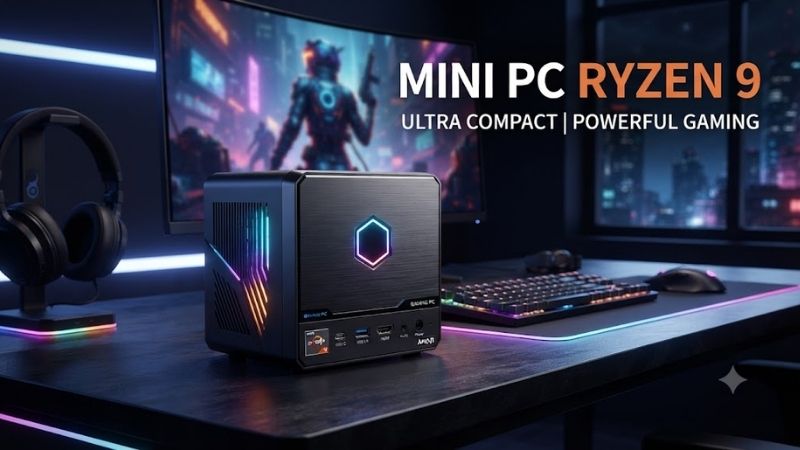
A Mini PC Ryzen 9 combines laptop-class AMD processing power with a chassis small enough to fit behind a monitor or on a crowded desk. The best options can handle office work, development, media creation, emulation, and light gaming, while specialized models add discrete graphics for much stronger gaming performance.
Quick answer: For most people in 2026, the best mini pc ryzen 9 is the GEEKOM A8 Ryzen 9 — our #1 rated choice. See the full ranked comparison, alternatives and buying advice below.
Quick Verdict
GEEKOM A8 is the strongest all-around choice for users who want a compact Ryzen 9 system built around the newer Ryzen 9 8945HS platform. Its Zen 4 CPU and Radeon 780M integrated graphics provide a useful balance for productivity, coding, everyday creative work, and gaming that does not require a dedicated GPU.
MINISFORUM UM790 Pro remains one of the most attractive performance-oriented Ryzen 9 mini PCs. Its Ryzen 9 7940HS combines eight Zen 4 cores with Radeon 780M graphics, while the chassis provides substantially more expansion and connectivity than many basic mini systems.
GEEKOM A7 is a good alternative when you want Ryzen 9 7940HS performance in a compact, polished system aimed at general productivity and mixed home use. Beelink GTR7 Pro is better suited to enthusiasts who value strong networking, connectivity, and a performance-focused mini-PC design.
ASUS ExpertCenter PN53 is the more conservative business-oriented choice. Its Ryzen 9 6900HX is older than the Zen 4 processors above, but it remains capable for productivity and office deployments.
For gaming, MINISFORUM HX99G is in a different category because it pairs Ryzen 9 6900HX with dedicated Radeon RX 6600M graphics. It is physically larger than a traditional mini PC, but it offers far more gaming capability than systems relying on integrated Radeon graphics.
Quick Comparison Table
| Product | Best For | Key Specifications | Main Advantage | Trade-Off |
|---|---|---|---|---|
| GEEKOM A8 Ryzen 9 | Best overall | Ryzen 9 8945HS, Radeon 780M, DDR5 | Modern Zen 4 platform | Integrated graphics only |
| MINISFORUM UM790 Pro | Performance and upgrades | Ryzen 9 7940HS, Radeon 780M, DDR5 | Strong expansion and connectivity | Cooling matters under sustained load |
| GEEKOM A7 Ryzen 9 | Compact productivity | Ryzen 9 7940HS, Radeon 780M | Small polished system | Limited compared with discrete-GPU PCs |
| Beelink GTR7 Pro | Enthusiasts and networking | Ryzen 9 7940HS, Radeon 780M, DDR5 | Feature-rich compact design | Older than newer Ryzen AI platforms |
| ASUS ExpertCenter PN53 | Business use | Ryzen 9 6900HX, Radeon 680M | Professional compact platform | Older CPU and iGPU generation |
| MINISFORUM HX99G | Gaming | Ryzen 9 6900HX, Radeon RX 6600M | Dedicated graphics | Larger than typical mini PCs |
How We Selected These Ryzen 9 Mini PCs
The systems in this roundup were chosen because they use identifiable AMD Ryzen 9 processors rather than simply carrying generic AMD branding. The selections also cover different buyer profiles, including home productivity, development, office deployment, integrated-graphics gaming, and compact systems with discrete graphics.
Processor generation was treated as an important distinction. Ryzen 9 8945HS and Ryzen 9 7940HS are Zen 4 mobile processors with Radeon 780M integrated graphics. Ryzen 9 6900HX belongs to an earlier Zen 3+ generation and uses Radeon 680M graphics, which changes both CPU capability and integrated gaming expectations.
Memory and storage expandability also matter. Mini PCs often use laptop-style SO-DIMM memory and M.2 NVMe storage, but implementation varies significantly by model. Some systems provide multiple M.2 slots or additional storage connections, while highly compact models may offer less internal flexibility.
Gaming recommendations were separated according to graphics architecture. Radeon 780M is significantly more capable than basic integrated graphics and can handle esports, indie games, emulation, and many older titles. It is still not a replacement for a dedicated gaming GPU in demanding AAA games at high settings.
No recommendation assumes a fixed retail price. Mini-PC pricing changes frequently according to RAM, SSD capacity, barebones configurations, operating-system licensing, promotions, and seller. Buyers should therefore compare complete configurations rather than deciding from the CPU name alone.
Best Mini PC Ryzen 9 Options
GEEKOM A8 Ryzen 9 8945HS — Best Overall Ryzen 9 Mini PC
Best For: Productivity, development, home computing, media work, and light gaming.
Why We Picked It: GEEKOM A8 is one of the cleanest ways to get Ryzen 9 8945HS performance in a genuinely compact desktop. The processor combines eight Zen 4 CPU cores with Radeon 780M integrated graphics, making it suitable for users who want substantial CPU capability without installing a separate graphics card.
Key Specifications
- AMD Ryzen 9 8945HS
- 8 cores and 16 threads
- Zen 4 CPU architecture
- Radeon 780M integrated graphics
- DDR5 memory platform
- M.2 NVMe SSD storage
- Multi-display support
- USB-C and USB-A connectivity
- Wired and wireless networking
Features & Benefits: Ryzen 9 8945HS gives the A8 enough CPU resources for code compilation, large spreadsheets, multitasking, photo editing, office applications, and many creator workloads. Eight cores and sixteen threads are especially useful when background tasks remain active while a demanding application is running.
Radeon 780M is also considerably more capable than traditional office integrated graphics. It can handle desktop acceleration, high-resolution displays, video playback, esports titles, emulation, and lighter PC gaming without requiring the space or power supply associated with a discrete GPU.
Performance & Practical Use: The main limitation is graphics performance. Radeon 780M shares system memory and operates within the processor’s overall power envelope. Modern demanding AAA games may require lower resolutions and quality settings, and some titles remain better suited to a PC with dedicated graphics.
What Makes It Different: A8 combines one of the stronger conventional Ryzen 9 mobile processors with a compact premium-style enclosure. It is particularly attractive to users who want a small workstation without moving to a larger discrete-GPU system.
Pros
- Ryzen 9 8945HS processor
- Strong Radeon 780M integrated graphics
- Compact chassis
- DDR5 platform
- Suitable for productivity and development
Cons
- No dedicated GPU
- Sustained performance depends on mini-PC cooling
Buy If: You want a modern Ryzen 9 mini desktop for work, coding, multitasking, media, and occasional gaming.
Skip If: AAA gaming performance is the main priority.
MINISFORUM UM790 Pro — Best for Performance and Expansion
Best For: Power users, developers, home labs, productivity, and integrated-graphics gaming.
Why We Picked It: MINISFORUM UM790 Pro uses AMD Ryzen 9 7940HS, another eight-core Zen 4 processor paired with Radeon 780M graphics. The system is especially appealing to enthusiasts because its internal and external expansion options are more ambitious than those of many office-focused mini PCs.
Key Specifications
- AMD Ryzen 9 7940HS
- 8 cores and 16 threads
- Zen 4 architecture
- Radeon 780M graphics
- DDR5 SO-DIMM memory
- M.2 NVMe storage support
- USB4 connectivity
- Multiple display outputs
- High-speed Ethernet
- Wireless networking
Features & Benefits: Ryzen 9 7940HS can handle CPU-heavy multitasking, development tools, productivity suites, virtualized workloads, and light content creation while remaining within the thermal constraints of a mini-PC platform.
Radeon 780M gives the system enough graphics capability for esports titles, retro and modern emulation, lighter Steam games, and GPU-accelerated desktop applications. Dual-channel or otherwise properly configured memory is particularly important because integrated graphics rely on system memory bandwidth.
USB4 support also expands what a mini PC can do. High-speed external storage, docks, displays, and compatible peripherals can be connected without turning the small chassis into a cable-management problem.
Performance & Practical Use: High-performance mobile processors can produce significant heat when sustained workloads use many cores simultaneously. The compact enclosure therefore needs unobstructed ventilation. Placing the system inside a closed cabinet can reduce cooling efficiency and increase fan activity.
What Makes It Different: UM790 Pro offers a strong combination of Ryzen 9 CPU performance, Radeon 780M graphics, storage flexibility, and enthusiast-oriented connectivity.
Pros
- Powerful Ryzen 9 7940HS
- Radeon 780M integrated GPU
- Strong connectivity
- Good upgrade potential
- Useful for home-lab workloads
Cons
- Integrated graphics still limit AAA gaming
- Compact cooling can become audible under load
Buy If: You want a performance-focused mini PC with room for memory and storage upgrades.
Skip If: You need dedicated graphics for high-resolution AAA gaming or professional GPU rendering.
GEEKOM A7 Ryzen 9 7940HS — Best Compact Productivity Mini PC
Best For: Home offices, business users, creators, and compact workstation setups.
Why We Picked It: GEEKOM A7 combines Ryzen 9 7940HS and Radeon 780M in a very compact desktop form factor. It is a sensible option for users who want a high-performance processor but prefer a quieter-looking professional system rather than a gaming-oriented mini-PC chassis.
Key Specifications
- AMD Ryzen 9 7940HS
- 8 cores
- 16 threads
- Radeon 780M graphics
- DDR5 memory
- NVMe SSD storage
- USB-C connectivity
- Multi-monitor support
- Wired and wireless networking
Features & Benefits: The processor is powerful enough for browser-heavy productivity, software development, office work, moderate photo and video editing, and substantial multitasking.
Its small size makes the A7 attractive for desks where a traditional tower would consume valuable space. It can also work well in living-room or media-center environments where users want desktop-class Windows functionality without a large case.
Radeon 780M means the system can handle more than basic display output. Lightweight games, older AAA titles, esports, and many emulators are realistic workloads when settings are chosen appropriately.
Performance & Practical Use: Like other integrated-graphics mini PCs, gaming performance depends strongly on memory bandwidth and system configuration. Buyers should pay attention to installed RAM capacity and arrangement instead of comparing only processor names.
Internal expansion is naturally more limited than in a traditional ATX desktop. If future GPU, PCIe, or extensive storage upgrades matter, a larger system may offer better long-term flexibility.
What Makes It Different: A7 emphasizes a refined small-form-factor design while retaining the full Ryzen 9 7940HS and Radeon 780M combination.
Pros
- Compact footprint
- Strong Zen 4 CPU
- Capable Radeon 780M graphics
- Suitable for professional desks
Cons
- Limited internal expansion compared with towers
- No dedicated graphics card
Buy If: You want substantial CPU performance in one of the smallest practical desktop formats.
Skip If: You expect to install internal graphics cards or several large storage devices.
Beelink GTR7 Pro Ryzen 9 7940HS — Best for Enthusiasts
Best For: Home labs, power users, multi-display setups, and advanced desktop workloads.
Why We Picked It: Beelink GTR7 Pro is another Ryzen 9 7940HS system, but its appeal comes from being designed for users who care about connectivity and performance tuning as much as raw compactness.
Key Specifications
- Ryzen 9 7940HS
- 8-core, 16-thread CPU
- Radeon 780M graphics
- DDR5 memory
- NVMe storage
- High-speed USB connectivity
- Multi-display capability
- Dual wired networking on the GTR7 platform
- Wireless connectivity
Features & Benefits: Multiple networking connections are useful in more specialized environments. A mini PC can act as a development workstation, home-lab node, compact server, or desktop connected to separate local and external networks.
For normal users, the more important benefit remains the Ryzen 9 7940HS itself. It provides enough multicore resources for demanding productivity while Radeon 780M handles multimedia, displays, and lighter games.
The compact chassis also makes it convenient for multi-computer desks. Developers can keep a small Windows or Linux system beside a main workstation without allocating space for another tower.
Performance & Practical Use: Buyers should consider whether they will actually use the advanced networking and connectivity features. A simpler mini PC using the same Ryzen 9 processor may deliver similar application performance when the additional interfaces are irrelevant.
As with other small systems, sustained CPU workloads depend on airflow and thermal design. It should be positioned where intake and exhaust openings remain clear.
What Makes It Different: GTR7 Pro is more appealing to enthusiasts than users simply looking for a small office computer.
Pros
- Ryzen 9 7940HS
- Radeon 780M
- Strong networking options
- Good multi-display flexibility
- Suitable for advanced home-lab use
Cons
- Extra connectivity may be unnecessary
- Integrated GPU remains the gaming limit
Buy If: You want a Ryzen 9 mini PC that can serve both as a workstation and a more advanced networking or lab system.
Skip If: Your needs are limited to browsing, Office, and basic home computing.
ASUS ExpertCenter PN53 Ryzen 9 6900HX — Best for Business Use
Best For: Offices, professional deployments, digital signage, and conventional productivity.
Why We Picked It: ASUS ExpertCenter PN53 is a more business-oriented mini PC than the enthusiast systems above. Ryzen 9 6900HX is based on Zen 3+ rather than Zen 4, but it still provides eight CPU cores and sixteen threads with Radeon 680M integrated graphics.
Key Specifications
- AMD Ryzen 9 6900HX
- 8 cores and 16 threads
- Zen 3+ architecture
- Radeon 680M integrated graphics
- DDR5 memory support
- M.2 NVMe storage
- Compact business chassis
- Multiple display support
- USB connectivity
- Ethernet and wireless networking depending on configuration
Features & Benefits: Ryzen 9 6900HX remains capable for office multitasking, browser-heavy work, code development, content management, and general business applications.
Radeon 680M also represents a major improvement over older Vega-class integrated graphics. It can support high-resolution desktops, multimedia workloads, light gaming, and hardware-accelerated applications without requiring a discrete GPU.
The ExpertCenter format makes more sense for professional environments where a clean compact chassis and predictable deployment are more important than gaming styling.
Performance & Practical Use: The older processor generation is the main compromise. Ryzen 9 7940HS and 8945HS systems provide newer CPU architecture and Radeon 780M graphics, so buyers focused on maximum performance should favor those newer options when total system cost is comparable.
For standard office tasks, however, the difference may matter less than RAM capacity, SSD size, warranty requirements, and deployment compatibility.
What Makes It Different: PN53 emphasizes professional mini-PC deployment rather than gaming and enthusiast features.
Pros
- Eight-core Ryzen 9 processor
- Radeon 680M graphics
- Compact professional design
- Suitable for business environments
Cons
- Older Zen 3+ processor
- Radeon 680M trails newer Radeon 780M systems
Buy If: You want a compact Ryzen 9 machine primarily for business or professional desktop applications.
Skip If: You specifically want the newer Zen 4 and Radeon 780M platform.
MINISFORUM HX99G — Best Ryzen 9 Mini PC for Gaming
Best For: Gaming, GPU-accelerated applications, and compact creator systems.
Why We Picked It: MINISFORUM HX99G stands apart because it pairs Ryzen 9 6900HX with a dedicated Radeon RX 6600M GPU. That completely changes its gaming capability compared with mini PCs using Radeon 680M or Radeon 780M integrated graphics.
Key Specifications
- AMD Ryzen 9 6900HX
- 8 cores and 16 threads
- Radeon RX 6600M dedicated graphics
- 8GB GDDR6 graphics memory
- DDR5 system memory
- M.2 NVMe storage
- High-speed USB connectivity
- Multiple display outputs
- Ethernet
- Wireless networking
Features & Benefits: Dedicated graphics provide their own VRAM and substantially more graphics resources than an integrated GPU. This makes HX99G appropriate for users who want to play demanding PC games without moving to a conventional mid-tower gaming desktop.
The RX 6600M also gives creator applications more GPU resources for supported acceleration tasks. Combined with the eight-core Ryzen 9 processor, the system can handle gaming, editing, streaming, and general productivity more effectively than most smaller integrated-graphics mini PCs.
The trade-off is physical size. HX99G is better described as a compact gaming PC than a palm-size mini desktop. Its larger cooling system is necessary because both the CPU and dedicated GPU generate considerably more heat.
Performance & Practical Use: The dedicated GPU makes the system much better suited to demanding games, but users should still set expectations according to the RX 6600M rather than comparing it with large desktop graphics cards from much higher performance tiers.
Power consumption and fan activity are also higher than on integrated-graphics mini PCs.
What Makes It Different: It is the only system in this roundup with a dedicated gaming GPU.
Pros
- Radeon RX 6600M discrete graphics
- Ryzen 9 processor
- Far stronger gaming capability
- Dedicated graphics memory
- Good compact creator potential
Cons
- Larger than conventional mini PCs
- Higher power and cooling requirements
- Older Ryzen CPU generation
Buy If: You want a compact Ryzen 9 system that can handle substantially more demanding gaming.
Skip If: Your priority is the smallest possible chassis or lowest power consumption.
Mini PC Ryzen 9 Buying Guide
Ryzen 9 8945HS vs Ryzen 9 7940HS
Both processors use Zen 4 CPU cores and Radeon 780M integrated graphics.
They are much closer to one another than their model numbers might suggest. For many buyers, cooling quality, memory configuration, SSD capacity, connectivity, and system price can matter more than choosing between these two processors.
Ryzen 9 8945HS belongs to a newer refresh and includes AMD’s Ryzen AI branding-era capabilities, while 7940HS remains a powerful Zen 4 option.
Ryzen 9 7940HS vs Ryzen 9 6900HX
Ryzen 9 7940HS represents a newer generation.
It uses Zen 4 CPU architecture and Radeon 780M graphics.
Ryzen 9 6900HX uses Zen 3+ CPU cores and Radeon 680M graphics.
Both provide eight CPU cores and sixteen threads, but the newer 7940HS platform offers stronger CPU architecture and a more capable integrated GPU.
A 6900HX system can still make sense when it includes a dedicated graphics card, as demonstrated by HX99G.
Radeon 780M Integrated Graphics
Radeon 780M is one of the main reasons Ryzen 9 7940HS and 8945HS mini PCs are attractive.
It allows a compact desktop to handle:
- Esports games
- Indie games
- Emulation
- Older AAA titles
- Hardware-accelerated video
- Multiple displays
- Light GPU workloads
It is still integrated graphics.
Modern AAA games at high resolution and maximum settings remain better suited to a discrete GPU.
Radeon 680M Integrated Graphics
Radeon 680M is found in Ryzen 9 6900HX.
It is based on AMD’s RDNA 2 graphics architecture and remains capable for media, office applications, emulation, esports, and lighter gaming.
Radeon 780M is the preferable choice when integrated gaming matters, but 680M systems can remain useful when sold at attractive total system prices.
Integrated vs Dedicated Graphics
This is one of the most important Mini PC Ryzen 9 buying decisions.
Choose integrated Radeon graphics when you prioritize:
- Small size
- Lower power consumption
- Office work
- Coding
- Media playback
- Light gaming
- Emulation
Choose dedicated graphics when you prioritize:
- AAA gaming
- Higher graphics settings
- GPU rendering
- More graphics memory
- Creator acceleration
- Higher sustained GPU performance
HX99G sacrifices some compactness to provide those dedicated-GPU advantages.
16GB vs 32GB RAM
Sixteen gigabytes is enough for general productivity, lighter gaming, office software, coding, and ordinary multitasking.
Thirty-two gigabytes is more suitable for:
- Large development environments
- Virtual machines
- Heavy browser workloads
- Video editing
- Content creation
- Memory-heavy games
- Advanced emulation
- Running several demanding applications simultaneously
A Ryzen 9 mini PC is a relatively high-performance system, so 32GB can be a sensible configuration for power users.
Memory Configuration Matters for Integrated Graphics
Integrated Radeon graphics use system memory instead of dedicated VRAM.
This means memory bandwidth directly affects graphics performance.
A correctly configured multi-channel memory setup is generally preferable to a single-module configuration when gaming or GPU-heavy integrated graphics workloads matter.
Do not judge a Ryzen 9 mini PC solely from total RAM capacity. Check how that capacity is installed.
NVMe SSD Storage
An NVMe SSD should be standard equipment in a performance mini PC.
It improves:
- Boot times
- Application launches
- Game loading
- Project-file access
- Virtual-machine responsiveness
- Large file transfers
A 512GB drive can work for office use, but 1TB or more is easier to live with for games and creative applications.
Systems with multiple M.2 slots provide much greater long-term flexibility.
Cooling Matters More in a Mini PC
A Ryzen 9 processor can generate substantial heat during sustained work.
Mini-PC cooling systems operate with much less physical space than desktop tower coolers.
Good placement therefore matters.
Avoid:
- Closed cabinets
- Blocking intake vents
- Stacking equipment directly against the chassis
- Soft surfaces that obstruct airflow
A mini PC can be powerful, but physics still limits how quietly a very small cooling system can dissipate sustained heat.
USB4
USB4 is especially useful on mini PCs because the chassis lacks conventional internal expansion slots.
It can support high-speed external:
- SSDs
- Docks
- Displays
- Network adapters
- Capture devices
- Compatible peripherals
For users who intend to keep the mini PC for several years, USB4 can be more valuable than having a large number of slower USB ports.
Ethernet
Many Ryzen 9 mini PCs provide 2.5Gb Ethernet, and some enthusiast models provide multiple Ethernet interfaces.
Fast Ethernet is useful for:
- NAS transfers
- Home labs
- Large game backups
- Media servers
- Development environments
- Local workstation networking
It does not increase internet speed beyond the limits of your router, switches, cables, and internet service.
Mini PC Ryzen 9 for Gaming
A Ryzen 9 mini PC with Radeon 780M can provide surprisingly capable light gaming, but CPU branding should not create unrealistic expectations.
The processor may be extremely fast while the integrated GPU remains the limiting component.
For competitive titles and lighter games, that balance works well.
For demanding AAA gaming, a system such as HX99G with dedicated graphics is more appropriate.
Mini PC Ryzen 9 for Productivity
Productivity is where conventional Ryzen 9 mini PCs perform particularly well.
Eight CPU cores and sixteen threads can handle:
- Large spreadsheets
- Development tools
- Code compilation
- Office suites
- Multitasking
- Image editing
- Database applications
- Browser-heavy workloads
Users can obtain substantial CPU capability without keeping a large tower under the desk.
Mini PC Ryzen 9 for Video Editing
Ryzen 9 mini PCs can handle light and moderate video editing, especially when projects are not dominated by GPU-intensive effects.
Radeon integrated graphics support useful media acceleration, while the CPU provides substantial multicore performance.
Professional editors working with complex effects, large high-resolution projects, or GPU-heavy applications should consider a dedicated-GPU system or conventional workstation.
Mini PC Ryzen 9 for Emulation
Emulation can be an excellent use case because many emulators benefit from strong CPU performance.
Radeon 780M also provides considerably more graphics capability than traditional office integrated GPUs.
Actual compatibility and performance depend on:
- Emulator
- Game
- API
- Resolution
- Shader workload
- Driver support
No mini PC can guarantee perfect emulation across every platform.
Mini PC Ryzen 9 vs Full-Size Desktop
A mini PC offers:
- Much smaller size
- Lower desk footprint
- Reduced cable clutter
- Lower typical power use
- Easy portability
A desktop tower offers:
- Dedicated GPU upgrades
- More storage
- PCIe expansion
- Larger cooling systems
- Easier repairs
- Better long-term hardware flexibility
Choose a mini PC when compactness matters more than internal expansion.
Frequently Asked Questions
Is a Ryzen 9 Mini PC Good for Gaming?
Yes, but gaming capability depends heavily on the GPU. Ryzen 9 7940HS and 8945HS systems use Radeon 780M integrated graphics, which are suitable for esports, emulation, indie games, and lighter gaming. Demanding AAA titles benefit significantly from a mini PC with dedicated graphics such as the MINISFORUM HX99G.
Is Ryzen 9 8945HS Better Than Ryzen 9 7940HS?
Ryzen 9 8945HS is a newer processor, but both use eight Zen 4 CPU cores and Radeon 780M integrated graphics. In a mini PC, cooling, power configuration, RAM bandwidth, and firmware can influence real-world behavior substantially. Buyers should compare complete systems instead of choosing solely from the model number.
Is 16GB RAM Enough for a Ryzen 9 Mini PC?
Sixteen gigabytes is enough for office work, browsing, coding, light gaming, media playback, and standard multitasking. Thirty-two gigabytes is a better match for virtual machines, heavier creation, large development projects, extensive multitasking, and users who want more long-term memory headroom from a Ryzen 9 system.
Can You Upgrade a Ryzen 9 Mini PC?
Many Ryzen 9 mini PCs use replaceable SO-DIMM memory and M.2 NVMe storage, making RAM and SSD upgrades possible. Upgradeability varies by exact model, however. The CPU and integrated graphics are generally soldered to the motherboard, so buyers should not expect processor or GPU upgrades like those available in desktop towers.
Can a Ryzen 9 Mini PC Replace a Desktop?
It can replace a conventional desktop for office work, programming, web use, media, multitasking, and many creative tasks. It can also handle lighter gaming. A traditional tower remains better when you need replaceable graphics cards, many internal drives, PCIe add-in cards, extensive cooling, or maximum long-term upgrade flexibility.
Which Ryzen 9 Mini PC Is Best for Gaming?
Among these options, MINISFORUM HX99G is the strongest gaming choice because it combines Ryzen 9 6900HX with dedicated Radeon RX 6600M graphics. For a smaller integrated-graphics system, Ryzen 9 7940HS or 8945HS models with Radeon 780M are better suited to esports, emulation, and less demanding PC games.
Final Verdict
The best Mini PC Ryzen 9 depends on whether you value compactness, expansion, productivity, or gaming. GEEKOM A8 is the strongest general-purpose option for users who want Ryzen 9 8945HS and Radeon 780M, while MINISFORUM UM790 Pro offers an excellent balance of Ryzen 9 7940HS performance, storage flexibility, and connectivity.
GEEKOM A7 works well for compact professional setups, Beelink GTR7 Pro suits enthusiasts, and ASUS ExpertCenter PN53 remains relevant for business users who do not require the newest CPU generation. For gaming, MINISFORUM HX99G is the clear specialist because its dedicated Radeon RX 6600M provides substantially more graphics capability than integrated Radeon 780M or 680M systems.
Ready to decide? Our #1 pick for 2026 is the GEEKOM A8 Ryzen 9.
Live price & availability on Amazon.