🛒 Best Price Today on Amazon
Prime members get fast, free shipping on everything above, plus member-only deals. New members get a 30-day free trial — cancel anytime.
A mouse wrist rest looks like the simplest accessory on a desk, yet the wrong one quietly changes your wrist angle for every hour you play. The real decision is not soft versus firm in the abstract. It is whether the rest should stay planted while your hand works over it, or travel with your hand across the pad, and whether its height lines up with the back of your mouse. Get either of those wrong and a comfort accessory turns into a fresh source of drag, pressure or aim wobble.
This guide is for mouse users who sit through long sessions: arm aimers on low sensitivity, palm-grip players with tall mice, and anyone whose wrist aches after a few matches. Every pick is a standalone rest built for the mouse hand only, with no mouse surface attached and no keyboard-length cushions. Products were chosen from the names, dimensions and materials published on their Amazon product pages, so every spec quoted here is one you can check before ordering.
Quick Picks
As an Amazon Associate we earn from qualifying purchases
| Product | Best for | Key spec from title |
|---|---|---|
| HyperX Wrist Rest – Mouse | Long sessions on warm desks | Cooling gel memory foam, anti-slip |
| DELTAHUB Carpio 2.0 | Players who aim with the whole arm | Easy-glide silicone rest, right-hand Large |
| Razer Ergonomic Wrist Rest for Gaming Mice | Palm-grip players who want a raised angle | Angled incline, anti-slip rubber base |
| Kensington ErgoSoft Wrist Rest for Standard Mouse | Shared desks that need wipe-clean gear | Gel-cushioned rest for standard mice |
| BRILA Ergonomic Memory Foam Mouse Wrist Rest | Small desks and fingertip-grip players | Memory foam with massage holes design |
How to Choose
Decide whether the rest should glide or stay put
A stationary rest anchors one spot on the desk: your palm heel sits on it and your fingers steer the mouse, which suits claw and fingertip grips and smaller mouse movements. A gliding rest rides under your palm and travels with your hand, which suits palm grips and the wide arm sweeps of low-sensitivity FPS play. Picking the wrong style is the most common regret with these products, because a fixed cushion under an arm aimer becomes a friction brake, while a glider under a fingertip player can feel like the desk is moving. Start from how you actually move the mouse, not from which design looks cleverer.
Match the rest height to your mouse
A wrist rest should bring your wrist close to level with the hand position your mouse already gives you, not jack it up or drop it down. Tall gaming mice, roughly an inch or more at the back, pair well with rests around 0.7 to 0.8 inches thick. Low, flat esports mice need less lift, and an overly tall rest can bend the wrist backward and add pressure underneath it. Before ordering, measure your mouse at its highest point and compare it with the thickness in the listing. Kensington, for example, states its standard-mouse rest is aimed at mice taller than one inch.
Choose the fill: foam, gel or silicone
Memory foam gives the softest first contact and molds to the palm heel, but it compresses over a long session and can hold heat. Gel cores feel firmer and cooler, keep their height better under a heavy hand, and usually come with wipe-clean covers that suit shared desks. Solid silicone pads, like the ones on gliding rests, barely compress at all; they spread pressure through shape rather than softness, and they rinse clean. None of these is automatically better. Foam favors comfort-first players, gel favors people who press down hard, and silicone favors players who want support that never changes height mid-match.
Check footprint, grip style and the base
A mouse rest only needs to cover the heel of your palm, so most are three to nine inches long; anything keyboard-width belongs in front of a keyboard, not beside a mouse. Check the footprint against the space your mouse hand actually uses, especially on a small desk or a narrow pad. Then look at the underside. Rubber and elastomer bases grip the desk so the rest stays where you dropped it, while gliding models use slick feet on purpose. Finally, if a rest is shaped for one hand or sold in sizes, confirm the hand and size in the listing title before you buy.
The 5 Best Options
HyperX Wrist Rest – Mouse

HyperX’s mouse-size rest pairs a cooling gel layer with memory foam, a combination aimed at players whose desks and hands run warm during long sessions. At nine inches long it gives your palm heel a generous landing zone without reaching keyboard-rest territory, and the anti-slip natural rubber underside keeps it from creeping during play. It suits palm and relaxed-claw players who keep their hand mostly in one area and want cushioning that feels cooler than plain foam. If your sessions regularly run past two hours in a warm room, this is the most direct answer in the list.
Specs
- Model: 4Z7X2AA (Mouse size)
- Fill: memory foam with cooling gel
- Base: anti-slip natural rubber underside
- Dimensions: 9 x 3.5 inches (228 x 88 mm)
- Item weight: 6.7 ounces
- Color: Black
Best for: Long gaming sessions where heat build-up under the palm is the main complaint.
Watch out for: Amazon’s dimension field lists a 0.1-inch thickness that does not match this padded gel-foam build, so check the size chart on the listing; also confirm you are on the Mouse size, since the same product line sells keyboard lengths under separate listings.
ASIN: B09SGTWKWV
DELTAHUB Carpio 2.0
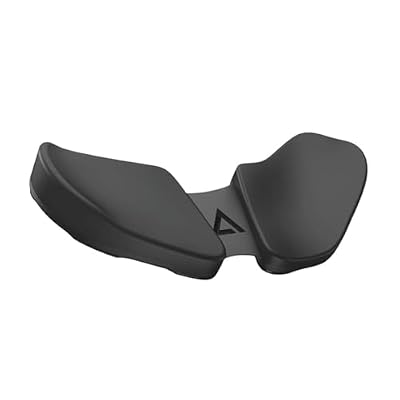
The Carpio 2.0 takes the opposite approach to a cushion: two shaped silicone pads sit under your palm heel and glide across the desk on slick feet, so support travels with your hand instead of anchoring it. That makes it the natural pick for low-sensitivity players who sweep the whole forearm and for anyone who finds a fixed rest creates a pressure point at one spot. It is sold by hand and by size, and this listing is the right-handed Large in black. Because the pads barely compress, the support height stays identical in the first minute of a session and the fifth hour.
Specs
- Model: DELTAHUB-Carpio-Ergo-RH-WR-LS-BL-LG-BK
- Material: silicone (pads, cover and fill)
- Dimensions: 3.78 x 1.57 inches
- Item weight: 0.08 kg
- Variant: right-handed, size Large, black
- Compatible device: mouse
Best for: Arm aimers and palm-grip players who want support that moves with the hand.
Watch out for: Hand and size are fixed per listing, so ordering the left-hand or Small variant by mistake is easy; the pads support the palm heel rather than the wrist crease, which feels unfamiliar for the first sessions.
ASIN: B098P8C3BT
Razer Ergonomic Wrist Rest for Gaming Mice

Razer’s mouse rest is a compact, firm cushion with an angled incline, so the palm heel sits slightly raised and the hand slopes down toward the mouse. The footprint is under nine inches, which keeps it inside a normal mouse area, and the anti-slip rubber base is meant to keep it planted during fast flicks. The memory foam core is wrapped in a leatherette surface that wipes clean and resists the fraying that fabric covers can show at the edges. It fits palm-grip players who like a defined, raised support and want a rest from a gaming brand that matches the rest of the desk.
Specs
- Model: RC21-01170100-R3M1
- Dimensions: 8.97 x 2.87 x 0.78 inches (228 x 73 x 20 mm)
- Weight: 0.16 lb (71.5 g)
- Profile: angled incline
- Fill and surface: memory foam with leatherette cover
- Base: anti-slip rubber
Best for: Palm-grip players who want a firm, raised support that stays fixed in place.
Watch out for: The incline is fixed, so with a low-profile mouse the raised front edge can lift your wrist higher than the mouse does; compare the 20 mm height against your mouse before ordering.
ASIN: B07733H7VP
Kensington ErgoSoft Wrist Rest for Standard Mouse

Kensington’s ErgoSoft rest uses a gel core under a textured, ultra-soft exterior, giving a firmer and cooler sit than foam at a slim 0.7-inch height. The surface wipes clean instead of absorbing sweat, and the elastomer base is nonskid, which makes it a practical choice for a desk that doubles for work and play or gets shared. Kensington sizes this model for standard mice and states it suits mice taller than one inch, so it pairs naturally with full-size gaming mice rather than flat travel shapes. Its six-inch length keeps the footprint modest beside the mouse pad.
Specs
- Model: K52802WW
- Dimensions: 6 x 2.9 x 0.7 inches (152 x 73 x 18 mm)
- Weight: 0.33 lb (0.15 kg)
- Interior: gel cushioning
- Exterior: textured TPU, wipes clean
- Bottom: elastomer nonskid base
Best for: Players with a standard or tall mouse who want gel support and an easy-clean surface.
Watch out for: Some retail listings print the much larger retail-pack dimensions of 8.7 x 7.8 inches; the rest itself is six inches long per Kensington’s data sheet and the Amazon title, so plan desk space around the smaller figure.
ASIN: B01MS8PIX9
BRILA Ergonomic Memory Foam Mouse Wrist Rest

BRILA’s small cushion is the compact option here: a five-inch slow-rebound memory foam pad with a wrist groove and a surface pattern of massage holes, covered in smooth Lycra fabric. The non-slip PU base holds it in place, and the short footprint leaves most of a small desk or narrow mouse pad free for the mouse itself. It suits fingertip and claw players who rest only the base of the palm, plus laptop users who want a rest that packs away easily. If the bigger rests in this list look like they would crowd your setup, this is the one shaped for tighter spaces.
Specs
- Model: 8541655831
- Dimensions: 5.1 x 3.1 x 0.8 inches
- Fill: slow-rebound memory foam
- Surface: Lycra fabric with massage holes and wrist groove
- Base: non-slip PU
- Weight: 0.059 kg
Best for: Small desks, fingertip-grip players and anyone who wants minimal, packable support.
Watch out for: The listing’s own copy prints two different sizes, 4.7 x 2.8 inches in one paragraph and 5.1 x 3.1 inches in the spec lines, so treat the footprint as roughly five inches and re-check the listing if your desk space is tight.
ASIN: B07DF83HK7
Which One Fits Your Situation
You aim with your whole arm on low sensitivity
Pick the DELTAHUB Carpio 2.0. Wide sweeps drag a stationary cushion out of position or force your palm to slide across it, adding friction exactly where you want none. The Carpio’s pads glide with your hand, so the support stays under your palm heel from one side of the pad to the other, and the silicone surface simply rinses clean afterward.
Your hands get hot during long ranked sessions
Pick the HyperX Wrist Rest – Mouse. Its cooling gel layer sits inside the memory foam specifically to slow heat build-up, and the nine-inch length means your whole palm heel stays on the cool surface instead of hanging off an edge. The rubber underside keeps it still while you play, so there is nothing to readjust between matches.
You play palm grip and like a raised, angled support
Pick the Razer Ergonomic Wrist Rest for Gaming Mice. The fixed incline holds your palm heel up and lets your hand slope toward the mouse, which palm-grip players tend to prefer over a flat pad. Its firm foam keeps that angle consistent, and the compact footprint fits inside a normal mouse area without pushing your pad aside.
Your desk is small or shared with work gear
Pick the BRILA if space is the problem, since its five-inch footprint tucks beside almost any mouse pad. If the desk is shared and hygiene matters more, pick the Kensington ErgoSoft instead: the gel core feels firmer, and the TPU surface wipes clean in seconds when the gaming gear gives way to work.
Common Mistakes
- Resting the wrist crease itself on the pad while moving the mouse, which presses on the underside of the wrist; these rests are meant to support the heel of the palm while the wrist stays free.
- Buying a keyboard-length rest for mouse use, which steals mouse room and encourages reaching; mouse rests are short on purpose.
- Ignoring rest height, then pairing a thick rest with a low esports mouse so the wrist bends backward all session.
- Choosing a stationary cushion for arm-aim play, so every wide sweep drags the palm across fabric and adds friction to your aim.
- Ordering a shaped rest in the wrong hand or size variant, since fitted models like the Carpio are sold per hand and per size under separate listings.
Frequently Asked Questions
Should a gaming wrist rest move with the mouse or stay in place?
Both designs are legitimate, and the right one follows your grip and sensitivity. Gliding rests suit palm grips and low-sensitivity arm aim because support travels with the hand. Stationary rests suit claw and fingertip grips, where the palm heel barely moves and a fixed cushion gives a stable reference point. Match the rest to how your hand already moves.
Will a wrist rest hurt my aim in FPS games?
It can if the height or style fights your technique: a rest that is too tall changes your wrist angle, and a fixed cushion adds drag during wide sweeps. Players who rest the palm heel lightly, keep the wrist free to pivot, and choose a gliding model for arm aim usually notice comfort changes long before they notice any effect on accuracy.
How thick should a mouse wrist rest be?
Start from your mouse. The rest should lift your palm heel just enough that your wrist sits roughly level with your hand on the mouse, which for most full-size gaming mice means a rest around 0.7 to 0.8 inches thick. Much thicker risks bending the wrist backward; much thinner adds little beyond a soft surface. Check the thickness in the listing rather than guessing from photos.
Can I use a keyboard wrist rest for my mouse instead?
You can in a pinch, but it is a poor fit. Keyboard rests are long, sit at typing height, and occupy the space your mouse hand needs to travel. A mouse rest is short, shaped for one palm heel, and leaves the mousing area clear. If you want support at both stations, buy one of each rather than sliding a keyboard rest back and forth.