🛒 Best Price Today on Amazon
Prime members get fast, free shipping on everything above, plus member-only deals. New members get a 30-day free trial — cancel anytime.
As an Amazon Associate, we earn from qualifying purchases made through links on this page.
Battery life is the specification that decides whether a wireless mouse feels freeing or faintly annoying. A mouse that dies every few days trains you to keep a cable on the desk, which defeats the point of buying wireless. A mouse rated in the hundreds of hours disappears from your attention entirely — you charge it, or swap a cell, a handful of times a year.
This article compares gaming mice purely on endurance: every pick is a wireless gaming mouse with a long manufacturer-published battery rating, from 100 hours up to a remarkable 950 hours. Two different strategies get there. Replaceable-cell mice (Razer Orochi V2, SteelSeries Rival 3 Wireless, Logitech G305) sip power from AA or AAA batteries and run for months, with the bonus that a spare cell ends a low-battery warning in seconds. Rechargeable mice (Logitech G502 X Lightspeed, HyperX Pulsefire Haste 2 Wireless) trade some endurance for USB-C convenience and lighter, sealed designs. The sections below explain how the ratings are measured, so the numbers mean something, and what each mouse gives up for its stamina.
What to look for in gaming mouse battery life
Ratings assume favourable settings. Published battery figures are measured with RGB lighting off, at standard polling rates, in continuous-motion tests. Turn on full lighting or an 8,000 Hz polling mode and real-world life can fall to a fraction of the headline number. Treat ratings as a comparison tool between mice, not a promise.
Connection mode changes everything. Several mice here last far longer on Bluetooth than on their 2.4 GHz gaming connection — the Orochi V2 is the extreme case, at up to 950 hours on Bluetooth versus up to 425 hours on HyperSpeed. Bluetooth adds latency, so the sensible pattern is 2.4 GHz for gaming and Bluetooth for work, stretching one charge across both.
Replaceable cells vs rechargeable. AA and AAA mice run longest and never wear out a battery, but you keep spare cells around and the cell adds weight. Rechargeable mice are lighter and charge over USB-C while you play wired, but their internal batteries slowly lose capacity over years of use.
Polling rate is the hidden drain. A 1,000 Hz polling rate is the gaming standard all five mice support. High-polling modes and always-on RGB are the two fastest ways to burn a charge, whatever the box says.
Sensor efficiency matters. Efficient sensors and aggressive sleep behaviour separate a 100-hour mouse from a 400-hour one. The mice at the top of this list pair efficient optical sensors with power management designed around endurance rather than lighting effects.
Weight is the usual trade. Big batteries and dual-mode radios add grams. The exception is the Pulsefire Haste 2 Wireless, which reaches 100 hours at 61 g — respectable endurance with no weight penalty.
The gaming mice with the best battery life
1. Razer Orochi V2 — up to 950 hours, the endurance champion

ASIN: B0916N2LPZ — View on Amazon
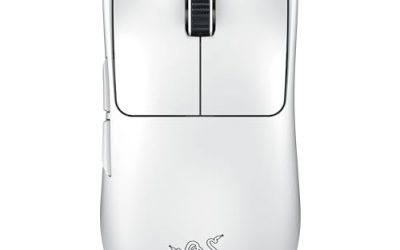
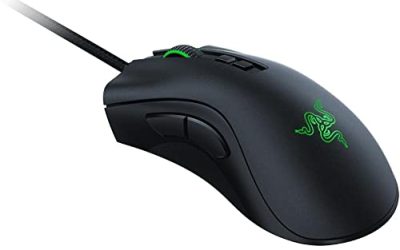
The Orochi V2’s battery figures are in a class of their own: up to 950 hours on Bluetooth and up to 425 hours on Razer’s HyperSpeed 2.4 GHz connection, from a single AA battery — or an AAA, if you prefer it lighter, since the compartment accepts either. It is a small symmetrical mouse at 108 mm long and under 60 g before the battery, aimed at claw and fingertip grips and laptop bags. The Razer 5G optical sensor reaches 18,000 DPI, mechanical switches are rated for fast clicks, and there is no RGB draining the cell — a deliberate design choice that explains much of the endurance.
- Dimensions: 108 × 62.6 × 38.5 mm
- Weight: under 60 g excluding battery
- Sensor: Razer 5G optical, up to 18,000 DPI
- Connection: HyperSpeed 2.4 GHz and Bluetooth
- Battery life: up to 950 hours (Bluetooth) / 425 hours (2.4 GHz)
- Power: 1 × AA or AAA battery
Who it’s for: Players who want to think about mouse power a few times a year at most, and who like a small, light mouse for claw or fingertip grips at a desk or on the road.
Limitations: The compact shell is too small for palm grips and large hands. Bluetooth’s 950-hour mode is for everyday use, not competitive play, and there is no wired fallback while a cell is swapped.
2. SteelSeries Rival 3 Wireless — 400+ hours on AAA cells

ASIN: B08GDDZML8 — View on Amazon
SteelSeries built the Rival 3 Wireless around its Quantum 2.0 dual wireless system and rates it beyond 400 hours in its high-efficiency mode. It runs on one or two AAA batteries: fit both for maximum life and a 106 g weight, or one to save weight. The TrueMove Air sensor reaches 18,000 CPI, the shell is a medium symmetrical shape that suits claw and fingertip grips, and Bluetooth 5.0 covers the second-device role. For a full-size-feeling gaming mouse, nothing else rechargeable-free runs this long between cell changes.
- Dimensions: 120.6 × 67 × 37.9 mm
- Weight: 106 g with two AAA batteries
- Sensor: TrueMove Air optical, up to 18,000 CPI
- Connection: 2.4 GHz and Bluetooth 5.0
- Battery life: 400+ hours in high-efficiency mode
- Power: 1 or 2 × AAA batteries
Who it’s for: Players who want months between battery changes in a normal-sized mouse, with the flexibility to trade weight for endurance by fitting one cell or two.
Limitations: The 400-hour figure applies to the efficiency mode; aggressive settings shorten it. At 106 g fully loaded it is heavier than the ultralight class, and AAA cells are a recurring purchase.
3. Logitech G305 Lightspeed — 250 hours on one AA

ASIN: B07CMS5Q6P — View on Amazon
The G305 is the classic endurance mouse: a single AA battery delivers up to 250 hours in its 1,000 Hz performance mode, and switching to the 125 Hz endurance mode stretches a cell toward nine months of everyday use. The HERO sensor was designed for exactly this efficiency, sipping power while tracking up to 12,000 DPI without smoothing or acceleration. The compact egg shape suits small to medium hands in claw and fingertip grips, the dongle stores inside the shell, and at 99 g with the battery it stays easy to flick.
- Dimensions: 116.6 × 62.2 × 38.2 mm
- Weight: 99 g with battery
- Sensor: HERO optical, up to 12,000 DPI
- Connection: LIGHTSPEED 2.4 GHz
- Battery life: up to 250 hours (performance mode)
- Power: 1 × AA battery
Who it’s for: Players who want proven, simple endurance — one AA, months of gaming — in a compact mouse that disappears into a laptop bag or a tidy desk.
Limitations: There is no Bluetooth and no rechargeable option, so a dead cell means a swap, not a cable. The small shell does not suit large hands or palm grips, and there is no wired mode to fall back on while you find a fresh battery.
4. Logitech G502 X Lightspeed — 140 hours, rechargeable, full-featured

ASIN: B092CRH1RX — View on Amazon
The G502 X Lightspeed is the endurance pick that gives up nothing in features: up to 140 hours of constant-motion battery life from its internal rechargeable battery, the HERO 25K sensor, LIGHTFORCE hybrid switches, 13 programmable controls and a dual-mode scroll wheel in a large 131.4 mm ergonomic shell. This is the non-RGB version of the G502 X line, and skipping the lighting is precisely how it outlasts its Plus sibling. When it does run low, USB-C charging lets you play wired while it tops up.
- Dimensions: 131.4 × 79.2 × 41.1 mm
- Weight: 102 g
- Sensor: HERO 25K optical, up to 25,600 DPI
- Connection: LIGHTSPEED 2.4 GHz, USB-C wired
- Battery life: up to 140 hours
- Power: internal rechargeable, USB-C
Who it’s for: Palm-grip players with larger hands who want flagship features and multi-week battery life without managing spare cells.
Limitations: 140 hours is excellent for a rechargeable mouse but still a third of the Orochi V2’s 2.4 GHz figure. At 102 g it is a substantial mouse, and the internal battery will gradually lose capacity over years.
5. HyperX Pulsefire Haste 2 Wireless — 100 hours at 61 grams

ASIN: B0BX52C4LN — View on Amazon
The Pulsefire Haste 2 Wireless makes the opposite trade to the G502 X: it keeps the weight at an esports-grade 61 g and still manages up to 100 hours per charge from its internal battery. The HyperX 26K sensor tracks up to 26,000 DPI, both 2.4 GHz and Bluetooth connections are on board, and the solid shell (this generation drops the honeycomb) suits claw and fingertip grips. A hundred hours is roughly two to three weeks of daily play, which for most players is the point where charging stops being a thought at all.
- Dimensions: 124.3 × 66.8 × 38.3 mm
- Weight: 61 g
- Sensor: HyperX 26K optical, up to 26,000 DPI
- Connection: 2.4 GHz and Bluetooth, USB-C wired
- Battery life: up to 100 hours
- Power: internal rechargeable, USB-C
Who it’s for: Competitive players who refuse to trade ultralight weight for endurance and want a rechargeable mouse that still goes weeks between charges.
Limitations: Its 100 hours is the shortest rating in this roundup — the price of the 61 g shell. There is no replaceable-cell option, and using Bluetooth to stretch the battery adds latency unsuitable for serious matches.
Comparison table
| Mouse | Battery life (rated) | Power source | Connection | Weight | Sensor |
|---|---|---|---|---|---|
| Razer Orochi V2 | Up to 950 h (BT) / 425 h (2.4 GHz) | 1 × AA or AAA | 2.4 GHz / Bluetooth | <60 g excl. battery | Razer 5G 18K |
| SteelSeries Rival 3 Wireless | 400+ hours | 1–2 × AAA | 2.4 GHz / Bluetooth | 106 g | TrueMove Air 18K |
| Logitech G305 Lightspeed | Up to 250 hours | 1 × AA | 2.4 GHz | 99 g | HERO 12K |
| Logitech G502 X Lightspeed | Up to 140 hours | Rechargeable, USB-C | 2.4 GHz / wired | 102 g | HERO 25K |
| HyperX Pulsefire Haste 2 Wireless | Up to 100 hours | Rechargeable, USB-C | 2.4 GHz / Bluetooth | 61 g | HyperX 26K |
FAQ
How long should a gaming mouse battery actually last?
For regular play of a few hours a day, anything rated at 90 hours or more works out to weeks between charges, which most players find effectively invisible. Mice rated in the hundreds of hours stretch that to months. Ratings assume lighting off and standard polling, so expect less with RGB or high-polling modes enabled.
Why does Bluetooth last so much longer than 2.4 GHz?
Bluetooth Low Energy is designed for tiny power budgets and reports far less often, which is why the Orochi V2 more than doubles its runtime on Bluetooth. The trade is latency: Bluetooth is fine for work and casual play, but competitive gaming should stay on the 2.4 GHz connection.
Are replaceable-battery mice better than rechargeable ones?
They last longer per charge cycle and never suffer battery wear, and a spare AA ends a low-battery moment instantly. Rechargeable mice are usually lighter, charge over USB-C while you keep playing, and avoid buying cells. Neither is objectively better — it depends on whether you value maximum endurance or convenience.
What drains a gaming mouse battery fastest?
RGB lighting and high polling rates, in that order for most mice. Turning lighting off is the single biggest battery saver available, and dropping from 8,000 Hz to 1,000 Hz polling can multiply runtime several times over on mice that offer high-polling modes.
Conclusion
If battery life is the whole point, the Razer Orochi V2 stands alone — up to 950 hours on Bluetooth and 425 hours on its gaming connection, from one AA cell. The Rival 3 Wireless and G305 bring the same replaceable-cell logic to larger and more classic shapes at 400+ and 250 hours. Players who prefer rechargeable convenience should take the G502 X Lightspeed for its 140 hours and full feature set, or the Pulsefire Haste 2 Wireless if every gram matters. Any of the five turns charging from a daily habit into an occasional one — which is exactly what wireless is supposed to feel like.