🛒 Best Price Today on Amazon
Prime members get fast, free shipping on everything above, plus member-only deals. New members get a 30-day free trial — cancel anytime.
Moving from 1080p to 1440p sounds like a modest step, but the arithmetic is not modest. A 2560 by 1440 image holds about 78 percent more pixels than a 1920 by 1080 one, so the card has to shade far more of the screen every frame and needs more memory for textures and buffers. That is why a GPU that felt generous at 1080p can feel strained at 1440p, and why the cheapest way to get there is not simply the cheapest card.
Instead of ranking by price alone, this list starts from a minimum bar: enough memory to avoid stutter at 1440p, and the upscaling and frame generation features that make a modest card feel faster. Everything below is priced at launch MSRP, since street prices shift, and the cut-off for what counts as cheapest in 2026 depends on your refresh-rate target, which we cover first.

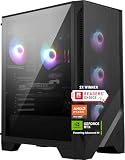
MSI Gaming GeForce RTX 3060 12GB 15 Gbps GDRR6 192-Bit HDMI/DP PCIe 4 Torx Twin Fan Ampere OC Graphics Card
Included for 'Cheapest GPU for 1440p Gaming (2026): How to Choose' as a relevant option in this category; details come from the product listing.
View on AmazonQuick answer: Our top pick in 2026 is the GeForce RTX 5060 Ti 16GB — our #1 rated choice. See the full ranked comparison, alternatives and buying advice below.
Quick Picks
| Product | Best for | Price (launch MSRP) |
|---|---|---|
| GeForce RTX 5060 Ti 16GB | Lowest-cost 1440p with real memory headroom | $429 |
| GeForce RTX 4060 Ti 16GB | 16GB on the previous generation, when the listing is lower | $499 |
| GeForce RTX 5070 12GB | Smoother 1440p at higher refresh rates | $549 |
| Radeon RX 9070 16GB | AMD alternative with 16GB at 1440p | $549 |
Prices are the manufacturer’s launch MSRP. Check the current listing price before buying and compare it against these.
First, Decide What “1440p” Means to You
Hitting 60 frames per second at 1440p on medium-high settings is a much cheaper target than 144 frames at high settings. If your monitor is 60Hz, the lowest tier below is plenty. If you own a 144Hz or 165Hz panel and want to use it, move up a tier. Reviews from outlets like TechPowerUp, Hardware Unboxed and Tom’s Hardware show a clear pattern: the gap between the lowest and the middle 1440p cards is large in heavy games and small in esports titles.
Upscaling closes some of that gap. DLSS on RTX cards and FSR on Radeon render at a lower internal resolution and rebuild the image, which helps a cheaper card reach a 1440p output. It is not free, but it is the reason a $429 card can serve as a 1440p card at all.
The Four Lowest-Cost Ways Into 1440p
GeForce RTX 5060 Ti 16GB
The cheapest sensible 1440p entry. It launched at $429 with a 180W target and 16GB of memory, which is the key spec: at 1440p, texture memory becomes the limit long before the shader cores do. DLSS 4 with multi frame generation adds an extra tool for demanding games. Be sure to pick the 16GB version, since an 8GB model at $379 shares the name.
- Pro: 16GB removes the main 1440p memory limit at the lowest price
- Pro: 180W target keeps the power supply and case requirements modest
- Con: High-refresh 1440p in demanding games will rely on upscaling
Skip it if you want a native 144Hz experience in new releases.
GeForce RTX 4060 Ti 16GB
The previous generation’s 16GB card, launched at $499 with a 160W target. It supports frame generation but not multi frame generation. Because its launch price sits above the newer 5060 Ti, it only makes sense if the live listing is clearly lower. Treat it as a bargain-hunter’s option.
- Pro: 16GB memory and a low 160W target
- Pro: Frame generation support and a mature driver stack
- Con: Launch MSRP sits above the newer RTX 5060 Ti 16GB
Skip it if the listing price is not meaningfully below the 5060 Ti.
GeForce RTX 5070 12GB
The step up for high-refresh gamers. At $549 launch and a 250W target, it brings a larger jump in raw speed than the 5060 Ti, with 12GB of memory that is enough for most 1440p games today. It also gets multi frame generation. It costs $120 more than the 5060 Ti at launch, so ask whether your monitor can use the extra speed.
- Pro: Noticeably stronger at 1440p high refresh
- Pro: Full RTX 50 features, including multi frame generation
- Con: 12GB offers less headroom than the 16GB cards for the heaviest textures
Skip it if you play at 60Hz, where the 5060 Ti already does the job.
Radeon RX 9070 16GB
The AMD answer at $549 launch with 16GB. It matches the RTX 5070’s price but doubles down on memory, which suits 1440p well, and it supports FSR 4. If you do not need NVIDIA tools, it is a strong competitor. Compare the board-partner models and their noise levels, since cooler quality varies.
- Pro: 16GB at the same launch price as a 12GB rival
- Pro: Strong raster performance for 1440p
- Con: Fewer creator and streaming features than NVIDIA
Skip it if your software depends on NVIDIA-specific encoders or features.
Buying for 1440p Without Overspending
Memory First, Speed Second
At 1440p, a card that runs out of memory stutters badly, while a card that is slightly slow just lowers frame rate. If the choice is between a slightly faster 8GB card and a slightly slower 16GB one, the 16GB one will age better.
Don’t Forget the Monitor
A 1440p monitor adds to the total cost of the upgrade. Budget for both together, and match the card’s capability to the monitor’s refresh rate.
Platform Checks
Confirm your power supply and PCIe slot. A Zen 3 or 12th-generation Intel CPU is a reasonable partner, and resizable BAR should be on in the BIOS.
The Cheapest Credible Answer
The RTX 5060 Ti 16GB is the lowest-cost card we would recommend for 1440p, because its memory removes the biggest limit. Move up to the RTX 5070 or RX 9070 only if your monitor refresh rate or settings demand it.
FAQ
Can an 8GB card run 1440p?
Yes in many games with reduced settings, but it runs out of margin quickly. Aim for 12GB or more.
Is 1440p worth the extra cost over 1080p?
For most monitor sizes above 24 inches, the sharper image is a visible improvement.
Does DLSS make 1440p cheaper to reach?
Yes. It renders at a lower internal resolution, so a modest card can output 1440p.
Do I need a new CPU?
Not usually. A recent mid-range CPU is plenty, though very old chips can hold the card back.
Ready to decide? Our #1 pick for 2026 is the GeForce RTX 5060 Ti 16GB.
Live price & availability on Amazon.