🛒 Best Price Today on Amazon
Prime members get fast, free shipping on everything above, plus member-only deals. New members get a 30-day free trial — cancel anytime.

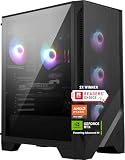
CyberPowerPC Gamer Xtreme VR Gaming PC, Intel Core i5-13400F 2.5GHz, GeForce RTX 5060 8GB, 16GB DDR5, 1TB PCIe 4.0 SSD, WiFi Ready & Windows 11 Home (GXiVR8060A40)
Included for 'Best VR Ready Gaming PC: 5 Powerful Prebuilt Picks 2026' because the listing specifies Intel Core i5-13400F 2.5GHz and GeForce RTX 5060 8GB, details this guide uses to compare options.
View on Amazon
The Horizon Autherium Dragon RGB I9 RTX Gaming PC || 64GB RAM || 5TB Storage || Core I9 Upto 5.4Ghz || RTX 5070 OC || Windows 11 PRO || 360MM AIO || 2.4GB/s WiFi, VR, Gaming Ready Desktop Computer
Included for 'Best VR Ready Gaming PC: 5 Powerful Prebuilt Picks 2026' because the listing specifies 64GB RAM and 5TB Storage, details this guide uses to compare options.
View on AmazonThe best VR ready gaming PC needs more than a powerful graphics card. Stable frame times, a fast CPU, enough memory, responsive storage, reliable cooling, and suitable display or USB connectivity all matter inside a headset. These prebuilts provide serious performance headroom for modern PC VR gaming.
Quick Comparison
| Gaming PC | Best For | CPU | GPU | RAM | Storage |
|---|---|---|---|---|---|
| NZXT Player Three | Overall VR gaming | Ryzen 7 9800X3D | RTX 5080 16GB | 32GB DDR5 | 4TB NVMe |
| Corsair Vengeance i8200 | VR plus streaming | Core i9-14900KF | RTX 5080 16GB | 64GB DDR5 | 4TB NVMe |
| Alienware Area-51 AMD | Premium high-end VR | Ryzen 9 9950X3D | RTX 5080 16GB | 32GB DDR5 | 1TB Gen5 |
| Lenovo Legion Tower 7i | Balanced RTX 5080 build | Core Ultra 7 265KF | RTX 5080 16GB | 32GB DDR5 | 1TB NVMe |
| HP OMEN 45L | Upgrade-focused VR setup | Core Ultra 9 285K | RTX 5080 16GB | 64GB DDR5 | 4TB SSD |
NZXT Player Three
Best For: Overall high-end VR gaming
Key Features:
- AMD Ryzen 7 9800X3D
- GeForce RTX 5080 16GB
- 32GB DDR5-6000
- 4TB NVMe M.2 SSD
- Kraken Elite 360 RGB V2 cooler
- NZXT H6 Flow case
- 850W Gold power supply
- Windows 11 Home
NZXT’s current Player Three configuration pairs AMD’s Ryzen 7 9800X3D with an RTX 5080 and 32GB of DDR5-6000 memory. That combination targets demanding 4K gaming, but the same GPU and CPU headroom is highly relevant to VR, where inconsistent frame delivery can feel much more disruptive than on a conventional monitor.
The RTX 5080 supplies 16GB of GDDR7 memory, giving the system room for high-resolution textures, demanding VR environments, and modern rendering features. VR resolution can become expensive because the GPU must continuously render separate views for both eyes, making strong graphics performance particularly important with higher-resolution headsets.
The Ryzen 7 9800X3D is a gaming-focused processor that gives the Player Three a strong foundation for CPU-heavy simulations and VR games. A fast CPU matters when titles calculate physics, artificial intelligence, tracking, and high refresh-rate frames simultaneously, because the GPU cannot maintain smooth presentation if the processor falls behind.
NZXT uses its H6 Flow chassis and a Kraken Elite 360 RGB V2 liquid cooler in the listed configuration. The combination provides substantial cooling capacity for extended gaming sessions. VR workloads can keep both CPU and GPU active for long periods, so maintaining clocks under sustained load matters more than short benchmark bursts.
What Makes It Different: The Player Three combines the gaming-focused Ryzen 7 9800X3D with an RTX 5080 rather than pairing a premium graphics card with an unnecessarily workstation-heavy CPU. Its 4TB SSD is another practical strength because modern VR games and standard PC titles can quickly consume large amounts of storage.
Pros:
- Ryzen 7 9800X3D gaming CPU
- RTX 5080 with 16GB VRAM
- 32GB DDR5-6000 memory
- Large 4TB SSD
- 360mm liquid cooling
- Airflow-focused case
- Standard ATX platform
Cons:
- High-end hardware raises power requirements
- RTX 5080 can be excessive for lighter standalone-style VR games
- Large desktop footprint
Use Case: High-resolution PC VR, racing simulators, flight simulators, demanding AAA games, and a mixed flat-screen and headset gaming library.
Who It’s For: Players who want strong VR performance without moving all the way to an RTX 5090-class system.
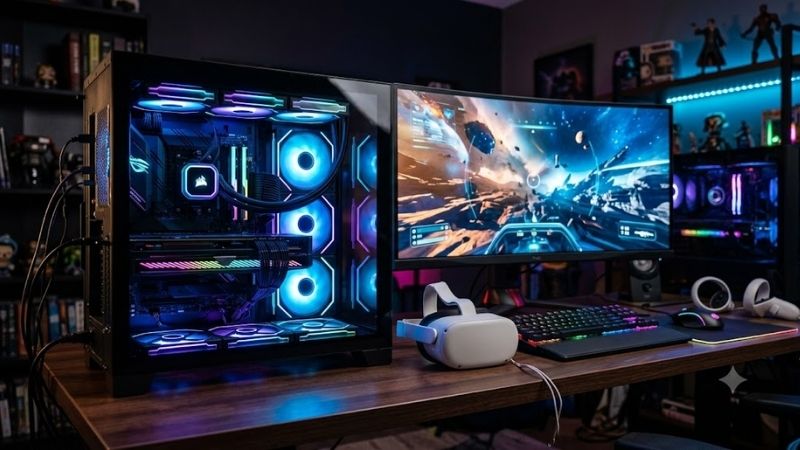
Corsair Vengeance i8200
Best For: VR gaming, streaming, and large multitasking workloads
Key Features:
- Intel Core i9-14900KF
- GeForce RTX 5080
- 64GB DDR5-6000
- Two 2TB NVMe SSDs
- 1200W 80 PLUS Gold PSU
- Liquid CPU cooling
- 2.5Gb Ethernet
- WiFi 6
- Windows 11 Pro
Corsair’s Vengeance i8200 configuration combines a Core i9-14900KF, RTX 5080, and 64GB of DDR5-6000 memory. Corsair lists two 2TB NVMe drives for 4TB total storage, providing considerably more capacity than many prebuilts. That makes the system suitable for VR alongside a large conventional game and recording library.
Sixty-four gigabytes of RAM is more than most gaming-only systems require, but it becomes useful when VR is combined with OBS, browser windows, voice software, telemetry, mod managers, or creative applications. Flight and racing simulator users may also run maps, launchers, tracking utilities, and peripheral software alongside the game itself.
The 1200W 80 PLUS Gold power supply gives the RTX 5080 configuration substantial power headroom. Corsair also uses liquid CPU cooling while the graphics card retains air cooling. A larger PSU does not improve frame rates directly, but it gives a high-end platform enough capacity for sustained loads and future component changes.
Connectivity includes 2.5Gb Ethernet, WiFi 6, front USB-C, multiple USB-A ports, DisplayPort, and HDMI outputs from the graphics hardware. Exact headset connectivity varies, so buyers should still check whether their VR headset expects DisplayPort, HDMI, direct USB-C video, or a streaming connection before purchasing.
What Makes It Different: The Vengeance i8200 focuses on memory, storage, and overall system capacity instead of simply installing a high-end GPU. Its 64GB memory and 4TB of NVMe storage make it especially useful for sim racing, flight simulation, VR recording, streaming, and creators who use the same PC for production work.
Pros:
- RTX 5080 graphics
- 64GB DDR5-6000
- 4TB total NVMe storage
- 1200W Gold power supply
- Liquid CPU cooling
- 2.5Gb Ethernet
- Broad front and rear connectivity
Cons:
- Core i9-14900KF is an older platform than newer Core Ultra systems
- 64GB RAM is unnecessary for basic gaming
- Large premium tower
Use Case: VR gaming combined with OBS, content creation, simulation accessories, large game libraries, and heavy multitasking.
Who It’s For: Users who want one high-end desktop to handle VR, streaming, editing, and conventional gaming without immediately upgrading memory or storage.
Alienware Area-51 AMD
Best For: Premium VR gaming with a high-end AMD processor
Key Features:
- AMD Ryzen 9 9950X3D
- GeForce RTX 5080 16GB
- 32GB DDR5-6400
- 1TB PCIe Gen5 NVMe SSD
- 360mm liquid CPU cooling
- 1500W Platinum PSU
- 2.5Gb Ethernet
- Windows 11 Home
The AMD version of Alienware’s Area-51 pairs a Ryzen 9 9950X3D with an RTX 5080, creating a powerful platform for demanding VR games and simulation software. Dell lists 16 CPU cores, 32GB of DDR5-6400 memory, and a Gen5 NVMe SSD, making this configuration much more than a minimum-spec VR machine.
A Ryzen 9 9950X3D can be particularly useful when the computer handles gaming plus background workloads. VR simulation titles may combine high-frequency game logic with tracking software, voice applications, telemetry, streaming, or recording. Extra CPU resources reduce the likelihood that those supporting applications compete heavily with the main game.
Dell equips this configuration with a 1500W Platinum-rated ATX12VO power supply and a 360mm liquid CPU cooler. Those specifications provide ample power and cooling capacity for the installed hardware. The trade-off is physical scale because Area-51 is designed as a large enthusiast desktop rather than a compact machine for small desks.
The listed 1TB SSD is the weakest specification for a high-end VR library. One terabyte is usable, but heavily modded simulators, large AAA games, recordings, and ordinary PC titles can consume it quickly. Buyers considering this configuration should examine additional storage options or plan to add another NVMe drive later.
What Makes It Different: Area-51 uses a premium chassis, oversized power delivery, and a Ryzen 9 9950X3D instead of focusing only on GPU performance. That makes it appropriate for players whose VR system is also a high-end desktop workstation, although users gaming only in VR may not use all of the processor’s capabilities.
Pros:
- Ryzen 9 9950X3D
- RTX 5080 16GB
- 32GB DDR5-6400
- PCIe Gen5 storage
- 360mm liquid cooling
- 1500W Platinum power supply
- Strong multitasking capacity
Cons:
- 1TB base storage is modest for the hardware level
- Large chassis
- Premium configuration can exceed the needs of ordinary VR games
Use Case: High-end VR simulation, multitasking, streaming, heavily modded games, and workstation-style use on the same PC.
Who It’s For: Enthusiasts who want a premium prebuilt and substantial CPU headroom alongside RTX 5080 graphics.
Lenovo Legion Tower 7i
Best For: Balanced RTX 5080 VR performance
Key Features:
- Intel Core Ultra 7 265KF
- GeForce RTX 5080 16GB
- 32GB DDR5-5600
- 1TB PCIe 4.0 NVMe SSD
- 34-liter tower
- Windows 11 Home
- Standard desktop form factor
Lenovo’s Legion Tower 7i 34L is available with a Core Ultra 7 265KF, RTX 5080 16GB, 32GB of DDR5-5600 memory, and a 1TB PCIe 4.0 NVMe SSD. This combination avoids an extreme flagship processor while keeping the graphics hardware needed for demanding high-resolution VR workloads.
The Core Ultra 7 265KF uses 20 cores across performance and efficiency core groups, providing substantial processing resources for games and background applications. VR rarely requires the most expensive desktop CPU available, so combining a capable processor with a stronger GPU can be a sensible allocation for a headset-focused gaming build.
Thirty-two gigabytes of memory is a comfortable target for current gaming because it provides headroom beyond the 16GB still found in some mainstream prebuilts. It also leaves room for SteamVR-related software, browsers, Discord, launchers, tracking utilities, and peripheral applications without immediately forcing the system into memory pressure.
Like the Alienware configuration, the main limitation is the listed 1TB SSD. VR libraries can become large, especially when Microsoft Flight Simulator, racing titles, texture packs, mods, and ordinary AAA games share one machine. Fortunately, desktop storage is easier to expand than the processor or graphics card when capacity runs low.
What Makes It Different: Legion Tower 7i provides RTX 5080 graphics without requiring the most extreme CPU, memory, or storage configuration. That makes it a more balanced starting point for gamers who want their budget concentrated on graphics performance and plan to upgrade inexpensive components such as storage later.
Pros:
- RTX 5080 16GB
- Modern Core Ultra 7 processor
- 32GB DDR5 memory
- Conventional tower format
- Strong gaming-focused component balance
- Windows 11 compatibility
Cons:
- 1TB SSD may fill quickly
- DDR5-5600 is slower than some premium configurations
- Storage expansion may be necessary for large libraries
Use Case: Modern PC VR, conventional 4K gaming, racing setups, and users who prefer adding storage later rather than buying an oversized factory configuration.
Who It’s For: Gamers who want RTX 5080-class VR graphics without paying primarily for 64GB RAM, huge factory storage, or a flagship CPU.
HP OMEN 45L
Best For: Upgrade-focused high-end VR setups
Key Features:
- Intel Core Ultra 9 285K
- GeForce RTX 5080 16GB
- 64GB RAM
- 2TB + 2TB SSD configuration
- 360mm liquid cooling
- OMEN Cryo Chamber design
- Tool-less component access
- Windows 11 Home
A current HP OMEN 45L RTX 5080 configuration combines a Core Ultra 9 285K, 64GB of memory, and two 2TB SSDs. HP also lists a 360mm liquid cooler and its dedicated Cryo Chamber cooling approach. The resulting system is designed for sustained enthusiast workloads rather than meeting only the minimum requirements for VR.
The Cryo Chamber isolates the CPU radiator toward the top of the chassis so it can access cooler outside air rather than relying entirely on air already heated by the graphics card. That design is relevant during long VR sessions because the CPU and GPU can remain loaded continuously instead of cycling through brief gaming bursts.
HP emphasizes tool-less access and support for standard replaceable components in the OMEN 45L family. Upgradeability matters because a VR desktop may remain useful through several headset generations. Adding storage, replacing memory, or eventually changing the graphics card is easier when the chassis is not built around inaccessible proprietary packaging.
The combination of 64GB RAM and 4TB total SSD capacity is especially attractive for heavily modded simulation environments. Microsoft Flight Simulator, driving simulators, texture packs, VR recordings, and conventional games can all coexist without the user constantly moving installations between drives or deleting older titles.
What Makes It Different: Cooling design and serviceability are the main reasons to consider the OMEN 45L. Rather than being a compact prebuilt, it provides a large chassis with dedicated cooling space and accessible internal hardware, making it a better fit for users who expect to maintain and upgrade the system over several years.
Pros:
- Core Ultra 9 285K
- RTX 5080 16GB
- 64GB memory
- 4TB combined SSD storage
- 360mm liquid cooling
- Tool-less access
- Upgrade-oriented chassis
Cons:
- Large 45-liter enclosure
- Excessive specification for basic VR titles
- More expensive configurations can provide hardware you may never use
Use Case: Long-term VR gaming, high-resolution headsets, heavily modded simulators, streaming, recording, and future hardware upgrades.
Who It’s For: Users who want a spacious enthusiast prebuilt that can remain the foundation of a VR setup through future component changes.
How to Choose the Best VR Ready Gaming PC
Start With the GPU
The graphics card is usually the most important component for demanding VR because the system must render high-resolution views at consistent frame rates. High-end headsets and supersampling increase GPU load quickly. RTX 5070 Ti or RTX 5080-class hardware provides more useful headroom than buying an extreme CPU with a weaker GPU.
Frame-Time Stability Matters More Than Average FPS
VR comfort depends heavily on consistent frame delivery. A computer that averages a high frame rate but repeatedly produces long frame-time spikes can feel worse inside a headset than a slightly slower system with stable pacing. CPU performance, background software, cooling, memory capacity, and GPU headroom all contribute to consistency.
Match the PC to the Headset Resolution
Not every headset creates the same rendering demand. Higher-resolution PC VR headsets require the GPU to process far more pixels than older models, particularly when supersampling is enabled. Choose a system around the headset you intend to use rather than relying on a generic VR-ready label applied across very different hardware generations.
32GB RAM Is a Practical Target
Sixteen gigabytes can still run many games, but 32GB provides better headroom for modern VR systems using launchers, tracking utilities, Discord, browsers, mods, and peripheral software. Sixty-four gigabytes becomes more relevant to flight simulation, content creation, heavy modding, or users who run several demanding applications together.
Storage Fills Faster Than Expected
A 1TB SSD sounds large until VR games, flat-screen AAA releases, mods, recordings, and simulator scenery share the drive. Two terabytes is a more comfortable starting point for enthusiasts, while 4TB helps users maintain a large installed library. NVMe storage also reduces the frustration of transferring massive titles between drives.
Check Headset Connectivity
VR headsets can use DisplayPort, HDMI, USB, USB-C, WiFi streaming, or proprietary link hardware depending on the model. Verify the exact headset requirements before buying the PC. A powerful desktop can still require an adapter, expansion card, suitable router, or correctly located USB port if its connectivity does not match the headset.
Cooling Matters During Long Sessions
VR games can keep a system under sustained load for hours, especially simulators. A strong airflow path and adequate CPU cooling help prevent temperatures from pushing components toward reduced clock speeds. Large liquid coolers are useful on high-power processors, but good case ventilation remains equally important for the graphics card.
Think About Wireless PC VR
Headsets using wireless PC streaming depend on the network as well as the computer. Ethernet from the gaming PC to the router or access point is preferable because it removes one wireless hop. WiFi 6E or WiFi 7 can provide high-capacity headset links, but placement, channel congestion, and local interference remain important.
FAQ
What Makes a Gaming PC VR Ready?
A VR-ready PC needs a compatible GPU, sufficient CPU performance, enough memory, supported headset connections, and an operating system that works with the required VR software. The exact requirement depends on the headset and game, so the phrase VR ready should be treated as a starting point rather than a universal certification.
Is an RTX 5080 Overkill for VR?
It can be excessive for older or lightweight VR games, but high-resolution headsets, flight simulators, racing titles, supersampling, and demanding AAA VR can use substantial GPU performance. An RTX 5080 also provides additional headroom for future headsets and conventional 4K gaming rather than serving only current VR software.
Is 32GB RAM Enough for VR Gaming?
Yes, 32GB is a strong target for modern VR gaming and leaves space for background programs, launchers, voice chat, and tracking software. Sixty-four gigabytes becomes more useful when VR is combined with heavy simulation mods, video editing, streaming, large creative projects, or unusually memory-intensive multitasking.
Do I Need a Powerful CPU for VR?
A powerful CPU helps with physics, simulation, tracking, high refresh rates, and games that process complex scenes. However, spending heavily on a flagship CPU while compromising the graphics card is usually a poor trade for demanding VR. Balance matters, with the GPU receiving particular attention for high-resolution headset rendering.
Can a VR Gaming PC Also Handle 4K Gaming?
A system built around an RTX 5080 and modern high-end processor is also designed for demanding conventional gaming. Settings, ray tracing, game engines, and target frame rates still affect performance, but the same graphics hardware that provides VR headroom is highly relevant to 1440p high-refresh and 4K monitor gaming.
Should I Build or Buy a VR Gaming PC?
Building gives you exact control over the motherboard, cooling, power supply, and case, while a prebuilt provides assembly, system-level support, and immediate usability. Either can work well for VR when the hardware is appropriate. Compare the actual components and upgrade options instead of assuming one purchasing method is always superior.
Conclusion
The best VR ready gaming PC depends on headset resolution, game complexity, upgrade plans, and whether you also play demanding flatscreen titles. Corsair, Alienware, NZXT, and Lenovo each offer RTX 5080-class systems with different strengths in cooling, storage, processor choice, expansion, and overall design.