🛒 Best Price Today on Amazon
Prime members get fast, free shipping on everything above, plus member-only deals. New members get a 30-day free trial — cancel anytime.
- Top 3 Picks
- Quick Comparison: Best Gaming PCs Under $1,300
- 1. Skytech Gaming Storm – Best Overall, About $1,150–$1,200
- 2. CyberPowerPC Gaming PC (Core i5-14400F, RTX 5060) – Best Value, About $1,050–$1,100
- 3. MXZ Gaming PC (Ryzen 5 5600X, RTX 4070) – Best for 1440p, About $1,250–$1,300
- 4. Skytech Gaming Chronos 3 (Core i5-14400F, RX 9060 XT 8GB) – Best AMD GPU Option, About $1,100–$1,150
- 5. CyberPowerPC Gaming PC (Ryzen 7 8700F, RTX 5060 Ti) – Best for Future Upgrades, About $1,250–$1,290
- 6. Skytech Gaming Azure 3 (Core i5-14400F, RTX 5060 Ti) – Best Case and Build, About $1,250–$1,300
- What to Expect From a Gaming PC Under $1,300 in 2026
- Buying Guide
- Frequently Asked Questions
The best gaming PC under $1,300 for most people is the Skytech Gaming Storm with an RTX 5060 Ti 8GB, 16GB of RAM and a 1TB SSD, because it delivers smooth high-refresh 1080p and capable entry-level 1440p gaming for roughly $1,150 to $1,200, leaving a little room in the budget. If raw performance at 1440p matters more than brand or platform age, the MXZ build with an RTX 4070 is the fastest system in this tier at close to $1,300. Everything below falls between roughly $1,100 and $1,300, the upper-budget tier where you move past entry-level graphics and into cards that can genuinely handle modern games on high settings.
Quick answer: For most people in 2026, the best gaming pc under $1,300 (october 2026) is the Skytech Gaming Storm — our #1 rated choice. See the full ranked comparison, alternatives and buying advice below.
Top 3 Picks
- Best overall: Skytech Gaming Storm with Ryzen 5, RTX 5060 Ti 8GB, 16GB RAM and 1TB SSD, a well-balanced system from an established builder at roughly $1,150 to $1,200.
- Best value: CyberPowerPC Gaming PC with Intel Core i5-14400F and RTX 5060 8GB, the cheapest entry into this tier at roughly $1,050 to $1,100.
- Best for 1440p: MXZ Gaming PC with Ryzen 5 5600X and RTX 4070, the fastest GPU and the only 12GB card here, at roughly $1,250 to $1,300.
Quick Comparison: Best Gaming PCs Under $1,300
| Model | CPU | GPU | RAM | Storage | Approx. price | Best for |
|---|---|---|---|---|---|---|
| Skytech Gaming Storm | Ryzen 5 | RTX 5060 Ti 8GB | 16GB | 1TB SSD | $1,150–$1,200 | Balanced 1080p high refresh |
| CyberPowerPC Gaming PC (i5-14400F) | Core i5-14400F | RTX 5060 8GB | Check listing | Check listing | $1,050–$1,100 | Lowest cost in the tier |
| MXZ Gaming PC | Ryzen 5 5600X | RTX 4070 | 16GB DDR4 | 1TB NVMe SSD | $1,250–$1,300 | Entry 1440p, best raw speed |
| Skytech Gaming Chronos 3 | Core i5-14400F | RX 9060 XT 8GB | Check listing | Check listing | $1,100–$1,150 | Strong raster performance from AMD |
| CyberPowerPC Gaming PC (Ryzen 7 8700F) | Ryzen 7 8700F | RTX 5060 Ti 8GB | Check listing | Check listing | $1,250–$1,290 | Newer AM5 platform for upgrades |
| Skytech Gaming Azure 3 | Core i5-14400F | RTX 5060 Ti 8GB | Check listing | Check listing | $1,250–$1,300 | Premium case and Intel platform |
1. Skytech Gaming Storm – Best Overall, About $1,150–$1,200
Specs from the listing: AMD Ryzen 5 processor, NVIDIA GeForce RTX 5060 Ti 8GB, 16GB RAM, 1TB SSD.

Skytech Gaming PC Storm, Ryzen 5, RTX 5060 Ti 8GB, 16GB RAM, 1TB SSD
Included for 'Best Gaming PC Under $1,300 (October 2026): Top 6 Picks' as a representative gaming desktop pc in this roundup; selection reflects the product set returned for this topic.
View on AmazonSkytech’s Storm line is its value-oriented series, and this configuration hits the sweet spot of the $1,000 to $1,300 tier. The RTX 5060 Ti 8GB is one of the strongest 1080p cards you can find at this price, with enough muscle for high or ultra settings in most current games and support for DLSS 4, including multi frame generation on RTX 50 series cards. Pair that with 16GB of RAM and a 1TB SSD and you get a complete system that needs nothing extra on day one.
The weak point is the 8GB of video memory. At 1080p it is usually fine, but reviewers have repeatedly shown 8GB cards losing performance or stuttering in the most memory-hungry games at 1440p with maximum textures. The title also only says “Ryzen 5,” so confirm the exact processor model on the listing; Storm builds are typically built on AMD’s mature AM4 platform with DDR4, which is affordable but not the newest.
Who should buy it?
Players with a 1080p 144Hz to 240Hz monitor who want high settings in AAA games and very high frame rates in competitive shooters.
Who should skip it?
Anyone planning to game mainly at 1440p with maximum textures in new releases. For that, the RTX 4070 system’s 12GB of VRAM is the safer choice. Buyers who want the newest CPU socket for future upgrades should look at the Ryzen 7 8700F build instead.
Is the RTX 5060 Ti worth it over the RTX 5060?
Usually, yes. Independent benchmarks generally put the RTX 5060 Ti roughly 15 to 20 percent ahead of the RTX 5060 at 1080p and 1440p. With this Storm build priced only about $100 above the CyberPowerPC RTX 5060 system, that is a fair trade. If your budget is fixed at $1,100, the RTX 5060 is still very capable at 1080p.
2. CyberPowerPC Gaming PC (Core i5-14400F, RTX 5060) – Best Value, About $1,050–$1,100
Specs from the listing: Intel Core i5-14400F, NVIDIA GeForce RTX 5060 8GB. Memory and storage are not given in the product title, so check the configuration before buying.

CyberPowerPC Gaming PC, Intel Core i5-14400F, GeForce RTX 5060 8GB
Included for 'Best Gaming PC Under $1,300 (October 2026): Top 6 Picks' as a representative gaming desktop pc in this roundup; selection reflects the product set returned for this topic.
View on AmazonCyberPowerPC is one of the largest prebuilt makers in the US, and its Gamer Xtreme and Gamer Master families cover most of this price range. This model pairs a ten-core Intel Core i5-14400F (six performance cores and four efficient cores) with the RTX 5060, the entry-level card of NVIDIA’s current lineup. The i5-14400F is a strong gaming CPU that can comfortably feed an RTX 5060 or even a faster card later.
The RTX 5060 is an excellent 1080p GPU and a noticeable step above previous-generation cards like the RTX 3060 Ti. It runs most new AAA games at high settings at 1080p with good frame rates, and DLSS 4 helps it stretch into 1440p in supported titles. Its limitations are the same 8GB memory concern and a gap of roughly 15 to 20 percent versus the 5060 Ti. Confirm the RAM and storage amounts; if the listing shows a single memory stick or a 500GB drive, plan for a small upgrade.
Who should buy it?
Buyers who want the cheapest ticket into the $1,000-plus tier with a current-generation GPU and a capable Intel processor.
Who should skip it?
Anyone targeting 1440p with high settings in demanding releases. Spending another $150 to $200 on the RTX 5060 Ti or RTX 4070 builds gives you noticeably more headroom.
Is the Core i5-14400F good enough for high-refresh gaming?
Yes. It is a well-regarded mid-range gaming chip with ten cores and sixteen threads. With an RTX 5060 or 5060 Ti, the GPU will almost always be the limiting factor, not the processor. It is on Intel’s LGA 1700 platform, which will not receive new CPU generations, so long-term upgrades are limited to existing 12th through 14th generation chips.
3. MXZ Gaming PC (Ryzen 5 5600X, RTX 4070) – Best for 1440p, About $1,250–$1,300
Specs from the listing: AMD Ryzen 5 5600X, NVIDIA GeForce RTX 4070, 16GB DDR4, 1TB NVMe SSD, six RGB fans, described as “Win 11 Pro Ready.”
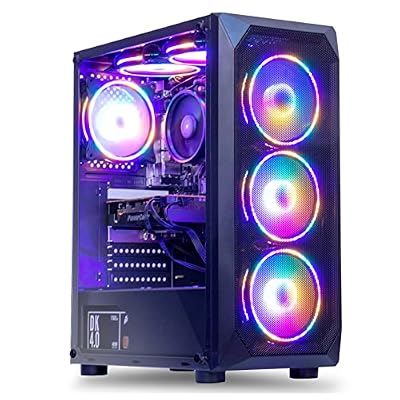
MXZ Gaming PC Desktop Computer, AMD Ryzen 5 5600X, RTX 4070, 16GB DDR4, NVME 1 T SSD, 6RGB Fans, Win 11 Pro Ready, Gamer Desktop Computer(R5 5600X| RTX4070)
Included for 'Best Gaming PC Under $1,300 (October 2026): Top 6 Picks' as a representative gaming desktop pc in this roundup; selection reflects the product set returned for this topic.
View on AmazonIf performance is the only thing that matters, this is the system to buy. The RTX 4070 is a tier above everything else on this list. Measured game benchmarks put it roughly 10 to 12 percent ahead of the RTX 5060 Ti in demanding titles, and some aggregate estimates show a wider gap. More importantly, it carries 12GB of video memory, which avoids most of the stuttering and texture problems that 8GB cards can hit at 1440p. It is the most comfortable choice here for 1440p gaming at high settings.
There are trade-offs to weigh. MXZ is a smaller builder than Skytech or CyberPowerPC, so check warranty terms and support policies. The Ryzen 5 5600X is a capable six-core chip, but it is an older AM4 processor, and in CPU-heavy games at 1080p it will leave some of the RTX 4070’s performance on the table. The “Win 11 Pro Ready” wording deserves attention: confirm whether Windows is activated, because “ready” can mean installed without a license.
Who should buy it?
Players with a 1440p monitor who want high settings in AAA games, and anyone who plays texture-heavy titles where 12GB of VRAM helps.
Who should skip it?
Buyers who want a big-name builder’s warranty and support, or who mainly play at 1080p in esports titles, where the 5060 Ti systems deliver similar results for less. If you want a modern platform for CPU upgrades, AM4 is a dead end.
RTX 4070 or RTX 5060 Ti: which should I pick at this price?
For 1440p, the RTX 4070. It is faster in measured tests and has 50 percent more video memory than the 8GB 5060 Ti. The 5060 Ti’s main advantage is DLSS 4 multi frame generation, which can boost displayed frame rates in supported games, though it does not reduce input lag the way real performance does.
4. Skytech Gaming Chronos 3 (Core i5-14400F, RX 9060 XT 8GB) – Best AMD GPU Option, About $1,100–$1,150
Specs from the listing: Intel Core i5-14400F, AMD Radeon RX 9060 XT 8GB. Memory and storage are not stated in the product title; confirm them on the listing.

Skytech Gaming Chronos 3 Gaming PC, Core i5 14400F, RX 9060 XT 8GB
Included for 'Best Gaming PC Under $1,300 (October 2026): Top 6 Picks' as a representative gaming desktop pc in this roundup; selection reflects the product set returned for this topic.
View on AmazonChronos 3 is one of Skytech’s main series, offered in configurations ranging from mainstream to high-end. This version pairs the Core i5-14400F with AMD’s RX 9060 XT 8GB. In traditional rasterized games, the RX 9060 XT and RTX 5060 Ti trade blows and land within a few percent of each other in most independent testing, which makes this a strong performance-per-dollar option at around $1,100 to $1,150.
Where it falls behind is ray tracing and upscaling. NVIDIA still leads in heavy ray-traced and path-traced games, often by 15 percent or more, and DLSS is supported in more titles than AMD’s FSR 4. The 8GB version also shares the memory limits of the 8GB NVIDIA cards; one widely cited review showed the RX 9060 XT 8GB struggling badly in a demanding game at 1440p ultra, while the 16GB version handled it fine.
Who should buy it?
Gamers who play mostly without ray tracing, including esports and many popular multiplayer games, and want near-5060 Ti speed for a bit less.
Who should skip it?
Anyone excited about ray-traced visuals or who wants the widest upscaling support. In that case, one of the RTX 5060 Ti systems is the better pick for a modest premium.
Is the RX 9060 XT 8GB as fast as the RTX 5060 Ti 8GB?
In standard rasterized games, roughly yes; the two are typically within a few percent. With ray tracing turned on, the RTX 5060 Ti pulls ahead clearly. Both 8GB cards are best paired with a 1080p or 1080p high-refresh monitor.
5. CyberPowerPC Gaming PC (Ryzen 7 8700F, RTX 5060 Ti) – Best for Future Upgrades, About $1,250–$1,290
Specs from the listing: AMD Ryzen 7 8700F, NVIDIA GeForce RTX 5060 Ti 8GB. RAM and storage are not given in the product title, so verify them before you order.

CyberPowerPC Gaming PC, AMD Ryzen 7 8700F, GeForce RTX 5060 Ti 8GB
Included for 'Best Gaming PC Under $1,300 (October 2026): Top 6 Picks' as a representative gaming desktop pc in this roundup; selection reflects the product set returned for this topic.
View on AmazonThis CyberPowerPC build stands out because of its platform. The Ryzen 7 8700F is an eight-core, sixteen-thread chip on AMD’s AM5 socket, which uses DDR5 memory and supports newer Ryzen processors. That means you can drop in a faster CPU later without replacing the motherboard, something you cannot do on the AM4 or LGA 1700 systems in this guide. For gaming today, the 8700F is a solid pairing for the RTX 5060 Ti, though AMD’s X3D chips remain the gaming champions if you upgrade later.
The trade-off is price. At close to $1,300, it costs about the same as the RTX 4070 system, which is faster for gaming right now. You are effectively paying for a newer platform rather than more frames. As always, confirm the memory and storage configuration, since this tier sometimes ships with 16GB in a single stick or a smaller SSD.
Who should buy it?
Buyers who plan to keep the PC for many years and upgrade the processor and graphics card over time.
Who should skip it?
Players focused purely on frame rates today. The Skytech Storm offers the same GPU for less, and the RTX 4070 machine is faster for similar money.
Does the Ryzen 7 8700F make a difference in games?
At 1080p high refresh in CPU-heavy titles, a little; at 1440p, rarely, because the GPU becomes the limit. Its real value is the AM5 platform and DDR5 support, which give this machine a clearer upgrade path.
6. Skytech Gaming Azure 3 (Core i5-14400F, RTX 5060 Ti) – Best Case and Build, About $1,250–$1,300
Specs from the listing: Intel Core i5-14400F, NVIDIA GeForce RTX 5060 Ti 8GB. Memory and storage are not stated in the title; check the full listing details.

Skytech Gaming Azure 3 Gaming PC, Core i5 14400F, RTX 5060 Ti 8GB
Included for 'Best Gaming PC Under $1,300 (October 2026): Top 6 Picks' as a representative gaming desktop pc in this roundup; selection reflects the product set returned for this topic.
View on AmazonThe Azure 3 line is Skytech’s mid-range series, built in a case co-designed with Montech in Skytech’s own edition. This configuration uses the same RTX 5060 Ti 8GB as the Storm, paired with Intel’s Core i5-14400F. Gaming performance will be very close to the Storm, so the premium here largely buys the case design, airflow and aesthetics.
That makes it hard to recommend over the Storm for buyers focused on value. At around $1,300, you are at the top of the budget with the same GPU, while the MXZ RTX 4070 system offers more performance for similar money. If the look and build quality of the chassis matter to you, though, it is a polished way to get a 5060 Ti system from a known builder.
Who should buy it?
Buyers who want an attractive desk-side PC from an established builder, with the RTX 5060 Ti and a proven Intel gaming CPU.
Who should skip it?
Value-focused players. The Storm delivers nearly the same gaming results for around $100 less, and the RTX 4070 system is faster for the same price.
What to Expect From a Gaming PC Under $1,300 in 2026
A gaming PC between $1,000 and $1,300 is the point where 1080p stops being a compromise. These systems run current games at high settings at 1080p, push esports titles to 144Hz and beyond, and handle 1440p at medium to high settings depending on the GPU. True 4K gaming in new releases is still a stretch without heavy upscaling.
| GPU | Esports at 1080p (Valorant, CS2, Fortnite) | AAA at 1080p | AAA at 1440p |
|---|---|---|---|
| RTX 4070 12GB | High/Ultra, roughly 200–400+ fps | Ultra, roughly 90–130 fps | High, roughly 65–100 fps |
| RTX 5060 Ti 8GB | High/Ultra, roughly 180–350 fps | High/Ultra, roughly 75–110 fps | Medium/High, roughly 55–80 fps |
| RX 9060 XT 8GB | High/Ultra, roughly 180–350 fps | High/Ultra, roughly 70–105 fps (lower with ray tracing) | Medium/High, roughly 50–78 fps |
| RTX 5060 8GB | High, roughly 150–300 fps | High, roughly 65–95 fps | Medium, roughly 45–65 fps |
These ranges summarize independent benchmark data and are typical, not guaranteed. Frame rates vary widely by game, settings, drivers and CPU pairing. Upscaling such as DLSS or FSR raises the numbers, and frame generation raises displayed frame rates further in supported games.
The RAM and SSD baseline
16GB of RAM in a dual-channel setup is the minimum in this tier, and 32GB is a nice extra for streaming or heavy multitasking. If any listing ships with 8GB, treat that as an upgrade you need right away. For storage, 1TB NVMe is the baseline; modern AAA games often take 70GB to 150GB each, so a 2TB drive is worth considering if you install many at once.
Upgrade paths
The AM5 system (Ryzen 7 8700F) has the most headroom for future CPU upgrades. The AM4 systems (Ryzen 5 5600X and the Storm’s Ryzen 5) and LGA 1700 systems (Core i5-14400F) are mature platforms, so CPU upgrades are limited to existing chips. For any of these, the easiest future upgrades are a second SSD, more RAM and, eventually, a faster GPU, so check that the power supply has the wattage and connectors to support it.
Buying Guide
GPU VRAM: 8GB vs 12GB vs 16GB
This is the most important spec to understand in this tier. 8GB is still fine for 1080p in most games, but reviewers have shown 8GB cards losing a lot of performance and suffering poor frame-time consistency in memory-heavy titles at 1440p with maximum textures. 12GB, as on the RTX 4070, is far more comfortable at 1440p. 16GB versions of the RTX 5060 Ti and RX 9060 XT exist and are recommended for 1440p, but they usually push prebuilt prices above $1,300. If you buy an 8GB system, plan to lower texture quality in the most demanding games.
CPU pairing
Any of the CPUs here, the Core i5-14400F, Ryzen 5 5600X, Ryzen 7 8700F or the Storm’s Ryzen 5, is suitable for these GPUs at 1080p and 1440p. The 14400F and 8700F are slightly better for high-refresh 1080p in CPU-heavy games.
RAM and storage
Look for 16GB in two sticks; dual-channel memory can make a meaningful difference in CPU-limited games. DDR4-3200 or faster is standard for AM4 and many LGA 1700 builds, while AM5 requires DDR5. For storage, prefer an NVMe SSD of at least 1TB, ideally a PCIe 4.0 model.
PSU quality and wattage
A system with an RTX 5060, 5060 Ti or RX 9060 XT runs comfortably on a quality 550W to 650W power supply; an RTX 4070 system is best served by a quality 650W to 750W unit. Look for an 80 Plus Bronze rating at minimum and Gold if possible. Listings often omit the PSU brand, so check the full specs or contact the seller, especially if you plan to upgrade the GPU later.
Cooling
The i5-14400F, Ryzen 7 8700F and Ryzen 5 5600X are moderate-heat chips, and a decent tower air cooler or a 240mm liquid cooler handles them well.
Windows activation
Major builders such as Skytech and CyberPowerPC generally ship with Windows 11 installed. Wording like “Win 11 Pro Ready,” used on some listings, can mean Windows is installed but not activated. An unactivated copy shows a watermark and limits personalization, and a legitimate license adds to your cost, so confirm before buying.
Prebuilt vs DIY: rough parts-cost comparison
Building your own PC can save money or get you a faster GPU, especially a 16GB card. A rough 2026 parts list for a comparable build looks like this:
- Core i5-14400F or Ryzen 5 7600-class CPU: roughly $150–$200
- B760 or B650 motherboard: roughly $110–$170
- 16GB to 32GB of DDR5 RAM: roughly $60–$120
- 1TB NVMe SSD: roughly $55–$90
- Quality 650W–750W PSU: roughly $70–$110
- Case with fans and CPU cooler: roughly $90–$150
- Windows 11 license: roughly $20–$140 depending on source
- RTX 5060 to RTX 5060 Ti 16GB-class GPU: roughly $300–$450
That totals roughly $855 to $1,430. DIY generally comes out ahead if you already own a Windows license and enjoy building, and it lets you pick a 16GB GPU. Prebuilts win on convenience, a single warranty, professional assembly and support, and they occasionally include deals on cards like the RTX 4070 that are hard to match piece by piece.
Frequently Asked Questions
What is the best gaming PC under $1,300 in 2026?
For most buyers, the Skytech Gaming Storm with an RTX 5060 Ti 8GB, 16GB RAM and 1TB SSD is the best balance of performance, price and support. If 1440p gaming is the priority, the MXZ system with an RTX 4070 and 12GB of VRAM is the fastest option here.
Can a $1,300 gaming PC run games at 1440p?
Yes. The RTX 4070 handles most new games at 1440p high settings, while the RTX 5060 Ti and RX 9060 XT 8GB manage medium to high settings, sometimes with lowered textures in the heaviest titles. The RTX 5060 is best treated as a 1080p card with occasional 1440p use via DLSS.
Is 8GB of VRAM enough in 2026?
For 1080p, mostly yes. For 1440p with maximum textures in the newest games, 8GB can cause stutter and lower 1% lows. If you plan to play mainly at 1440p, a 12GB or 16GB card is the better long-term choice.
RTX 5060 Ti or RX 9060 XT: which is better?
They are close in standard games, often within a few percent. The RTX 5060 Ti leads in ray tracing and has broader DLSS support, while the RX 9060 XT system here costs a little less. Choose NVIDIA if ray tracing matters to you; choose AMD if you want the most rasterized performance for the money.
Should I build or buy a prebuilt gaming PC at this price?
Building can save around $100 or get you a 16GB GPU, especially if you already own Windows. Buying prebuilt gives you a single warranty, professional assembly and support, which many buyers find worth the small premium.
How long will a $1,300 gaming PC last?
Typically four to six years of comfortable 1080p gaming, longer if you lower settings or upgrade the GPU along the way. A 12GB card like the RTX 4070 and an AM5 platform like the Ryzen 7 8700F build tend to age better than 8GB cards on older platforms.
Ready to decide? Our #1 pick for 2026 is the Skytech Gaming Storm.
Live price & availability on Amazon.