🛒 Best Price Today on Amazon
Prime members get fast, free shipping on everything above, plus member-only deals. New members get a 30-day free trial — cancel anytime.
- Quick Comparison
- How We Chose Mice for Fingertip Grip FPS
- Pulsar X2 V3 Mini — Best for Compact Fingertip Grip
- Endgame Gear OP1 8k v2 — Best Wired Fingertip Option
- Razer Viper V3 Pro — Best for Larger-Hand Fingertip Grip
- Logitech G PRO X SUPERLIGHT 2 — Best Stable Wireless Shape
- Buying Guide: What Matters for Fingertip Grip FPS
- FAQ
- Conclusion
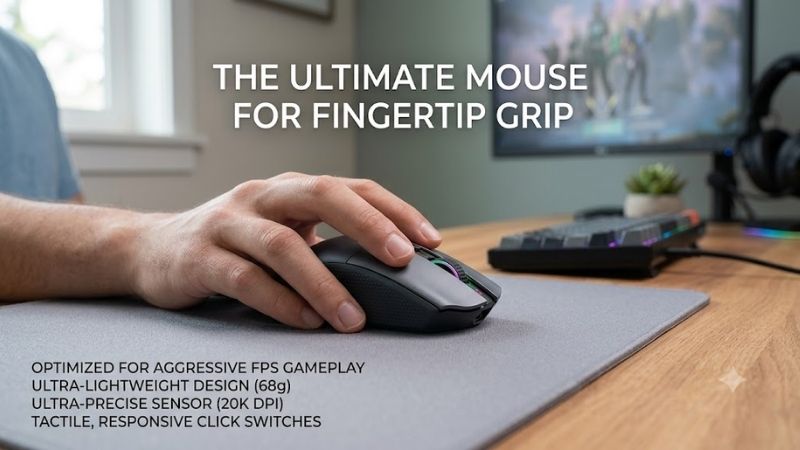
The best mouse for fingertip grip FPS play should feel light, compact, and easy to steer with the fingers instead of the palm. Shape matters more than headline DPI: a low hump, manageable width, crisp clicks, and stable tracking can make rapid corrections, flicks, and recoil control feel more natural during long competitive sessions.
Quick answer: For most people in 2026, the best mouse for fingertip grip fps is the Pulsar X2 V3 Mini — our #1 rated choice. See the full ranked comparison, alternatives and buying advice below.
Quick Comparison
| Mouse | Best For | Weight | Size | Polling | Key Trade-Off |
|---|---|---|---|---|---|
| Pulsar X2 V3 Mini | Compact fingertip control | 51 g ±1 g | 115.6 × 61 × 36.6 mm | Up to 8,000 Hz with compatible dongle | Small shell may feel cramped for large hands |
| Endgame Gear OP1 8k v2 | Narrow wired control | 49.5 g | 118.2 × 60.5 × 37.2 mm | Up to 8,000 Hz | Wired only |
| Razer Viper V3 Pro | Larger-hand fingertip wireless | 54 g black / 55 g white | 127.1 × 63.9 × 39.9 mm | Up to 8,000 Hz | Longer shell than mini models |
| Logitech G PRO X SUPERLIGHT 2 | Stable medium-size wireless shape | 60 g | 125 × 63.5 × 40 mm | Up to 8,000 Hz | Fuller shape for strict fingertip users |
How We Chose Mice for Fingertip Grip FPS
Fingertip grip leaves most of the palm off the shell, so the mouse must allow forward, backward, and side-to-side adjustments without forcing the hand into a fixed position. We favored lighter symmetrical shapes, lower humps, and dimensions that support finger-driven control, while noting that hand size still changes what feels compact or wide.
Sensor quality and polling rate matter, but they do not replace a suitable shape. Every mouse here uses a modern gaming sensor and supports up to 8,000 Hz polling in some form, yet higher polling raises system load and battery use. For most players, fit, weight balance, click feel, and reliable 1,000 Hz operation remain the practical priorities.
Pulsar X2 V3 Mini — Best for Compact Fingertip Grip
| Review Point | Details |
|---|---|
| Best For | Small-to-medium hands using pure fingertip or fingertip-claw hybrid grip |
| Key Features | 51 g ±1 g, 115.6 × 61 × 36.6 mm, XS-1 sensor, 32,000 DPI, 1,000 Hz standard polling, up to 8,000 Hz with the required dongle |
| What Makes It Different | Short, low symmetrical shell explicitly recommended by Pulsar for claw and fingertip grip |
| Use Case | Tactical shooters, arena FPS, and tracking-heavy play where finger-driven micro-adjustments matter |
| Who It’s For | Players who want a compact wireless mouse with minimal rear-shell interference |
| Verified Source | Pulsar Gaming Gears product specifications. |
The Pulsar X2 V3 Mini is the most directly fingertip-focused shape in this group. Its 115.6 mm length, 61 mm width, 36.6 mm height, and 51 g listed weight create a short, low shell that leaves room for finger movement. Pulsar itself recommends the shape for claw and fingertip grip, which closely matches the needs of fast FPS aiming.
Its XS-1 sensor is rated to 32,000 DPI, 750 IPS, and 50 g acceleration, while the standard receiver runs at 1,000 Hz. The mouse can reach up to 8,000 Hz with the required higher-rate dongle. That gives competitive players room to tune report rate, but the compact shape is the bigger reason to choose it over larger esports mice.
Pros
- Short 115.6 mm body gives fingertip users generous fore-aft adjustment room.
- Low 36.6 mm height helps reduce accidental palm contact.
- 51 g listed weight supports fast lift-offs and repeated corrections.
- Wireless design keeps cable drag out of wide low-sensitivity swipes.
- Supports higher polling when paired with the required compatible dongle.
Cons
- Mini dimensions may feel too small for large hands or relaxed grip styles.
- 8,000 Hz operation requires the higher-rate dongle rather than the standard receiver.
Endgame Gear OP1 8k v2 — Best Wired Fingertip Option
| Review Point | Details |
|---|---|
| Best For | Players who want a narrow, lightweight wired mouse for fast finger control |
| Key Features | 49.5 g, 118.2 × 60.5 × 37.2 mm, PixArt PAW3950 sensor, 1,000–8,000 Hz polling, Kailh GX mechanical switches |
| What Makes It Different | Compact dimensions, default 8,000 Hz mode, and user-changeable main switches without soldering |
| Use Case | Competitive FPS setups where charging is unwanted and cable management is already solved |
| Who It’s For | Fingertip and aggressive claw users who value a slim shell and wired consistency |
| Verified Source | Endgame Gear specifications and switch documentation. |
The Endgame Gear OP1 8k v2 combines a narrow chassis with a low 37.2 mm height and 118.2 mm length. At 49.5 g, it stays easy to lift and reposition, while its wired connection removes charging from the equation. The shape is useful when you want strong fingertip access without the broad rear support of larger wireless shells.
Endgame Gear equips the OP1 8k v2 with a PixArt PAW3950 sensor, 8,000 Hz polling by default, and Kailh GX mechanical main switches. Its main switches can also be changed without soldering. The trade-off is simple: you get a light, responsive wired platform with deep tuning potential, but a cable remains on the desk during low-sensitivity swipes.
Pros
- Very low 49.5 g listed weight.
- Compact 118.2 mm body gives the fingers room to steer.
- Supports 1,000, 2,000, 4,000, and 8,000 Hz polling.
- Main switches can be changed without soldering.
- No battery charging or wireless receiver management.
Cons
- The cable can introduce drag if routing is poor.
- Wired-only operation is less convenient for players who travel or prefer a clean desk.
Razer Viper V3 Pro — Best for Larger-Hand Fingertip Grip
| Review Point | Details |
|---|---|
| Best For | Medium-to-large hands that want fingertip freedom without moving to a mini shell |
| Key Features | 54 g black / 55 g white, 127.1 × 63.9 × 39.9 mm, Focus Pro 35K Optical Sensor Gen-2, up to 8,000 Hz wireless polling |
| What Makes It Different | Lightweight full-size esports shape with high-rate wireless and detailed lift-off controls |
| Use Case | Competitive shooters where a longer body feels steadier during wide tracking and flicks |
| Who It’s For | Fingertip users who find mini mice unstable, cramped, or too narrow |
| Verified Source | Razer technical specifications. |
The Razer Viper V3 Pro is longer than the compact picks, yet its 54 g black-model weight and symmetrical right-handed shape keep it agile. At 127.1 mm long and 39.9 mm high, it suits fingertip users who prefer more shell under the fingers or have larger hands. The extra length can feel less free than a mini mouse for smaller hands.
Razer lists a Focus Pro 35K Optical Sensor Gen-2, up to 8,000 Hz wireless polling, optical Gen-3 switches, and up to 95 hours of battery life at 1,000 Hz. Battery life falls as polling rises, reaching a listed 17 hours at 8,000 Hz. That makes 1,000 or 2,000 Hz more sensible for players who value longer wireless sessions.
Pros
- Very low weight for a longer esports shell.
- Up to 8,000 Hz wireless polling through the HyperPolling system.
- 35,000 DPI Focus Pro Optical Sensor Gen-2.
- Optical Gen-3 main switches.
- Up to 95 hours of listed battery life at 1,000 Hz.
Cons
- Longer shell may reduce finger-only movement for smaller hands.
- Battery life drops substantially at the highest polling settings.
Logitech G PRO X SUPERLIGHT 2 — Best Stable Wireless Shape
| Review Point | Details |
|---|---|
| Best For | Medium-to-large hands wanting a familiar medium-size wireless shell |
| Key Features | 60 g, 125 × 63.5 × 40 mm, HERO 2 sensor, up to 44,000 DPI, up to 8,000 Hz report rate, LIGHTSPEED wireless |
| What Makes It Different | A balanced, conventional symmetrical shell rather than an aggressively short fingertip shape |
| Use Case | FPS players who mix fingertip with relaxed claw and want extra shell stability |
| Who It’s For | Users who prefer a fuller grip platform but still want low weight and high-rate wireless |
| Verified Source | Logitech G official specifications. |
The Logitech G PRO X SUPERLIGHT 2 uses a familiar 125 mm symmetrical shell with a 63.5 mm width, 40 mm height, and 60 g listed weight. It is not as compact as the X2 V3 Mini or OP1 8k v2, so pure fingertip users with smaller hands may find it fuller. Medium or larger hands can gain a steadier platform without moving to a heavy mouse.
Logitech lists the HERO 2 sensor at up to 44,000 DPI, LIGHTSPEED wireless, LIGHTFORCE hybrid switches, and up to 8,000 Hz report rate. Battery life is rated at 95 hours of constant motion. Its appeal is balance rather than extreme mini sizing: low weight, broad software support, and a shape many competitive players can adapt to.
Pros
- 60 g listed weight remains light for competitive FPS play.
- Up to 8,000 Hz report rate.
- HERO 2 sensor with zero smoothing, acceleration, or filtering listed by Logitech.
- LIGHTSPEED wireless and USB-C charging.
- 95-hour listed constant-motion battery life.
Cons
- 125 mm body is less compact than mini fingertip-focused shapes.
- 40 mm height can create more palm contact for strict fingertip users.
Buying Guide: What Matters for Fingertip Grip FPS
Shape, Length, and Hump Height
For fingertip grip, shell length and hump position usually matter more than maximum DPI. A shorter body gives the fingers more space to pull the mouse backward, while a lower hump reduces unwanted palm contact. Narrower sides can improve pinch control, but an overly narrow shell may increase finger tension for players with wider hands.
Weight and Balance
Low weight helps because fingertip users move the mouse mainly through the fingers and wrist instead of anchoring the whole hand. A lighter shell reduces the force needed for repeated micro-corrections and lift-offs. Still, chasing the lowest number can backfire if the shape feels unstable, so weight should support control rather than replace it.
Polling Rate
Polling rate describes how often the mouse reports movement to the PC. At 1,000 Hz the theoretical report interval is 1 ms, while 8,000 Hz lowers it to 0.125 ms. Higher rates can improve temporal granularity on fast systems and high-refresh displays, but they also consume more CPU resources and, on wireless mice, more battery power.
Wired vs Wireless
Wireless removes cable drag and gives low-sensitivity FPS players a cleaner sweep across the pad. Modern esports wireless mice are built for competitive use, but they need charging and may lose battery faster at high polling rates. Wired models avoid battery management, though cable routing and a mouse bungee can affect how free they feel.
Main Clicks and Side Buttons
Main-button feel matters in FPS because firing and burst control depend on repeatable actuation. Optical switches avoid traditional mechanical contact bounce, while mechanical designs can offer a different tactile response. Side buttons should be reachable without shifting your fingertip grip, especially for melee, push-to-talk, or utility.
Sensor Performance
Do not choose a mouse only because its maximum DPI number is higher. Competitive FPS play often uses far lower sensitivity, so consistent tracking, sensible lift-off behavior, stable wireless performance, and usable software matter more than the top figure. A good sensor should fade into the background instead of becoming the focus.
FAQ
Is a small mouse better for fingertip grip in FPS games?
A small mouse is often easier for fingertip grip because it leaves more room between the palm and shell, letting the fingers move the mouse in several directions. It is not automatically better, however. Large hands may prefer a medium shell for stability, while very small mice can force a tight pinch that becomes tiring during long FPS sessions.
What mouse weight is best for fingertip grip?
For fingertip grip in FPS games, a useful target is a mouse light enough to move and lift without effort, but there is no universal ideal number. The models here range from about 49.5 g to 60 g. Shape and balance matter as much as raw mass, because a slightly heavier mouse that fits the fingers can feel easier to control than a lighter poor fit.
Do I need 8,000 Hz polling for competitive FPS?
No. An 8,000 Hz mouse can report more frequently than a 1,000 Hz mouse, but the benefit depends on the game, CPU, display refresh rate, frame rate, and wireless battery trade-offs. A well-shaped 1,000 Hz mouse remains competitive. Treat 4,000 or 8,000 Hz as an optional performance setting, not a requirement for accurate fingertip aiming.
Is a low hump better for fingertip grip?
A low or modest rear hump is usually easier for pure fingertip grip because it reduces palm contact and preserves room for finger-driven adjustments. A higher hump can add stability for relaxed claw or hybrid grips, but it may limit backward movement in a strict fingertip style. The best shape still depends on hand length, width, and palm contact.
Is wireless better than wired for fingertip FPS aiming?
Wireless is convenient for FPS because there is no cable to pull during large swipes, and current esports models support high polling rates. Wired still makes sense if you want zero charging and a simpler setup. For fingertip grip, the key question is whether the cable or battery system changes how freely the mouse moves across your pad.
Conclusion
The best mouse for fingertip grip FPS play depends on hand size and how much shell contact you want. The Pulsar X2 V3 Mini favors compact finger control, the OP1 8k v2 offers a narrow wired option, while the Viper V3 Pro and PRO X SUPERLIGHT 2 suit players who prefer a larger wireless shape. Prioritize fit before polling rate.
Ready to decide? Our #1 pick for 2026 is the Pulsar X2 V3 Mini.
Live price & availability on Amazon.