🛒 Best Price Today on Amazon
Prime members get fast, free shipping on everything above, plus member-only deals. New members get a 30-day free trial — cancel anytime.
A 512GB NVMe SSD is a practical upgrade for laptops and desktop PCs that need faster boot times, shorter application loading, quieter operation, and enough capacity for Windows plus a focused collection of software or games. The best drive depends on PCIe generation, NAND quality, controller behavior, thermal performance, endurance, and whether value or sustained speed matters most.
Quick answer: For most people in 2026, the best 512gb nvme ssd is the SSD — our #1 rated choice. See the full ranked comparison, alternatives and buying advice below.
Best 512GB NVMe SSDs at a Glance
| SSD | Best For | PCIe Class | Main Strength |
|---|---|---|---|
| Samsung 980 | Overall reliability | PCIe 3.0 | Balanced performance |
| WD Blue SN580 | Everyday PCIe 4.0 use | PCIe 4.0 | Strong efficiency |
| Crucial P3 Plus | Budget PCIe 4.0 | PCIe 4.0 | Good everyday value |
| Kingston NV2 | Low-cost upgrades | PCIe 4.0 | Affordable entry point |
| ADATA LEGEND 710 | Laptop upgrades | PCIe 3.0 | Low-power design |
| Silicon Power P34A60 | Budget older systems | PCIe 3.0 | Simple low-cost upgrade |
Samsung 980
Best For: Overall reliability
The Samsung 980 remains a strong option for users who want a straightforward NVMe SSD from an established storage brand. It uses a PCIe 3.0 interface, which means it does not chase the headline speeds of newer PCIe 4.0 drives, but its real-world responsiveness remains more than adequate for Windows, applications, gaming, and normal productivity.
For everyday computing, the difference between a good PCIe 3.0 NVMe SSD and a faster PCIe 4.0 model is often smaller than benchmark charts suggest. Operating-system startup, browser launches, game loading, and office software depend on more than peak sequential speed alone.
The Samsung 980 also works well in older laptops and desktops that do not support PCIe 4.0. Installing a newer high-end drive in those systems would simply force the SSD to run at the platform’s slower interface speed anyway.
A 500GB- or 512GB-class model is best treated as a system drive for users with moderate storage requirements. Windows, productivity applications, and several games can fit comfortably, but users with large AAA libraries may outgrow the capacity quickly.
Key Features
- M.2 2280 form factor
- PCIe 3.0 NVMe interface
- Suitable for laptops and desktops
- Good everyday responsiveness
- No moving parts
- Efficient operation
- Compatible with many older systems
- Suitable as a Windows boot drive
What Makes It Different
The Samsung 980 prioritizes predictable mainstream performance rather than maximum benchmark speed. It is particularly useful for systems where PCIe 4.0 would provide little practical advantage.
Pros
- Reliable everyday performance
- Good software responsiveness
- Works well in older PCIe systems
- Suitable for laptops
- Strong brand ecosystem
- Good boot-drive option
Cons
- Slower than modern high-end PCIe 4.0 drives
- Capacity can feel limited for large game libraries
- Premium branding may increase price
Use Case: Windows installation, office work, school, light gaming, and laptop upgrades.
Who It’s For: Users who want a dependable general-purpose NVMe SSD without paying for extreme sequential performance.
WD Blue SN580
Best For: Everyday PCIe 4.0 performance
The WD Blue SN580 is a strong choice for users upgrading a modern laptop or desktop with PCIe 4.0 support. It focuses on mainstream efficiency and responsiveness rather than enthusiast-level performance, making it well suited to home PCs, school systems, office computers, and moderate gaming builds.
PCIe 4.0 provides additional bandwidth compared with PCIe 3.0, although everyday applications rarely use the full theoretical interface capability. The real benefit comes from having a modern drive architecture that can handle file transfers, installations, application launches, and game loading smoothly.
The SN580 is also attractive for laptops because power efficiency and heat matter in confined spaces. Very high-end SSDs can run hotter under sustained workloads and may require more cooling, whereas mainstream drives are often easier to manage thermally.
For users choosing between 500GB and 1TB, capacity should be considered carefully. A 512GB-class drive is enough for Windows and normal applications, but gaming users may prefer a larger model if they install several modern titles at once.
Key Features
- PCIe 4.0 NVMe interface
- M.2 2280 format
- Mainstream performance
- Efficient operation
- Suitable for notebooks
- Good Windows responsiveness
- Fast application loading
- Compatible with PCIe 3.0 systems at reduced speed
What Makes It Different
The SN580 offers a sensible middle ground between inexpensive entry-level drives and expensive high-performance SSDs. It gives modern platforms PCIe 4.0 capability without unnecessary heat or cost.
Pros
- Strong everyday speed
- PCIe 4.0 support
- Good laptop fit
- Efficient operation
- Suitable for gaming
- Balanced price-to-performance
Cons
- Not a top-tier workstation SSD
- Limited capacity for large libraries
- Peak speed matters less in older systems
Use Case: Modern laptops, gaming PCs, office systems, Windows upgrades, and general storage.
Who It’s For: Users who want a modern PCIe 4.0 drive without paying for flagship performance.
Crucial P3 Plus
Best For: Budget PCIe 4.0 upgrades
The Crucial P3 Plus is designed for users who want PCIe 4.0 compatibility at an affordable price. It can provide a noticeable upgrade over SATA SSDs and mechanical hard drives while keeping overall system cost under control.
This type of SSD is particularly attractive when upgrading a budget gaming PC or mainstream laptop. Boot times, application launches, software installations, and general file handling all benefit from NVMe storage, even if the drive is not designed for the heaviest professional workloads.
The P3 Plus is best suited to read-heavy and everyday usage. Users regularly writing very large files for hours at a time may prefer a more endurance-focused SSD with higher sustained write performance.
Gaming is a good fit because game loading is predominantly read-oriented. Once a game is installed, the SSD spends much of its time retrieving data rather than performing constant heavy writes.
Key Features
- PCIe 4.0 NVMe
- M.2 2280
- Budget-oriented design
- Suitable for laptops and desktops
- Fast boot performance
- Good application loading
- Silent operation
- Backward compatibility with older PCIe systems
What Makes It Different
The P3 Plus targets users who want the responsiveness of a PCIe 4.0 NVMe drive without paying for enthusiast hardware.
Pros
- Affordable PCIe 4.0 option
- Good for Windows
- Strong gaming-use fit
- Quiet
- Low physical footprint
- Easy desktop or laptop upgrade
Cons
- Not ideal for sustained heavy writes
- Small-capacity versions fill quickly
- Performance can decline during very large transfers
Use Case: Budget gaming PCs, home desktops, laptops, secondary systems, and Windows boot drives.
Who It’s For: Value-focused users who want modern NVMe storage for everyday use.
Kingston NV2
Best For: Low-cost PC upgrades
The Kingston NV2 is positioned as an affordable entry-level NVMe SSD for systems that need more speed than SATA storage without requiring premium performance.
This makes it a logical choice for older PCs being refreshed or budget desktops where the storage drive should not consume a large portion of the build budget.
For normal computing, even an entry-level NVMe SSD can feel dramatically faster than a mechanical hard drive. Windows updates, startup, application installation, and file browsing become more responsive because solid-state storage eliminates mechanical seek delay.
The NV2 supports PCIe 4.0 connectivity, but users should not buy it expecting flagship PCIe 4.0 performance. It is better evaluated as a low-cost NVMe drive that takes advantage of the modern interface rather than as a high-end benchmark product.
Another consideration is component variation. Budget SSD families may use different internal components across production runs. This does not automatically make them unsuitable, but buyers should treat the product as an entry-level drive rather than expecting workstation consistency.
Key Features
- PCIe 4.0 NVMe interface
- M.2 2280 design
- Budget-focused pricing
- Compact form factor
- Suitable for laptops
- Faster than mechanical storage
- Good for Windows installation
- Low cable clutter
What Makes It Different
The NV2 focuses primarily on affordability. It allows users to add NVMe storage to a modern PC without spending heavily on performance they may never use.
Pros
- Low purchase cost
- PCIe 4.0 compatibility
- Easy installation
- Good for basic systems
- Quiet operation
- Suitable as a boot drive
Cons
- Not intended for heavy professional writes
- Internal components may vary
- Lower sustained performance than premium SSDs
Use Case: Budget desktops, office PCs, student systems, secondary computers, and affordable laptop upgrades.
Who It’s For: Buyers who prioritize low cost over maximum benchmark consistency.
ADATA LEGEND 710
Best For: Laptop upgrades
The ADATA LEGEND 710 is a PCIe 3.0 NVMe SSD aimed at mainstream computing. It makes sense in notebooks and desktop systems that either lack PCIe 4.0 support or do not need the additional bandwidth of a newer high-end drive.
A PCIe 3.0 SSD remains more than fast enough for many everyday workloads. Browser applications, Windows, documents, media playback, and light gaming rarely require the sequential speed provided by expensive enthusiast drives.
Laptop users should pay particular attention to thermals and power consumption. Small notebooks do not always provide substantial SSD cooling, so a moderate-performance drive can be more appropriate than a very fast model that produces more heat during sustained transfers.
The 512GB capacity tier also works well for productivity laptops because many office users store much of their large data in cloud services or external storage rather than on the internal SSD.
Key Features
- PCIe 3.0 NVMe
- M.2 2280 format
- Mainstream performance
- Compact construction
- Suitable for notebook upgrades
- Efficient operation
- Fast boot behavior
- No cables required
What Makes It Different
The LEGEND 710 is aimed at practical upgrades rather than benchmark competition. It is particularly relevant to laptops that cannot fully use PCIe 4.0 speeds.
Pros
- Good laptop compatibility
- Fast compared with SATA storage
- Efficient
- Compact
- Suitable for everyday productivity
- Practical for older systems
Cons
- PCIe 3.0 limits peak throughput
- Not designed for heavy workstation use
- 512GB may be restrictive for gaming
Use Case: Laptop upgrades, office systems, school computers, and general home PCs.
Who It’s For: Users upgrading an older machine where PCIe 4.0 would provide little benefit.
Silicon Power P34A60
Best For: Budget older systems
The Silicon Power P34A60 is another affordable PCIe 3.0 option that can make a large difference when replacing a hard drive or SATA SSD in a compatible computer.
It is especially useful for users revitalizing an older desktop or laptop. Systems that already support an M.2 NVMe slot can gain much faster storage access without replacing the motherboard or other major components.
For normal workloads, the drive is suitable for Windows, productivity applications, browsing, and moderate gaming. Its purpose is straightforward responsiveness rather than sustained professional write performance.
A low-cost 512GB NVMe SSD can also work as a secondary application drive. Users with a larger primary SSD may install frequently used programs or selected games on the P34A60 while keeping bulk storage elsewhere.
Key Features
- PCIe 3.0 NVMe
- M.2 2280
- Entry-level pricing
- Compatible with many older platforms
- Suitable for boot storage
- Silent operation
- Lightweight design
- No power or data cables
What Makes It Different
The P34A60 provides a simple way to add NVMe storage to older systems without overspending on interface speed the platform cannot use.
Pros
- Affordable
- Good for older PCs
- Faster than SATA in many workloads
- Simple installation
- Works as primary or secondary storage
- Compact form factor
Cons
- Slower than PCIe 4.0 drives
- Limited sustained-write capability
- Small capacity for modern game libraries
Use Case: Older desktop upgrades, laptops, budget gaming builds, and secondary storage.
Who It’s For: Users who want inexpensive NVMe performance from an existing PCIe 3.0 platform.
How to Choose a 512GB NVMe SSD
Check Whether Your PC Supports NVMe
An M.2 slot does not automatically support every M.2 SSD.
Some systems support SATA M.2 drives, some support NVMe, and others support both. Before buying, check the motherboard or laptop documentation to confirm NVMe compatibility.
The physical length also matters. M.2 2280 is common, but some compact devices require shorter formats.
PCIe 3.0 vs PCIe 4.0
PCIe 4.0 provides much greater theoretical bandwidth than PCIe 3.0.
However, normal Windows use does not become twice as fast simply because the benchmark number doubles.
For office work, browsing, and ordinary gaming, a good PCIe 3.0 SSD still feels fast.
PCIe 4.0 becomes more useful for large file transfers, advanced workloads, newer systems, and users buying storage they expect to keep for several years.
Consider NAND Type
SSDs can use different NAND flash technologies.
TLC NAND is often preferred for stronger endurance and sustained performance.
QLC NAND can provide lower cost per gigabyte but may slow more substantially during large sustained writes after its fast cache is exhausted.
For general home use, either can work well.
Heavy content creators should pay more attention to sustained performance and endurance.
Understand DRAM and DRAM-Less SSDs
Some SSDs include dedicated DRAM cache, while others use DRAM-less designs.
Modern DRAM-less NVMe drives can still provide excellent everyday performance, particularly when they use Host Memory Buffer technology to access a small amount of system memory.
A DRAM-equipped SSD is more important for certain sustained or professional workloads than for basic gaming and office use.
Check Endurance
SSD endurance is commonly expressed through a total-bytes-written rating.
Most normal users do not write enough data every day to exhaust a modern SSD quickly.
However, video editors, content creators, database users, and professionals handling large datasets should consider endurance more carefully.
Higher endurance can be more valuable than a small increase in peak speed.
Consider Thermal Performance
NVMe SSDs can become warm during large transfers.
High-performance PCIe 4.0 drives may benefit from a motherboard heatsink, especially in desktop systems.
Mainstream SSDs usually produce less heat and are easier to use in laptops.
Thermal throttling occurs when the controller reduces performance to prevent excessive temperature, so airflow still matters during heavy sustained workloads.
Is 512GB Enough for Gaming?
A 512GB SSD is enough for Windows, normal applications, and several games.
The challenge is that modern AAA games can consume more than 100GB each. A few large titles can therefore fill the drive quickly.
Competitive games and smaller titles are easier to manage.
Gamers who keep a large library installed simultaneously should consider 1TB or 2TB instead.
For a budget gaming PC, 512GB can still be an excellent starting point because storage can often be expanded later.
Is 512GB Enough for a Laptop?
For many students and office users, yes.
A laptop used for documents, browsing, cloud storage, video calls, and light media can operate comfortably with 512GB.
Photographers, video editors, and users maintaining large local media collections may need more capacity.
Always remember that the full advertised capacity is not available after formatting and the operating system consumes part of the remaining space.
NVMe SSD vs SATA SSD
Both use flash storage and are much faster than mechanical hard drives.
SATA SSDs are limited by the older SATA interface.
NVMe drives communicate through PCIe and can provide substantially higher throughput and lower protocol overhead.
For a new computer with an available NVMe slot, an NVMe SSD is usually the better choice unless a SATA drive is significantly cheaper or additional M.2 slots are unavailable.
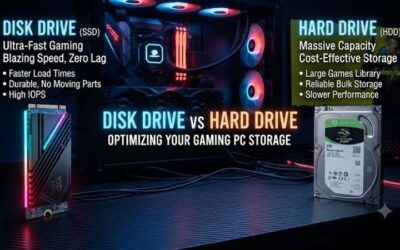
NVMe SSD vs Hard Drive
The difference is dramatic.
A mechanical hard drive uses spinning platters and a moving read/write head. This creates noticeable access delay, noise, vibration, and slow application launches.
An NVMe SSD contains no moving parts.
Windows boots faster, applications open more quickly, and updates complete more smoothly.
Hard drives still offer lower cost per terabyte, making them useful for large archives, but NVMe is preferable for the operating system and frequently used software.
Should You Buy 512GB or 1TB?
Choose 512GB when:
- Budget is limited
- The PC is used mainly for work
- Most files are stored in the cloud
- Only a few games are installed
- Additional storage can be added later
Choose 1TB when:
- You play many modern games
- You store photos and videos locally
- The laptop has only one SSD slot
- You want more long-term flexibility
The price difference between 512GB and 1TB should always be considered because larger-capacity SSDs often provide better value per gigabyte.
FAQ
Is a 512GB NVMe SSD Good for Gaming?
Yes. It provides fast game loading and enough space for Windows plus several titles. Users with large AAA libraries may prefer 1TB or more because modern games can consume substantial storage.
Is NVMe Faster Than SATA?
Yes. NVMe uses PCIe rather than the SATA interface and can provide much higher sequential throughput. Everyday differences are smaller than benchmark numbers suggest, but NVMe is still the better choice for most new systems.
Is PCIe 4.0 Worth It?
It is worthwhile for modern PCs, large file transfers, and users who want additional performance headroom. Basic office users may notice little difference between a good PCIe 3.0 and PCIe 4.0 SSD during normal tasks.
Does an NVMe SSD Need a Heatsink?
Not always. Mainstream drives usually work without one. High-performance PCIe 4.0 models can benefit from a motherboard heatsink during sustained transfers.
Is 512GB Enough for Windows 11?
Yes. Windows 11 and ordinary applications fit comfortably on a 512GB SSD. The amount of remaining space depends on games, media files, and other installed software.
Can I Install an NVMe SSD in Any Laptop?
No. The laptop must have a compatible M.2 slot with NVMe support and enough physical space for the drive length. Check the service manual before purchasing.
Conclusion
The best 512GB NVMe SSD depends on system age and workload. Samsung 980 offers dependable PCIe 3.0 performance, WD Blue SN580 is a strong modern PCIe 4.0 choice, Crucial P3 Plus and Kingston NV2 suit budget builds, while ADATA LEGEND 710 and Silicon Power P34A60 provide practical upgrades for older laptops and desktops.
Ready to decide? Our #1 pick for 2026 is the SSD.
Live price & availability on Amazon.