🛒 Best Price Today on Amazon
Prime members get fast, free shipping on everything above, plus member-only deals. New members get a 30-day free trial — cancel anytime.
- DDR vs SSD at a Glance
- What Is DDR Memory?
- What Is an SSD?
- Main Difference Between DDR and SSD
- Speed Difference
- Volatile vs Non-Volatile Memory
- Capacity Differences
- DDR vs SSD for Gaming
- DDR vs SSD for Boot Time
- DDR vs SSD for Multitasking
- DDR Generations
- SSD Types
- Which Upgrade Should You Choose First?
- Cost Differences
- Can SSD Be Used as RAM?
- Can DDR Store Files Permanently?
- FAQ
- Conclusion
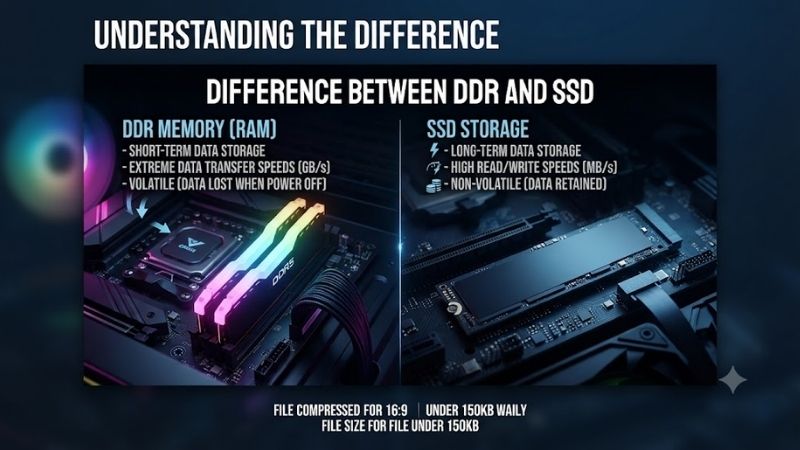
The difference between DDR and SSD is that DDR memory is temporary working memory used by the CPU, while an SSD is permanent storage used for Windows, games, applications, and files. DDR is much faster but loses data when power is removed, whereas an SSD keeps data and offers far more capacity.
DDR vs SSD at a Glance
| Feature | DDR Memory | SSD |
|---|---|---|
| Main Purpose | Temporary working memory | Permanent data storage |
| Keeps Data Without Power | No | Yes |
| Typical Capacity | 8GB–64GB or more | 500GB–4TB or more |
| Speed | Extremely high | Lower than DDR, much faster than HDD |
| CPU Access | Directly used as system memory | Accessed as storage |
| Main Benefit | Multitasking and active workloads | Fast booting and loading |
| Upgrade Effect | Reduces memory bottlenecks | Improves storage responsiveness |
| Cost per GB | Higher | Lower |
What Is DDR Memory?
DDR stands for Double Data Rate and refers to a family of synchronous dynamic random-access memory used as system RAM. Modern desktop computers commonly use generations such as DDR4 and DDR5. The memory modules are installed directly into motherboard DIMM slots and provide fast temporary storage for actively used data.
When you launch a game, browser, editing application, or operating-system process, relevant data is loaded into RAM so the processor can access it quickly. The more active software you run, the more memory the system may require. Insufficient RAM can force Windows to use slower storage as virtual memory.
DDR is volatile memory, meaning its contents disappear when the computer loses power. This is intentional because RAM is designed for fast temporary access rather than permanent file retention. Applications therefore save important data to an SSD or another storage device before the computer shuts down.
What Is an SSD?
An SSD, or solid-state drive, is a non-volatile storage device that uses flash memory to keep files even when the computer is powered off. It can hold the operating system, applications, games, photos, videos, documents, and other data just like a traditional hard disk but with much faster access.
SSDs are available in several forms. SATA SSDs commonly use 2.5-inch drives and are limited by the SATA interface, while NVMe SSDs connect through PCIe and can deliver substantially higher bandwidth. Modern gaming PCs usually use M.2 NVMe drives for the operating system and frequently played games.
An SSD does not replace system RAM because the two devices solve different problems. Even a very fast PCIe NVMe drive has much higher latency than DDR memory. The operating system therefore loads active data from the SSD into RAM rather than asking the processor to work directly from storage continuously.
Main Difference Between DDR and SSD
The core difference is function. DDR memory is a high-speed workspace that temporarily holds data the processor needs right now. An SSD is long-term storage that keeps software and files available between sessions. Both improve computer performance, but they affect different parts of the system.
Think of DDR as a work desk and the SSD as a filing cabinet. A larger desk allows more active documents to remain open and accessible at once, while a larger filing cabinet stores more documents permanently. A fast filing cabinet does not remove the need for desk space, and a huge desk does not provide permanent storage.
This is why upgrading one component cannot always compensate for a weakness in the other. A computer with plenty of RAM but a slow storage drive can still boot and load applications slowly. A system with a fast SSD but too little RAM can still stutter when memory-intensive programs exhaust available system memory.
Speed Difference
DDR memory operates at much higher effective bandwidth and lower latency than consumer SSD storage. Modern RAM can move tens of gigabytes per second with latency measured in nanoseconds, while even fast NVMe SSDs operate with much higher access latency and are optimized for persistent storage rather than direct CPU working memory.
SSD performance is still extremely fast compared with mechanical hard drives. SATA models can reach roughly 500MB/s in sequential transfers, while PCIe 4.0 and PCIe 5.0 NVMe drives can reach several gigabytes per second. These speeds improve booting, installations, loading, and large file transfers.
The performance numbers should not be compared as if DDR and SSD compete directly. DDR is connected through the memory controller and participates continuously in processor workloads. SSDs communicate through storage interfaces and serve as a source from which data is loaded into memory when required.
Volatile vs Non-Volatile Memory
DDR is volatile. If the computer loses power, every active application state stored only in RAM disappears. That is why unsaved documents can be lost during a crash or power outage. RAM clears itself because retaining information after shutdown is not its primary purpose.
An SSD is non-volatile. Files written to the drive remain available after shutdown, restart, or disconnection from power. This makes it suitable for operating systems, saved games, applications, photos, and backups. Flash cells preserve information until the data is intentionally changed or erased.
The distinction explains why both devices are necessary in a normal PC. You need permanent storage to keep software and files between sessions, and you need fast temporary memory to let the CPU work efficiently while those applications are running.
Capacity Differences
RAM capacity is usually measured in gigabytes, with mainstream gaming systems commonly using 16GB or 32GB. Workstations and high-end systems may use 64GB, 128GB, or more depending on software requirements. Adding unnecessary memory beyond what workloads use usually provides little additional performance.
SSD capacity is much larger because permanent storage requirements are greater. A gaming PC may use a 1TB, 2TB, or 4TB SSD to store Windows and several large games. Content creators and media users may need even more storage, particularly when working with video or large project files.
The correct capacities should therefore be selected independently. A PC can have 32GB of DDR5 RAM and a 2TB NVMe SSD because these capacities reflect different needs. Comparing 32GB of RAM with 2TB of storage does not indicate one component is better than the other.
DDR vs SSD for Gaming
DDR affects gaming when a game and its background processes need more active memory than the system provides. Insufficient RAM can cause stuttering, increased disk activity, slow multitasking, or application closures. Faster memory can also affect CPU performance in some games, depending on the platform and workload.
An SSD mainly improves game installation, loading screens, level transitions, asset streaming, updates, and general responsiveness. It usually has little effect on average frame rate because the CPU and GPU perform most rendering work. However, some modern games can show fewer storage-related stalls when installed on an SSD.
For most gaming PCs, both components matter. A balanced system should have enough RAM to prevent memory pressure and enough SSD capacity to hold Windows and frequently played games. Spending excessively on one while neglecting the other can create a noticeably unbalanced experience.
DDR vs SSD for Boot Time
SSD performance has a much larger effect on boot time. Windows files are stored on the drive, so faster storage allows them to be read and processed more quickly during startup. Moving from a mechanical HDD to an SSD can dramatically reduce boot time and improve the speed at which applications become usable.
Adding RAM does not normally improve boot time unless the system was severely memory-constrained. The operating system does not need huge amounts of active memory simply to begin loading. Once Windows is running, however, adequate RAM helps maintain smooth multitasking and reduces reliance on virtual memory.
If a computer takes a long time to boot from an HDD but already has sufficient RAM, upgrading the storage should be the priority. If it boots quickly from an SSD but becomes sluggish with many applications open, insufficient RAM may be the more likely problem.
DDR vs SSD for Multitasking
RAM has the larger impact on multitasking because active applications consume system memory. Keeping a browser with many tabs, a game, Discord, streaming software, and editing tools open simultaneously can require significant capacity. Once RAM fills, the operating system must move less-active data to storage.
This process is called paging or swapping. Even a fast SSD is much slower than DDR memory, so heavy use of virtual memory can make the computer feel sluggish. Increasing RAM reduces the need for this behavior and allows more active software to remain available at full memory speed.
An SSD still helps because the page file is faster on solid-state storage than on a mechanical hard drive. However, storage speed is not a substitute for having enough physical memory. A system that constantly swaps data because RAM is exhausted will remain slower than one with adequate DDR capacity.
DDR Generations
DDR memory comes in generations such as DDR3, DDR4, and DDR5. Each generation uses different electrical standards and physical keying, so modules are not interchangeable. A motherboard designed for DDR4 cannot accept DDR5 memory even if the DIMM slots appear visually similar.
DDR5 provides higher bandwidth and other architectural changes compared with DDR4, but real-world performance depends on processor architecture, memory speed, latency, application behavior, and workload. Simply having a newer DDR generation does not automatically make every program dramatically faster.
When upgrading RAM, motherboard and CPU compatibility must come first. You cannot convert a DDR4 system into DDR5 by replacing only the memory. A platform upgrade involving the motherboard and often the processor is required when moving between incompatible memory generations.
SSD Types
SATA and NVMe are the two main SSD categories encountered in gaming PCs. SATA SSDs use the older SATA interface and usually peak around the practical limits of SATA 6 Gb/s. They remain useful for older computers, secondary storage, and systems without available PCIe M.2 slots.
NVMe SSDs communicate over PCIe and provide much greater bandwidth. PCIe 3.0, 4.0, and 5.0 drives offer progressively higher theoretical throughput, although real application performance does not increase in direct proportion to benchmark numbers.
Compatibility still matters. An M.2 slot can support different protocols depending on the motherboard, and not every slot accepts every M.2 device. Users should verify whether a slot supports SATA M.2, NVMe PCIe, or both before buying a replacement drive.
Which Upgrade Should You Choose First?
Upgrade the SSD first if the computer still uses a mechanical hard drive. Moving Windows and applications to solid-state storage usually produces one of the largest improvements in everyday responsiveness because startup, file access, program launches, updates, and game loading all become faster.
Upgrade RAM first if the computer already has a good SSD but frequently reaches its memory limit. Signs include heavy swapping, stuttering while multitasking, browser tabs constantly reloading, memory warnings, or major slowdowns when several applications run together.
For gaming, 16GB of RAM remains adequate for many systems, while 32GB provides more breathing room for newer games, heavy multitasking, modding, streaming, and background applications. Storage capacity should then be selected according to the size of your game library and other files.
Cost Differences
DDR memory typically costs more per gigabyte than SSD storage because it is designed for much faster direct access by the processor. Buying 32GB of RAM can cost as much as hundreds or thousands of gigabytes of SSD storage depending on generation, speed, brand, and market conditions.
Cost per gigabyte is therefore not a useful way to judge value between the two technologies. RAM capacity should be purchased according to workload requirements, while SSD capacity should be selected according to how much permanent data you need to store and how fast you want that storage to perform.
Spending more on premium memory timings while using a nearly full, slow storage drive may be a poor allocation of budget. Likewise, installing a huge high-end SSD does not solve severe RAM limitations. Balanced component selection typically produces the best overall experience.
Can SSD Be Used as RAM?
An SSD can participate in virtual memory, but it cannot truly replace DDR RAM. Windows can reserve part of the storage drive as a page file and move inactive memory pages there when physical RAM becomes full, allowing programs to continue operating instead of immediately running out of memory.
The disadvantage is speed. Even a premium NVMe SSD has much higher access latency than DDR and cannot deliver the same behavior as physical system memory. Heavy paging therefore causes noticeable performance loss, particularly when applications repeatedly move data between RAM and storage.
Virtual memory should be treated as a safety mechanism rather than a substitute for adequate RAM. If a computer repeatedly relies heavily on the page file during normal use, increasing physical memory is usually a better solution than purchasing an even faster SSD.
Can DDR Store Files Permanently?
DDR memory cannot serve as conventional permanent storage because its data disappears when power is removed. Specialized systems can create RAM disks that temporarily behave like extremely fast storage volumes, but their contents must be saved elsewhere before shutdown if the data needs to survive.
RAM disks can be useful for specific temporary workloads, testing, caches, or scratch files, but they consume valuable system memory. For normal users, keeping applications in DDR while storing permanent data on an SSD provides a much more practical balance of performance and reliability.
This separation of responsibilities is fundamental to computer design. RAM prioritizes speed and immediate processor access, while SSD technology prioritizes non-volatile storage capacity and persistence. Neither component is designed to completely replace the other.
FAQ
Is DDR faster than SSD?
Yes. DDR memory is significantly faster and has much lower latency than an SSD because it is designed as working memory directly used by the processor. SSDs are much faster than mechanical hard drives but remain storage devices, so even premium NVMe models cannot match the access characteristics of system RAM.
Is SSD the same as RAM?
No. An SSD stores files permanently, while RAM temporarily stores active data being used by the CPU. Turning the computer off clears RAM but does not erase SSD files. Both use electronic memory technologies, but their architecture, interfaces, performance, purpose, and capacity are very different.
Does more RAM make an SSD faster?
Adding RAM does not directly increase the SSD’s rated read or write speed. However, more memory can reduce paging and allow the operating system to cache more frequently used data, improving overall responsiveness. The physical performance of the SSD itself remains determined by its controller, flash, and interface.
Which is more important for gaming, DDR or SSD?
Both are important for different reasons. Enough DDR memory prevents active games and applications from running out of working space, while an SSD improves loading and asset access. If you already have adequate RAM but still use an HDD, an SSD is usually the more noticeable upgrade for everyday responsiveness.
Can I upgrade DDR and SSD separately?
Yes. RAM and SSD upgrades are normally independent, provided the motherboard supports the parts you choose. RAM must match the supported DDR generation and module specifications, while the SSD must match an available SATA or compatible M.2 interface. Check system specifications before purchasing either component.
Conclusion
The difference between DDR and SSD comes down to temporary memory versus permanent storage. DDR provides the ultra-fast workspace the CPU needs for active programs, while an SSD stores Windows, games, and files between sessions. A balanced PC needs enough RAM for its workload and enough fast SSD storage for its software and data.