🛒 Best Price Today on Amazon
Prime members get fast, free shipping on everything above, plus member-only deals. New members get a 30-day free trial — cancel anytime.
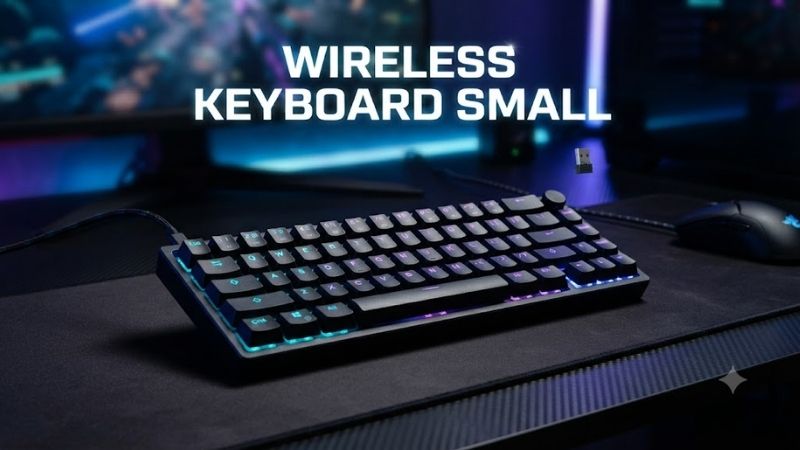
Wireless Keyboard Small shoppers usually want a compact board that frees desk space without making daily typing frustrating. The best options combine reliable Bluetooth or 2.4GHz wireless, useful battery life, comfortable key spacing, and enough shortcuts for work, travel, gaming, or multi-device setups.
Quick Comparison
| Product | Best For | Key Advantage | Limitation |
|---|---|---|---|
| Logitech Pebble Keys 2 K380s | Best Overall | Small, quiet, and three-device pairing | No backlight |
| Logitech MX Keys Mini | Best Premium Work | Smart backlighting and excellent typing | No 2.4GHz receiver included |
| Keychron K3 Max | Best Work and Gaming | 75% mechanical layout with 1000Hz wireless | Shorter battery life with RGB |
| Razer BlackWidow V4 Mini HyperSpeed | Best Gaming | Hot-swappable 65% mechanical design | More expensive than office keyboards |
| ASUS ROG Falchion RX Low Profile | Best Low-Profile Gaming | 65% layout with optical switches | Gaming features may be excessive for office use |
| HP 350 Compact Multi-Device | Best Budget Travel | Very light multi-device Bluetooth design | No mechanical switches or backlight |
Best Small Wireless Keyboard Picks
Logitech Pebble Keys 2 K380s — Best Overall
Best For: Everyday PC work, travel, students, and users who regularly switch between several devices.
Key Features:
- Compact low-profile layout
- Bluetooth connectivity
- Three-device Easy-Switch
- Quiet laptop-style keys
- Ten customizable function-row shortcuts
- Windows, macOS, Linux, ChromeOS, and mobile support
- Up to 36 months rated battery life
- 279 mm width
The Pebble Keys 2 K380s is one of the easiest compact wireless keyboards to recommend because its 279 mm width saves considerable desk space without shrinking normal letter keys excessively. It weighs about 415 grams with batteries, making it practical for a backpack while remaining substantial enough for regular desktop typing.
Its strongest productivity feature is Easy-Switch, which allows the keyboard to remain paired with as many as three compatible devices. Bluetooth support covers Windows, macOS, ChromeOS, Linux, Android, iPadOS, and iOS, so the same board can move between a desktop, laptop, tablet, or phone without rebuilding the connection each time.
What Makes It Different: Logitech combines a very small footprint with quiet typing and unusually long rated battery life. The rounded low-profile keys feel closer to a laptop than a mechanical board, making the K380s easier to adapt to for users who alternate between notebook computers and desktop PCs.
Pros:
- Compact 279 mm width
- Three-device switching
- Up to 36 months rated battery life
Cons:
- No backlighting
- No dedicated number pad
Who Should Buy It: Choose the K380s if you want a small wireless keyboard primarily for productivity, school, travel, or a crowded desk and do not need gaming-focused switches or a dedicated 2.4GHz connection.
Logitech MX Keys Mini — Best Premium Work Keyboard
Best For: Writers, programmers, business users, and compact premium office setups.
Key Features:
- Compact 79-key layout
- Perfect Stroke keys
- Smart backlighting
- Bluetooth connectivity
- Logi Bolt compatibility
- USB-C rechargeable battery
- 10-meter wireless range
- Multi-device productivity design
MX Keys Mini takes the typing concept of Logitech’s larger MX productivity keyboards and removes the number pad. The result is a compact 79-key board that leaves more room for a mouse while retaining dedicated arrows and common productivity controls. Its sculpted low-profile keys are designed to guide fingers toward the center of each key.
Backlighting is the major upgrade over cheaper compact models. MX Keys Mini uses illuminated keys and a rechargeable 1,500mAh battery, with Logitech rating the business version for around 10 days of use on a full charge under its stated conditions. Logi Bolt and Bluetooth provide flexible wireless deployment.
What Makes It Different: MX Keys Mini focuses on premium typing rather than portability alone. The backlit layout is better for evening work than the Pebble Keys 2, while its compact width helps keep the mouse closer to the keyboard and creates additional room for notebooks, microphones, or other desk accessories.
Pros:
- Excellent low-profile typing feel
- Smart backlit keys
- Rechargeable through USB-C
Cons:
- Costs more than basic compact keyboards
- Number pad requires a separate accessory
Who Should Buy It: Pick MX Keys Mini if you spend hours typing and want a compact professional keyboard with better illumination and refinement than entry-level Bluetooth models.
Keychron K3 Max — Best for Work and Gaming
Best For: Users who want a small mechanical keyboard capable of serving productivity and gaming workloads.
Key Features:
- 75% 84-key layout
- Low-profile mechanical switches
- 2.4GHz wireless
- Bluetooth 5.1
- USB-C wired mode
- 1000Hz polling over 2.4GHz and wired
- QMK/VIA customization
- Three-device Bluetooth pairing
Keychron K3 Max provides considerably more enthusiast flexibility than conventional office keyboards while staying only 306 mm wide. Its 75% layout retains the function row, arrow keys, and navigation controls in a compressed arrangement, making it more practical for work than many 60% keyboards while still freeing substantial mouse space.
For gaming, the dedicated 2.4GHz mode supports a 1000Hz polling rate, while Bluetooth can pair with three devices. The keyboard also works over USB-C and supports Windows, macOS, and Linux. Its 1,550mAh battery is rated for around 73 hours with lighting off or roughly 42 hours with RGB at low brightness.
What Makes It Different: K3 Max combines low-profile mechanical switches, fast wireless performance, and QMK/VIA customization in a layout small enough for travel. Hot-swappable configurations also let enthusiasts change compatible low-profile switches instead of replacing the entire keyboard when they want a different feel.
Pros:
- 1000Hz 2.4GHz wireless
- Mechanical low-profile switches
- Powerful QMK/VIA customization
Cons:
- RGB reduces battery life
- More complex than basic office boards
Who Should Buy It: Choose K3 Max if you want one compact wireless keyboard for daytime productivity and PC gaming without moving to a stripped-down 60% layout.
Razer BlackWidow V4 Mini HyperSpeed — Best Gaming Pick
Best For: Competitive gaming, custom mechanical setups, and users wanting a small 65% keyboard with arrow keys.
Key Features:
- 65% layout
- Razer HyperSpeed 2.4GHz wireless
- Bluetooth 5.0
- Three Bluetooth device profiles
- Hot-swappable switch sockets
- Supports 3-pin and 5-pin switches
- Per-key Chroma RGB
- Up to 200 hours rated battery life
Razer BlackWidow V4 Mini HyperSpeed compresses gaming controls into a 65% layout while retaining dedicated arrow keys. That gives gamers more mouse room than a tenkeyless or full-size board without removing navigation completely. HyperSpeed wireless is intended for gaming, while Bluetooth provides easier connection to secondary systems.
Customization is its main advantage over many mainstream gaming keyboards. The PCB supports hot-swapping with compatible 3-pin and 5-pin switches, allowing owners to change switch feel without soldering. Razer also includes per-key Chroma RGB and rates battery life at up to 200 hours depending on operating conditions.
What Makes It Different: Most small wireless boards force buyers to accept the switches installed at the factory. BlackWidow V4 Mini HyperSpeed instead combines mainstream gaming wireless technology with enthusiast-style switch replacement, making it easier to experiment with tactile, linear, or other compatible switches.
Pros:
- Hot-swappable mechanical switches
- Fast 2.4GHz gaming wireless
- Compact 65% design with arrow keys
Cons:
- Premium price
- RGB consumes additional battery power
Who Should Buy It: Pick this Razer model if gaming comes first but you also want a compact keyboard that can be customized beyond keycaps and software profiles.
ASUS ROG Falchion RX Low Profile — Best Low-Profile Gaming
Best For: Gamers who want a very thin compact keyboard without giving up fast wireless connectivity.
Key Features:
- 65% layout in compact chassis
- 306 mm width
- 26.5 mm profile
- ROG RX Low-Profile optical switches
- 2.4GHz ROG SpeedNova
- Bluetooth 5.1
- USB wired mode
- Per-key RGB
- Programmable keys
The ROG Falchion RX Low Profile is 306 mm wide and only 26.5 mm tall, giving it a much slimmer profile than conventional mechanical gaming boards. ASUS fits a 65% key arrangement into a compact chassis while preserving arrow and navigation functions, making it easier to use for general PC work than many minimalist layouts.
Connectivity includes 2.4GHz RF, Bluetooth 5.1, and wired USB. Bluetooth can handle multiple paired devices, while the gaming-oriented RF connection provides the more appropriate option for latency-sensitive play. ASUS also includes per-key RGB, N-key rollover, programmable keys, and an interactive touch control area.
What Makes It Different: The combination of optical switches and a 26.5 mm low-profile chassis distinguishes the Falchion from compact boards using conventional tall mechanical switches. The included protective cover also makes the keyboard more practical to transport without leaving exposed keycaps rubbing against other equipment.
Pros:
- Thin 65% gaming design
- Optical low-profile switches
- Bluetooth, 2.4GHz, and wired modes
Cons:
- 595g weight is substantial for travel
- Premium gaming features increase cost
Who Should Buy It: Choose the Falchion RX Low Profile if you want mechanical-style gaming responsiveness but strongly prefer a thinner keyboard that leaves more vertical and horizontal desk space.
HP 350 Compact Multi-Device — Best Budget Travel Pick
Best For: Travelers, business users, students, and anyone who wants a simple compact Bluetooth keyboard.
Key Features:
- Bluetooth 5.2
- Multi-device pairing
- Compact low-profile design
- Standard-size keycaps
- Two AAA batteries
- 282.1 mm width
- 340g weight
- Windows-focused productivity features
HP 350 Compact Multi-Device Bluetooth Keyboard measures approximately 282.1 x 121.8 x 16 mm and weighs about 340 grams, placing it between the Pebble K380s and heavier mechanical models. HP specifically positions the compact design for carrying in small bags while still maintaining normal-size keycaps for typing comfort.
Bluetooth 5.2 and multi-pair functionality allow the keyboard to work across several devices without using a USB receiver. Power comes from two AAA batteries rather than an internal rechargeable pack. That removes charging-cable management, although users need replacement batteries when the installed set eventually runs out.
What Makes It Different: HP keeps the concept intentionally simple. There is no RGB, mechanical switch system, or gaming receiver to increase size or complexity. Instead, the board focuses on compact dimensions, familiar keys, and convenient Bluetooth connectivity for laptops and desktop PCs.
Pros:
- Light 340g construction
- Bluetooth 5.2 multi-device pairing
- Compact 16 mm profile
Cons:
- No backlighting
- No gaming-oriented 2.4GHz mode
Who Should Buy It: Choose HP 350 if you need an uncomplicated portable keyboard for office tasks and travel and prefer replaceable batteries over another USB-C device that needs charging.
How to Choose a Small Wireless Keyboard
Choose the Right Compact Layout
A 60% board removes the number pad, function row, and many navigation keys, creating maximum mouse room but requiring more keyboard shortcuts. A 65% layout adds arrow keys, while 75% keyboards such as Keychron K3 Max preserve the function row and extra navigation controls without becoming full-size.
For office work, 75% is often the safest compact format because common controls remain visible. Gamers may prefer 65% because it leaves more room for low-sensitivity mouse movement. Travelers who mainly type documents can also consider minimalist Bluetooth layouts such as Pebble Keys 2 or HP 350.
Compare Bluetooth and 2.4GHz
Bluetooth is ideal for laptops, tablets, and productivity PCs because no receiver needs to occupy a USB port. It is also convenient for multi-device switching. The disadvantage is that Bluetooth is not usually the preferred connection for competitive gaming, where latency and polling behavior become more important.
A dedicated 2.4GHz connection is better suited to gaming. Keychron K3 Max, Razer BlackWidow V4 Mini HyperSpeed, and ROG Falchion RX Low Profile provide receiver-based wireless in addition to Bluetooth, giving users a faster mode for the gaming PC and a convenient mode for secondary devices.
Consider Keyboard Width and Weight
A small keyboard should save meaningful desk space, not merely remove a few keys. Pebble Keys 2 is only 279 mm wide, HP 350 is about 282 mm wide, and Keychron K3 Max and ASUS Falchion are around 306 mm. These dimensions leave considerably more horizontal mouse room than standard full-size keyboards.
Weight affects portability differently. Very light keyboards are easier to carry, while heavier designs can feel more planted during gaming. HP 350 weighs around 340 grams, Pebble Keys 2 about 415 grams with batteries, and the ASUS Falchion approximately 595 grams without its cable.
Mechanical vs Low-Profile Scissor Keys
Scissor keyboards provide short travel and quiet operation familiar to laptop users. They also allow thinner chassis designs and generally consume less space in a travel bag. Logitech Pebble Keys 2, MX Keys Mini, and HP 350 are appropriate when noise, portability, and office comfort take priority.
Mechanical and optical keyboards provide a more distinctive switch feel and stronger gaming-oriented customization. Keychron K3 Max, Razer BlackWidow V4 Mini, and ROG Falchion target this audience. The trade-off is usually greater cost, higher weight, more complicated software, and shorter battery runtime with RGB enabled.
Check Battery and Backlighting
Backlighting helps in dark rooms but consumes substantial battery power. MX Keys Mini adds practical white illumination, while Razer, ASUS, and some Keychron versions provide RGB. If maximum wireless runtime matters, either disable lighting or select an unlit productivity keyboard designed around long-lasting battery operation.
Replaceable batteries also remain useful. Logitech rates Pebble Keys 2 for up to 36 months under its stated conditions, while HP 350 runs from standard AAA cells. Rechargeable models avoid disposable batteries but need occasional cable access, so neither method is automatically better for every user.
FAQ
What Is the Best Small Wireless Keyboard for PC?
Logitech Pebble Keys 2 K380s is the strongest general-purpose choice because its 279 mm width, quiet laptop-style keys, three-device Easy-Switch capability, broad operating-system compatibility, and long rated battery life cover most productivity and travel needs without adding gaming features that many users will never use.
Is a 65% or 75% Keyboard Better?
A 65% keyboard saves more desk space and normally keeps arrow keys while removing the function row. A 75% keyboard adds the function row and extra navigation keys, making it easier for productivity and mixed work. Gamers wanting maximum mouse room may prefer 65%, while most office users will find 75% less restrictive.
Are Small Wireless Keyboards Good for Gaming?
Yes, provided the keyboard has a suitable low-latency connection. Razer BlackWidow V4 Mini, ASUS ROG Falchion RX Low Profile, and Keychron K3 Max all provide dedicated 2.4GHz wireless modes in addition to Bluetooth. Compact layouts also create more room for large mouse movements during low-sensitivity gaming.
Can a Compact Keyboard Work With Multiple Devices?
Many can. Pebble Keys 2 can switch among three paired devices, Keychron K3 Max supports three Bluetooth devices, and Razer BlackWidow V4 Mini also provides three Bluetooth profiles. Multi-device support is useful when one keyboard needs to move between a desktop PC, laptop, tablet, or work computer.
Do Small Wireless Keyboards Have a Number Pad?
Most compact keyboards remove the dedicated number pad because it occupies significant horizontal space. Users who frequently enter financial data can buy a separate wireless number pad or choose a full-size keyboard instead. Removing the pad is what allows compact models to position the mouse closer to the body and fit more easily in a bag.
Conclusion
The best Wireless Keyboard Small option depends on whether you prioritize travel, productivity, gaming, or customization. Logitech Pebble Keys 2 is the easiest portable pick, MX Keys Mini suits premium office work, Keychron K3 Max balances work and gaming, while Razer and ASUS deliver stronger compact gaming performance.