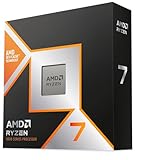
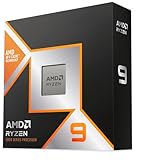
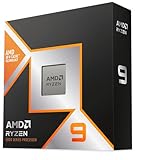
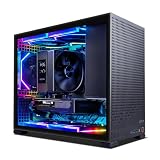
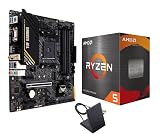
AMD’s AM5 platform has been around long enough that the hard part is no longer choosing a socket — it’s choosing which eight-core Zen 5 chip goes into it. The Ryzen 7 9800X3D and the Ryzen 7 9700X share the same architecture, the same 8 cores and 16 threads, the same PCIe 5.0 and DDR5 support, and the same motherboards. On a spec sheet they look like siblings separated by a modest price gap. In real workloads, they behave like two genuinely different processors.
The reason is 3D V-Cache. The 9800X3D stacks an extra slab of L3 cache onto the compute die, tripling the pool of fast memory the cores can reach without touching system RAM. Games love that. In 2026, with GPUs quick enough that 1080p and 1440p high-refresh gaming is frequently CPU-limited, and with simulation, strategy and extraction shooters punishing weak cache subsystems, that architectural difference decides more frames than clock speed does. The 9700X, meanwhile, is the efficiency play: lower power, lower cooling requirements, a slightly higher peak boost clock, and a noticeably friendlier price.
As an Amazon Associate we earn from qualifying purchases at no extra cost to you.



⚡ Save on Your Next PC — Amazon Prime
Prime members get fast free shipping on the systems above, plus early access to Prime Day & Black Friday PC deals. New members get a 30-day free trial.
Watch: Ryzen 7 9800X3D vs 9700X: 2026 Gaming CPU — Video Review
Quick Verdict
Buy the Ryzen 7 9800X3D if gaming is the primary job and you’re pairing it with a high-end GPU at 1080p or 1440p — it is still the fastest mainstream gaming CPU you can drop into AM5, and the gap is largest in exactly the CPU-bound titles people play for hundreds of hours. Buy the Ryzen 7 9700X if you’re building to a budget, running a mid-range GPU, gaming at 4K, or prioritising a cool, quiet, low-power system where every watt and every dollar spent on cooling matters.
Key Differences
- L3 cache: The 9800X3D carries 96MB of total L3 thanks to second-generation 3D V-Cache; the 9700X has 32MB. This single spec drives most of the performance delta.
- Gaming performance: Expect roughly a 15–20% average uplift for the 9800X3D at 1080p, stretching well past 30% in cache-hungry games like Microsoft Flight Simulator, Factorio, Stellaris and large-map shooters. At 4K with a GPU bottleneck, the gap narrows sharply.
- Clock speed and productivity: The 9700X boosts higher on paper, giving it a slim lead in some lightly threaded, cache-insensitive tasks. In sustained multi-threaded rendering and compilation the two trade blows, with the 9800X3D’s higher power budget usually keeping it ahead.
- Power and thermals: 65W default TDP on the 9700X (with an optional higher-power mode) versus 120W on the 9800X3D. The 9700X is far easier to cool in small cases and with modest air coolers.
- Overclocking: AMD moved the cache layer beneath the cores on this generation, so the 9800X3D is fully unlocked — a first for an X3D part. Both chips support Precision Boost Overdrive and EXPO memory profiles.
- Bundles and value: The 9800X3D is widely sold in motherboard bundles, including the Micro Center 9800X3D with MSI B850 Gaming Plus WF, the 9800X3D with TUF Gaming X870-PLUS WiFi, and the Micro Center 9800X3D with MSI MAG X870E Tomahawk. Bundling frequently erases a good chunk of the price premium.
AMD Ryzen 7 9800X3D: The Gaming Benchmark
The 9800X3D fixed the one real complaint about its predecessor. By placing the stacked cache under the compute die rather than on top of it, AMD improved thermal transfer, raised clocks, and unlocked overclocking. The result is a chip that no longer trades productivity performance for gaming performance — it simply wins at games and holds its own everywhere else. Against the 9700X, it delivers dramatically better 1% lows in open-world and simulation titles, which is what actually makes gameplay feel smooth on a 165Hz or 240Hz panel.
It does demand more from the rest of the build. Budget for a solid 240mm AIO or a high-end dual-tower air cooler, and a board with decent VRMs — which is precisely why the X870 and B850 bundles are so popular. It’s also worth noting the newer Ryzen 7 9850X3D, a higher-clocked refresh of the same eight-core V-Cache design; if it’s in stock near the 9800X3D’s price, compare them directly, but the 9800X3D remains the value pick of the two. Buyers hunting a bargain should also check the previous-generation Ryzen 7 7800X3D, which is still excellent and often significantly cheaper.
AMD Ryzen 7 9700X: The Efficient All-Rounder
Judged on its own terms rather than against a halo part, the 9700X is a very good processor. Eight Zen 5 cores at 65W deliver strong single-threaded performance, comfortable 100+ FPS gaming in the vast majority of titles, and excellent performance-per-watt. It runs cool enough that a mid-range air cooler is genuinely sufficient, which saves money and noise — a real advantage in compact ITX builds where a 120W chip becomes a thermal headache.
The strategic argument is just as strong. Money saved on the CPU can go straight into a better graphics card, and at 1440p Ultra or 4K a stronger GPU almost always buys more frames than a stronger CPU. Because AM5 is supported well into the future, a 9700X build can be upgraded to an X3D chip later, once prices fall, without replacing the board, RAM or cooler.
Which Should You Buy?
- For competitive 1080p esports: Pick the 9800X3D. Frame rates well above 300 FPS are heavily CPU-bound, and the cache advantage is decisive.
- For 1440p high-refresh gaming with a flagship GPU: Pick the 9800X3D, ideally as a motherboard bundle to soften the cost.
- For 4K gaming or a mid-range GPU:
Explore Our Guides & Free Tools