🛒 Best Price Today on Amazon
Prime members get fast, free shipping on everything above, plus member-only deals. New members get a 30-day free trial — cancel anytime.
- What Are Computer Peripherals?
- What Are Computer Accessories?
- Keyboard
- Mouse
- Monitor
- Mouse Pad
- Headset
- Headphones
- Microphone
- Webcam
- Speakers
- External SSD
- External Hard Drive
- USB Flash Drive
- USB Hub
- Docking Station
- Printer
- Scanner
- Router
- Ethernet Cable
- Wi-Fi Adapter
- Bluetooth Adapter
- Memory Card Reader
- Surge Protector
- UPS
- Monitor Arm
- Laptop Stand
- FAQ
- Conclusion
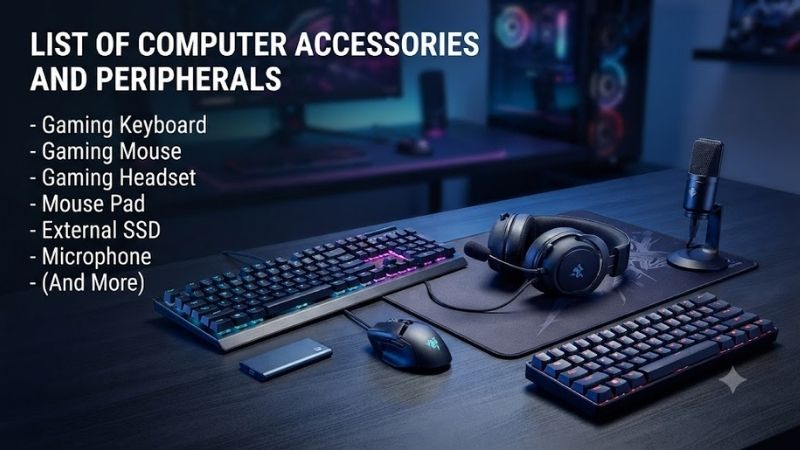
A list of computer accessories and peripherals includes the external devices and add-ons that improve how a computer is used, connected, controlled, or expanded. Common examples include keyboards, mice, monitors, webcams, speakers, headsets, storage drives, USB hubs, printers, routers, microphones, and ergonomic desk accessories.
What Are Computer Peripherals?
Computer peripherals are devices connected to a computer to provide input, output, storage, communication, or additional functionality. They are not usually required for the computer’s core processing tasks, but they make the system practical for everyday use. Some peripherals connect by USB, Bluetooth, Wi-Fi, audio ports, or dedicated interfaces.
Peripherals are commonly divided into input devices, output devices, storage devices, and communication devices. Modern setups often combine categories. A gaming headset, for example, provides audio output through the headphones while also providing audio input through its microphone, making it both an input and output peripheral.
What Are Computer Accessories?
Computer accessories are a broader category that includes peripherals as well as non-electronic items that improve organization, comfort, protection, or usability. Monitor stands, mouse pads, laptop stands, cable trays, wrist rests, surge protectors, carrying cases, and desk lighting can all be considered computer accessories even though they do not process data directly.
The terms accessory and peripheral are often used interchangeably in shopping and general discussion. The difference is mostly functional: a peripheral communicates with the computer, while an accessory may simply support the user or equipment. For practical buying purposes, both categories are usually considered part of a complete computer setup.
Keyboard
A keyboard is one of the most important input peripherals because it handles text entry, shortcuts, commands, and many game controls. Keyboards are available in membrane, mechanical, optical, low-profile, ergonomic, wired, and wireless designs. The best choice depends on typing preference, noise tolerance, gaming requirements, and available desk space.
Full-size keyboards include a numeric keypad, while tenkeyless models remove it to save space. Compact 75%, 65%, and 60% layouts reduce the footprint further. Office users may prioritize comfort and quiet switches, while gamers often care more about response, rollover, customization, and consistent key feel.
Mouse
A mouse controls the pointer and provides precise navigation in operating systems, games, and creative applications. Modern mice use optical sensors and may connect through USB, 2.4 GHz wireless, or Bluetooth. Shape, weight, button layout, and sensor behavior are usually more important than extremely high advertised DPI values.
Gaming mice often include programmable buttons, adjustable sensitivity, lightweight shells, and high polling rates. Productivity mice may focus on ergonomic support, additional scroll controls, or multi-device connectivity. The correct model should fit the user’s hand size and preferred palm, claw, or fingertip grip style.
Monitor
A monitor is the main visual output device for most desktop computers. Important specifications include screen size, resolution, refresh rate, panel technology, brightness, contrast, color performance, ports, and adaptive-sync support. A monitor can have a greater impact on daily usability than many internal hardware upgrades.
For office work, 24- to 27-inch displays are common, while gaming users may prioritize high refresh rates such as 144Hz, 165Hz, 240Hz, or higher. Creators often focus on color accuracy and resolution. Ultrawide monitors can replace multi-display setups when continuous horizontal workspace is more valuable.
Mouse Pad
A mouse pad provides a consistent tracking surface and protects both the mouse feet and desk. Gaming pads generally come in speed-focused or control-focused surfaces, although the difference between materials can be subtle. Large desk mats also provide space for the keyboard while creating a more uniform appearance.
Hard pads offer faster movement and easier cleaning, while cloth pads are quieter and provide more cushioning. Competitive players should choose a size large enough for their sensitivity settings because low-sensitivity aiming can require wide arm movements that quickly exceed the area of a small pad.
Headset
A computer headset combines headphones and a microphone in one device. It is convenient for gaming, video calls, online classes, customer support, and voice communication. Important factors include comfort, microphone clarity, wired or wireless operation, battery life, isolation, weight, and compatibility with the target computer or console.
Gaming headsets often include virtual surround processing, detachable microphones, or software equalizers. For work, clear speech and long-session comfort may matter more than gaming features. Open-back headsets can sound spacious but leak audio, while closed-back designs provide better isolation from surrounding noise.
Headphones
Dedicated headphones may offer better sound quality than similarly priced gaming headsets when a built-in microphone is unnecessary. They can be paired with a separate microphone for streaming, meetings, or voice chat. Common designs include closed-back, open-back, over-ear, on-ear, wired, and Bluetooth models.
Open-back headphones provide a wider, more natural soundstage but allow outside noise in and audio out. Closed-back headphones are better for shared rooms and recording situations. Wireless models prioritize convenience, while wired headphones avoid battery management and can work with external DACs or audio interfaces.
Microphone
A standalone microphone improves voice quality for streaming, podcasts, video meetings, voice-over work, and multiplayer communication. USB microphones are simple because they connect directly to the computer, while XLR microphones typically require an audio interface but offer greater flexibility for advanced recording setups.
Pickup pattern also matters. Cardioid microphones focus mainly on sound from the front, making them practical for desks. Dynamic microphones often reject more room noise, while condenser microphones can capture more detail but may also pick up keyboard clicks, fans, and environmental sounds more easily.
Webcam
A webcam provides video input for meetings, streaming, remote work, and content creation. Resolution is only one part of image quality. Autofocus, exposure control, lens quality, low-light performance, frame rate, field of view, and software processing can matter just as much as whether the camera is advertised as 1080p or 4K.
For normal meetings, a good 1080p webcam is usually sufficient. Streamers and creators may benefit from higher-quality sensors, faster frame rates, or advanced tracking. Correct lighting can improve webcam image quality dramatically, so upgrading room lighting may provide more value than buying the highest-resolution camera available.
Speakers
Computer speakers provide audio without requiring headphones. Basic stereo systems include left and right speakers, while 2.1 systems add a subwoofer for deeper bass. Soundbars can save desk space, and powered studio monitors are useful for users who prioritize music, video editing, or more accurate audio reproduction.
Speaker placement affects performance. The left and right units should generally form a balanced listening position around the user rather than sitting together on one side. Large speakers also require more desk space, so compact models can be more practical for workstations with multiple monitors or limited surface area.
External SSD
An external SSD provides fast portable storage for backups, games, projects, photos, and large file transfers. USB 3.2, USB4, or Thunderbolt interfaces can support significantly higher speeds than basic external hard drives, although the actual result also depends on the SSD controller, enclosure, computer port, and workload.
External SSDs are useful for laptops because they add storage without opening the computer. They are also more shock resistant than mechanical drives because they contain no moving platters. Their main disadvantage is cost per gigabyte, especially when compared with high-capacity external hard drives used mainly for archives.
External Hard Drive
External hard drives remain useful for large backups, media libraries, archived projects, and other workloads where capacity matters more than speed. They usually offer more storage per dollar than SSDs, making them attractive when several terabytes are required without the cost of equivalent flash storage.
Because HDDs contain mechanical components, they are more vulnerable to drops and vibration than SSDs. They are also slower when dealing with many small files. For backup use, however, those disadvantages may be acceptable because the drive often spends most of its time storing data rather than running applications.
USB Flash Drive
USB flash drives are compact removable storage devices used for transferring files, creating installation media, carrying documents, or performing firmware updates. Capacity and performance vary widely, so buyers should not assume two drives with the same advertised storage size will deliver similar read and write speeds.
A flash drive is convenient but should not be the only location for important data. Small devices are easy to lose, and inexpensive models may have limited endurance. For critical files, use the flash drive as a transfer tool while maintaining independent copies on a computer, external drive, NAS, or cloud service.
USB Hub
A USB hub expands one computer port into several additional connections. This is especially useful for laptops with limited USB ports. Hubs may include USB-A, USB-C, card readers, audio ports, Ethernet, and display outputs depending on the model and the capabilities of the host port.
Powered hubs are better when connecting devices that draw substantial power, such as external drives or several peripherals simultaneously. A hub does not increase the bandwidth of the original host connection, so multiple high-speed devices may need to share the same available throughput when active at the same time.
Docking Station
A docking station turns a laptop into a more complete desktop workstation through a single connection. Depending on the dock and laptop, it can provide external displays, Ethernet, USB ports, audio, card readers, storage connections, and charging. USB-C and Thunderbolt docks are common in professional work-from-home setups.
Compatibility should be checked carefully because not every USB-C port supports display output or high-power charging. Multiple-monitor support can also vary between Windows laptops, Macs, dock chipsets, and connection standards. The dock should therefore be chosen around the exact laptop rather than only the connector shape.
Printer
A printer converts digital documents or images into physical copies. Inkjet printers are common for home use and color printing, while laser printers can be more efficient for high-volume text. Multifunction models may also include scanning and copying capabilities, reducing the number of separate devices required.
Remote workers should consider ongoing ink or toner costs rather than purchase price alone. A cheap printer can become expensive if cartridges are small or frequently replaced. Users who print only occasionally should also consider whether a local print service is more economical than maintaining a printer at home.
Scanner
A scanner converts physical documents, photos, or receipts into digital files. Flatbed scanners are versatile, while sheet-fed scanners are faster for large document batches. Many multifunction printers include basic scanning features, which may be sufficient for contracts, forms, and normal work-from-home paperwork.
Dedicated document scanners become useful when digitizing many pages because they may include automatic document feeders and duplex scanning. Software features such as optical character recognition can make scanned text searchable, improving document organization compared with storing only image-based copies.
Router
A router connects devices to the home network and internet while directing traffic between them. Modern routers may support Wi-Fi 6, Wi-Fi 6E, or Wi-Fi 7 along with Gigabit or multi-gig Ethernet. Router quality affects coverage, stability, device capacity, and local networking performance more than many users realize.
Gaming and work-from-home users should prioritize stable connectivity rather than marketing claims about extreme theoretical speeds. Placement also matters. A powerful router hidden in a cabinet or positioned at one end of a large home may perform worse than a properly located system with more modest specifications.
Ethernet Cable
Ethernet cables provide wired networking between computers, routers, switches, NAS devices, and other equipment. A wired connection usually offers more consistent latency and stability than Wi-Fi, which makes it valuable for competitive gaming, desktop workstations, network storage, and high-bandwidth file transfers.
Cat6 is sufficient for many home networks and supports Gigabit Ethernet comfortably, with higher speeds possible over appropriate distances. Buying extremely high-category cables does not automatically improve internet performance. The network ports, switches, router, and internet connection must support the desired speed as well.
Wi-Fi Adapter
A Wi-Fi adapter adds or upgrades wireless networking on a desktop or laptop. USB adapters are easy to install, while PCIe cards can provide stronger antennas and better performance on desktop PCs. Newer adapters may support Wi-Fi 6E or Wi-Fi 7 when paired with compatible routers and operating systems.
Desktop users should position antennas away from metal cases and walls when possible. Upgrading the adapter will not solve every wireless problem if the router is too far away or blocked by dense construction. Network performance depends on both ends of the wireless connection and the environment between them.
Bluetooth Adapter
A Bluetooth adapter allows a computer without built-in Bluetooth to connect wirelessly to keyboards, mice, headphones, controllers, phones, and other compatible devices. Small USB adapters are inexpensive and useful for older desktop systems that otherwise require cables or proprietary wireless receivers.
Bluetooth versions affect range, efficiency, and supported features, but device compatibility matters more than purchasing the highest version number alone. Audio users should also understand that Bluetooth introduces compression and latency, making dedicated 2.4 GHz wireless or wired connections preferable for some gaming and professional audio situations.
Memory Card Reader
A card reader transfers files from SD, microSD, CompactFlash, or other memory cards to the computer. It is particularly useful for photographers, videographers, drones, action cameras, and devices that record directly to removable media. Some laptops include card readers, while many desktop PCs require external units.
Performance depends on both the reader and memory card standard. A fast card placed into an older reader may operate far below its potential. Creators moving large amounts of high-resolution footage should match the reader to the card format and speed class used by their cameras.
Surge Protector
A surge protector provides additional power outlets while helping protect connected equipment from certain voltage spikes. It is useful for computers, monitors, speakers, routers, and peripherals that share one workstation. Buyers should distinguish genuine surge protectors from simple power strips that only increase outlet count.
Surge protection is not the same as battery backup. A power outage will still shut the computer down immediately unless the system is connected to a UPS. For expensive workstations, combining sensible surge protection with backup practices and an appropriate UPS can provide broader protection against power-related problems.
UPS
An uninterruptible power supply provides temporary battery power when electricity fails. It gives users time to save work and shut down a computer safely, while some models also regulate voltage and protect connected equipment. UPS units are particularly valuable for desktops, NAS systems, networking equipment, and workstations handling important files.
Capacity should match the equipment load and desired runtime. A UPS does not need to keep a gaming PC running for hours; even several minutes can be enough for a controlled shutdown. High-powered systems require larger units than basic office computers, so wattage and VA ratings should be checked carefully.
Monitor Arm
A monitor arm replaces the standard display stand and allows more control over height, distance, angle, and desk placement. It can free surface space and make multi-monitor setups easier to arrange. Gas-spring arms are popular because they allow frequent adjustment without loosening screws.
Before purchasing, check monitor weight, VESA compatibility, desk thickness, and clamp clearance. Heavy ultrawide displays may require specialized arms. Correct monitor positioning can improve comfort, but an arm cannot compensate for a desk that is fundamentally too shallow or a chair that cannot reach the correct height.
Laptop Stand
A laptop stand raises the computer screen closer to eye level, reducing the need to bend the neck downward during long work sessions. It is particularly useful for remote work when combined with an external keyboard and mouse, because the laptop can then function primarily as a display.
Folding laptop stands are portable, while heavier metal models provide more stability for permanent desks. Ventilation is also important because blocking the laptop’s air intakes can increase temperatures. The stand should support the device securely without placing excessive pressure on the chassis or screen hinge.
FAQ
What Are the Most Important Computer Accessories?
For most users, the essential accessories are a keyboard, mouse, monitor, audio device, and reliable network connection. Laptop users may also benefit from a stand, external keyboard, mouse, and USB hub. Additional equipment should be chosen around specific tasks rather than added only to make the desk look more complete.
What Is the Difference Between an Accessory and a Peripheral?
A peripheral connects to the computer and provides input, output, storage, or communication functions. An accessory is a broader term that may also include items such as stands, pads, cable organizers, or protective cases. Many products, including keyboards and webcams, can reasonably be described using either term.
Which Computer Accessories Are Best for Gaming?
Gaming setups commonly benefit from a responsive mouse, comfortable keyboard, high-refresh monitor, quality headset, large mouse pad, Ethernet connection, and controller when supported by the game. Competitive players should prioritize input consistency and display performance before spending heavily on decorative RGB accessories.
What Accessories Are Useful for Work From Home?
A monitor, ergonomic keyboard and mouse, webcam, headset or microphone, laptop stand, docking station, and reliable router can improve remote work significantly. An adjustable chair and proper lighting are also important even though they are not traditional computer peripherals, because comfort directly affects long working sessions.
Do I Need a USB Hub?
A USB hub is useful when the computer does not have enough ports for all connected peripherals. Laptop users benefit most because modern thin systems often provide only a few USB connections. Choose a powered hub when connecting several storage devices or other hardware that requires more electrical power.
Conclusion
A complete list of computer accessories and peripherals ranges from keyboards, mice, monitors, webcams, and headsets to storage drives, docks, networking equipment, power protection, and ergonomic accessories. The best setup is not the one with the most devices, but the one that adds the right tools for gaming, work, creativity, or everyday use.