- Top Pick: SteelSeries Apex 3 TKL RGB Gaming Keyboard – Tenkeyless Compact Form Factor – 8-Zone RGB Illumination – IP32 Water & Dust Resistant – Whisper Quiet Gaming Switch – Gaming Grade Anti-Ghosting,Black
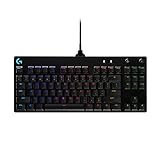
- Best Value: Logitech G PRO Mechanical TKL Tenkeyless Gaming Keyboard (Clicky) – Black
- Premium Choice: Corsair K55 CORE TKL RGB Gaming Keyboard – Tenkeyless, 8-Zone RGB, Quiet Membrane Keys, Spill Resistant, Media Keys, 1000Hz Polling – NA Layout – Black
The full-size versus tenkeyless debate used to be a niche argument among competitive players. In 2026, it’s the first real decision most people make when they upgrade, because keyboard layout now dictates far more than how much desk you give up. It shapes your mouse arc, your shoulder position, your bag weight on LAN weekends, and — increasingly — how much you pay for build quality, since manufacturers are putting their best switches and hot-swap sockets into compact boards first.
A full-size board gives you all 104 keys: function row, navigation cluster, and a dedicated number pad. A tenkeyless (TKL) board drops that number pad and keeps everything else, shrinking width by roughly 15–20% without touching the keys you use to play. That single missing block is the entire argument, and which side you land on depends less on genre preference than on how you actually use your desk. Here’s how the two layouts compare, and which specific boards are worth buying right now.
As an Amazon Associate we earn from qualifying purchases at no extra cost to you.




⚡ Save on Your Next PC — Amazon Prime
Prime members get fast free shipping on the systems above, plus early access to Prime Day & Black Friday PC deals. New members get a 30-day free trial.
Watch: Full-Size vs TKL Keyboard: 2026 Comparison — Video Review
Quick Verdict
Buy a full-size keyboard if you regularly enter numbers — accounting, CAD, data entry, sim racing telemetry, or MMO macro binding across a numpad — and your desk is at least 120cm wide. Buy a TKL if you play anything that rewards low-sensitivity mouse movement, if you share your desk with a laptop or drawing tablet, or if you carry your gear anywhere. For most gamers in 2026, TKL is the better default; the number pad is the least-used real estate on a full-size board, and reclaiming it costs you nothing in-game.
Key Differences
- Footprint: Full-size boards run roughly 44–46cm wide; TKL boards land around 35–36cm. That’s an extra 9–10cm of mousepad, which is the difference between comfortable 40cm/360 flicks and clipping your keyboard mid-swipe.
- Ergonomics: Removing the numpad centres your typing hands on the desk and lets your mouse arm sit closer to your shoulder line, reducing the outward reach that causes rotator-cuff and wrist strain over long sessions.
- Numeric input: A full-size board is dramatically faster for spreadsheets, invoicing, and any workflow with sustained digit entry. TKL users fall back to the number row, which is noticeably slower for bulk input.
- Portability: TKL boards fit in a standard backpack sleeve. Full-size boards generally don’t, which matters for LAN events, dorm moves, and hot-desking.
- Price and specification: At any given budget, a TKL usually buys you better switches, a stiffer plate, or a higher polling rate than the full-size version of the same model, simply because there’s less board to build.
- Extras: Full-size boards more often include dedicated media wheels, passthrough ports, and magnetic wrist rests. TKLs increasingly consolidate these into function-layer shortcuts.
Full-Size Keyboards: Everything on One Deck
The case for full-size is simple: nothing is missing. If your PC does double duty as a work machine, the number pad is not a luxury but a tool you’ll use hundreds of times a day, and switching between a TKL at home and a full-size at the office creates real muscle-memory friction. Sim racers and flight-sim players also benefit, since the numpad block provides a dense, tactile cluster for view controls and system bindings that’s easy to find without looking.
The trade-off is spatial. On a 100cm desk, a full-size board plus a large mousepad leaves you crowding the edge, which pushes low-sens players into repeated mouse lifts and encourages a bent-wrist posture. If you can’t push the keyboard forward and still rest your forearms on the desk, the layout is working against you — and no amount of switch quality fixes bad geometry.
TKL Keyboards: The Competitive Default
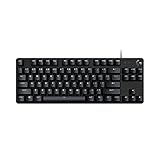
TKL has become the standard for a reason, and the current lineup shows how wide the price band has gotten. The Logitech G PRO TKL remains the benchmark for competitive play with genuine clicky mechanical switches, a detachable cable for tournament transport, and a compact chassis that’s survived years of esports abuse. The Logitech G413 TKL SE sits just below it with an aluminium top plate and clean white backlighting — the pick if you want mechanical feel without RGB.
Below that, the quiet options dominate. The SteelSeries Apex 3 TKL pairs whisper-quiet gaming switches with IP32 water and dust resistance and 8-zone RGB, and the Renewed Apex 3 TKL is the cheapest legitimate way into that feature set. The Corsair K55 CORE TKL adds dedicated media keys, spill resistance, and 1000Hz polling on a membrane base, while the Razer Ornata V3 TKL uses low-profile keys for a shorter, laptop-like travel that suits fast tapping and cramped desks.
Which Should You Buy?
- For competitive FPS: Pick TKL — the Logitech G PRO TKL for clicky mechanical feedback and a detachable cable.
- For a shared work-and-play desk: Pick full-size, or pair a TKL with a separate USB numpad you can move aside.
- For late-night or shared rooms: Pick TKL — the SteelSeries Apex 3 TKL or Corsair K55 CORE TKL keep noise down.
- For the tightest budget: Pick the Renewed Apex 3 TKL or the G413 TKL SE.
- For low-profile typists: Pick the Razer Ornata V3 TKL for shorter travel and a slimmer stack height.
Frequently Asked Questions
Do professional gamers use TKL or full-size?
Overwhelmingly TKL or smaller. Tournament desks are shallow, mouse space is the priority, and detachable-cable TKLs travel well. Full-size boards are rare on any competitive stage.
Will I actually miss the number pad?
Only if you do sustained numeric entry. For gaming, browsing, and general typing, most people stop noticing within a week. If you’re unsure, unplug your numpad mentally for a few days and count how often you reach for it.
Are TKL keyboards better value?
Usually, yes. Fewer keys, less plate, and a smaller PCB mean manufacturers can spend the savings on switches and construction — which is why compact boards often feel a tier above same-price full-size models.
Can I add a number pad to a TKL later?
Yes. Standalone USB and wireless numpads are inexpensive and can sit on the left side, which is arguably more ergonomic than the fixed right-hand placement on a full-size board.
Final Verdict
Unless you have a specific, daily need for numeric input, TKL is the smarter buy in 2026 — it gives you more mouse room, better posture, easier transport, and typically stronger hardware for the money. Start with the Logitech G PRO TKL if you want the competitive standard, the SteelSeries Apex 3 TKL if quiet operation and water resistance matter more, and the Renewed Apex 3 TKL or G413 TKL SE if you’re building to a budget. Choose full-size only when the number pad earns its 10cm.