🛒 Best Price Today on Amazon
Prime members get fast, free shipping on everything above, plus member-only deals. New members get a 30-day free trial — cancel anytime.
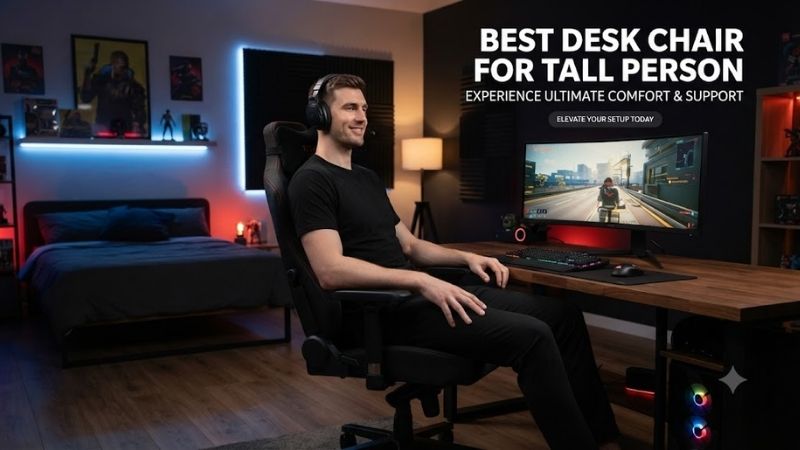
The best desk chair for tall person use needs more than a high backrest. Taller users often need extra seat height, deeper thigh support, enough backrest height, and armrests that reach the elbows without raising the shoulders. These five ergonomic chairs stand out for their dimensions, adjustability, and suitability for long workdays.
Quick answer: For most people in 2026, the best desk chair for tall person is the Chair — our #1 rated choice. See the full ranked comparison, alternatives and buying advice below.
Quick Comparison
| Chair | Best For | Seat Height | Seat Depth | Weight Capacity |
|---|---|---|---|---|
| Herman Miller Aeron Size C | Best Overall | Up to about 23 in | About 18.5–19.8 in | Up to 350+ lb depending on version |
| Steelcase Gesture | Best Adjustable | 16–21 in | Adjustable | 400 lb |
| Haworth Fern | Best Tall Back | 16.5–21.5 in | 15.5–18.5 in | Up to 325–350 lb |
| HON Ignition 2.0 Big & Tall | Best Heavy-Duty | Adjustable | Adjustable option | 450 lb |
| Branch Ergonomic Chair Pro | Best Value | Up to 22.9 in tall version | 16.7–19.7 in | 275 lb |
Herman Miller Aeron Size C
Best For: Tall users who want a purpose-sized ergonomic chair
Key Features:
- Large Size C frame
- Recommended for users up to about 6 ft 7 in
- Larger seat pan
- High seat-height range
- 8Z Pellicle suspension
- PostureFit SL option
- Adjustable arm configurations
- Tilt limiter
- Optional forward tilt
The Herman Miller Aeron Size C is one of the strongest chairs for tall users because Herman Miller produces Aeron in three actual sizes instead of attempting to fit every body into one shell. Herman Miller’s current fit guidance recommends Size C for users roughly 5 ft 10 in through 6 ft 7 in.
The Size C seat is also physically larger. Herman Miller lists a seat depth of about 470 mm on its specifications page, while current retail fit information lists a larger seat pan around 502 mm on some configurations. Either way, Size C offers substantially more thigh support than the smaller Aeron models.
Seat height is another advantage. Current Herman Miller Size C specifications list a range reaching roughly 22.8 inches, while regional retail configurations can approach 23.3 inches. This makes it easier for people with long lower legs to maintain a natural knee angle instead of sitting with their knees noticeably above their hips.
Aeron uses 8Z Pellicle suspension rather than a thick foam cushion. The suspension distributes pressure and allows airflow through the seat and back, which can be beneficial during long work sessions. PostureFit SL is available to provide additional sacral and lumbar support.
The biggest limitation is that seat depth is not independently adjustable. You choose the appropriate Aeron size rather than sliding the seat pan forward or backward. For tall users who fall clearly into Size C territory, however, the larger physical frame can fit better than chairs designed around an average-size shell.
What Makes It Different: Aeron Size C is genuinely scaled for larger users. The seat, backrest, width, and height range are all different from the smaller Aeron sizes rather than simply using a taller gas cylinder.
Pros:
- Dedicated large frame
- Excellent fit range for tall users
- Deep and wide seat
- Breathable suspension
- Multiple arm options
- Good lumbar support
- Premium build quality
Cons:
- Expensive
- Seat depth is fixed
- No factory headrest
- Mesh feel will not suit everyone
Use Case: Long office work, programming, management, writing, editing, and users who consistently find standard task chairs physically too small.
Who It’s For: Tall users who prefer buying a chair specifically sized around a larger body instead of relying primarily on adjustment range.
Steelcase Gesture
Best For: Maximum ergonomic adjustability
Key Features:
- Seat height from 16 to 21 inches
- Adjustable seat depth
- 400-pound weight limit
- 3D LiveBack
- Highly adjustable arms
- Optional headrest
- Multiple recline stops
- Flexible seat edges
- 12-year limited warranty
Steelcase Gesture is particularly useful for tall people whose proportions do not fit neatly into a standard size category. Steelcase lists a seat-height range from 16 to 21 inches and a weight limit of 400 pounds, while the chair also provides adjustable seat depth.
Seat-depth adjustment is important for long legs. A shallow seat can leave a large portion of the thighs unsupported, concentrating pressure closer to the hips. Gesture allows the seat to move so users can increase thigh support while retaining clearance between the seat edge and the back of the knees.
Gesture’s armrests are another major advantage. Their broad adjustment range lets the arms move inward, outward, forward, and through different working positions. For tall users, this can prevent the common problem of armrests sitting too low or too far away, which can contribute to raised or unsupported shoulders.
Steelcase uses its 3D LiveBack system to support changes in posture while the user moves. Recline includes an upright lock and several angle-stop settings, allowing the chair to transition from focused keyboard work into more relaxed positions without removing back support.
An optional integrated headrest can also make Gesture more appealing to taller users. It is adjustable rather than being a fixed cushion, helping accommodate different torso and neck lengths when reclining.
What Makes It Different: Gesture provides exceptional adjustment instead of an oversized fixed chair. That is useful for tall people with unusually long legs, arms, or torsos who need several areas of the chair adjusted independently.
Pros:
- Adjustable seat depth
- 400-pound capacity
- Excellent armrests
- Optional headrest
- Strong recline system
- Flexible seat
- 12-year warranty
Cons:
- Premium price
- 21-inch maximum seat height may be low for extremely long legs
- Headrest costs extra
- Upholstered seat retains more heat than mesh
Use Case: Programming, design, gaming, multitasking, meetings, and work involving frequent changes between keyboard, mouse, laptop, tablet, and reclined positions.
Who It’s For: Tall users who value adjustment flexibility more than having the physically largest chair frame.
Haworth Fern
Best For: Tall users with long torsos
Key Features:
- Overall height up to 47 inches without headrest
- Up to 53 inches with headrest
- Seat height from 16.5 to 21.5 inches
- Seat depth from 15.5 to 18.5 inches
- 19.9-inch seat width
- Wave Suspension
- Optional adjustable headrest
- Optional lumbar support
- 4D armrests available
Haworth Fern stands out because of its unusually tall and flexible back. Haworth lists an overall chair height from 41.5 to 47 inches without a headrest and up to 53 inches with its headrest configuration. That provides useful upper-back coverage for users with longer torsos.
Its seat height ranges from 16.5 to 21.5 inches, while the adjustable seat depth spans 15.5 to 18.5 inches. The seat is approximately 19.9 inches wide. The depth is not as generous as some dedicated large-size chairs, but adjustment allows users to fine-tune the relationship between thigh support and knee clearance.
Fern’s Wave Suspension system is designed to flex with the user’s movement. Instead of supporting the back through one rigid panel, its structure responds across several areas of the spine. This can feel more natural for taller users who frequently shift, twist, or reach while seated.
The headrest version provides additional support for taller users who frequently recline. Haworth also offers height-adjustable lumbar and 4D arms in applicable configurations. These adjustments help align the lower spine and elbows before setting the upper-back or head position.
Depending on configuration, Haworth lists Fern for users up to approximately 325 or 350 pounds. The forward-tilt mechanism can affect the published capacity, so buyers should check the exact configuration they are ordering.
What Makes It Different: Fern provides tall upper-back coverage while remaining flexible rather than feeling like an oversized executive chair.
Pros:
- Tall flexible backrest
- Optional headrest
- Adjustable seat depth
- Wave Suspension
- Adjustable lumbar available
- 4D arm option
- Strong weight capacity
Cons:
- Premium pricing
- Maximum seat height is moderate
- Seat depth may be short for exceptionally long thighs
- Options increase final price
Use Case: Long workdays, creative work, meetings, hybrid offices, and users whose main problem with standard chairs is inadequate upper-back support.
Who It’s For: Tall users with long torsos who want a flexible high-back chair rather than a wide heavy-duty design.
HON Ignition 2.0 Big & Tall
Best For: Tall and heavier users
Key Features:
- 450-pound weight capacity
- Dedicated Big & Tall version
- Adjustable seat height
- Adjustable seat depth available
- Adjustable arms available
- Adjustable lumbar available
- Headrest configurations available
- Mesh back
- Commercial task-chair design
HON Ignition 2.0 Big & Tall is the heavy-duty choice in this roundup. HON rates the current Big & Tall version for up to 450 pounds and identifies it as a dedicated Big & Tall task chair instead of simply increasing the capacity of a standard-size model.
That distinction matters because tall users need more than a reinforced cylinder. HON offers adjustable seat depth, adjustable arms, and adjustable lumbar depending on the selected configuration. These options allow the chair to adapt to longer legs and different upper-body proportions rather than relying only on extra width.
HON also offers Ignition 2.0 Big & Tall configurations with a mesh headrest. This provides additional support during recline for taller users whose head and neck extend beyond the back of conventional mid-back office chairs.
The mesh back provides ventilation while the upholstered seat gives more traditional cushioning. This combination can work well for larger users who want a substantial seat but do not want thick upholstery surrounding the entire torso.
A 450-pound capacity also provides substantial structural headroom for commercial workplaces or shared seating. Weight capacity does not automatically mean ergonomic comfort, but the Ignition 2.0 combines its stronger construction with genuine adjustment options.
What Makes It Different: It provides one of the highest published capacities here while retaining seat-depth, armrest, lumbar, and headrest options.
Pros:
- 450-pound capacity
- Dedicated Big & Tall construction
- Adjustable seat-depth option
- Adjustable arms
- Lumbar options
- Headrest available
- Strong commercial design
Cons:
- Exact features depend on configuration
- More utilitarian styling
- Options can increase cost
- Less refined than some premium competitors
Use Case: Commercial offices, long daily shifts, shared workstations, and tall users who also require substantially higher structural capacity.
Who It’s For: Taller and heavier users who need a genuine Big & Tall task chair rather than an average chair with a tall backrest.
Branch Ergonomic Chair Pro With Tall Cylinder
Best For: Value-focused tall users
Key Features:
- Optional tall cylinder
- Seat height up to 22.9 inches
- Seat depth from 16.7 to 19.7 inches
- 14 adjustment points
- Adjustable lumbar
- 5D armrests
- Optional two-axis headrest
- Forward tilt
- 275-pound capacity
The Branch Ergonomic Chair Pro is one of the more affordable options that specifically addresses taller users through an optional tall cylinder. Branch lists the tall configuration with a seat-height range of approximately 19.3 to 22.9 inches, giving long-legged users significantly more elevation than many standard office chairs.
The adjustable seat depth spans roughly 16.7 to 19.7 inches. That combination of nearly 20 inches of seat depth and a 22.9-inch maximum height makes the chair particularly attractive to tall, relatively average-weight users who frequently find mainstream ergonomic chairs too low.
Branch also provides adjustable lumbar support, 5D armrests, recline tension, forward tilt, and an optional headrest. These features help tall users adjust the complete sitting position instead of merely raising the seat.
The main limitation is its 275-pound maximum capacity. Someone who is both tall and heavier may be better served by HON Ignition 2.0 Big & Tall, Aeron Size C, or Steelcase Gesture. Within its weight rating, however, Branch offers impressive dimensional flexibility at a lower price tier.
What Makes It Different: The optional manufacturer-designed tall cylinder gives extra seat height without relying on aftermarket modifications.
Pros:
- Up to 22.9-inch seat height
- Nearly 20-inch seat depth
- 5D armrests
- Adjustable lumbar
- Optional headrest
- Forward tilt
- Strong value
Cons:
- 275-pound weight limit
- Tall cylinder costs extra
- Headrest is optional
- Assembly required
Use Case: Home offices, study, programming, remote work, and tall users who need extra legroom without paying premium-chair prices.
Who It’s For: Tall, average-weight buyers who prioritize seat height, adjustable depth, and affordability.
How to Choose a Desk Chair for a Tall Person
Measure Seat Height
Your feet should remain fully supported while the thighs sit approximately level or slope slightly downward. If a chair is too short, tall users often sit with their knees above their hips, which can encourage the pelvis to rotate backward and make maintaining an upright posture harder.
Prioritize Seat Depth
Tall users commonly need more thigh support. Look for a seat approaching 19 inches or more, or choose a chair with adjustable depth. You should be able to sit against the backrest while leaving a small gap between the front edge of the seat and the backs of the knees.
Check Backrest Height
Overall chair height can be misleading because it includes the base and cylinder. Tall users with longer torsos should focus on how far the actual backrest reaches. Fern and Aeron Size C are particularly useful when standard chair backs stop too low.
Check Armrest Range
The armrests should meet your elbows without forcing the shoulders upward or leaving the arms unsupported. Multi-directional armrests are especially useful for tall users because longer arms may place the keyboard and mouse farther from the body.
Match Your Chair to Your Desk
A taller chair may place the knees correctly but raise the elbows above a low desk. Check desk clearance before choosing a tall cylinder. Height-adjustable desks are especially useful because both the chair and working surface can be tuned to taller body dimensions.
Separate Height From Weight Capacity
A tall person does not automatically need a 450-pound chair, and a heavy-duty chair does not automatically fit long legs. Compare seat height, seat depth, back dimensions, and arm range separately from structural weight capacity.
FAQ
What Seat Height Is Best for a Tall Person?
There is no universal height, but many tall users benefit from chairs that reach 21 to 23 inches or higher. The correct setting keeps the feet supported, the knees near hip level, and the thighs free from excessive pressure.
What Seat Depth Is Good for Tall Users?
Around 19 inches or more can be useful for long legs, although body proportions vary. Adjustable seat depth is often safer because it allows the user to increase thigh support while maintaining clearance behind the knees.
Is Herman Miller Aeron Size C Good for Tall People?
Yes. Herman Miller currently recommends Size C for people up to approximately 6 ft 7 in and gives it a larger seat and back than Sizes A or B. It is one of the clearest purpose-sized ergonomic chairs for very tall users.
Do Tall People Need a Headrest?
Not necessarily. A correctly fitted backrest can support upright work without head contact. A headrest becomes more useful while reclining. Taller users should choose adjustable headrests because fixed designs may sit too low.
Is Big and Tall the Same as Tall?
No. Big-and-tall chairs often emphasize additional width and weight capacity. A tall but slim user may benefit more from seat depth and height than extra width. Always compare actual dimensions rather than relying only on the product label.
Conclusion
The best desk chair for tall person use depends on leg length, torso height, and body weight. Aeron Size C offers the strongest purpose-sized fit, Gesture delivers exceptional adjustment, Fern supports longer torsos, HON Ignition 2.0 Big & Tall handles heavier users, and Branch Ergonomic Chair Pro provides excellent value with its optional tall cylinder.
Ready to decide? Our #1 pick for 2026 is the Chair.
Live price & availability on Amazon.