🛒 Best Price Today on Amazon
Prime members get fast, free shipping on everything above, plus member-only deals. New members get a 30-day free trial — cancel anytime.
- Best Corsair Flash Voyager GTX Options Compared
- Corsair Flash Voyager GTX 256GB
- Corsair Flash Voyager GTX 512GB
- Corsair Flash Voyager GTX 1TB
- Corsair Flash Voyager GTX 128GB
- Corsair Flash Voyager GTX USB 3.1 vs Older USB 3.0 Version
- How Fast Is The Corsair Flash Voyager GTX?
- Is Corsair Flash Voyager GTX An SSD?
- Corsair Flash Voyager GTX vs Portable SSD
- How To Choose A Corsair Flash Voyager GTX Capacity
- FAQ
- Conclusion
The Corsair Flash Voyager GTX is designed for users who want much more performance than a basic USB flash drive can provide. Its 3D NAND, SSD-style architecture, rugged zinc-alloy body, and sequential speeds reaching around 440MB/s make it suitable for large video files, backups, project transfers, portable software, and demanding everyday storage.
Best Corsair Flash Voyager GTX Options Compared
| Model | Best For | Capacity | Read Speed | Write Speed |
|---|---|---|---|---|
| Flash Voyager GTX 256GB | Best Overall | 256GB | Up to 440MB/s | Up to 440MB/s |
| Flash Voyager GTX 512GB | Large Media Libraries | 512GB | Up to 440MB/s | Up to 440MB/s |
| Flash Voyager GTX 1TB | Maximum Capacity | 1TB | Up to 440MB/s | Up to 440MB/s |
| Flash Voyager GTX 128GB | Portable Work Files | 128GB | Up to 440MB/s | Up to 440MB/s |
Corsair Flash Voyager GTX 256GB
Best For: Best overall Corsair Flash Voyager GTX
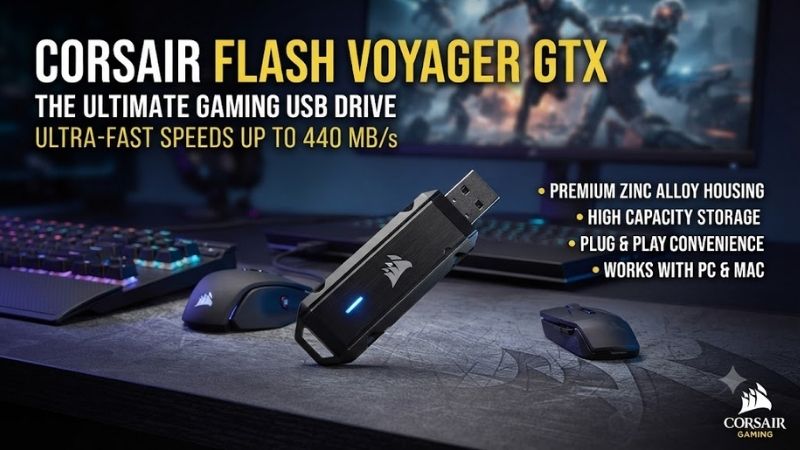
The 256GB Flash Voyager GTX provides the strongest balance between capacity, performance, and practical portability. It uses Corsair’s USB 3.1 Gen 1 interface and high-speed 3D NAND, with official sequential performance reaching up to 440MB/s read and 440MB/s write under compatible test conditions.
A 256GB capacity is large enough for substantial video projects, RAW photo libraries, portable game files, software installers, backups, and everyday documents without becoming excessive for users who mainly need a fast transfer device.
Key Features
- 256GB unformatted capacity
- USB 3.1 Gen 1 interface
- USB Type-A connector
- Up to 440MB/s sequential read
- Up to 440MB/s sequential write
- Up to 470MB/s in supported ATTO testing
- 3D NAND flash
- Zinc-alloy housing
- Aluminum accents
- 40G shock rating
- Corsair SSD Toolbox support
- Windows, macOS, and Linux compatibility
- Backward compatibility with USB 3.0 and USB 2.0
What Makes It Different
Performance is the biggest reason to choose the Flash Voyager GTX instead of a normal thumb drive. Basic USB drives can slow dramatically during sustained transfers, particularly when writing large video files or folders containing many gigabytes of data. The GTX is built more like a compact SSD and aims to maintain much higher throughput.
Corsair also lists random 4K performance reaching up to 33K IOPS for reads and 40K IOPS for writes on current USB 3.1 variants. These specifications help explain why the drive can feel more responsive than inexpensive flash storage when working with many smaller files rather than one large sequential transfer.
The metal housing gives the drive a premium and durable feel. At approximately 64 grams, it is heavier than an ordinary plastic USB stick, but the additional weight comes from a much more substantial enclosure intended to protect the internal storage during travel.
Pros
- Excellent read and write speeds
- Useful 256GB capacity
- Rugged metal housing
- SSD-style performance
- Broad operating-system compatibility
- Corsair SSD Toolbox support
- Backward-compatible USB-A connection
Cons
- More expensive than ordinary flash drives
- Larger and heavier than compact USB sticks
- USB-A rather than USB-C
- Maximum speed requires a fast USB host port
- Can block adjacent ports on tightly spaced devices
Use Case and Who It’s For
The 256GB version is best for photographers, video editors, technicians, students, content creators, and professionals who routinely move large files. It offers enough space for serious workloads without paying for the much larger 1TB capacity when that amount of portable storage is unnecessary.
Corsair Flash Voyager GTX 512GB
Best For: Large media libraries
The 512GB Flash Voyager GTX doubles the capacity of the 256GB version while maintaining the same basic performance architecture. Corsair specifies USB 3.1 Gen 1, up to 440MB/s CrystalDiskMark sequential read and write speeds, and up to 470MB/s sequential performance under ATTO testing.
This capacity is particularly useful for media-heavy workflows. A 512GB drive can carry large collections of high-resolution photos, video footage, virtual machines, portable project files, or game installers while remaining much smaller physically than a portable external SSD.
Key Features
- 512GB unformatted capacity
- Up to 440MB/s sequential read
- Up to 440MB/s sequential write
- USB 3.1 Gen 1
- USB-A connector
- 3D NAND
- Rugged zinc-alloy chassis
- Aluminum trim
- 40G shock specification
- SSD Toolbox compatibility
- Cross-platform support
- Backward compatibility
What Makes It Different
The main reason to choose 512GB is convenience. Users working with modern 4K video, large Lightroom catalogs, design assets, or several game backups can exceed 128GB or 256GB surprisingly quickly. Doubling capacity reduces the need to constantly delete old data before beginning another transfer.
It also provides enough space to serve as a portable project drive. A user can maintain current files on the Voyager GTX and move between desktop and laptop systems without carrying a larger external SSD enclosure.
The USB Type-A connector remains widely useful on desktops, workstations, consoles, and older laptops. However, users with modern ultrabooks that only provide USB-C will need an adapter or hub, making a native USB-C SSD potentially more convenient for those systems.
Pros
- Large 512GB capacity
- Fast sequential transfers
- Strong random performance
- Durable enclosure
- Excellent for media files
- Driver-free operation
- Suitable for multiple operating systems
Cons
- Higher cost than 256GB
- No native USB-C connector
- Larger than standard thumb drives
- Performance depends on host hardware
- More expensive per drive than budget flash storage
Use Case and Who It’s For
Choose the 512GB Flash Voyager GTX if you regularly move large video, photography, game, or development files but still want a device small enough to keep in a pocket or laptop bag. It is also a strong option for professionals who want one fast portable drive instead of several small USB sticks.
Corsair Flash Voyager GTX 1TB
Best For: Maximum portable capacity
The 1TB Flash Voyager GTX is the largest current option in the family and turns the concept of a USB thumb drive into something much closer to a compact external SSD. Corsair lists the same headline sequential performance of up to 440MB/s read and write, along with USB 3.1 Gen 1 connectivity.
One terabyte is substantial for a flash drive. It can hold large video projects, multiple system images, extensive game libraries, creative assets, development environments, or a sizable collection of personal media while occupying very little physical space.
Key Features
- 1TB unformatted capacity
- Up to 440MB/s sequential read
- Up to 440MB/s sequential write
- Up to 470MB/s ATTO sequential performance
- USB 3.1 Gen 1
- High-speed 3D NAND
- Zinc-alloy body
- 40G shock rating
- USB-A interface
- SSD Toolbox support
- Windows, macOS, and Linux compatibility
What Makes It Different
Capacity is clearly the main advantage. Many conventional flash drives are used as temporary transfer devices because they cannot hold an entire working library. The 1TB Voyager GTX can function more like a genuine portable storage drive that happens to use the shape of an oversized USB stick.
That makes it useful for people who dislike carrying cables. Traditional external SSDs generally require a USB cable, whereas the Voyager GTX plugs directly into the computer. There is no separate cable to lose, pack, or replace.
The trade-off is price. Corsair’s official pricing places the 1TB version significantly above basic flash drives, and buyers should compare it with modern portable NVMe SSDs before purchasing. External SSDs may offer much faster interfaces, especially when USB 10Gbps or 20Gbps connectivity is available.
Pros
- Massive 1TB capacity
- SSD-class transfer performance
- No cable required
- Rugged metal design
- Excellent for portable project storage
- Strong OS compatibility
- Small compared with external drives
Cons
- Expensive
- USB 3.1 Gen 1 limits maximum throughput
- USB-A only
- Heavier than normal flash storage
- External SSDs can offer faster modern interfaces
Use Case and Who It’s For
The 1TB version is best for professionals who need a large portable library and strongly prefer direct plug-in storage. Video editors, photographers, IT technicians, developers, and users who transport hundreds of gigabytes at a time will gain the most from the extra capacity.
Corsair Flash Voyager GTX 128GB
Best For: Fast portable work files
The 128GB version provides the lowest capacity in the current Flash Voyager GTX USB 3.1 lineup while retaining the family design and performance target. Corsair still specifies up to 440MB/s sequential read and write speeds, allowing users to gain the performance benefits without purchasing more storage than they need.
For office files, software tools, school projects, compressed backups, photography selections, and operating-system installers, 128GB remains a useful capacity. It is also easier to justify for users who mainly care about transfer speed rather than carrying an entire media collection.
Key Features
- 128GB capacity
- USB 3.1 Gen 1 interface
- Up to 440MB/s sequential read
- Up to 440MB/s sequential write
- 3D NAND
- USB Type-A
- Zinc-alloy enclosure
- 40G shock rating
- SSD Toolbox support
- Cross-platform compatibility
What Makes It Different
The 128GB model provides the same general GTX experience in the smallest capacity. This makes it useful for buyers who need a premium high-speed USB drive but do not want to pay for hundreds of gigabytes they will rarely use.
It is particularly useful as a toolkit drive. PC technicians can store operating-system images, diagnostic utilities, drivers, firmware files, and recovery software while benefiting from much faster transfer speeds than a cheap promotional USB stick.
The limitation is capacity per dollar. High-performance storage becomes easier to justify at 256GB or 512GB because modern project files are large. A 128GB drive can fill quickly once video footage, virtual machines, or modern game installations are involved.
Pros
- Same premium GTX design
- Fast read and write speeds
- Good for recovery and toolkit use
- Rugged construction
- Compact portable storage
- Broad compatibility
Cons
- Lowest capacity in the range
- Can fill quickly with video
- Premium pricing for 128GB
- USB-A connector
- Larger than ordinary small flash drives
Use Case and Who It’s For
The 128GB Flash Voyager GTX is best for users who prioritize speed over capacity. It works well as a professional toolkit, recovery drive, fast document transporter, or dedicated storage device for selected projects rather than a complete portable media library.
Corsair Flash Voyager GTX USB 3.1 vs Older USB 3.0 Version
Corsair previously sold Flash Voyager GTX USB 3.0 models using an SSD controller and NAND flash. Earlier versions could reach up to approximately 450MB/s reads and 360MB/s writes under some test conditions, although performance specifications varied by capacity and benchmark.
The newer USB 3.1 Gen 1 generation uses 3D NAND and is officially rated up to 440MB/s for both sequential reading and writing under CrystalDiskMark testing. That makes the current generation substantially more balanced for workloads requiring frequent large writes.
Older models can still be useful when found at a low price, but buyers should verify the exact model number. Different generations share very similar names, so assuming every Flash Voyager GTX delivers identical performance can lead to incorrect expectations.
How Fast Is The Corsair Flash Voyager GTX?
Corsair rates current Flash Voyager GTX USB 3.1 drives for sequential read and write speeds up to 440MB/s. ATTO figures can reach up to around 470MB/s under supported conditions.
Real-world transfers will usually be lower because storage performance depends on the host controller, USB port, file size, file system, operating system, source drive, thermal conditions, and background workloads.
Copying one large video file generally produces higher throughput than moving thousands of tiny documents because small-file workloads require many more individual operations.
Using a USB 2.0 port will dramatically limit performance. The GTX is backward compatible, but compatibility does not mean the older interface can deliver USB 3.x transfer speeds.
Is Corsair Flash Voyager GTX An SSD?
It is physically a USB flash drive, but Corsair designed it using technologies associated with SSD storage. The company describes the product as providing SSD-style performance and supports management through Corsair SSD Toolbox.
This design explains why the GTX can significantly outperform ordinary USB sticks. Higher-quality NAND and a more capable controller provide stronger sequential and random performance.
However, a modern external NVMe SSD can still be much faster. USB 10Gbps and faster enclosures can exceed the throughput ceiling of the Voyager GTX’s USB 3.1 Gen 1 interface.
Corsair Flash Voyager GTX vs Portable SSD
The main advantage of the Voyager GTX is convenience. It plugs directly into a USB-A port and requires no cable. For users frequently moving between several desktop computers, this can be simpler than carrying an external SSD and cable.
Portable SSDs usually provide more modern connectivity and better performance scaling. Many USB-C models reach around 1,000MB/s or higher, substantially above the GTX’s roughly 440MB/s rating.
A portable SSD can also be physically easier to connect when USB ports are closely spaced. The Voyager GTX has a relatively wide body that may interfere with adjacent connectors on some laptops and compact PCs.
Choose the GTX for direct plug-in convenience. Choose a modern external SSD when maximum speed, USB-C connectivity, or multi-gigabyte-per-second interfaces are the priority.
How To Choose A Corsair Flash Voyager GTX Capacity
Choose 128GB For Essential Files
The 128GB version makes sense for operating-system images, diagnostic utilities, office files, and smaller project libraries. It provides the performance of the GTX family without paying for excessive capacity.
Choose 256GB For The Best Balance
The 256GB version is the easiest recommendation for most users. It provides enough storage for large transfers while remaining practical for users who do not maintain huge video or game collections.
Choose 512GB For Creative Work
The 512GB model is better for photographers, editors, designers, and users who frequently move large media libraries. It offers enough space to keep substantial projects together rather than splitting them across several drives.
Choose 1TB For Maximum Portability
The 1TB version makes sense when the drive will function as a complete portable storage library. It is especially valuable when avoiding cables and carrying one compact device are more important than getting the fastest possible USB-C SSD.
FAQ
Is Corsair Flash Voyager GTX fast?
Yes. Current USB 3.1 Gen 1 versions are rated for up to 440MB/s sequential reads and writes, making them substantially faster than basic USB flash drives. Actual performance varies according to the computer and workload.
Is the Flash Voyager GTX USB-C?
No. Current Flash Voyager GTX models use a standard USB Type-A connector. A USB-C adapter or hub is required for laptops and tablets that lack full-size USB-A ports.
What capacities are available?
Corsair offers the USB 3.1 generation in 128GB, 256GB, 512GB, and 1TB capacities. Availability can vary by region because some capacities are frequently out of stock.
Can I use it on Mac and Linux?
Yes. Corsair lists compatibility with Windows, macOS, and Linux without requiring a special driver. You may need to choose an appropriate file system if the same drive will regularly move between different operating systems.
Is 256GB or 512GB better?
Choose 256GB for general file transfer and everyday professional use. Choose 512GB when working with large video footage, photography libraries, games, virtual machines, or other projects that can quickly consume hundreds of gigabytes.
Is the 1TB version worth buying?
It can be worthwhile when you specifically want a large, direct-connect USB-A drive. If maximum performance or USB-C connectivity matters more, compare it against modern portable external SSDs before purchasing.
Conclusion
The Corsair Flash Voyager GTX remains an unusual high-performance USB drive that combines SSD-style speed with direct USB-A convenience. The 256GB version offers the best overall balance, 512GB suits large creative projects, 1TB provides maximum portable capacity, and 128GB works well for fast toolkits and essential files.