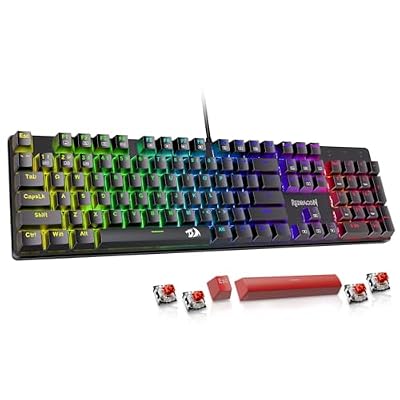
- Top Pick: Redragon Mechanical Gaming Keyboard Wired, 11 Programmable Backlit Modes, Hot-Swappable Red Switch, Anti-Ghosting, Double-Shot PBT Keycaps, Light Up Keyboard for PC Mac
- Best Value: Razer BlackWidow V4 X Mechanical Gaming Keyboard, Yellow Switches, Black
- Premium Choice: Logitech G413 SE Full-Size Mechanical Gaming Keyboard – Black
Mechanical keyboards used to be a luxury purchase, but the sub-$50 market has quietly become one of the most competitive segments in PC gaming. The problem is that it’s also the most crowded and the most inconsistent: for every board with genuine hot-swappable sockets and double-shot PBT keycaps, there are a dozen with mushy membrane switches hiding behind “mechanical-feel” marketing, thin ABS caps that go shiny in three months, or RGB so poorly diffused it looks like a novelty toy. Spending badly at this price hurts more than spending badly at $150, because there’s no headroom for regret.
This guide cuts through that. We’ve focused on boards that deliver real mechanical switches, durable keycaps, and reliable anti-ghosting at a price that genuinely stays under $50 — not a $50 “sale price” that snaps back to $90 next week. Below you’ll find what actually matters when shopping this tier, honest reviews of the strongest options available in 2026, and answers to the questions we get asked most often by first-time buyers.
As an Amazon Associate we earn from qualifying purchases at no extra cost to you.





⚡ Save on Your Next PC — Amazon Prime
Prime members get fast free shipping on the systems above, plus early access to Prime Day & Black Friday PC deals. New members get a 30-day free trial.
Watch: Best Mechanical Keyboard Under $50 — Video Review
How to Choose Mechanical Keyboard Under $50
- Verify the switches are truly mechanical: At this price, “mechanical-feel” and “mecha-membrane” are marketing terms for rubber dome boards. Look for a named switch type — linear reds, tactile browns, or clicky blues — and a stated actuation force and lifespan rating in the 50–80 million keystroke range.
- Prioritise PBT keycaps over ABS: Double-shot PBT resists the greasy shine that develops on cheap ABS caps within a few months of daily use, and the legends never wear off because they’re moulded rather than printed. This single spec does more for long-term satisfaction than any amount of RGB.
- Decide if hot-swap matters to you: Hot-swappable sockets let you change switch feel later without soldering, turning a $45 board into a platform you can upgrade. If you’re new to mechanical keyboards and unsure whether you prefer linear or tactile, it’s genuinely worth prioritising.
- Check anti-ghosting and rollover claims carefully: Full N-key rollover over USB is ideal, but 6-key rollover is perfectly adequate for the vast majority of games. Be wary of boards advertising anti-ghosting only on a limited cluster of gaming keys, which is a common corner-cut at this tier.
- Match the layout to your desk and your games: Full-size boards give you a numpad for productivity and MMOs; 75% and TKL layouts free up significant mouse room for low-sensitivity FPS play. Measure your desk before you buy — layout regret is the most common complaint we hear.
The Best Picks Reviewed
AULA F75 Pro Wireless
The F75 Pro is the most feature-dense board on this list by a wide margin, combining a 75% layout, a control knob, tri-mode connectivity via 2.4GHz, Bluetooth 5.0 and USB-C, hot-swappable sockets and pre-lubed Reaper switches — a spec sheet that would have cost triple this three years ago. The side-printed PBT keycaps and gasket-style typing feel make it our overall pick for anyone who wants a genuine enthusiast experience on a budget.
Redragon Hot-Swappable Wired
This is the safest recommendation for a first mechanical keyboard: linear red switches that suit both gaming and typing, double-shot PBT keycaps that will still look new next year, and hot-swap sockets so you can experiment with tactiles later without buying a new board. The 11 backlight modes are single-zone rather than per-key RGB, but they’re clean and well-diffused, and full anti-ghosting means no missed inputs during frantic moments.
Redragon K580
The K580 is the enthusiast-adjacent pick for players who want dedicated macro keys and a media wheel without stepping up to a $100 board, and it’s a natural fit for MMO, MOBA and streaming setups where quick binds and volume control genuinely earn their keycaps. Per-key RGB is brighter and better implemented here than on most sub-$50 competitors, though the ABS keycaps are the clearest compromise.
Logitech G413 SE
The G413 SE is the build-quality champion of this price bracket, with an aluminium-alloy top plate that removes almost all flex and tactile mechanical switches that feel considerably more refined than the switch quality typically found at this price. You trade RGB for single-colour white backlighting and there’s no hot-swap, but if you value a board that feels solid and simply works for years, this is the one.
Razer BlackWidow V4 X
The BlackWidow V4 X is the most premium-feeling option here when you can catch it at the right price, pairing Razer’s linear yellow switches — light, fast and quiet, ideal for competitive FPS — with per-key Chroma RGB and dedicated macro keys. It sits at the very top of this budget and often drifts above it, so buy on a genuine discount rather than at list price.
Frequently Asked Questions
Are sub-$50 mechanical keyboards actually good for gaming?
Yes. Switch technology has commoditised to the point that a $45 board’s actuation speed and reliability are functionally identical to a $150 board’s for gaming purposes. What you give up at this price is acoustic tuning, premium case materials, software depth and warranty support — none of which affect your in-game performance.
Should I choose linear, tactile or clicky switches?
Linear switches (reds, yellows) are smooth with no bump and are generally preferred for fast-paced competitive gaming. Tactile switches (browns) give you a noticeable bump at actuation that many people find better for typing accuracy. Clicky switches (blues) add an audible click — satisfying to use, but avoid them if you share a room or use voice chat.
Is hot-swappability worth paying extra for?
If you’re new to mechanical keyboards, it’s arguably the single most valuable feature at this price, because it lets you correct a switch preference mistake for the cost of a $15 switch set rather than a whole new keyboard. If you already know exactly what switch you like, you can safely deprioritise it in favour of build quality.
Do I need wireless, and does it add input lag?
Modern 2.4GHz wireless with a dedicated dongle is effectively lag-free and indistinguishable from wired in blind testing; Bluetooth is noticeably slower and is best reserved for productivity or travel. Wireless is a desk-tidiness and flexibility feature, not a performance one, so only pay for it if you’ll genuinely use it.
Final Thoughts
If you want the most keyboard for your money in 2026, the AULA F75 Pro is the clear value leader — tri-mode wireless, hot-swap sockets, a control knob and PBT caps at this price is a combination that simply didn’t exist at the budget tier a few years ago. For a first mechanical keyboard where reliability matters more than features, the Redragon hot-swappable wired board is the safest possible starting point, while the Logitech G413 SE remains the pick for anyone who’d rather have an aluminium plate and years of trouble-free service than RGB and extra buttons.
Top picks from this guide
 Logitech GLogitech G213 Prodigy Wired RGB Gaming Keyboard - Black$55 \xc2\xb7 99/100
 RedragonRedragon Mechanical Gaming Keyboard Wired, 11 Programmable Backlit Modes, Hot-Swappable…$30 \xc2\xb7 98/100
 RedragonRedragon K580 Wired RGB Mechanical Gaming Keyboard, Macro Key &…$53 \xc2\xb7 97/100
 RazerRazer BlackWidow V4 X Mechanical Gaming Keyboard, Yellow Switches, Black$85 \xc2\xb7 97/100