- Top Pick: Sceptre New 22-Inch Gaming Monitor, FHD 1080p, Up to 144Hz, HDMI, DisplayPort, Built-in Speakers, Machine Black (E225W-FW144 Series, 2026)
- Best Value: Samsung 27" Odyssey G5 (G51F) Series QHD (1440P) Gaming Monitor
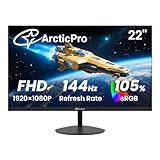
- Premium Choice: ArcticPro 22 Inch Gaming Monitor 144Hz, FHD Computer Monitor, 105% sRGB
Shopping for a gaming monitor under $200 in 2026 means navigating a market flooded with panels that promise “144Hz gaming performance” but quietly cut corners on color accuracy, response time, or panel uniformity. The result is a screen that looks fine in a product photo and disappointing on your desk. The good news is that budget monitors have genuinely improved: high refresh rates, adaptive sync, and near-full sRGB coverage are now realistic expectations at this price rather than premium extras.
This guide covers six monitors that deliver real value below the $200 mark, spanning compact 22-inch 144Hz panels for competitive shooters, larger 27-inch displays for immersive single-player games, and a curved option for sim racing and open-world titles. We’ve focused on what actually matters at this budget — refresh rate, panel quality, connectivity, and whether each screen justifies its price against the competition.
As an Amazon Associate we earn from qualifying purchases at no extra cost to you.







⚡ Save on Your Next PC — Amazon Prime
Prime members get fast free shipping on the systems above, plus early access to Prime Day & Black Friday PC deals. New members get a 30-day free trial.
Watch: Best Gaming Monitor Under $200 — Video Review
How to Choose Gaming Monitor Under $200
- Refresh rate over resolution: At this budget, a 1080p panel at 144Hz will feel dramatically smoother than a 1440p panel at 60Hz. Prioritize frames unless you play slower, visually driven games.
- Panel type matters: IPS panels give you better color and viewing angles, VA panels deliver deeper contrast for dark scenes, and TN panels are increasingly rare but still fastest. Most sub-$200 monitors now use IPS or VA — check before buying.
- Adaptive sync is non-negotiable: AMD FreeSync (and G-Sync Compatible certification) eliminates screen tearing without the input lag of V-Sync. Nearly every monitor here supports it, and there’s no reason to buy one that doesn’t.
- Check the ports you’ll actually use: DisplayPort is required to hit maximum refresh rates on most budget panels. If a monitor is HDMI-only, verify it supports HDMI 2.0 or higher, or you may be capped at a lower refresh rate.
- Ignore inflated response time claims: Marketing figures of “1ms” typically refer to grey-to-grey with aggressive overdrive that introduces ghosting. Real-world performance on a good budget IPS panel lands closer to 4-6ms, which is perfectly playable.
The Best Picks Reviewed
Sceptre 22″ 144Hz (E225W-FW144)
This is the value benchmark for competitive play: a genuine 144Hz refresh rate with both HDMI and DisplayPort inputs, at a price that leaves room in the budget for a decent mouse. The 22-inch size keeps the entire playfield in your central vision, which is exactly what you want for shooters, and the built-in speakers are a useful fallback even if they’re no substitute for a headset.
Samsung 27″ Odyssey G5 (G51F)
The standout pick if you can stretch to the top of the budget — QHD resolution on a 27-inch panel gives you noticeably sharper text and more visible detail than any 1080p option here, without the pixel density looking stretched. It’s the only monitor on this list that will still feel current when you upgrade your GPU in a couple of years.
ArcticPro 22″ 144Hz
A strong alternative to the Sceptre in the same size and refresh bracket, with 105% sRGB coverage that makes it the better choice if you edit photos or video between gaming sessions. Colors are noticeably more saturated out of the box than typical budget panels, though you’ll want to calibrate slightly for accurate work.
Sceptre 27″ Prime (E275W-FW100T)
At 100Hz and 27 inches with 100% sRGB coverage and dual HDMI plus DisplayPort, this hits a sweet spot for players who want screen real estate more than raw frame rate. It’s the right pick for RPGs, strategy games, and anyone splitting time between gaming and desk work, where the extra size pays off constantly.
Philips 22″ 100Hz (221V8LB)
The VA panel here delivers deeper blacks and stronger contrast than the IPS competition, which makes a real difference in horror games and dark environments. Flicker-free backlighting and VESA mounting support round out a monitor that’s best understood as an excellent all-rounder rather than a specialist esports display.
Frequently Asked Questions
Is 1080p still acceptable for gaming in 2026?
Absolutely, particularly at 22 to 24 inches where pixel density remains high enough that individual pixels aren’t visible at normal viewing distance. 1080p also lets mid-range and older GPUs push high frame rates, which matters more for feel than resolution does.
Do I need 144Hz, or is 100Hz enough?
For competitive shooters and fast-paced action, 144Hz is a meaningful advantage. For most other genres, the jump from 60Hz to 100Hz delivers the majority of the perceived smoothness improvement, and the remaining gain has diminishing returns.
Will a curved monitor help my gaming?
On a 24-inch panel the curve is subtle, offering mild immersion benefits in racing and open-world games without the distortion issues that plague larger aggressive curves. It’s a nice-to-have rather than a deciding factor at this size.
Can these monitors handle console gaming?
Yes, though check HDMI specifications carefully. Current-generation consoles output 120Hz at 1080p over HDMI 2.1, but most budget monitors use HDMI 2.0, which still handles 1080p at 120Hz on the majority of titles.
Final Thoughts
If your priority is competitive performance, the Sceptre 22-inch 144Hz remains the smartest value buy on this list, delivering the refresh rate that matters at a price that undercuts nearly everything else. Players who want a display that will age gracefully should stretch to the Samsung Odyssey G5, whose QHD panel is genuinely future-proof at this budget. And for anyone splitting time between gaming and productivity, the Sceptre 27-inch Prime offers the most usable screen real estate without sacrificing color accuracy — a combination that’s rare below $200.