🛒 Best Price Today on Amazon
Prime members get fast, free shipping on everything above, plus member-only deals. New members get a 30-day free trial — cancel anytime.
- Quick Verdict
- Quick Comparison Table
- How We Selected These Keyboard Trays
- Best Adjustable Computer Keyboard Tray Picks
- Adjustable Computer Keyboard Tray Buying Guide
- Adjustable Keyboard Trays for Gaming
- Adjustable Keyboard Trays for Standing Desks
- Keyboard Tray vs Keyboard on Desk
- Ergonomic Setup Beyond the Keyboard Tray
- Common Keyboard Tray Buying Mistakes
- Frequently Asked Questions
- Final Verdict
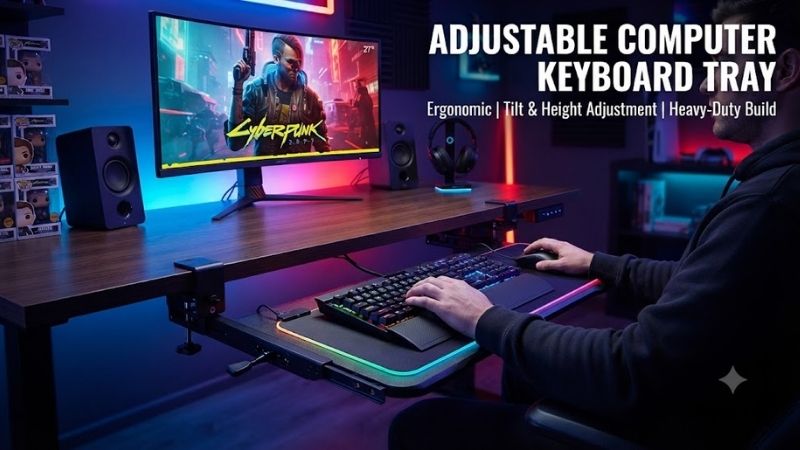
An Adjustable Computer Keyboard Tray can improve desk ergonomics by placing the keyboard and mouse closer to a neutral elbow and wrist position while freeing valuable desktop space. The best option depends on tray width, height adjustment, tilt range, mouse room, mounting method, desk thickness, knee clearance, and whether the workstation is fixed or height adjustable.
Quick answer: For most people in 2026, the best adjustable computer keyboard tray is the 3M Adjustable Keyboard Tray — our #1 rated choice. See the full ranked comparison, alternatives and buying advice below.
Quick Verdict
3M’s Adjustable Keyboard Tray is the strongest choice for users who prioritize ergonomic adjustment over low cost. Its under-desk design is intended to provide flexible keyboard positioning while keeping the work surface clear, making it particularly relevant to long office sessions.
Fellowes Professional Series Sit/Stand Keyboard Tray is a better fit for users who need a broad working surface and more substantial ergonomic positioning. It makes sense in professional workstations where typing posture matters throughout the day.
VIVO’s Large Keyboard Tray Under Desk is the most practical option for buyers who mainly need extra desk space and room for both a full-size keyboard and mouse. Its clamp-mounted design can also avoid drilling into certain desks, though desktop compatibility must be checked carefully.
HUANUO’s Clamp-On Keyboard Tray targets similar users and is particularly convenient for home offices where permanent modification is undesirable. Mount-It!’s under-desk tray is more appropriate for users who prefer a mounted sliding design.
Kensington SmartFit Clamp-On Keyboard Drawer is the simplest choice for office and compact-desk users who want an accessible keyboard platform without turning their desk into a complicated ergonomic installation.
Quick Comparison Table
| Product | Best For | Adjustment Style | Main Advantage | Trade-Off |
|---|---|---|---|---|
| 3M Adjustable Keyboard Tray | Best overall ergonomics | Articulating under-desk | Broad positioning control | More involved installation |
| Fellowes Professional Series Sit/Stand Tray | Professional workstations | Adjustable arm | Strong ergonomic flexibility | Requires sufficient underside space |
| VIVO Large Keyboard Tray Under Desk | Large keyboards and gaming | Clamp-on sliding tray | Spacious work area | Clamps remain visible |
| HUANUO Keyboard Tray Under Desk | No-drill home offices | Clamp-on | Straightforward installation | Less adjustment than premium arms |
| Mount-It! Keyboard Tray Under Desk | Fixed desk setups | Sliding under-desk mount | Clean permanent installation | Desk drilling may be required |
| Kensington SmartFit Clamp-On Keyboard Drawer | Compact office use | Clamp-on drawer | Simple ergonomic positioning | More basic adjustment |
How We Selected These Keyboard Trays
The products were chosen around the main reasons people buy an adjustable keyboard tray: lowering the keyboard below desktop height, improving wrist and elbow position, recovering usable desk space, and creating enough room for both keyboard and mouse movement.
Adjustment quality received more weight than appearance. An ergonomic tray becomes valuable when the user can position the keyboard at a comfortable height and, where supported, alter tilt or distance from the desk. A tray that merely slides out but remains too high may create little ergonomic improvement.
Tray width was another important consideration. Compact office keyboards require relatively little space, but full-size keyboards can consume much of a narrow platform. Gamers also need enough remaining room for the mouse, making larger trays much more practical for combined keyboard-and-mouse use.
Mounting style was considered because not every desktop can accept screws. Clamp-on trays are attractive for renters and users who do not want permanent modification. Screw-mounted systems can create a cleaner installation but require an appropriate solid mounting surface.
We also considered knee clearance and desk construction. An under-desk mechanism occupies physical space beneath the work surface, and thicker trays or adjustment arms can interfere with the user’s legs. Compatibility therefore involves more than simply matching desktop width.
Best Adjustable Computer Keyboard Tray Picks
3M Adjustable Keyboard Tray — Best Overall Ergonomic Choice
Best For: Long office sessions and users who need substantial ergonomic adjustment.
Why We Picked It: 3M’s adjustable keyboard-tray systems focus more heavily on ergonomic positioning than basic pull-out drawers. Their articulating mechanism is designed to move the keyboard away from the fixed height of the desktop, allowing users to create a typing position better matched to chair and elbow height.
Key Features
- Under-desk installation
- Articulating adjustment mechanism
- Keyboard and mouse platform
- Height positioning
- Tilt adjustment on compatible versions
- Retractable design
- Wrist-support features on selected models
Features & Benefits: Height adjustment is important because many desks are too tall for comfortable typing when the user’s chair is positioned correctly for their legs. Lowering the keyboard can allow the elbows to remain closer to a relaxed angle instead of forcing the shoulders upward.
Negative tilt can also be useful. Rather than raising the back edge of the keyboard toward the user, an ergonomically positioned tray may allow the keyboard to remain flatter or angle slightly away, helping reduce unnecessary wrist extension.
The retractable design lets the platform move under the desk when not needed, preserving room around the workstation.
Performance & Practical Use: Articulating hardware requires more under-desk clearance than a simple sliding shelf. Users need to examine crossbars, drawers, cable-management channels, and standing-desk mechanisms before installation.
The mounting surface must also be structurally suitable for the tray, keyboard, mouse, and pressure generated during typing.
What Makes It Different: This is primarily an ergonomic positioning system rather than a simple space-saving keyboard shelf.
Pros
- Strong ergonomic adjustability
- Keyboard and mouse support
- Retracts beneath desk
- Suitable for prolonged office work
Cons
- More complicated installation
- Requires sufficient under-desk clearance
Buy If: You spend many hours typing and need height and angle control rather than only extra desk space.
Skip If: You only need an inexpensive shelf for occasional keyboard use.
Fellowes Professional Series Sit/Stand Keyboard Tray — Best for Professional Workstations
Best For: Ergonomic offices and workstations used throughout the day.
Why We Picked It: Fellowes Professional Series keyboard trays are aimed at users who need more deliberate positioning than a fixed drawer can provide. An adjustable arm allows the keyboard platform to move relative to the desktop, which is useful when workstation geometry does not naturally place the hands at a comfortable height.
Key Features
- Under-desk mounting
- Adjustable arm
- Keyboard and mouse platform
- Height adjustment
- Tilt positioning
- Retractable storage
- Professional workstation design
Features & Benefits: A separate mouse area or sufficiently wide platform can keep the mouse at roughly the same height as the keyboard. This is important because lowering the keyboard while leaving the mouse high on the desktop can simply transfer strain from one arm to the other.
Adjustability also makes the system more useful when several people share one workstation. Different users can reposition the tray rather than adapting their chair and posture around a fixed keyboard surface.
For sit/stand workflows, a properly mounted tray can help maintain keyboard positioning as workstation height changes, although compatibility with the specific desk mechanism must be confirmed.
Performance & Practical Use: The mechanism requires adequate depth beneath the desktop for both installation and retraction. Desk support rails located near the front edge can interfere with the mounting track.
A premium tray also makes little sense if the chair, monitor, and desk remain poorly positioned. It should be considered part of the entire ergonomic workstation.
What Makes It Different: Fellowes emphasizes professional ergonomic adjustability instead of simply creating a place to store the keyboard.
Pros
- Useful height adjustment
- Keyboard and mouse positioning
- Appropriate for long work sessions
- Retractable platform
Cons
- Requires careful desk compatibility checks
- More hardware beneath the desk
Buy If: Ergonomic positioning is more important than minimal cost.
Skip If: You cannot mount a track beneath your desk.
VIVO Large Keyboard Tray Under Desk — Best for Full-Size Keyboards
Best For: Gaming keyboards, full-size office keyboards, and users who need a wide work surface.
Why We Picked It: VIVO’s large under-desk keyboard tray prioritizes usable platform width. That is important for anyone using a full-size keyboard with a number pad because narrow trays can leave almost no room for the mouse.
Key Features
- Large keyboard platform
- Space for keyboard and mouse
- Clamp-on installation on compatible versions
- Sliding under-desk storage
- No-drill installation concept
- Raised edge or platform retention features depending on version
Features & Benefits: A large tray allows the keyboard and mouse to remain on the same surface. This creates more consistent arm positioning and prevents the awkward situation where the keyboard sits below the desk while the mouse stays several inches higher.
Gamers also benefit from extra horizontal room, although users who play at very low mouse sensitivity may still require more movement area than a keyboard tray can provide.
Clamp installation is appealing to renters and users who may change desks later. Removing the clamps leaves less permanent modification than screw-mounted tracks.
Performance & Practical Use: Clamp systems require exposed desktop edges and compatible thickness. Desks with large aprons, drawers, metal frames, beveled edges, or unusual shapes may prevent proper installation.
The clamps can also occupy visible space along the front or sides of the desk.
What Makes It Different: Its priority is large usable surface area rather than advanced articulating ergonomics.
Pros
- Room for full-size keyboard and mouse
- No-drill installation on clamp version
- Frees desktop space
- Straightforward sliding design
Cons
- Clamp compatibility varies
- Less sophisticated ergonomic positioning
Buy If: You want a large tray without permanently drilling into your desk.
Skip If: You need extensive height and tilt adjustment.
HUANUO Keyboard Tray Under Desk — Best No-Drill Home Office Option
Best For: Renters, home offices, and users who want simple installation.
Why We Picked It: HUANUO’s clamp-on keyboard tray offers a straightforward way to move the keyboard below the desktop without attaching a permanent rail system. It is particularly useful for conventional home-office desks where users want more working surface but do not want to drill holes.
Key Features
- Clamp-on mounting
- Under-desk placement
- Sliding keyboard platform
- Keyboard-and-mouse space
- Removable installation
- Desktop-space-saving design
Features & Benefits: Moving the keyboard below the main surface immediately creates room for notebooks, tablets, documents, or larger monitor stands.
The lower keyboard position can also improve typing posture when the desktop itself sits above ideal elbow height. However, this benefit depends on the tray’s final height relative to the user’s chair.
Clamp mounting makes installation reversible. This is valuable when the desk belongs to a rental property, employer, dormitory, or temporary workspace.
Performance & Practical Use: A clamp-on tray normally provides less ergonomic adjustment than a true articulating arm. Users should therefore measure how far below the desktop the keyboard will sit before purchasing.
Knee clearance is another consideration. Lowering a wide platform beneath a shallow desk can bring it close to the user’s thighs, particularly when the chair is raised.
What Makes It Different: It balances desk-space savings, keyboard-and-mouse support, and installation simplicity.
Pros
- No drilling on compatible desks
- Easy to remove
- Creates additional desktop space
- Suitable for home-office setups
Cons
- Limited height adjustment
- Clamps require a compatible desk edge
Buy If: You want an easily removable tray for a standard desk.
Skip If: Your desk has drawers, thick framing, or no suitable clamping surface.
Mount-It! Keyboard Tray Under Desk — Best Permanent Sliding Setup
Best For: Fixed home offices and workstations where a clean installation matters.
Why We Picked It: Mount-It!’s under-desk keyboard solutions appeal to users who prefer a mounted sliding tray rather than visible front-edge clamps. A fixed installation can look cleaner and remain stable when the workstation will not be moved frequently.
Key Features
- Under-desk mounting
- Sliding tray mechanism
- Keyboard and mouse platform
- Retractable storage
- Permanent hardware installation
- Space-saving workstation design
Features & Benefits: Mounting the keyboard beneath the desk opens the primary work surface for monitors, speakers, documents, controllers, or other equipment.
A permanently installed track also avoids front-edge clamps that may interfere with the visual appearance of a desk or with where the user’s arms naturally rest.
The tray can slide away when the workstation is not in use, making the desk appear less cluttered.
Performance & Practical Use: Installation is more demanding because screw placement must avoid weak desktop material and internal desk structures. Users should not drill into thin hollow sections without confirming that the mounting surface is designed to carry the load.
The track also consumes underside depth, so desks with drawers or cable trays may not provide enough room.
What Makes It Different: It offers a cleaner fixed appearance than typical clamp-on trays.
Pros
- Clean under-desk installation
- Retractable
- Frees desktop surface
- Suitable for permanent workstations
Cons
- May require drilling
- Harder to move to another desk
Buy If: You own the desk and want a more permanent installation.
Skip If: You need a completely reversible setup.
Kensington SmartFit Clamp-On Keyboard Drawer — Best for Compact Office Desks
Best For: Basic office work, smaller workspaces, and straightforward keyboard positioning.
Why We Picked It: Kensington’s SmartFit keyboard-drawer approach targets users who need an uncomplicated platform beneath the desk rather than a large articulating mechanism. It is particularly useful where the primary goal is creating extra desktop room and improving keyboard height.
Key Features
- Clamp-on installation
- Under-desk keyboard storage
- Sliding platform
- Space-saving design
- Office-focused construction
- Removable mounting method
Features & Benefits: A compact tray works well with tenkeyless or standard office keyboards where large gaming mouse movements are not required. Lowering the input surface can also help users whose fixed desk places the keyboard noticeably above elbow height.
Clamp mounting reduces installation complexity and makes the tray easier to transfer to another workstation later.
This can be useful in flexible offices where employees change locations or where furniture cannot be permanently modified.
Performance & Practical Use: Compact trays provide less room than large gaming-oriented models. Users with full-size keyboards should verify that enough horizontal space remains for the mouse.
Adjustment is also more limited than premium articulating systems, so it should be selected primarily for straightforward ergonomic improvement and organization.
What Makes It Different: It focuses on office simplicity and removable mounting rather than advanced adjustment.
Pros
- Simple clamp installation
- Suitable for smaller desks
- Easy to remove
- Frees desktop space
Cons
- Limited mouse room on compact versions
- Less ergonomic adjustment than articulating trays
Buy If: You want a simple office keyboard drawer without permanent installation.
Skip If: You use a very large gaming keyboard or need extensive tilt and height control.
Adjustable Computer Keyboard Tray Buying Guide
Start With Keyboard and Mouse Width
Measure the actual keyboard before buying a tray.
Typical layouts include:
- Full-size
- 96%
- Tenkeyless
- 75%
- 65%
- 60%
A full-size keyboard can occupy most of a compact tray, leaving insufficient room for a mouse.
For office work, modest mouse space may be enough. Gaming users should allow considerably more horizontal movement.
Height Adjustment
Height is one of the most important ergonomic features.
Ideally, the keyboard should allow the shoulders to remain relaxed while the elbows stay reasonably close to the body.
A desktop that is too high may force users to raise their shoulders or extend their wrists.
An articulating tray can lower the input devices independently of the main work surface.
A simple sliding drawer cannot usually provide the same adjustment range.
Keyboard Tilt
Traditional keyboard feet create positive tilt by raising the back of the keyboard.
That position can increase wrist extension for some users.
Adjustable ergonomic trays may allow flat or negative keyboard tilt, where the front edge is slightly higher than the rear.
The correct position depends on body geometry and typing style, so adjustability is preferable to a single aggressive angle.
Mouse Position
The mouse should remain close enough that the upper arm does not repeatedly reach outward.
A tray wide enough for both keyboard and mouse can help maintain consistent arm height.
Separate mouse platforms can also work, but they should not position the pointing device significantly higher or lower than the keyboard.
Gamers should ensure the platform has enough room for their sensitivity settings.
Desk Thickness
Clamp-on trays have minimum and maximum desk-thickness requirements.
A clamp that cannot open far enough will not fit a thick solid-wood desk.
A thin desktop can create the opposite problem if the clamp cannot tighten securely.
Always measure the actual edge where the tray will be attached rather than relying on the nominal thickness elsewhere.
Desk Edge Shape
Clamp mounts usually work best with a flat, square desk edge.
Potential compatibility problems include:
- Beveled edges
- Curved fronts
- Thick aprons
- Drawers
- Metal frames
- Cable channels
- Glass surfaces
A beautiful tray is useless if the clamp cannot physically reach a solid mounting surface.
Under-Desk Clearance
Look underneath the desk before ordering.
Potential obstructions include:
- Crossbars
- Standing-desk motors
- Control boxes
- Drawers
- Power strips
- Cable trays
- Monitor-arm bolts
Articulating systems require especially careful planning because their tracks and arms use more space than simple clamp-on trays.
Knee and Leg Clearance
Lowering a keyboard inevitably places hardware closer to the user’s legs.
A tray that improves wrist position but constantly touches the thighs is not ergonomic.
Measure chair seat height and knee position while sitting normally.
Standing desks require additional consideration because the user’s body position changes across sitting and standing modes.
Clamp-On vs Screw-Mounted
Choose a clamp-on tray when you:
- Rent your workspace
- Do not want to drill
- Change desks frequently
- Need fast installation
Choose a screw-mounted tray when you:
- Own the desk
- Want a cleaner appearance
- Need a more advanced articulating arm
- Plan to keep the workstation long term
Neither mounting style is automatically more ergonomic.
Sliding vs Articulating Tray
A sliding tray moves primarily forward and backward.
It is useful for:
- Saving desk space
- Hiding the keyboard
- Basic lowering
- Simple installations
An articulating tray can additionally change height and angle.
It is better for users trying to solve a specific ergonomic positioning problem.
The additional flexibility comes with more hardware, higher cost, and greater installation complexity.
Adjustable Keyboard Trays for Gaming
A keyboard tray can work for gaming, but conventional office trays are not always ideal.
Low-sensitivity FPS players often use large mouse pads and broad arm movements. A narrow tray can restrict that motion severely.
Gamers should prioritize:
- Large platform width
- Strong mounting hardware
- Minimal wobble
- Adequate mouse room
- Wrist clearance
- Easy access to keyboard controls
A 60%, 65%, or tenkeyless keyboard can make a tray-based gaming setup significantly more practical.
Adjustable Keyboard Trays for Standing Desks
Standing desks create additional considerations.
A tray attached directly to the desktop moves with the desk, which preserves its relationship to the monitor and other equipment.
However, the tray also reduces the effective keyboard height below the desktop.
This can be helpful if the desk does not lower enough for comfortable seated typing, but users should confirm that the tray remains comfortable in standing mode.
Keyboard Tray vs Keyboard on Desk
Keeping the keyboard on the desktop is simpler and provides unlimited mouse-pad placement.
It works well when the desk height already matches the user’s body.
A tray becomes more useful when:
- Desk height is too high
- Desktop space is limited
- Mouse and keyboard need lower positioning
- The user wants the keyboard hidden when not in use
The tray should solve a real workstation problem rather than being added solely for appearance.
Ergonomic Setup Beyond the Keyboard Tray
A keyboard tray cannot compensate for every workstation issue.
Also consider:
- Chair height
- Seat depth
- Armrest position
- Monitor height
- Monitor distance
- Foot support
- Desk height
- Mouse placement
If lowering the keyboard requires raising the chair, shorter users may need a footrest to maintain stable leg support.
The best setup treats the chair, desk, keyboard, mouse, and display as one system.
Common Keyboard Tray Buying Mistakes
Buying a Tray That Is Too Narrow
Measure both keyboard and mouse requirements.
A full-size keyboard plus a large mouse area needs substantially more width than an office keyboard alone.
Ignoring Desk Hardware
Crossbars and drawers frequently block installation.
Inspect underneath the desk before ordering.
Assuming Clamp-On Means Universal
Clamp range, desk thickness, and edge shape vary.
A clamp-on design still has strict physical requirements.
Blocking Standing Desk Controls
An under-desk rail can interfere with:
- Control panels
- Motors
- Power boxes
- Cable-management trays
Plan component positions before drilling or clamping.
Ignoring Stability
Gaming and fast typing can apply lateral force to a tray.
A platform that flexes or wobbles may feel frustrating even if its dimensions look correct.
Frequently Asked Questions
What Is the Best Adjustable Computer Keyboard Tray?
The 3M Adjustable Keyboard Tray is a strong choice for users who prioritize ergonomic height and tilt positioning, while VIVO’s large under-desk tray is better for users who mainly need space for a full-size keyboard and mouse. The best design depends on desk construction, required adjustment, and available underside clearance.
Are Keyboard Trays Better for Ergonomics?
They can improve ergonomics when a fixed desk places the keyboard too high. A properly adjusted tray can lower the keyboard and mouse so the shoulders remain relaxed and the wrists stay closer to neutral. A poorly positioned tray can create new problems, however, including insufficient knee clearance or excessive reaching.
Should a Keyboard Tray Have Negative Tilt?
Negative tilt can be useful because it may reduce wrist extension compared with raising the keyboard’s rear edge. It is not mandatory for every user. The goal is a comfortable wrist position while typing, so a tray offering adjustable tilt is more flexible than one that permanently forces the keyboard into a specific angle.
Can I Use a Keyboard Tray for Gaming?
Yes, provided the tray is wide and stable enough for both the keyboard and mouse. Low-sensitivity FPS players require much more mouse space than typical office users and may prefer a compact keyboard. Check platform dimensions carefully because many office trays leave very little mouse area beside a full-size keyboard.
Can I Install a Keyboard Tray on a Standing Desk?
Often yes, but the tray must not interfere with the frame, motors, control box, crossbars, or cables. The added drop below the desktop also changes the required standing-desk height. Check comfort in both seated and standing positions and make sure the tray remains stable throughout the desk’s full movement range.
Is a Clamp-On Keyboard Tray Better Than a Screw-Mounted Tray?
Clamp-on trays are better for renters, temporary workstations, and users who do not want permanent desk modifications. Screw-mounted systems can offer cleaner installation and more sophisticated adjustment mechanisms. The better choice depends on the desk material, required ergonomics, installation restrictions, and how often the tray will move.
Final Verdict
The best Adjustable Computer Keyboard Tray depends on whether your priority is true ergonomic adjustment, additional desk space, or easy installation. 3M and Fellowes are the stronger choices for users who need meaningful height and tilt control, while VIVO provides a practical large platform for full-size keyboards and gaming setups.
HUANUO and Kensington are easier to justify for removable home-office installations, while Mount-It! suits users who prefer a clean permanent sliding tray. Before buying any model, measure the keyboard, mouse area, desktop thickness, underside obstructions, and knee clearance—the correct fit matters more than adding the largest number of adjustment features.
Ready to decide? Our #1 pick for 2026 is the 3M Adjustable Keyboard Tray.
Live price & availability on Amazon.