🛒 Best Price Today on Amazon
Prime members get fast, free shipping on everything above, plus member-only deals. New members get a 30-day free trial — cancel anytime.
- Best Keyboards for Esports Compared
- Wooting 80HE — Best for Deep Competitive Tuning
- Razer Huntsman V3 Pro Low-profile Tenkeyless 8KHz — Best Low-Profile Pick
- SteelSeries Apex Pro TKL Gen 3 — Best Balanced TKL Option
- Logitech G PRO X TKL RAPID — Best for Logitech G Users
- Corsair K70 PRO TKL — Best for Wired Tournament Setups
- How to Choose the Best Keyboard for Esports
- Choosing a Keyboard by Esports Genre
- Check Tournament Rules Before Using Input-Priority Features
- FAQ
- Conclusion

Razer Huntsman V3 Pro TKL Esports Gaming Keyboard, Black | Analog Optical Switches, Snap Tap, Rapid Trigger, Adjustable Actuation, Media Keys & Dial, Doubleshot PBT Keycaps, Wrist Rest
Included for 'Best Keyboard for Esports: 5 Competitive Picks for 2026' because the listing specifies Black and Analog Optical Switches, details this guide uses to compare options.
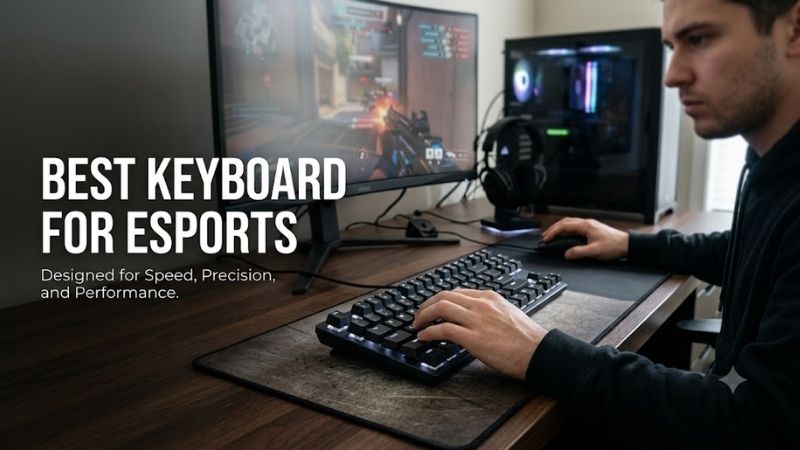
View on AmazonCompetitive players need more than a fast-looking keyboard. The best keyboard for esports should deliver predictable inputs, compact mouse-friendly sizing, adjustable actuation where useful, and settings that survive serious play. This roundup compares five models built around modern competitive features and clear use cases.
Best Keyboards for Esports Compared
| Keyboard | Best For | Switch Technology | Layout | Standout Feature |
|---|---|---|---|---|
| Wooting 80HE | Deep competitive tuning | Analog Hall effect | 80% | Rapid Trigger and per-key actuation |
| Razer Huntsman V3 Pro Low-profile TKL 8KHz | Low-profile FPS play | Analog optical | TKL | Low-profile Rapid Trigger |
| SteelSeries Apex Pro TKL Gen 3 | Balanced competitive setup | Analog magnetic | TKL | Protection Mode and Rapid Tap |
| Logitech G PRO X TKL RAPID | Logitech ecosystem users | Magnetic analog | TKL | KEYCONTROL and multi-point actions |
| Corsair K70 PRO TKL | Wired tournament setups | Magnetic Hall effect | TKL | Game Mode and Rapid Trigger |
The strongest esports keyboards now center on rapid-trigger behavior, magnetic or analog switches, compact layouts, and reliable profile control. Those features matter because they can shorten reset travel, free more desk space for low-sensitivity aiming, and let players tune movement keys without making every key equally sensitive.
Wooting 80HE — Best for Deep Competitive Tuning
Best For: FPS players who want detailed control over movement keys.
Key Features:
- Analog Hall effect switches
- Rapid Trigger
- Per-key adjustable actuation
- 80% layout
- True 8,000 Hz polling
Wooting 80HE is the most tuning-focused option here. Its analog Hall effect system supports per-key actuation changes and Rapid Trigger, while the 80% layout leaves more mouse room than a full-size board without stripping away the navigation cluster. It suits players who want to fine-tune movement behavior rather than accept one fixed switch feel.
What Makes It Different
What makes the 80HE different is the depth of control rather than a single headline speed figure. Players can make WASD highly responsive while keeping utility keys less sensitive, which reduces unwanted inputs. The trade-off is that getting maximum value from the board rewards time spent learning profiles and testing settings in real matches.
Pros
- Extensive per-key tuning
- Rapid Trigger for repeated movement inputs
- Compact layout without moving to 60%
- Separate gaming and typing profiles
Cons
- Advanced tuning can require experimentation
- Competitive features may be unnecessary for casual players
Use Case: Counter-strafing, fast peeking, movement-heavy FPS games, rhythm games.
Who It’s For: Players who frequently adjust actuation and want granular control over keyboard behavior.
Razer Huntsman V3 Pro Low-profile Tenkeyless 8KHz — Best Low-Profile Pick
Best For: Competitive FPS players who prefer a flatter keyboard.
Key Features:
- Low-profile analog optical switches
- Rapid Trigger
- Adjustable actuation
- True 8,000 Hz HyperPolling
- TKL chassis
Razer Huntsman V3 Pro Low-profile Tenkeyless 8KHz targets players who want esports features in a thinner chassis. Its low-profile analog optical switches support Rapid Trigger and adjustable actuation, while true 8,000 Hz polling is aimed at reducing the reporting interval between the keyboard and PC during fast competitive input.
What Makes It Different
The low-profile design is the key distinction. Shorter key height can feel faster and may reduce finger travel for players who prefer a flatter hand position, but it will not suit everyone coming from conventional mechanical boards. This model makes the most sense for FPS competitors who value compact width, direct tuning, and a low typing angle.
Pros
- Low-profile competitive design
- Adjustable actuation
- Rapid Trigger support
- Compact TKL footprint
Cons
- Low-profile feel can require adaptation
- Advanced features may offer little benefit outside competitive play
Use Case: Valorant, Counter-Strike 2, battle royale titles, fast movement games.
Who It’s For: Players who want modern analog control without the height of a standard mechanical keyboard.
SteelSeries Apex Pro TKL Gen 3 — Best Balanced TKL Option
Best For: Players wanting competitive features without abandoning a familiar layout.
Key Features:
- Analog magnetic switches
- Adjustable actuation
- Rapid Trigger
- Protection Mode
- Rapid Tap
- TKL layout
SteelSeries Apex Pro TKL Gen 3 combines analog magnetic switches with Rapid Trigger, adjustable actuation, Protection Mode, and Rapid Tap. Its standard TKL layout keeps familiar function and navigation keys while removing the numpad, giving competitive players more mouse clearance without forcing them onto a heavily layered 60% layout.
What Makes It Different
Protection Mode is especially useful for players who run sensitive actuation because it is designed to reduce accidental presses on nearby keys. Rapid Tap focuses on directional priority for strafing. Those tools make the Apex Pro TKL Gen 3 attractive to players who want aggressive movement tuning but still prefer a familiar keyboard shape.
Pros
- Familiar TKL layout
- Adjustable magnetic switches
- Protection Mode targets accidental inputs
- Dedicated competitive movement features
Cons
- Larger than compact 60% alternatives
- Directional-priority features may face tournament restrictions
Use Case: Competitive shooters, ranked play, gaming plus general desktop use.
Who It’s For: Players who want modern esports functions without sacrificing dedicated navigation and function keys.
Logitech G PRO X TKL RAPID — Best for Logitech G Users
Best For: Competitive players already using Logitech G peripherals.
Key Features:
- Magnetic analog switches
- Rapid Trigger
- Per-key adjustable actuation
- KEYCONTROL
- Multi-point actions
Logitech G PRO X TKL RAPID uses magnetic analog switches with Rapid Trigger, per-key actuation adjustment, KEYCONTROL, and multi-point actions. It is built around competitive customization, allowing movement keys to react differently from ability, communication, or utility keys instead of forcing one actuation point across the entire board.
What Makes It Different
Its strongest use case is for players already comfortable with Logitech G gear who want granular input behavior in a conventional TKL frame. Multi-point actions can add layered control, but tournament players should keep configurations simple and verify game rules before relying on advanced input features during organized competition.
Pros
- Per-key actuation control
- Rapid Trigger
- Familiar TKL arrangement
- Flexible key behavior through KEYCONTROL
Cons
- Complex mappings require setup
- Some advanced actions may be irrelevant for straightforward FPS use
Use Case: FPS, arena shooters, competitive games requiring different sensitivities across key groups.
Who It’s For: Logitech G users who want magnetic-switch tuning without moving to an unfamiliar compact layout.
Corsair K70 PRO TKL — Best for Wired Tournament Setups
Best For: Players prioritizing a dedicated wired competitive station.
Key Features:
- MGX Hyperdrive magnetic switches
- Rapid Trigger
- Adjustable actuation
- 8,000 Hz polling
- Game Mode
- FlashTap
Corsair K70 PRO TKL pairs MGX Hyperdrive magnetic switches with Rapid Trigger, adjustable actuation, 8,000 Hz polling, and a dedicated Game Mode. The wired TKL design favors a fixed competitive setup, while Game Mode can quickly apply match-oriented settings and lock keys that are easy to hit accidentally under pressure.
What Makes It Different
This model fits players who want a direct wired connection and easy transition between normal desktop use and competition. Corsair also includes FlashTap, an SOCD-style directional feature, but its legality can vary by title or tournament. Treat it as optional and verify organizer rules before enabling it in ranked or official play.
Pros
- Wired competitive design
- Adjustable magnetic switches
- Rapid Trigger
- Dedicated Game Mode
Cons
- No wireless flexibility
- FlashTap may not be permitted in every competition
Use Case: Fixed gaming desks, tournament stations, competitive FPS setups.
Who It’s For: Players who prefer wired peripherals and want competitive settings accessible through a dedicated gaming mode.
How to Choose the Best Keyboard for Esports
Rapid Trigger
Rapid Trigger changes when a key resets. Instead of waiting for a traditional fixed reset point, compatible keyboards can deactivate the input as the key begins moving upward, then reactivate it on the next downward motion. That matters most in games where repeated strafes, taps, or directional corrections happen many times each round.
Adjustable Actuation
Adjustable actuation controls how far a key must move before it registers. Very shallow settings can make movement feel immediate, but they can also create accidental inputs when fingers rest on the board. A better esports setup often uses sensitive movement keys and deeper actuation for utility, chat, or rarely used commands.
Keyboard Size
Keyboard size changes how much room remains for the mouse. TKL layouts remove the numpad but keep the function row and navigation cluster, while 80% boards compress spacing further. Players using low mouse sensitivity often benefit most from the extra width, because large arm movements are less likely to collide with the keyboard edge.
Polling Rate
Polling rate is only one part of responsiveness. A higher rate means the keyboard can report input more frequently, but switch sensing, firmware, game timing, USB behavior, and the rest of the PC still affect the complete input path. Do not choose an esports keyboard from an 8,000 Hz label alone; focus on the whole control system.
Onboard Profiles and Tournament Setup
Onboard settings matter more when you play on tournament PCs, LAN stations, or gaming-café machines. A board that can retain key behavior reduces setup friction when software access is limited. Even then, players should keep a simple backup profile with familiar actuation and disabled experimental features so match-day behavior stays predictable.
Comfort and Key Feel
Competitive sessions can last for hours, so physical consistency deserves attention. Keycap texture, board height, switch weight, case stability, and wrist angle all influence fatigue and control. The fastest setting is not useful if it causes mispresses or hand tension, so test sensitivity gradually and prioritize a repeatable feel over novelty.
Choosing a Keyboard by Esports Genre
FPS players usually gain the most from Rapid Trigger, adjustable movement actuation, and a compact footprint. MOBA players may care more about dependable key feel, function-row access, and fast ability repetition. Fighting-game users should focus on clean directional input and verify whether SOCD or priority features are permitted.
Check Tournament Rules Before Using Input-Priority Features
Some esports titles and organizers restrict features that change how opposite directional inputs are resolved. Names such as Snap Tap, Rapid Tap, FlashTap, or similar SOCD functions describe different implementations, so do not assume one rule applies everywhere. Check the current game, league, event, and anti-cheat policy before competition.
FAQ
Is Rapid Trigger worth it for esports?
Rapid Trigger is most useful when a game rewards repeated movement changes, because the key can reset as soon as upward motion is detected rather than waiting for a fixed reset point. It can make counter-strafing and repeated taps feel more immediate, but it does not replace positioning, aim, timing, or other mechanical skill.
Is TKL or 60% better for competitive gaming?
A TKL keyboard is often the safest competitive layout because it removes the numpad while retaining dedicated function and navigation keys. A 60% or 80% board can save even more desk space, but smaller layouts rely more on layers. Choose the smallest format that does not slow the commands you actually use during play.
Is a wired keyboard better for esports?
Wired is not automatically faster in every real-world situation, but it removes charging and wireless-link concerns from tournament setup. For esports, the practical priorities are stable input, predictable profiles, and quick recovery on another PC. A strong wireless board can still work well if its competitive mode and battery state are reliable.
Should I use the lowest possible actuation setting?
Very shallow actuation is not automatically better. It can reduce travel before a key registers, but it may also cause unwanted movement when your fingers rest lightly on WASD. Start with a moderate setting, lower it only on keys that benefit, and judge the result by fewer errors and better control rather than by the smallest number available.
Does an 8,000 Hz keyboard make a big difference?
An 8,000 Hz keyboard can report input more frequently than a 1,000 Hz board, but the difference is only one part of system latency. Switch sensing, firmware, frame rate, game engine timing, and display latency also matter. Competitive players should treat high polling as a supporting feature, not proof that one keyboard will improve results.
Conclusion
The best keyboard for esports should match your game, movement style, and tournament needs rather than chase one specification. Wooting 80HE favors deep tuning, Razer emphasizes low-profile optical control, while SteelSeries, Logitech G, and Corsair offer distinct TKL approaches. Prioritize reliable input, useful actuation control, and comfort.