🛒 Best Price Today on Amazon
Prime members get fast, free shipping on everything above, plus member-only deals. New members get a 30-day free trial — cancel anytime.
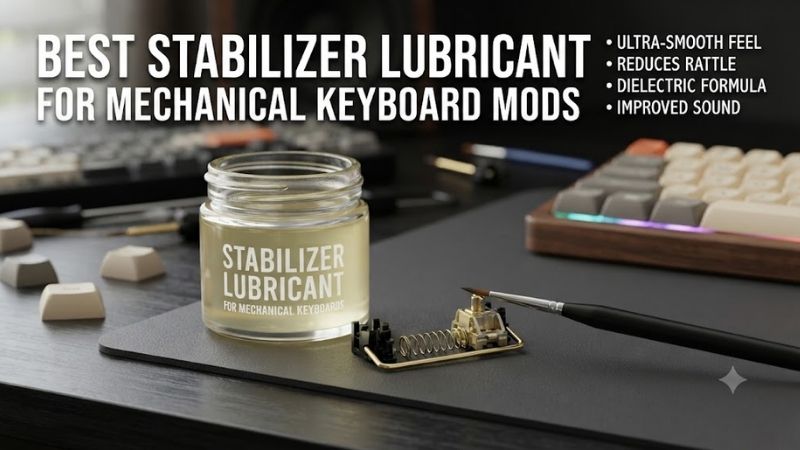
A smooth mechanical keyboard depends on more than high-quality switches. Large keys often develop unwanted rattling, ticking, or inconsistent movement when their stabilizers are poorly lubricated. Choosing the best stabilizer lubricant for mechanical keyboard mods helps reduce friction and improve keypress consistency without creating a sticky or sluggish feel.
Quick Verdict: Which Stabilizer Lubricant Should You Choose?
The best lubricant depends on where it will be applied. Stabilizer stems and housings benefit from a controlled coating of plastic-compatible grease, while wire ends may require a thicker material to reduce unwanted movement. One product can sometimes perform both tasks, but using separate lubricants provides greater control.
For most keyboard builders, Krytox GPL 205 Grade 0 offers the best balance of versatility and application control. Krytox XHT-BDZ is particularly useful for wire-end tuning, while Permatex Dielectric Tune-Up Grease provides a more accessible alternative for targeted wire treatment.
Quick Comparison Table
| Lubricant | Type | Best application | Main limitation |
|---|---|---|---|
| Krytox GPL 205 Grade 0 | PFPE/PTFE grease | Housings, stems, moderate wire tuning | Overapplication |
| Krytox XHT-BDZ | Very thick fluorinated grease | Stabilizer wire ends | Difficult to distribute thinly |
| Permatex Dielectric Tune-Up Grease | Silicone-based grease | Wire ends and contact gaps | Excess can cause sluggish movement |
| TriboSys 3204 | Medium-consistency grease | Lighter stem and housing lubrication | Less effective for large wire gaps |
| TriboSys 3203 | Lighter grease | Minimal-friction tuning | Limited gap-filling capability |
| Super Lube 21030 | Synthetic PTFE-containing grease | Budget maintenance where compatible | Not specifically formulated for keyboard stabilizers |
How We Selected These Stabilizer Lubricants
We evaluated lubricant consistency, material compatibility, application control, resistance to migration, and suitability for the two primary stabilizer contact areas. The ideal product should reduce friction without restricting the movement of the stabilizer stem or allowing excessive grease to accumulate around the wire.
We also considered maintenance requirements and the consequences of incorrect application. A product that fills wire gaps effectively may be inappropriate for sliding plastic surfaces. Likewise, a lightweight lubricant that improves stem motion may provide insufficient damping for a loose wire.
The 6 Best Stabilizer Lubricants for Mechanical Keyboard Mods
Mechanical keyboard stabilizers contain multiple moving components with different lubrication requirements. The plastic stem slides inside its housing, while a metal wire coordinates movement across both sides of a large keycap. These mechanisms explain why a lubricant should be selected according to contact conditions rather than reputation alone.
Krytox GPL 205 Grade 0 – Best Overall Stabilizer Lubricant
Krytox GPL 205 Grade 0 is a versatile option for enthusiasts who want a single lubricant for several mechanical keyboard modifications. Its combination of relatively thick consistency, controlled brush application, and broad compatibility with common keyboard plastics makes it especially useful for stabilizer housings and stems.
Best for: General stabilizer tuning, custom keyboard builds, and beginners learning controlled lubrication.
Technical characteristics
-
PFPE-based lubricating grease
-
PTFE thickener
-
NLGI Grade 0 consistency
-
Suitable for thin application on compatible plastic sliding surfaces
-
Commonly used on mechanical keyboard switches and stabilizers
-
Available through keyboard-focused suppliers in small quantities
Why it works for stabilizers
The stabilizer stem moves repeatedly against the inside of its plastic housing. Without adequate lubrication, this contact can produce friction and contribute to scratchy or inconsistent movement.
A thin coating of Krytox 205g0 can separate the interacting surfaces and reduce direct contact between small surface irregularities.
This matters most on the Space, Enter, Shift, and Backspace keys, where stabilizer friction may be more noticeable than on ordinary single-unit keys.
The lubricant can also be used in moderate quantities around the wire contact areas, although particularly loose stabilizers may benefit from a thicker dedicated wire grease.
Application control
The greatest advantage of 205g0 is its versatility, but that same characteristic encourages some beginners to use too much.
Applying a large amount can increase resistance rather than reduce it.
The correct approach is to create a thin, even coating on the moving contact surfaces. The lubricated plastic should not have large visible deposits.
After reassembly, test the stabilizer before installing the entire keyboard.
What makes it different
Unlike heavy wire-focused grease, Krytox 205g0 is suitable for multiple keyboard maintenance operations.
Builders can use it on appropriate switch components and stabilizer sliding surfaces, reducing the number of different products required.
Its performance depends on controlled application rather than simply maximizing the amount applied.
Pros
-
Versatile across several keyboard modifications
-
Suitable consistency for stem and housing contact
-
Good control with a fine brush
-
Broadly familiar to keyboard enthusiasts
-
Available in small quantities
Cons
-
More expensive than general-purpose grease
-
Excess can create sluggish movement
-
Not always the strongest option for large wire gaps
-
Product authenticity matters when buying repackaged quantities
Buy If: You want one reliable lubricant for ordinary stabilizer tuning and compatible mechanical switch modifications.
Skip If: Your only objective is filling a particularly loose stabilizer wire channel with very thick grease.
Krytox XHT-BDZ – Best for Stabilizer Wire Rattle
Krytox XHT-BDZ is a specialized high-viscosity lubricant that appeals to enthusiasts dealing with audible stabilizer wire movement. Its thick, paste-like consistency makes it useful around the wire hook ends, where a small amount of persistent material can reduce contact noise between metal and plastic.
Best for: Wire-end treatment on stabilizers that continue to rattle after ordinary lubrication.
Technical characteristics
-
High-viscosity fluorinated grease
-
Thick, paste-like consistency
-
Intended for targeted wire-contact applications
-
Commonly sold in small keyboard-modification quantities
-
Not recommended as a general coating for stabilizer housings
Why wire ends need different treatment
A stabilizer wire rotates and moves slightly inside its retaining channel as the keycap travels.
When the wire has more clearance than necessary, it may contact the surrounding plastic unevenly.
These interactions can produce audible ticks or metallic rattling.
A thicker grease can help cushion some of these contacts.
However, lubrication cannot straighten a bent wire or correct a badly manufactured housing.
If the stabilizer has significant geometric problems, replacing or adjusting the hardware may be more effective.
Correct application
XHT-BDZ should be applied sparingly to the relevant wire contact areas.
Cover the sections of the wire that interact with the stabilizer stem or channel, without filling the entire cavity with grease.
A heavily packed channel may prevent the wire from moving freely.
The result can be a spacebar that feels sluggish or fails to return consistently.
Start with a small quantity, assemble the stabilizer, and test movement before adding more.
Long-term maintenance
The grease’s high viscosity can help it remain in the intended location.
The trade-off is cleanup difficulty.
Removing excessive XHT-BDZ may require disassembly and careful wiping.
Builders who regularly rebuild their keyboards may prefer a more manageable lubricant when extremely thick grease is unnecessary.
Pros
-
Thick consistency for wire contact
-
Useful for targeted rattle reduction
-
Relevant to enthusiast stabilizer tuning
-
Requires only small quantities
Cons
-
Difficult to apply evenly
-
Excess can cause binding
-
More demanding to clean
-
Poor choice for coating all sliding plastic surfaces
Buy If: You have a compatible stabilizer with wire-related noise that needs a thicker lubricant.
Skip If: You are performing your first keyboard modification and want one general-purpose product.
Permatex Dielectric Tune-Up Grease – Best Budget Wire Lubricant
Permatex Dielectric Tune-Up Grease is a practical alternative for mechanical keyboard builders seeking a thick lubricant for stabilizer wire contacts. Although it is marketed primarily for electrical maintenance applications, suitable silicone dielectric grease can also reduce friction and noise at compatible keyboard contact points.
Best for: Budget-conscious stabilizer wire tuning and larger maintenance projects.
Material characteristics
Permatex dielectric grease is silicone-based and formulated to provide lubrication and protection in its intended automotive and electrical applications.
For keyboard use, its thick consistency is the relevant characteristic.
It can be applied to the bent ends of stabilizer wires where they interact with plastic housings or stems.
However, buyers should verify the specific product formulation and material compatibility before using it on keyboard plastics.
Performance considerations
The advantage of thick grease is its ability to remain around a contact region and reduce direct impacts.
For a noisy spacebar, this can be useful when the wire is otherwise correctly aligned.
However, the amount applied matters greatly.
Too much grease can resist movement and interfere with key return.
It can also spread outside the intended contact area during repeated use.
Practical application
A small applicator or fine brush can help control placement.
Apply the grease to the wire sections that contact the stabilizer channel.
Avoid coating the PCB, switch contacts, and surrounding electronic components.
After installation, press the stabilized key slowly at both ends.
If the key feels sticky, remove excess lubricant rather than forcing it to operate normally.
What makes it different
Permatex is an alternative to specialized keyboard-branded lubricants.
For users performing only a few wire modifications, it may be easier to obtain than niche enthusiast grease.
However, packaging size and actual cost efficiency should be evaluated before purchase.
Pros
-
Thick consistency
-
Useful for targeted wire lubrication
-
Alternative to specialized keyboard products
-
Suitable for careful manual application
Cons
-
Not specifically designed for keyboards
-
Material compatibility should be verified
-
Overapplication can restrict movement
-
Not a substitute for correcting bent wires
Buy If: You want a practical wire-focused grease and understand how to apply it sparingly.
Skip If: You need a lubricant primarily for sliding stabilizer stems and housings.
TriboSys 3204 – Best Balanced Alternative for Light Stabilizer Tuning
TriboSys 3204 offers a middle-ground consistency for users who want controlled lubrication without relying on very thick wire grease. It is especially relevant to stabilizer stems and housings where the goal is to reduce friction while preserving easy, predictable movement throughout the keypress.
Best for: Builders who prefer a moderate lubricant coating on plastic sliding surfaces.
Material and consistency
TriboSys 3204 is commonly positioned between lighter lubricants and thicker Grade 0 grease in keyboard modification applications.
This makes it useful when the builder wants less resistance from the lubricant itself.
It can be applied to stabilizer rails, contact surfaces, and other compatible areas that experience repeated sliding movement.
However, it is not necessarily the best choice for loose wire channels that require substantial damping.
Typing feel
The stabilizer should move smoothly without creating noticeable drag.
A moderate coating can help reduce small amounts of friction while maintaining a natural return.
This may appeal to users who dislike the heavily dampened sensation sometimes associated with excessive thick grease.
The difference will depend on the stabilizer geometry and the amount applied.
Practical limitations
If the main problem is a loose wire, 3204 may not remain as effective as a thicker lubricant at cushioning the contact.
In that situation, the builder may choose a second wire-focused grease.
This illustrates why stabilizer lubrication should be approached as a combination of mechanical adjustment and material selection.
Pros
-
Moderate consistency
-
Useful for plastic sliding surfaces
-
Controlled application
-
Suitable for light stabilizer tuning
Cons
-
Limited ability to fill large wire gaps
-
May require a second lubricant
-
Does not correct poor stabilizer geometry
Buy If: You want a moderate lubricant for smooth stabilizer stem and housing operation.
Skip If: Your main problem is pronounced wire rattle.
TriboSys 3203 – Best for Minimal Lubrication
TriboSys 3203 is a lighter lubricant often associated with mechanical switch applications where preserving existing tactile characteristics matters. For stabilizer work, it can be useful when the builder wants minimal lubrication on compatible plastic contact surfaces rather than substantial damping.
Best for: Fine adjustments to stabilizer sliding movement.
Why a lighter lubricant may help
Not every stabilizer requires a thick grease coating.
A well-manufactured assembly with correctly aligned parts may already have low mechanical friction.
In such cases, only a small amount of lubricant may be necessary.
A lighter consistency can be easier to distribute as a thin coating.
This can support smooth movement without significantly increasing resistance.
Limitations around wire noise
TriboSys 3203 is not intended to function like a thick gap-filling grease.
If a stabilizer wire moves loosely inside its channel, the lubricant may provide limited sound reduction.
The builder should identify the source of noise before choosing this product.
For significant wire rattle, a thicker material is generally more appropriate.
Maintenance considerations
A small quantity should be applied only to the relevant contact surfaces.
The stabilizer should then be reassembled and tested for consistent return.
If the key still makes noise, inspect wire alignment rather than repeatedly adding more lubricant.
Pros
-
Light application characteristics
-
Useful for controlled stem lubrication
-
Minimal change to movement resistance
-
Appropriate for fine adjustments
Cons
-
Limited wire-gap filling
-
Not ideal for noisy, poorly fitted stabilizers
-
May require another lubricant for comprehensive tuning
Buy If: Your stabilizers are mechanically sound and need only light lubrication.
Skip If: You need substantial damping around the wire ends.
Super Lube 21030 – Best General-Purpose Maintenance Alternative
Super Lube 21030 is a synthetic grease containing PTFE and is used in a wide range of mechanical maintenance applications. It can be considered for keyboard stabilizers when the exact material compatibility has been checked, although it is not a purpose-built enthusiast stabilizer grease.
Best for: Users seeking a general-purpose alternative for compatible mechanical contact surfaces.
Material considerations
Super Lube 21030 uses a synthetic base oil and PTFE-containing formulation.
Its comparatively thick consistency may be useful on suitable moving plastic and metal contacts.
However, keyboard stabilizers contain small components with limited movement clearances.
A grease suitable for general mechanisms is not automatically ideal for every stabilizer design.
The exact formulation and compatibility with the keyboard’s plastics should be verified before application.
Practical performance
The most relevant use is friction reduction at compatible contact surfaces.
For occasional keyboard maintenance, a general-purpose grease may provide adequate lubrication.
However, application control can be more difficult if the grease is thicker than the builder expects.
Apply a very small amount and test the stabilizer before proceeding.
Why specialist grease may still be preferable
Keyboard-focused products have the advantage of established application practices within the enthusiast community.
General-purpose grease requires more care in evaluating suitability.
For an expensive custom keyboard, the potential savings may not justify uncertainty about long-term behavior.
Pros
-
General-purpose mechanical lubricant
-
PTFE-containing formulation
-
Potentially useful across other maintenance tasks
-
Available in multiple package sizes
Cons
-
Not specifically developed for stabilizers
-
Requires material compatibility verification
-
Consistency may not match every application
-
Easy to overapply
Buy If: You already use compatible Super Lube products and can confirm suitability for your stabilizer materials.
Skip If: You prefer a well-established keyboard-specific lubricant workflow.
Buying Guide: How to Choose the Best Stabilizer Lubricant
Stabilizer lubrication is most effective when the source of unwanted sound or friction has been identified. The moving plastic components and metal wire operate under different conditions, so a lubricant that works well in one location may be poorly suited to another.
Understand Stabilizer Housing and Wire Contact Points
A conventional mechanical keyboard stabilizer contains two housings, two stems, and a connecting wire.
The stems move vertically inside the housings as the keycap is pressed.
The wire synchronizes the movement of both sides.
Plastic-on-plastic sliding contact primarily benefits from reduced friction.
Metal-to-plastic wire contact may require additional damping when the parts have clearance.
These two mechanisms should be evaluated separately during tuning.
Choose the Right Lubricant Consistency
Lubricant consistency influences how easily the material spreads and how strongly it resists displacement.
A lighter grease may work well for thin coatings on sliding surfaces.
A thicker grease may remain more effectively in a wire-contact cavity.
However, higher viscosity is not automatically better.
Excessively thick grease can resist stabilizer movement and interfere with key return.
Choose the minimum consistency necessary to solve the actual mechanical problem.
How to Lubricate Stabilizer Housings Correctly
Remove the stabilizer and separate its components according to the manufacturer’s instructions.
Inspect the inside of each housing for dirt, debris, or existing excess lubricant.
Use a fine brush to apply a thin layer of suitable grease to the surfaces where the stem slides.
Avoid leaving visible accumulations at the bottom of the housing.
Reinsert the stem and test its movement before installing the wire.
If the stem does not move freely, remove excess lubricant.
How to Lubricate Stabilizer Wires Without Overdoing It
Inspect the stabilizer wire for visible bending or uneven contact.
A bent wire may need correction before lubrication can be effective.
Apply a small quantity of suitable grease to the wire ends that engage with the stabilizer stems.
Avoid covering the entire length of the wire unnecessarily.
Reassemble the stabilizer and press both sides repeatedly.
The key should return promptly without a sticky sensation.
Avoid Common Stabilizer Lubrication Mistakes
The most common mistake is applying more lubricant than necessary.
A large grease deposit can increase resistance and create inconsistent key movement.
Another mistake is attempting to fix poor alignment through lubrication alone.
A twisted wire or loose housing may continue producing noise even after excessive grease has been applied.
Finally, avoid spraying general-purpose oils directly into assembled keyboards.
Controlled application is safer and produces more predictable results.
Frequently Asked Questions
Is Krytox 205g0 good for stabilizers?
Yes. It is widely used on compatible stabilizer stems and housings and can also serve some wire-contact applications.
Is dielectric grease better than Krytox 205g0?
It depends on the application. Thick dielectric grease can be useful at wire ends, while 205g0 is more versatile for sliding plastic surfaces.
Can I lubricate stabilizers without removing them?
Some limited adjustments may be possible, but complete disassembly provides better access and application control.
How much lubricant should I use?
Start with a thin coating on relevant surfaces. More can be added later if necessary.
Can lubricant damage a mechanical keyboard?
Incorrect products or excessive application can interfere with movement or contaminate surrounding components.
Does lubrication eliminate every stabilizer sound?
No. Bent wires, loose housings, warped keycaps, and incorrect mounting may require mechanical correction.
Should I lubricate factory-lubed stabilizers?
Only when there is a clear reason. Adding lubricant to an already well-tuned assembly can make its performance worse.
Final Verdict
Krytox GPL 205 Grade 0 is the most versatile starting point for mechanical keyboard stabilizer modifications. Krytox XHT-BDZ and Permatex Dielectric Tune-Up Grease are useful for targeted wire tuning, while TriboSys options support lighter lubrication. Apply sparingly, test movement, and correct mechanical alignment before adding more grease.