🛒 Best Price Today on Amazon
Prime members get fast, free shipping on everything above, plus member-only deals. New members get a 30-day free trial — cancel anytime.
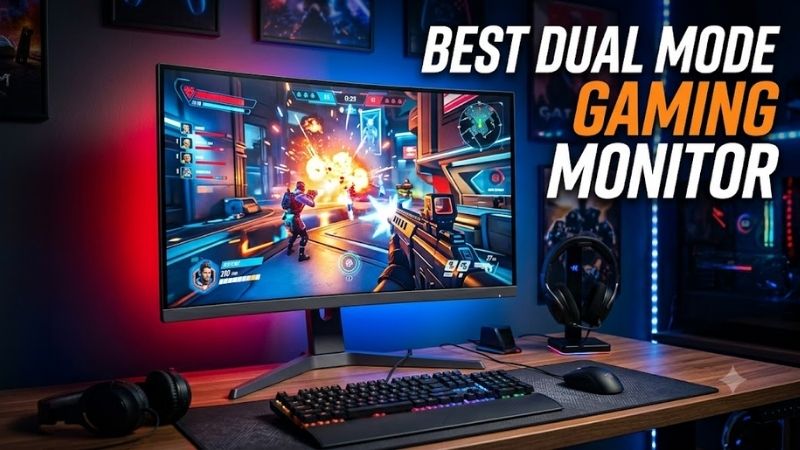
The best dual mode gaming monitor should let you switch between a high-resolution mode for immersive games and a much faster refresh mode for competitive play. The strongest options now pair 4K clarity with 240Hz performance, then jump to FHD refresh rates as high as 480Hz whenever speed matters most.
Quick answer: For most people in 2026, the best dual mode gaming monitor for 4k and esports gaming is the LG UltraGear 32GS95UE-B — our #1 rated choice. See the full ranked comparison, alternatives and buying advice below.
Best Dual Mode Gaming Monitors Compared
| Monitor | Panel / Size | High-Resolution Mode | High-Refresh Mode | Best For |
|---|---|---|---|---|
| LG UltraGear 32GS95UE-B | 31.5-inch OLED | 4K 240Hz | FHD 480Hz | Gaming plus integrated audio |
| ASUS ROG Swift OLED PG32UCDP | 31.5-inch WOLED | 4K 240Hz | FHD 480Hz | Gaming, laptops, and multi-PC desks |
| Acer Predator X32 X3 | 31.5-inch OLED | 4K 240Hz | FHD 480Hz | Straightforward 4K/480Hz versatility |
| ViewSonic XG2730D-4K | 27-inch | 4K 144Hz | FHD 288Hz | Smaller desks and esports-focused setups |
The picks below were limited to monitors with a manufacturer-documented dual-mode function that changes both resolution and refresh behavior. Standard overclocked displays, fixed-refresh 4K models, and monitors with only picture presets were excluded. That keeps the comparison focused on hardware that genuinely matches the search intent.
What Is a Dual Mode Gaming Monitor?
Dual mode changes the monitor’s operating resolution and refresh ceiling rather than applying a simple picture preset. A typical premium OLED model runs at 3840 x 2160 up to 240Hz, then switches to 1920 x 1080 up to 480Hz. That lets one screen serve both cinematic AAA games and latency-focused esports.
The main benefit is flexibility without keeping two monitors on the desk. You can use 4K for RPGs, racing games, strategy titles, and detailed single-player releases, then move to the lower-resolution high-Hz mode for Counter-Strike 2, Valorant, Overwatch 2, or other games where frame rate and motion clarity matter more.
Dual mode does not guarantee that every PC can drive 4K at 240 fps or FHD at 480 fps. Your GPU, CPU, game engine, graphics settings, cable, and selected input all matter. The lower-resolution mode also looks softer on a 31.5-inch panel, so buyers should treat it as a competitive mode rather than an all-purpose desktop setting.
Not every dual-mode monitor uses the same pairing. Some premium OLED models switch between 4K 240Hz and FHD 480Hz, while other displays use 4K 144Hz and FHD 288Hz. The right combination depends on whether you want maximum competitive speed, a smaller screen, lower GPU demands, or stronger all-around value.
LG UltraGear 32GS95UE-B
Best For: Gamers wanting 4K OLED, 480Hz esports capability, and integrated audio.
Key Features
- 31.5-inch OLED panel
- 3840 x 2160 native resolution
- Dual Mode: 4K up to 240Hz
- Dual Mode: FHD up to 480Hz
- 0.03ms GtG response specification
- NVIDIA G-SYNC Compatible
- AMD FreeSync Premium Pro
- Pixel Sound with DTS Virtual:X
- HDMI and DisplayPort connectivity
- Anti-glare and low-reflection screen treatment
LG’s 32GS95UE-B is built around a 31.5-inch 4K OLED panel with Dual Mode switching between 4K at up to 240Hz and FHD at up to 480Hz. Its 0.03ms GtG response specification, G-SYNC Compatible support, FreeSync Premium Pro, and low-reflection treatment make it especially focused on fast-paced PC gaming.
What Makes It Different
What separates the LG from many rivals is Pixel Sound, which uses the panel area as part of the audio system instead of relying on conventional visible speakers. That can reduce desk clutter while keeping the monitor’s front clean. It is most attractive to gamers who want premium OLED motion plus integrated sound in one display.
Pros
- 4K 240Hz and FHD 480Hz modes
- Fast OLED pixel response
- Integrated Pixel Sound
- G-SYNC Compatible and FreeSync Premium Pro
- Strong fit for mixed AAA and competitive gaming
Cons
- FHD looks less sharp across a 31.5-inch screen
- 480Hz requires extremely high PC frame rates
- Buyers using dedicated speakers may not value Pixel Sound
Use Case
Switch to 4K 240Hz for games where textures, environments, lighting, and fine detail matter. FHD 480Hz is more appropriate for competitive shooters where reducing frame intervals and improving motion sampling can be more valuable than retaining maximum image resolution.
Who It’s For
Choose the LG if you want one OLED monitor to replace separate high-resolution and esports displays while also keeping desktop audio simple. Its combination is particularly logical for a gaming room where external speakers are inconvenient but 4K image quality and very high refresh capability are both priorities.
ASUS ROG Swift OLED PG32UCDP
Best For: Gamers who also use laptops, multiple PCs, or shared peripherals.
Key Features
- 31.5-inch WOLED panel
- 3840 x 2160 resolution
- 4K up to 240Hz
- FHD up to 480Hz
- 0.03ms GtG response specification
- USB-C with 90W power delivery
- KVM switch
- HDMI 2.1
- DisplayPort 1.4 with DSC
- Adaptive-Sync
- DisplayWidget Center
- ASUS OLED Care
- Proximity sensor
The ASUS ROG Swift OLED PG32UCDP uses a 31.5-inch WOLED panel and also switches between 4K at 240Hz and FHD at 480Hz. It adds a USB-C input with 90W power delivery, a KVM switch, DisplayWidget Center controls, a proximity sensor, and extensive OLED-care tools, making it unusually strong for mixed PC use.
What Makes It Different
Its biggest advantage is connectivity and desk integration. A gamer who also uses a laptop can connect through USB-C, charge the system, share peripherals with the KVM, and still keep HDMI 2.1 and DisplayPort available for other devices. The trade-off is that the PG32UCDP has no built-in speakers, so separate audio remains necessary.
Pros
- 4K 240Hz and FHD 480Hz
- USB-C with 90W power delivery
- Integrated KVM switch
- Multiple OLED-care functions
- HDMI 2.1 and DisplayPort connectivity
- Useful for gaming and productivity systems
Cons
- No integrated speakers
- FHD mode sacrifices visible sharpness
- Premium connectivity may be unnecessary on single-PC desks
Use Case
The PG32UCDP works particularly well when a desktop gaming PC shares a desk with a work laptop. The KVM can reduce duplicate peripherals, while USB-C handles display and laptop charging. When gaming, its 4K mode suits visually detailed releases and the 480Hz mode targets high-frame-rate competitive titles.
Who It’s For
Buy the ASUS if dual-mode gaming is only part of the requirement and your monitor also acts as the center of a multi-device workstation. It is especially relevant to users who switch between a desktop and USB-C laptop but still want OLED contrast and an extremely high esports refresh ceiling.
Acer Predator X32 X3
Best For: Gamers wanting 4K/240Hz and FHD/480Hz with broad connectivity.
Key Features
- 31.5-inch OLED display
- 3840 x 2160 at up to 240Hz
- 1920 x 1080 at up to 480Hz
- 0.03ms GtG response specification
- HDMI 2.1
- DisplayPort
- USB-C
- AMD FreeSync Premium support
- Height-adjustable stand
- Integrated stereo speakers
Acer’s Predator X32 X3 is another 31.5-inch OLED option capable of 3840 x 2160 at 240Hz and 1920 x 1080 at 480Hz through its dual-frequency design. Official configurations include HDMI 2.1, DisplayPort, USB-C, FreeSync Premium support, a height-adjustable stand, and integrated stereo speakers for desktop use.
What Makes It Different
The Acer makes sense for buyers who want the same headline 4K/240Hz and FHD/480Hz split without prioritizing ASUS software or LG’s Pixel Sound approach. Its built-in speakers can simplify a gaming setup, while USB-C broadens device support. Exact regional specifications should be checked because Acer sells multiple X32-family variants.
Pros
- 4K 240Hz and FHD 480Hz operation
- OLED panel technology
- HDMI 2.1, DisplayPort, and USB-C
- Built-in speakers
- Height-adjustable stand
Cons
- Model specifications can differ by region
- FHD loses substantial pixel density at 31.5 inches
- Buyers should verify the exact X32 X3 variant before ordering
Use Case
The X32 X3 fits a desktop where both PC and console connectivity matter, while the high-speed FHD mode remains available for competitive PC gaming. Its integrated audio is also practical for secondary sound, casual gaming, or users who want fewer devices occupying space around the monitor.
Who It’s For
Consider the Acer when you want the essential 4K 240Hz and FHD 480Hz experience but do not specifically need the ASUS KVM ecosystem or LG Pixel Sound design. It is also worth considering for setups where USB-C and built-in speakers are useful additions alongside standard gaming connections.
ViewSonic XG2730D-4K
Best For: Gamers who prefer a 27-inch screen and dedicated esports sizing.
Key Features
- 27-inch panel
- 4K UHD at up to 144Hz
- FHD at up to 288Hz
- 24.5-inch esports display mode
- AMD FreeSync Premium
- NVIDIA G-SYNC Compatible
- 1ms MPRT specification
- Ergonomic stand
- Eye ProTech features
The ViewSonic XG2730D-4K takes a different approach with a 27-inch panel, 4K at up to 144Hz, and FHD at up to 288Hz. It also offers a 24.5-inch esports display mode, letting competitive players shrink the active image area while keeping the monitor physically centered on the desk for a more focused view.
What Makes It Different
This model is better suited to gamers who value 27-inch size and esports framing more than the extreme 480Hz ceiling of the premium 32-inch OLED models. The slower 4K refresh rate is still sufficient for many visually demanding games, while 288Hz in FHD remains very fast for shooters when the PC can sustain high frame rates.
Pros
- More compact 27-inch format
- 4K and FHD dual-mode operation
- Dedicated 24.5-inch esports display option
- 288Hz competitive refresh mode
- FreeSync Premium and G-SYNC compatibility
Cons
- Lower peak refresh than 480Hz alternatives
- 4K mode tops out below 240Hz
- Less attractive for buyers specifically seeking premium 32-inch OLED
Use Case
The 4K mode works well for single-player games, strategy titles, productivity, and general desktop use, while FHD 288Hz targets fast competitive gaming. The optional 24.5-inch image area is useful for players accustomed to smaller tournament-style displays where the whole scene stays closer to central vision.
Who It’s For
Choose the ViewSonic if a 31.5-inch monitor feels too large or if 480Hz is unnecessary for your hardware. Its balance makes more sense for users who want 4K versatility but still value a dedicated esports-oriented mode without committing to the size and demands of a 4K 240Hz OLED display.
LG vs ASUS vs Acer vs ViewSonic
Among the 32-inch OLED choices, LG, ASUS, and Acer all target the same core use case: 4K high-refresh gaming by default and FHD 480Hz for competition. The differences are mainly in audio, USB-C implementation, peripheral switching, software, stand design, and OLED-protection features rather than the basic dual-mode concept.
| Feature | LG 32GS95UE-B | ASUS PG32UCDP | Acer X32 X3 | ViewSonic XG2730D-4K |
|---|---|---|---|---|
| 4K Maximum | 240Hz | 240Hz | 240Hz | 144Hz |
| Fast Mode | FHD 480Hz | FHD 480Hz | FHD 480Hz | FHD 288Hz |
| Screen Size | 31.5″ | 31.5″ | 31.5″ | 27″ |
| OLED | Yes | Yes | Yes | No |
| USB-C | No major focus | Yes, 90W PD | Yes | Model-dependent connectivity |
| KVM | No | Yes | Verify regional model | No |
| Built-In Audio | Pixel Sound | No | Yes | Check regional specification |
| Best Fit | Audio-focused setup | Multi-device desk | Flexible gaming setup | Smaller esports desk |
How to Choose the Best Dual Mode Gaming Monitor
Match the Refresh Rate to Your Games
Start with the games you actually play. If most of your time goes to story-driven titles, 4K image quality should be the priority and the faster mode should be treated as a bonus. If competitive shooters dominate your library, verify that your CPU and GPU can push very high frame rates before paying extra for a 480Hz-capable monitor.
A 480Hz mode is most relevant when the rest of the system can keep frame times consistently low. Competitive games often become CPU-limited before the GPU is fully loaded, so processor performance, memory tuning, and game settings can matter as much as the graphics card. Buying 480Hz without enough frame rate wastes much of the benefit.
Consider 27-Inch vs 32-Inch Screen Size
Screen size changes how the lower-resolution mode feels. FHD stretched across 31.5 inches is visibly less dense than 4K, so some players prefer models that offer a smaller simulated esports area or a physically smaller panel. For desktop work, browsing, and text, the native 4K mode will usually provide the sharper everyday experience.
Check HDMI, DisplayPort, USB-C, and KVM Features
Connectivity matters if the display will serve more than one system. HDMI 2.1 is useful for modern consoles and PCs, DisplayPort remains common for desktop GPUs, and USB-C can simplify laptop use. A built-in KVM becomes valuable when two computers share one keyboard and mouse, while integrated speakers reduce the need for extra desk hardware.
Understand OLED Care
OLED delivers near-instant pixel transitions and deep blacks, which suits both high-refresh competition and dark cinematic games. The trade-off is that OLED ownership benefits from sensible care around static desktop elements. Use the manufacturer’s panel-protection features and follow the model’s maintenance guidance.
Check How Quickly Dual Mode Switches
Mode switching can briefly interrupt the image while the display changes timing and resolution, which is normal behavior rather than a defect. The important question is whether switching is quick through a hotkey, joystick, or software control, because frequent menu navigation reduces the practical value of dual mode.
FAQ
What is a dual mode gaming monitor?
A dual mode gaming monitor supports two distinct resolution-and-refresh combinations, such as 4K at 240Hz and FHD at 480Hz. The purpose is to let one display prioritize image detail in visually rich games and then prioritize refresh rate in competitive titles without changing monitors or maintaining a second esports display.
Is 480Hz worth it for competitive gaming?
For esports, 480Hz can improve motion sampling and reduce the time between displayed frames compared with lower refresh rates, but only when the system delivers extremely high frame rates. The practical gain depends on the game, CPU, GPU, settings, and player sensitivity, so 480Hz should not be treated as an automatic advantage for every setup.
Do I need 240 fps to use a 4K 240Hz monitor?
A 4K 240Hz mode is useful even when a game does not reach 240 fps because the monitor still provides a high refresh ceiling, quick OLED response, and room for lighter games to run faster. Demanding AAA titles may operate far below 240 fps, so variable refresh support and sensible graphics settings remain important parts of the experience.
Are dual mode gaming monitors good for consoles?
Console players can benefit from these monitors mainly for their 4K capability, HDMI 2.1 support on compatible models, fast pixel response, and variable refresh features. The 480Hz FHD mode is aimed primarily at high-end PC gaming because current consoles do not output games at refresh rates anywhere near 480Hz.
Which dual mode monitor is best for gaming and work?
The ASUS PG32UCDP is especially convenient for a gaming-and-work setup because it combines dual mode with USB-C power delivery and a KVM switch. LG’s 32GS95UE-B is more attractive when integrated audio matters, while ViewSonic’s 27-inch option may suit users who prefer a smaller screen and focused esports sizing.
Conclusion
The best dual mode gaming monitor depends on how often you switch between visual fidelity and competitive speed. LG, ASUS, and Acer offer the most aggressive 4K 240Hz to FHD 480Hz combinations, while ViewSonic provides a smaller 27-inch alternative. Match the mode, ports, audio, and screen size to your actual games and hardware.
Ready to decide? Our #1 pick for 2026 is the LG UltraGear 32GS95UE-B.
Live price & availability on Amazon.