PS5 M.2 SSD Requirements & Compatibility Checklist
A PS5 storage upgrade passes only when the drive, cooling hardware, and assembled dimensions all satisfy Sony’s requirements. The same core M.2 specification applies to the CFI-1000, CFI-2000, and CFI-7000 model groups, but the physical installation instructions are not identical.
- PS5 M.2 requirements: pass/fail checklist
- PS5 heatsink dimensions: measure the finished assembly
- PS5 HMB compatibility caveat
- PS5 internal M.2 or USB storage?
- PS5 model-group installation differences
- PS5 requirements decision matrix
- PS5 compatibility risk checklist
- Who should add a compatible PS5 M.2 SSD?
- FAQ
Use this checklist before ordering. It screens specifications; it does not certify any third-party SSD. Sony Interactive Entertainment (SIE) explicitly says that it cannot guarantee every M.2 SSD meeting the published requirements will work.
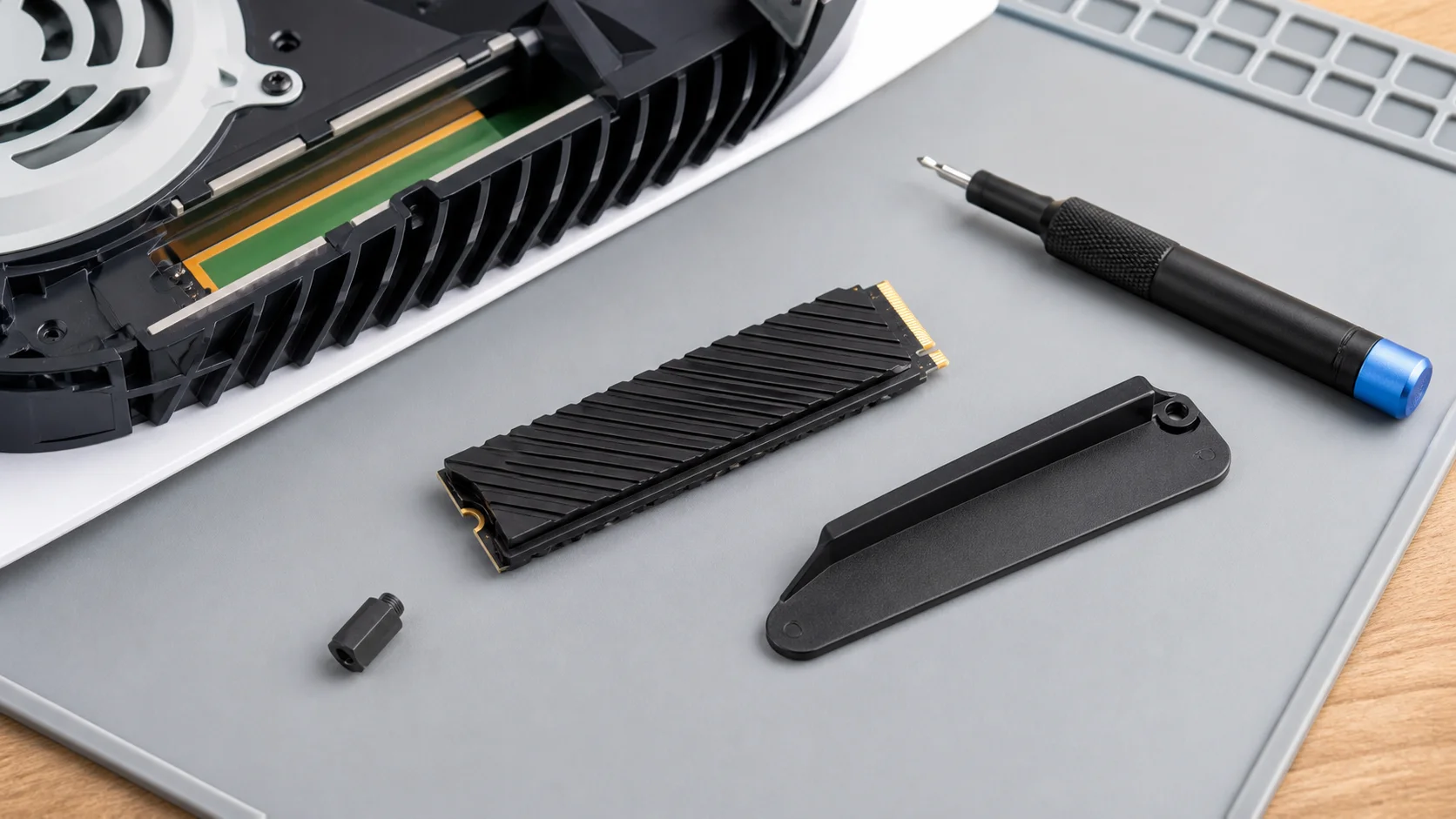
PS5 upgrade illustration—not product photography, fit certification, or speed evidence.
PS5 M.2 requirements: pass/fail checklist
Mark every required line Pass. A single Fail means the product is not a match for the internal expansion slot.
- Interface — Pass: PCI Express Gen4 x4 M.2 NVMe SSD, Socket 3, Key M. Fail: PCIe Gen3, SATA, mSATA, a 2.5-inch SSD, or an M.2 SATA drive.
- Capacity — Pass: 250 GB through 8 TB. Fail: anything below 250 GB or above 8 TB.
- Form factor — Pass: 2230, 2242, 2260, 2280, or 22110. These codes correspond to 22 mm board width and lengths of 30, 42, 60, 80, or 110 mm. Fail: an unlisted size.
- Cooling — Pass: the SSD has an effective heat-dissipation mechanism, such as a heatsink or heat-transfer sheet. Fail: a bare drive with no cooling structure.
- Assembled size — Pass: no more than 25 mm wide and 11.25 mm thick in total, with no more than 8.0 mm above the board and 2.45 mm below it. Fail: the drive-plus-heatsink assembly exceeds any limit.
- Read specification — Pass for the recommendation: the manufacturer rates sequential read speed at 5,500 MB/s or faster. Caution: Sony presents 5,500 MB/s as a recommendation, not a promise of identical game performance.
- Firmware — Pass: the console is updated to the latest available system software before installation.
Recheck Sony’s M.2 SSD requirements immediately before purchase; support guidance can change.
PS5 heatsink dimensions: measure the finished assembly
The retail listing must disclose enough information to evaluate the SSD with its cooling structure attached. Sony allows up to 25 mm total width. Total thickness is 11.25 mm, divided asymmetrically: up to 8.0 mm above the circuit board and up to 2.45 mm below it. Permitted lengths are exactly 30, 42, 60, 80, and 110 mm.
Both single-sided and double-sided M.2 SSDs are supported. Sony notes that a single-sided cooling structure is easier to fit, but that observation does not make every single-sided heatsink compliant. If the seller reports only bare-board dimensions, treat the fit as unknown. Ask the manufacturer for the assembled dimensions or choose a product with complete specifications.
Do not stack another heatsink onto an SSD with an integrated heatsink. Sony recommends against it because the addition may reduce the built-in cooler’s effectiveness. It may also push the assembly outside the allowed envelope. During installation, the expansion-slot cover must close correctly; forcing it is not a valid fit test.
PS5 HMB compatibility caveat
PS5 consoles do not support Host Memory Buffer (HMB). HMB-capable SSDs may rely on host system memory instead of dedicated onboard DRAM for some controller tasks. Sony warns that such drives may show slower-than-expected performance in PS5 use.
This does not justify a blanket claim that every DRAM-less drive fails or that every drive with DRAM passes. It means buyers should not assume a PC-oriented HMB feature will operate on PS5. Look for explicit controller-memory information from the SSD manufacturer and weigh HMB reliance as a compatibility-performance risk, not as an invented certification rule.
If the interface terminology is unclear, this NVMe versus SATA SSD explainer covers the distinction. For PS5’s internal slot, “M.2” describes the physical family; it does not make an M.2 SATA product compatible.
PS5 internal M.2 or USB storage?
Choose internal M.2 storage when the goal is to download, update, and play PS5 games from the added drive. A compatible internal M.2 SSD can also hold and launch PS4 games and media apps.
USB extended storage serves a different role. PS5 games can be stored on USB storage, but must be copied back to console storage or M.2 SSD storage before play. PS4 games can be played directly from supported USB extended storage. The official PlayStation accessories overview reflects this split between internal M.2 and external USB options.
Therefore, USB is useful for lower-friction library parking or PS4 titles; it is not a substitute for playable PS5 expansion. For a broader desktop installation sequence, see how to install an M.2 NVMe SSD, but follow Sony’s model-specific PS5 directions—not a PC procedure—when opening the console.
PS5 model-group installation differences
Read the printed model number rather than inferring it from color, drive configuration, or a seller’s informal name. This guide follows Sony’s US model-group labels.
The storage specification above applies across the three named groups. The access procedure differs:
- CFI-1000 model group: Sony instructs users to disconnect the console, let it cool, remove the base, position the PS logo downward, and remove the relevant outer cover before opening the long expansion-slot cover. The spacer is moved to the groove matching the SSD length.
- CFI-2000 model group: Sony groups these instructions with CFI-7000. The procedure begins by removing the triangle cover, followed by the expansion-slot cover, screw, and spacer. Feet are reattached during reassembly as applicable.
- CFI-7000 model group: Use the same official CFI-2000/7000 instruction section, including the triangle-cover path. Do not substitute the CFI-1000 cover-removal method.
For all groups, discharge static electricity by touching a metal-grounded object, keep the console off while the cover is removed, insert the drive fully, secure it at the correct spacer position, replace the slot cover, and follow the onscreen format prompt. First-use formatting erases the entire SSD. Sony notes that formatting is not required when moving an M.2 SSD between two PS5 consoles, while access to its games requires the same account on both consoles.
Before opening the system, use Sony’s PS5 system software update instructions and confirm no update remains pending. Menus and behavior can vary by firmware version and region, so current on-console prompts and the support page take precedence over screenshots or older guides.
PS5 requirements decision matrix
| Candidate | Specification result | Buying decision |
|---|---|---|
| Gen4 x4 NVMe, 250 GB–8 TB, allowed length, compliant heatsink, 5,500 MB/s+ | Passes published screening | Consider buying; still verify vendor fit and return policy |
| Correct drive, but heatsink dimensions missing | Fit unknown | Pause and request assembled measurements |
| Gen4 x4 NVMe that relies on HMB | May fit; performance caveat | Consider only with informed expectations |
| M.2 SATA or PCIe Gen3 SSD | Interface fail | Do not buy for the PS5 internal slot |
| USB SSD | External-storage category | Buy only for PS4 direct play or PS5 game storage/copy-back |
| More than 8 TB or under 250 GB | Capacity fail | Do not buy for the PS5 internal slot |
After screening these requirements, use our PS5 M.2 SSD shopping guide to compare candidates. A roundup mention is not Sony certification.
PS5 compatibility risk checklist
- Confirm the exact model and capacity variant; specifications can differ within one product family.
- Save the manufacturer’s interface, rated read speed, dimensions, and heatsink documentation.
- Verify whether cooling is included or must be added separately.
- Measure the combined assembly, not the box or bare PCB.
- Avoid listings that say only “PS5 compatible” without underlying specifications.
- Check the seller’s return policy in case the console rejects or underperforms with the drive.
- Back up any data on a reused SSD because PS5 formatting erases it completely.
- Never interrupt formatting or a system software update.
- If gameplay problems occur, follow Sony’s troubleshooting advice and move the game to internal console storage.
- Remove the M.2 SSD before sending the console for repair, as Sony instructs.
Who should add a compatible PS5 M.2 SSD?
An internal M.2 SSD suits players who regularly rotate several PS5 games and want those games playable without a USB copy-back step. It also makes sense for mixed PS5/PS4 libraries when one internal expansion pool is preferred.
It is a weaker fit for someone who mainly archives PS5 games, plays mostly PS4 titles, or does not want to open the console; USB extended storage may meet those needs. Skip the purchase for now if the candidate’s heatsink dimensions, interface, or exact capacity variant cannot be verified.
FAQ
Does every PCIe Gen4 M.2 SSD work in PS5?
No. It must also be NVMe Key M, fall within the capacity and form-factor ranges, include compliant cooling, and fit the complete dimensional envelope. Even then, SIE does not guarantee every third-party device.
Is 5,500 MB/s mandatory?
Sony recommends sequential reads of 5,500 MB/s or faster. Treat that threshold as the official buying target, while recognizing that a higher advertised number does not guarantee performance identical to the console’s built-in SSD.
Can PS5 play games from a USB SSD?
PS4 games can play from supported USB extended storage. PS5 games can be stored there but must be copied to console storage or M.2 SSD storage to play.
Do CFI-1000, CFI-2000, and CFI-7000 need different SSDs?
Sony publishes one M.2 requirements table for PS5 consoles. The meaningful model-group difference here is the cover-access and reassembly procedure: CFI-1000 has its own instructions; CFI-2000 and CFI-7000 share another section.
Can I use an HMB SSD?
Do not assume its HMB feature will work. PS5 does not support HMB, and Sony warns that HMB-capable drives may perform more slowly than expected. Verify the drive architecture with its manufacturer.
Sources
- PlayStation Support: How to add an M.2 SSD to a PS5 console
- PlayStation: Official accessories and extra-storage overview
- PlayStation Support: How to update PS5 system software