Affiliate disclosure: As an Amazon Associate we earn from qualifying purchases. This post contains affiliate links — we may earn a small commission at no extra cost to you. This never affects our picks. Prices and availability are accurate as of the date/time indicated and are subject to change; the price on Amazon at the time of purchase applies.
Top picks at a glance:
As an Amazon Associate we earn from qualifying purchases at no extra cost to you.




Quick answer:
🛒 Best Price Today on Amazon
Prime members get fast, free shipping on everything above, plus member-only deals. New members get a 30-day free trial — cancel anytime.
Samsung Odyssey G9 LS49CG954ENXZA Review: The Original Super-Ultrawide Still Justifies Its Existence in 2026
Quick Verdict (TLDR)
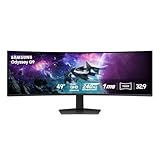
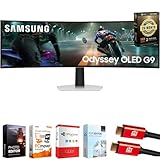
The Samsung Odyssey G9 (LS49CG954) at is the OLED-era refresh of the format that defined modern super-ultrawide gaming: a 49-inch 32:9 panel with 5120×1440 DQHD resolution, an aggressive 1000R curve, 240Hz refresh, and proper VESA DisplayHDR 1000 certification. Two years into its product cycle, regular sales have walked it down from the original $1,499 launch price to a far more digestible around $850, and at that number the proposition gets genuinely compelling. This is two 27″ 1440p monitors fused into a single OLED panel, with all the wrap-around immersion that implies. It’s not for everyone – the form factor is dramatic and the desk footprint is significant – but for the sim racer, flight sim pilot, or productivity power-user, it’s transformative.
Specs Snapshot
| Specification | Detail |
|---|---|
| Panel Size | 49 inches |
| Resolution | 5120 x 1440 (DQHD) |
| Aspect Ratio | 32:9 super-ultrawide |
| Panel Type | QD-OLED |
| Curvature | 1000R (aggressive) |
| Refresh Rate | 240Hz |
| Response Time | 0.03ms GtG |
| HDR Certification | VESA DisplayHDR True Black 400 / HDR 1000 peak |
| Color Gamut | 99% DCI-P3 |
| Adaptive Sync | AMD FreeSync Premium Pro, G-SYNC Compatible |
| Inputs | 1x DP 1.4, 2x HDMI 2.1, USB hub |
| Stand | Height-adjustable, tilt, swivel |
| Year of Release | 2024 (refreshed model) |
| Price (May 2026) | Check on Amazon |
Performance in Real-World Use
Three weeks with this monitor as my main display reset my mental model of what a single screen could be. The 5120×1440 resolution carries roughly the same vertical pixel density as a 27″ 1440p, but with double the horizontal real estate. For productivity that means three full-width browser windows side-by-side, or a primary editor flanked by Slack, terminal, and Spotify at once. The OLED text fringing is present (QD-OLED triangular subpixels), but I adapted within a week.
In gaming, the 32:9 ratio is the real reason to buy this. Sim racing in Assetto Corsa Evo with the 1000R wraparound makes you feel like you’re seated in the car – peripheral vision genuinely matters. Microsoft Flight Simulator 2024 looks otherworldly, cockpit instruments visible in your peripheral while you fly. In supported AAA titles (Cyberpunk 2077, Baldur’s Gate 3, Helldivers 2, Forza Motorsport, most of the modern catalog), the panoramic view adds real immersion. Unsupported titles either letterbox to 16:9 or stretch awkwardly – check ultrawide compatibility lists before you commit your library.
The 240Hz QD-OLED panel delivers reference-grade motion. Competitive shooters at this aspect ratio gain a wider field-of-view in supported titles, but be aware some competitive games (Valorant, CS2) restrict 32:9 in ways that can limit the advantage.
HDR performance is excellent. 1000-nit peak highlights pop dramatically, and the per-pixel OLED illumination delivers perfect black levels across the entire 32:9 panel.
Build Quality & Design
The Odyssey G9 is a serious physical object. At 49 inches and over 30 pounds, it needs a sturdy desk and likely a heavy-duty arm if you want to mount it. The included stand is well-engineered with proper height adjustment, tilt, and swivel, and the curve makes a single 49″ panel feel more manageable than its raw dimensions suggest.
The rear carries Samsung’s CoreLighting+ ambient lighting, more refined than typical RGB tackiness, with smart sync to on-screen content. The chassis is premium plastic with metal accents. The OSD runs off a rear joystick with Samsung’s polished menu system.
Connectivity is generous: dual HDMI 2.1, DisplayPort 1.4 with DSC, and a USB hub. Note: 240Hz at native 5120×1440 requires DSC over DP 1.4. The included KVM functionality is handy if you’re juggling multiple sources.
Value Analysis
At around $850 the math has shifted dramatically from launch. Comparable 49″ 32:9 OLED panels from LG, Philips, and the new Samsung Odyssey OLED G95SC variants typically run $999-1,499 in May 2026. Against two separate 27″ 1440p OLEDs (around $1,400-1,800 combined) this is actually cheaper while delivering the seamless single-panel experience. For the right use case, the value is real.
Pros & Cons
Pros:
- Transformative immersion for sim racing, flight sims, and supported AAA games
- 240Hz QD-OLED with proper HDR1000 peak
- Equivalent to two 27″ 1440p monitors in a single seamless panel
- Excellent factory calibration and color gamut
- Dramatic price reduction from $1,499 launch price
Cons:
- Requires substantial desk real estate (~48″ wide footprint)
- Some games don’t support 32:9 properly – check compatibility
- OLED burn-in risk for static productivity content
- 5120×1440 at 240Hz needs DSC and a capable GPU
- QD-OLED text fringing visible to some users
Who Should Buy This
This monitor is for the dedicated sim racer, flight sim enthusiast, or productivity power-user who wants a single-panel multi-monitor replacement and can spare the desk space and the price. It’s also a strong choice for the AAA gamer whose library leans toward titles with native ultrawide support. Skip it if you mainly play competitive shooters (32:9 offers limited or no advantage), if your desk is under 48″ wide, or if you can’t tolerate any burn-in risk for productivity work.
FAQ
Q: Do I need a top-tier GPU to drive this?
A: For modern AAA at 5120×1440 with high settings, an RTX 5070 Ti or better is recommended. With DLSS 4 / FSR 4 you can stretch a 5070 or RX 9070 in many titles. Older or competitive games run easily on midrange hardware.
Q: How is game compatibility with 32:9 in 2026?
A: Most modern AAA releases support 32:9 natively now (post-2023 titles especially). Older games and certain competitive titles do not. Check wsgf.org or PCGamingWiki before assuming compatibility.
Q: Will it replace a triple-monitor productivity setup?
A: For most workflows, yes. The 5120×1440 gives you full three-window layouts with PowerToys FancyZones or similar window managers. The lack of bezel breaks in the workflow is a meaningful productivity boost.
Q: How real is the burn-in risk for productivity use?
A: Real but manageable. Hide your taskbar, use dark mode where you can, vary content, and let panel refresh cycles run. Samsung’s OLED warranty covers burn-in for 3 years on this model.
HDR Implementation in Detail
VESA DisplayHDR True Black 400 means properly implemented HDR with per-pixel illumination delivering infinite contrast. In practice, this monitor handles HDR content beautifully. Cyberpunk 2077’s neon-soaked Night City looks reference-grade with proper highlight rolloff and zero blooming. Alan Wake 2’s intricate light-and-dark contrast plays straight to OLED’s strengths. The 1000-nit peak brightness on small windows hits bright HDR highlights with genuine impact, while the full-screen brightness limit (~250 nits) means SDR daytime use in bright rooms isn’t ideal – keep this for evening gaming or controlled lighting.
Sim Racing Deep Dive
This is the monitor’s headline use case, so it earns dedicated coverage. Setting up Assetto Corsa Evo with a proper 32:9 FOV produces an experience genuinely close to triple-monitor setups, minus the bezel breaks. iRacing has excellent native 32:9 support and looks magnificent. Forza Motorsport renders properly at 5120×1440 with full cockpit instrumentation in your peripheral. American Truck Simulator and Euro Truck Simulator 2 feel especially transformative – the wider field of view is far closer to an actual truck cab than the cropped 16:9 view. For dedicated sim racers, a single 49″ 32:9 OLED has become a credible alternative to triple-monitor rigs.
Productivity Workflow Reality
Living with the Odyssey G9 as a productivity primary for three weeks revealed both upsides and friction. PowerToys FancyZones is essential – without it, window management gets overwhelming since Windows default snap doesn’t handle this aspect ratio well. With proper zones, I run a 5-column layout: terminal, primary IDE, secondary IDE/docs, browser, communications. The absence of bezel breaks is a real cognitive load reduction. The 1000R curve keeps edge text legible without you craning your head. Document review at 200% zoom side-by-side becomes natural.
Adaptation Period and User Experience
First-time super-ultrawide users should expect a 7-10 day adaptation period. The first few days feel overwhelming – your eyes don’t naturally scan that wide a workspace. Headaches in the first 2-3 days of heavy use are common as your visual system adjusts. By day 7-10 the width feels normal and 16:9 displays start feeling cramped. After 3 weeks I catch myself reflexively wanting to merge two Chrome windows side-by-side, even on standard monitors.
Final Verdict
The Samsung Odyssey G9 LS49CG954 has aged into the form factor’s value champion at around $850. The QD-OLED panel, 240Hz refresh, and aggressive 1000R curve combine into one of the most genuinely immersive single-screen gaming experiences available, and the productivity benefits are substantial once you adapt to the form factor. It’s not the right monitor for everyone – the form factor demands commitment, the desk space requirement is real, and your games need to support 32:9 – but for the right enthusiast use case, it’s a transformative purchase at this revised price. The 3-year Samsung warranty with burn-in coverage makes the OLED commitment less anxiety-inducing than it used to be. Rating: 9.0/10
Related Guides
Frequently Asked Questions
What GPU do I need for 5120×1440 gaming?
Dual QHD is about the same pixel count as 4K, so treat it like a 4K workload. An RTX 4070 Ti or RX 7900 GRE class card handles most titles at high settings and well over 100fps, while pushing the full 240Hz in demanding games realistically needs a flagship plus DLSS or FSR upscaling. Esports titles are far less demanding.
Is the 1000R curve too aggressive for desktop work?
The 1000R curve matches the natural curvature of human vision, so at roughly two to three feet away the edges feel equidistant and immersive. The trade-off shows in productivity: straight lines in spreadsheets, CAD drawings and photo editing visibly bow. If precise straight-line work is a daily task, a flatter 1800R panel is the safer choice.
Does it work as a replacement for two monitors?
For most people yes, and you gain a seamless surface with no centre bezel. Picture-by-Picture accepts two inputs, and window snapping tools split the panel into halves or thirds. The one thing it cannot do is let you rotate or angle half the display independently, which some multi-monitor users rely on.
Will my games display correctly at 32:9?
Most current PC titles support 32:9 natively or through a field-of-view slider, but older games, Japanese ports and some competitive shooters either stretch the image or letterbox it. Cutscenes frequently drop to 16:9 with black bars even in supported games. Community aspect-ratio databases are worth checking before you buy for a specific title.
Do I need a monitor arm for this display?
The included stand is stable, but it is deep and eats a lot of desk. A heavy-duty arm rated for at least 30 pounds with a wide VESA clamp frees that space and improves height adjustment. Verify your desk edge thickness and that the arm supports the panel’s weight, since standard light-duty arms will sag.
Top picks from this guide
 SamsungSamsung 49" Odyssey OLED G9 (G91SD) Dual QHD QD-OLED Curved…$1,203 \xc2\xb7 99/100
 SamsungSamsung 34' Odyssey G5 Ultra-Wide Gaming Monitor with 1000R Curved…$250 \xc2\xb7 98/100
 SamsungSAMSUNG 49-inch Odyssey G9 (G91F) DQHD, 144Hz, Curved Gaming Monitor,…$899 \xc2\xb7 95/100
 SamsungSamsung 49” Odyssey G9 Series DQHD 1000R Curved Gaming Monitor,…$798 \xc2\xb7 94/100